

S02E03 – Niall Ratcliffe – B2B Marketers: Off The Record
In this episode of B2B Marketers Off the Record, Freya Ward interviews Niall Ratcliffe, CEO…
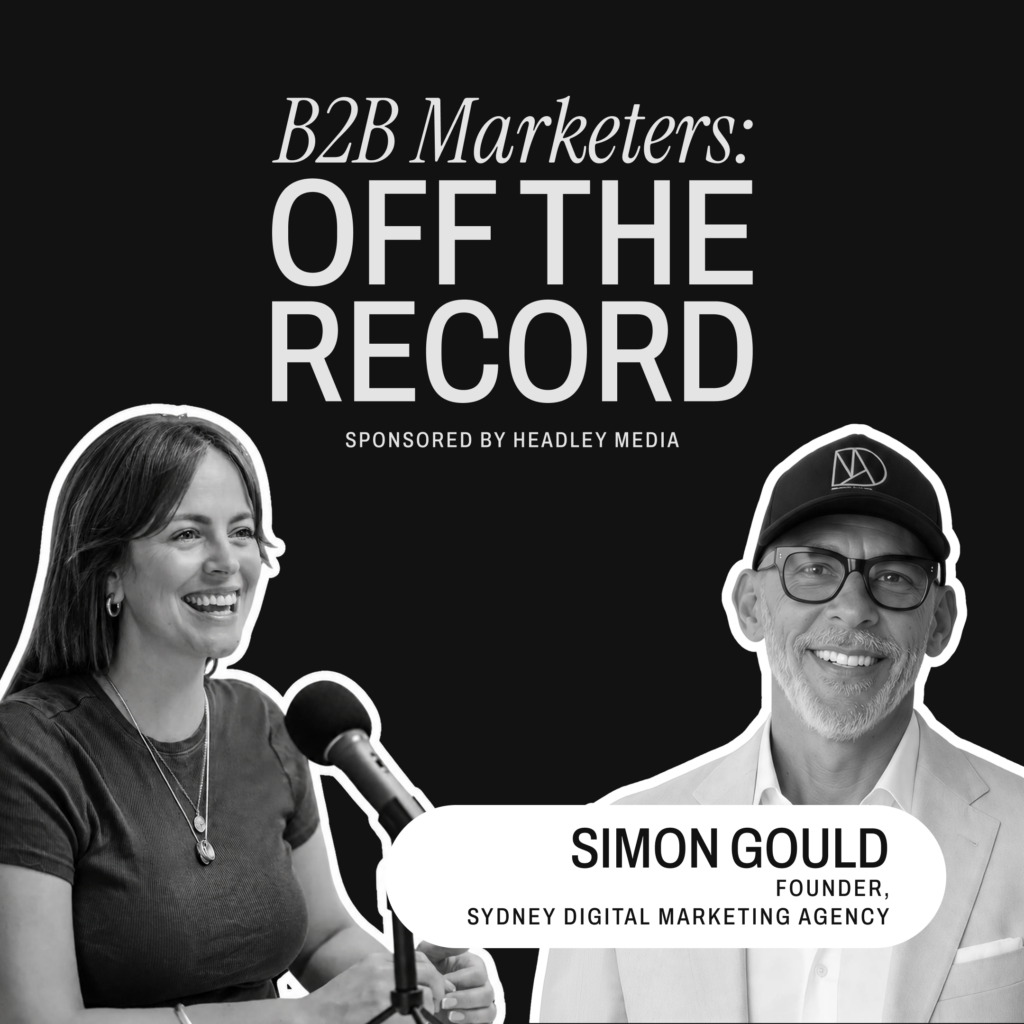
“The only thing when so many things become commoditised, it just comes down to judgement, taste and relationships.”
— Simon Gould, Sydney Digital Marketing Agency
In this episode, Simon Gould shares his extensive journey in digital marketing, emphasizing the transformative impact of AI on B2B marketing. He discusses the importance of human interaction and customer experience in a rapidly evolving digital landscape. In this conversation, Simon Gould and Freya Ward discuss the critical relationship between C-suite executives and marketing, emphasizing the need for alignment and understanding marketing as an investment rather than a cost. They explore the current state of B2B marketing, the impact of digital visibility, and the evolving landscape of AI and LLMs, while also addressing the challenges of multilingual content.
Takeaways


Simon Gould (00:00)
okay, we’re looking at our quarter’s figures, and we spent $100,000, a million dollars on marketing in that quarter.
Where’s the return? The C-suite isn’t doesn’t understand the fact that that return might come in three quarters time because we’re investing, you know, the we’re investing more in brand now because you if you can be found for brand, fantastic.
And like any investment, it will take time for it to mature and provide those returns.
Screen mate.
Freya Ward (00:52)
Welcome to another episode of B2B Marketers Off the Record. I am joined by Simon Gould, who is the founder of Sydney Digital Marketing, an agency based over in Sydney, and also the host of a podcast called Before We Get Started. Simon, welcome to the podcast. Please introduce yourself.
Simon Gould (01:11)
Thanks, Freya. It’s lovely to be here. I am from your part of the world originally, in lovely sunny Brighton a long time ago, and have been there living in Sydney for probably forty, forty eight years or so since I was quite young. And yeah, my my background is is varied. I’ve had businesses for I don’t know, the last thirty thirty plus years, predominantly in tech. Started off in the the
mobile phone or car phone industry as it was back then. actually was one of the, I think the second or third employee of the car phone warehouse, hundred last century.
Freya Ward (01:50)
you
Simon Gould (01:50)
and have had a background in tech, technology since then, invented the world’s first coin operated internet kiosk in nineteen ninety-six when we didn’t have internet on the move and people would pay to access the internet and access their hotmail. I actually brought that
Back to the UK for six years in 1998 to 2004. And then when I came back to Australia from that little sojourn back in Brighton again, I set up a self-serve online telco in about 2004-2005 called the Fat Free Phone Company. And then ran that for a few years, pivoted into wireless broadband, still very connected to the internet side of things.
And then around that for a few years, got out, went and got a corporate job for a New Zealand telco based in Sydney. Hello, mate. and then in 2012 was at a bit of a crossroads and found myself in the sort of the digital marketing space where it, you know, learning Google AdWords and Facebook was just starting to monetize, social media marketing was just starting to monetize paid social media marketing.
And and then somebody said to me one day, hey Simon, with all of your online experience and knowledge, you should take that and help people monetize and grow their businesses online. And so I did. And so in it’s actually two thousand and twelve, I registered the name Sydney Digital Marketing. And I wasn’t sure whether it was gonna be Sydney online marketing or I wasn’t sure what the vernacular was gonna be, whether it was always gonna be
internet marketing, online marketing, but digital marketing was the right horse to back. And here we are twelve years later, running an agency. We’ve gone up and down in in size. I think at our biggest through a team of about fifteen. our superpower is lead generation in the B2B space and a little bit of B2C as well. And now with the advent of our two favourite
letters A and I. we’re managing to run a business with a lot more success and delivering a lot more success for our clients and with a lot more intelligence as well. So it’s it’s a really exciting time to be to be in the space.
Freya Ward (04:21)
Thank you, Simon. Some experience that you’ve had and moving over, I guess, always in that tech space and then moving into the B2B marketing world. Just for those of you that are listening purely on audio, Simon’s wonderful cat, Tiger, has joined us as well. So if you can hear anything in the background, that’s what it is.
You gave us bit of insight into how you got into the marketing space, but I guess it would be great to unpack that a little bit more so that our audience can get to know you. I mean, purchasing Sydney Digital Marketing as a domain back then, you definitely backed the right horse, because I imagine the competition even on that domain now is wild.
Simon Gould (05:00)
wild. It’s wild. it is, yeah, look, I I haven’t come up with any traditional marketing degree or anything like that. It’s it’s literally been you know school of hard knocks and and just you know test and learn everything, come up with an idea, take it to the market, grow the business. the w when I started Sydney digital marketing, it was it was a much easier
space to play and not nearly as competitive. All of a sudden anybody with a laptop was a digital guru at the time. And it was set up an upwards campaign, send traffic across to a website, and people would buy or or they wouldn’t buy. And then obviously the algorithm came in and the whole game became a a lot more challenging with a lot more moving parts. And so
the the the sort of the the entrepreneur in me, the ideas guy, the creative guy is going, wow, okay, so what can we do with this? And then there’s the numbers side of it. There’s the science part of it as well, which which is the data. And I enjoy both sides of those. I’m not necessarily a a numbers guy, but I do like to look at the data. And I think that’s really what has that’s where my interest has been in this whole internet
Side of things. Even when I had the kiosks back in you know, we had them in Mike Victoria Station, we had them at all the major stations in in London. we didn’t have Google Analytics then. We had a thing called weblogs, and you could just go in and see what the hits were to that particular website at the time. And I was always fascinated to see how we could increase the length of time that people would spend on our on our portal, which they’d get to via the via the
putting a pound in or two pounds. Hotmail was the the the killer app for us. Obviously loads of people moving through the UK, tourists traveling, etc., students, not on the keyboard. and so I was always fascinated with the numbers and the fact that you could control that. So when when I stepped into agency life, knowing those numbers, having having n understanding
what those metrics were and what were what were the key metrics. you know for many years we talked in terms of vanity metrics, impressions, clicks to the website, but ultimately, as we’ll probably get into i in a little bit later in the pod, it’s about cash in the till. You can show your ad four billion times, but ultimately what what did it return? And that that’s where we’ve tried to differentiate ourselves as as an agency by always really focusing on that
that ROI piece where sadly with digital a lot of digital agencies they’re just a bit of a revolving door with clients because they make a big promise but then the delivery just isn’t isn’t there in the end.
Freya Ward (08:10)
Yeah, yeah, really true.
Yeah, really interesting. I was just thinking about the weblogs. My brain was just catching up because I had a conversation on the podcast the other day and someone else was talking about weblogs and I was thinking,
Simon Gould (08:24)
Really.
Freya Ward (08:24)
my goodness, it’s just been so much transformation and change and that digitalization and the access to that data and the intelligence is wild. Simon, what’s one belief about B2B marketing that you’ve changed your mind on in the last 12 months? Having seen so much change over the years, if we hone in on that last year, there’s equally
Simon Gould (08:43)
Yeah.
Freya Ward (08:44)
been so much change in that time period, right?
Simon Gould (08:47)
There has and and and even just the last six months, you know, again, you know, last year things really started to change. And then I think when Claude started to get a lot of oxygen in the in the room back in back in February, away from chat, Chat GPT. you know, now I think that the the biggest change I’ve seen is everybody just thought that AI was going to
Eat all the meaningful traffic, which to to a degree it has, you know, you get an answer, you don’t need to to visit a website. so I think the the biggest change I’ve seen is or the biggest thing I’ve changed my mind on is is how AI nobody nobody really knew last year what this how this was gonna play out. Now we’ve got a little bit more experience.
And the the tools, the platforms, the models are getting so smart that you can now start to really understand w how you’re being surfaced on the on the LLMs, why you’re being surfaced, and if if you’re not being surfaced, your competition is. So I think my biggest mindset change has been that this is the pretty much internet web f
What where are we at? 3.0, 4.0. I’ve I’ve lost I’ve lost count of how many web yeah, 10
Freya Ward (10:14)
Like 10.0 at this point I think.
Simon Gould (10:16)
10. Yeah, 10.0. I see this as it it’s starting all over again. Whereas maybe a year ago, I was thinking, well, you know, you can build a website over breakfast, you can build an AdWords campaign, you can do a competitive analysis, you can
you you can pull apart your com your competitions strategy, not just one competitor, but five competitors again over breakfast. So yeah, this time last year I was thinking, wow, we really need to either go dive all in on this and know exactly what the levers are that we that we can be pulling to maintain the the results for our clients, but also remain relevant ourselves.
having been in the room this morning with with twenty other founders and running running this workshop,
That’s confirmed my mindset that things are gonna be okay, we’re all gonna make it.
Freya Ward (11:20)
It was just such a different, scary world, I think, a year ago, but we’ve gained so much knowledge about how the appropriate use of AI, I think, is where that knowledge has come in.
I’m seeing a lot of mindsets shift more towards, actually, this is gonna be okay. Actually, this is really helpful and useful. Actually, okay, the traffic might not be coming to my website because they might be surfacing the answers they need elsewhere, but there is still a need for sales. There is still a need for communication. is still, you know, all of these things are still happening. It’s just different.
Simon Gould (11:58)
And interaction. People at the end of the day, people still we still want to interact with people. I know that certainly in Sydney the the vibe is more pe more in person events. I don’t want to sit
Freya Ward (12:09)
Yes.
Simon Gould (12:09)
on a Zoom. I don’t want to sit, hey, you know what? Let’s grab a coffee in person. so I think you know we we had obviously the first half of of or first few years of of this decade was again, you know, with everything was a big change through COVID. But I think now people people really value
In a such a fast-paced world and everything’s moving so quickly, even quicker than it was. yeah, people are really valuing that that that chemistry, human, human interaction, critical thinking as well. Yes, the AI is powerful, and yes, you can do all those things I mentioned over breakfast, but ultimately you’ve also got to have some critical thinking in there yourself and bring yourself into the the
or the tools or or whatever it is that you you you know you you’re using it for so I’ve I’ve always had a bit of a a belief I said probably the last 10 years that I think everybody can be an entrepreneur if you’ve got the agency but previously you needed to understand how to use the the the the internet you know and how to you know how do I get my name out there how do I get my brand out there how do how do I make it work. Now now anybody with with a
with an iPhone, with a with a device, can start to ideate with you know with with Claude or Chat GPT. predominantly perplexity. Google Gemini obviously is there as well. But yeah, I d I do see even though we’ve had this these two arguments, we’re all heading to a dystopian future and no one’s gonna have any work, I think those I think those with agency will be able to, you know, our our I think the whole work
as we know it, the eight hours a day is gonna look very different in the in the twenty thirties.
Freya Ward (14:04)
Yeah, great prediction. So let’s take it to the B2B buyer and what we’re seeing in that space. So what particular shifts are you seeing in how they behave right now? I know we’ve covered off a couple of examples, but I’m curious about your take on this one.
Simon Gould (14:20)
definitely and I mean look this this has been happening for years. Buyers are turning up much later and much more informed. You know, they they’ve done all of their research. they’re much more informed. They usually decided whether you’re credible, whether your brand is i is credible, whether your reputation is credible before you even know that that they exist.
I think the research phase obviously now is very, very different to what it was before because you can get all the research you need on two or three prompts, one screen, you’re not hopping from one website to the next to the next. You’ve got it, you’ve got your short list there. And the beauty of AI as I see it right now is that just because you say you’re the best in the business or you know you you’ve got the best team or you’ve been around for for 30 years.
What are others saying about you? You know, where else are you being cited? Because that’s what the the AI engines are are looking for. They’re looking to surface a trusted brand. So I think that’s really the the big shift from you know, if you’re sitting in the marketing seat or even in the in the the the C suite, you’ve got to understand that if you have a business that relies on a strong online presence, that traffic that we talked about before.
isn’t necessarily going to land on on your website. We’re not clicking blue links. We’re not looking at ten blue links anymore. We’re we’re looking at recommended
From this computer personality that for some reason we trust more than we ever trusted Google. And there’s one point I I’ll say to that as well is even if inquiries and opportunities have dropped off, the ones that that are coming through are better quality. A and we’re seeing not only s for ourselves, because obviously we’re in the B2B space as well, we’re relying on the leads and opportunities coming through.
But the conversion rate of somebody that’s been referred to as by chat, Gemini, or or Claude is, and we’re seeing this on some of our other clients as as well, like upwards of fifteen to twenty percent versus a organic Google search or you organic bit of traffic coming through at anywhere from four to seven, eight, maybe. So yeah, so the quality of buyer coming through is is far more far
better informed. They’re coming much later in their decision process. And I think that’s where the obviously the brand experience then comes into it. How quickly was I responded to? Did they get in touch? You know, what what was that experience like before I handed over my, you know, my checkbook or
Freya Ward (17:16)
Yeah.
Simon Gould (17:17)
showing my age. But yeah, you know, did you know what I mean? Like it it’s it’s
Yeah, i it’s I I that human element is still very much an important part of the sales process, but in terms of how they got there in the first place, yeah, they’re coming in far better informed. And probably if the the human experience or that that initial contact experience isn’t wonderful and amazing and and smooth with with the business, they they’ll go to the next one.
Freya Ward (17:49)
Hmm. Yeah. It’s really interesting, isn’t it? Because in, we’re seeing that as well, on our side and it’s terrifying when that volume, volume piece starts to decline, right? So the traffic side of it on your own website or, know, clients talk to me about this a lot. And that in itself is terrifying because we’ve got PPC is stopped.
working in the same way that it was. And now my website traffic is dwindling. But actually, if you look at the quality of those are converting through to a lead on your on your website, and then you map that afterwards. If that I agree that human to human interaction is now more important than it ever was before. Because I feel that B2B buyers have more
choice, they have more knowledge now, they have more access to your competitors as well, so if you’re not going to serve them exactly what they need at that point, it doesn’t take much
for them to
Simon Gould (18:49)
Yeah.
Freya Ward (18:50)
turn elsewhere.
Simon Gould (18:51)
Yeah, it exactly. Accessibility I think i is it yeah, and that’s
the online space that we live in. You know, you I was reading an article the other day that was talking about, you know, for instance, relationships and how, you know, the next relationship is literally just a a swipe away, which just everything is about convenience. You know, Uber, call an Uber, end up where where you see exactly where the car’s coming. Hungry, you know Uber eats. you know, so we just we are living in this world where we just expect convenience and we expect service. I took my daughter into to buy her a first
Apple device and Apple Watch in February in the city. And we had the loveliest guy there. He was this big giant of of a man, but just a gentle giant, loads of tats everywhere. And we walked out of there. He gave us, and my little nine and my nine-year-old commented on, she goes, Wow, Dad, that was so much fun. I said, Wasn’t that a great experience? And again, you know, you talk about
Everything is is about experience. And she knows that now as a nine-year-old. She’s Apple to set the bar for her in terms of what a an expensive sort of purchase experience should look like. And some something else came a couple of weeks ago as well. I can’t remember. that’s all right. We were at the lindt chocolate shop. I know this is not we’re off B2B, but it’s the the the the theme is still the same. It’s all about experience because you’ll go and tell someone, you say I had a great experience with this company.
And when you see it through the lens of a nine-year-old, and we went to the lindt chocolate shop, and again she walked out of there going, Dad, that was a really good experience, wasn’t it? I said, Yes, it was. yeah. Yes, I know. Yeah, I know.
Freya Ward (20:30)
The bar has been set very high though!
Simon Gould (20:36)
but but also you know, just another bit of a tech insight as well. She talks to I’ve set her up with her on a little project in ChatGPT with guardrails and everything around it. She just talks to ChatGPT, speech to device for her.
is that’s standard. It’s it’s it’s not it’s not it’s not interacting via a keyboard or or even dictating. It’s literally having a conversation w with with her devices. So that’s the next thing that we’re going to be faced with is in the in all businesses, B2C or B2B.
Freya Ward (21:13)
So we haven’t got just the concern about short tail versus long tail. We’ve also got the not even, I don’t even know what we’d call it, not long tail, but full paragraph searches and that’s specific. I can’t say the word very, very specific,
Simon Gould (21:28)
Are you speci Yeah, yeah.
Freya Ward (21:32)
detailed requests. I guess
So my experience on the B2B tech side, not to get too technical into it, but my experience on the B2B tech side is actually there’s a real opportunity for brands, especially if you work within a niche tech area. Because if you can match against those specific searches and stuff, there is actually a lot less competition for those specific terms within the LLMs and within, because they’re…
There’s
just less content. There’s less content. So if you look
Simon Gould (22:03)
Yeah.
Freya Ward (22:03)
at, for example, the engagement within chat, that is still growing as one of the fastest growing LLMs for usage. But if you then split that by B2B versus B2C, and then if you start going down into segments of tech, it’s not painting an accurate picture. You your cybersecurity manager
Simon Gould (22:19)
Yeah.
Freya Ward (22:20)
isn’t necessarily using chat to inform. They may be using Claude, they may be using Gemini, for example, perplexity. They may be using traditional publications.
Simon Gould (22:30)
Yes.
Freya Ward (22:31)
don’t follow the big trend, don’t follow the big stats, look at your niche would be, that’s the biggest shift I’m starting to see.
Simon Gould (22:38)
Yeah. And and put yourself in your customer’s shoes. Like, you know, always, you know, it’s it’s always start with with the customer. You know, what are the what are their pain points? What are the things that are relevant to them? What are they sitting up? What are they speaking into Chat GPT or typing into Chat GPT? That you can ensure that you are that that your content talks to you know to that search, to that problem, challenge, pain point, etc. And
you know, I mean I don’t know the the sort of the what size businesses the listener base is here. But you know, if there’s sort of if it’s founder-led businesses, then again it’s it’s time. Who’s gonna sit there and run through a hundred iterations across three different models? We’ve just launched a a new service line called Top of Prompt, which basically will do what you
What anybody can do and go and see what ChatGPT or Claude or anybody’s saying about your business, but it’ll do it at scale. It will go through, you know, it’ll go a hundred prompts on three different engines and then come back with an average to say, okay, this person over here is appearing in 40% of the the answers. and this is where they’re being cited. But you you can only start to understand that if you’re thinking like a customer, what would somebody type in or what would somebody how how would I be found?
in a conversational way rather than best digital marketing agency in Sydney, for instance, in you know, traditional
Freya Ward (24:10)
Yeah, yeah.
Simon Gould (24:12)
way.
Freya Ward (24:13)
That’s so true, isn’t it? You really have to think about the end. Well, you should anyway in marketing, right? We should always think about the customer and the customer experience and put yourself in their shoes. But yeah, that’s fascinating. Okay, so what is a strategic bet that you think more marketing leaders will need to make over the next couple of years?
Simon Gould (24:38)
think it’s exactly that. I think you know every marketing leader is about to be asked whether their business shows up in a model and and most people can’t can’t answer that today, you know, from a consistent, from a consistent business centric perspective. Yeah, you can you can be in there if you if you type in a certain a very certain specific prompt if you like or or search. So I think
Making sure that you’re being cited in the answer is probably becoming what ranking number one on Google was for the last twenty years, basically. So we’re seeing I think we’re seeing that, you know, that is the biggest thing that should be on certainly marketing leaders from a a strategic bets point of view is is really focusing on that.
I asked twenty people in the room today, you know, how many people had used Google that morning by about sort of ten thirty or so. And I’d say it was probably about I don’t know, a third of the room. And I said, Okay, so have you needed to find an answer to something today where you normally would have gone to Google and that was the rest of the room. So I don’t know if Australia’s got a slightly
different approach to to the UK in terms of sort of adoption and and sort of penetration. But making sure and and working out, it’s not how to gain the system, but working out how you’re going to appear and how your business and brand or product is going to be the one that gets cited because there there isn’t going to be 10 or 20 options anymore from a Blue Links perspective. So that that entails investing in your website, making sure that your your content is
structured correctly. So you know there’s some technical work to go into your website as well to to bring it up to to the right tech spec for for the LLMs. And then making sure that your content actually is solving somebody’s problem. You know, it’s we’re still following the old E E A T method, you know, where you know trust is just as important, authority is just as important, expertise. So all of those things, all of those things are still important.
But if you’re not being found or recommended by the LLMs, then i i y we talked before about traffic dropping off. Well, it’s just gonna go straight to the to the top line and the bottom line, I believe.
Freya Ward (27:12)
Yeah, I completely agree. think that is something that is so pressing in so many marketing leaders’ minds and I think it’s not just a topic for marketing, right? The C-suite are talking about it, talking about it probably more than marketing. Why
Simon Gould (27:29)
Yeah.
Freya Ward (27:29)
aren’t we showing up in my search, in my LLM search,
Simon Gould (27:32)
Yeah.
Freya Ward (27:33)
whatever it might be? it can be very, very challenging for marketing to exp… We tell marketing folks,
often not to, so I talk a lot about marketing need to be bilingual and what I mean by that is being able to speak different departments, not different languages. So being able to communicate C-suite, being able to communicate to finance in a way that they understand and in a way that prevents other departments thinking that they’re a marketer and you know, coming in and telling you cut your budget because of X, Y and Z and it doesn’t impact anything.
So coming out of marketing speak and instead being able to sales, speak about marketing, but from a sales point of view, C-suite, et cetera. There’s a real challenge though, isn’t there? Because of the AI boom, if you want to call it that, C-suite suddenly have more of an interest in it and probably think it’s quite simplistic. So there’s a whole lot of work that needs to be done from a marketeers perspective to educate the C-suite as well that, you know, it’s…
we’re not going to surface in every search that you make in your search terms, but if you search in the way that one of our customers would, then yes, we are able to. And I guess that’s where tracking really
Simon Gould (28:47)
Yeah.
Freya Ward (28:48)
comes in.
Simon Gould (28:49)
Yes. Yeah, that old attribution challenge, which is amazing.
Freya Ward (28:55)
Yeah.
Simon Gould (28:56)
it’s a whole that’s a whole other podcast, I’m sure you’ve you’ve you’ve spent plenty of time talking about attribution and tracking. but I I I think y y if if
And this comes to to one of the other questions as well, but if marketing is not sitting at the table with the C suite and you’ve got all of these people who think they understand because they’ve watched a y couple of YouTube videos or, you know, the the old barbecue chat or a chat down the pub with somebody saying, yeah, well I was using Chat GPT and it did this, this and this and then the you know, the CEO comes in on a Monday morning and says, Right, where’s where’s our AI strategy? the the
These things take time as well. Like, you know, you’re not you need to ev everybody needs to have a really good understanding of exactly what the I guess what the capabilities and and the possibilities are of of these tools. But also just because you can spin up a hundred blogs, you know, a a week or something, or twenty LinkedIn posts and s and some videos.
doesn’t necessarily mean that, you know, the sales graph or the inquiry graph goes up by twenty percent at the end of the month. It’s still the same old game. It still takes time. You’ve got to build that trust. You’ve got to build that authority. and
It’s it’s I think it’s gonna get because of the fact that we have now so much more ac I mean, I’m building things. I’m not a builder, I’m not a coder, I’m not a programmer, I’ve never written any code i in my life. But in the last two weeks I’ve probably launched three websites and a business behind them, all three of them, and run my own business at the same time.
But now we’ve we’ve got so much capability. It’s like being Tony Stark in Iron Man. You know, you’ve got all these these new superpowers. But ultimately
I think it’s just making sure that everybody, in i both in C suite and marketing is is is getting aligned and really understanding what the challenge what business what what the business challenge is.
in terms of adopting new ways of growing opportunities.
Freya Ward (31:25)
I think that’s really interesting. And I think the relationship between C-suite and marketing, marketing is cyclical, right? So if you’ve been in the marketing space for a while, you’ve probably been through a similar process. Okay, maybe it wasn’t called AI at the time. that wasn’t the impact. That wasn’t where the impact was coming from, but it is very cyclical and being able to secure that alignment between the two departments, I think is so important.
What’s one thing that you think that leadership then needs to understand about marketing?
Simon Gould (32:01)
They need to look at it as an investment, not a cost. And as we know, as marketers, one of the first things that especially from an agency side, you know, one of the first things that goes in times of uncertainty is the marketing budget, because it’s looked at as a cost. So I think understanding that
okay, we’re looking at our quarter’s figures, and we spent $100,000, a million dollars on marketing in that quarter.
Where’s the return? The C-suite isn’t doesn’t understand the fact that that return might come in three quarters time because we’re investing, you know, the we’re investing more in brand now because you if you can be found for brand, fantastic. You know, it’s all you’re always gonna win. It’s bit like us, Sydney Digital Marketing Agency. I’m looking for a Sydney Digital Marketing Agency, and up we pop, always number number one. so
Freya Ward (32:58)
such solid piece of branding, sorry.
Simon Gould (33:03)
so yeah, I think it’s num number one, certainly view marketing as an investment. And like any investment, it will take time for it to mature and provide those returns.
Yes, we’ve got attribution. Yes, we can say, right, we spent a dollar, we got 500 visits to our website this month, and three of them turned into inquiries and one of them turned into sales thanks to HubSpot and Salesforce and all all the the CRM tools that we’ve got.
But when you’re just looking at it from a CFO’s perspective, and you’re going, Well guys, we’re spending all of this money, where’s the return? And understanding that the return isn’t always going to be in the quarter that it was spent, it might come three, four, it might come in two years’ time, but it’s it’s an investment, not a cost.
Freya Ward (33:51)
this is such you are well you are preaching to the choir with this one I spend a lot of my time obviously working for Headley we’re a content syndication lead generation company and I spend so much time setting expectations and speaking to marketers and helping them educate leadership on the investment in content syndication if you are a an enterprise tech business and the lowest level investment contains more than six seven noughts
then you need to look at your sales cycle and you need to at least benchmark the success of content syndication fairly against your average sales cycle. often that can be six months, nine months, 18 months, even in some instances. and that’s just for content syndication and lead generation. If you’re looking at brand and you’re looking at awareness and you know, you’re looking at an event or you’re looking at all of these different top, very top of the funnel.
activities, which I think contents indication is also top of the funnel, but any of these top of the funnel activities, need to as a base benchmark it against your average sales cycle, but then probably add a couple of quarters to that as well because,
Simon Gould (35:06)
Yeah.
Freya Ward (35:06)
you know, especially if you’re in new territory, especially if you’re an emerging market, take all of the surrounding factors into play when it comes to benchmarking that investment.
I think
Simon Gould (35:18)
Yes.
Freya Ward (35:19)
all too often all of these activities are treated, like you said Simon, by finance, by C-suite, by leadership as a cost.
Simon Gould (35:28)
Mm.
Freya Ward (35:30)
There’s no other department where every single cost needs to result in a return on investment. A sales department, don’t measure the… Okay, of course you always look for a return when it comes to client expense or a gift or a…
a lunch that you’ve taken, taken clients or prospects out to. But if there isn’t a return, a direct return on an investment for that cost, they’re not punished in the same way as marketing.
Simon Gould (35:57)
Yeah. No, that’s right. That’s right. And it and and because we’re so because digital is is so visible, literally, you know, the it’s it’s literally there. Sales conversations, you know, don’t get quite as much well, there’s really I mean there’s tracking around it, but and now with call transcripts, obviously you can you can see whether you’ve got a good salesperson, you know, how that how they’re performing. But
I think be because digital is so visible and it’s literally okay, we spent this much, we got this much, th these many impressions, this this many visits to the website, and this many inquiries or calls or or you know, conversions on our you know, or downloads on our on our white paper or something. So it’s a double edged sword. It’s great that we can track everything, but it also holds you very, very much at accountable to
the whim of of of the C suite or you know or founder founder led business who’s looking at it going, Okay, well I’m just going to the next agency because these guys aren’t aren’t performing for me. Or I’ll do it myself now. Claude Claude and I will we’ll do it ourselves over breakfast. I didn’t say that.
Freya Ward (37:09)
We’re a victim of our
own success when it comes to metrics because now there’s an expectation that if some of it’s measurable it should all be measurable and the reality is there’s dark metrics in there as well right? Attribution, we’re not
Simon Gould (37:23)
Yeah.
Freya Ward (37:24)
talking about attribution because as we said we could go into a whole other episode about that but yeah it’s a very interesting time I think that’s…
Such an important thing for leadership to start to understand about marketing, Simon. Bit of a fun one, take it in the direction you wish. What three words do you think describes B2B marketing right now?
Simon Gould (37:46)
I had this one. Hang on.
Noisy, impatient.
Human again.
Freya Ward (38:01)
I’ll take that as
three words.
Simon Gould (38:05)
W It’s been a long day. Was it two words or three words? Or three words, right, yeah. Noise you’re human again. Yeah, yeah. Or human, okay, yeah.
Freya Ward (38:08)
No, three words, three words, but human again, take as one. No, I
think they’re fantastic words to describe it. And there’s so many different directions of each of those words. Do you want to unpack them a little bit further?
Simon Gould (38:25)
yeah, sure. I think no noisy noisy is probably an obvious one because i it’s a no it’s noisy out there. You know, we’re you know, I commute backwards and forwards to the office and I just see everybody on their devices. Just e we all of us. We’ve all got our heads in our devices. My pet peeve is people crossing the road with their head in their phone, you know. and so you you you know, you’re you’re just w how do you stop the thumb?
As we say, how do you stop stop that scroll? It’s very noisy out there, whether it’s B to B or B to C. impatient because as I said, budgets want a return inside the quarter, and that return might not come for yeah, a much a much longer time frame. So I think that’s where what that’s where I say sort of the impatience side of things are. And human again for the reasons I said before where
You know, the the only thing when so many things become commoditized, it’s j it just then comes down to to judgement, taste and then relationships.
Freya Ward (39:34)
Yeah, yeah. And again, it’s so cyclical, isn’t it? We’re going back to relationship selling, we’re going back to not to, someone was saying this in another recording, and I was like, not to bring in another phrase, but H to H, you know, it’s human to human. It’s,
Simon Gould (39:50)
human to human.
Freya Ward (39:51)
all of that is coming back round again, and us as marketers are responsible now for serving two audiences, I think. We’ve got.
your target audience, which is the human part. And then you also need to be able to serve this AI audience and this AI assist, which I
think is fascinating. It’s such an opportunity, but I don’t think it’s about backing one horse. I think you have to be able to create your content that serves both. Yeah.
Simon Gould (40:18)
Yeah. Yeah
Yeah. and and making sure like if you know we we haven’t even touched on agents, you know, we’re all suddenly going to have swarms of agents, or maybe it’s just one that goes out and and does everything for us. But you know, an agent’s gonna come my agent is gonna come through to your website and it’s going to make an inquiry on my behalf and then it’s gonna come back to me and say, Hey, I haven’t heard back from these guys, so I’ve got I’ve gone with these other guys.
So
Again, like I was saying earlier on, there’s like this this this whole new beginning of Web ten point we’ve got the AI conversation to be having, the L LLM conversation to be having. But all of a sudden, you know, procurement is going to have a series of agents that just goes out and and you know, we we’ve got a new tender or RFP coming up. Perhaps it’s the end of the RFP because the agents are just gonna go out there and they’re gonna knock on a few doors, have a conversation on your behalf, and then come back to you and go, Okay, look.
All you have to do is decide, is this the, you know, the the company that you want to move ahead with in a partnership? And from your perspective as well, from a publishing perspective, you know, there’s obviously been a a lot of noise about LLMs coming through and just taking everybody’s knowledge and then just surfacing it up. Thank you very much. But reversing it so that when the agent comes to your website,
you will charge that agent a penny, or you know, pennies, a a tenth of a Ethereum or something, you know, to to actually come into the website and then monetize your revenue by flipping
Freya Ward (42:06)
interesting.
Simon Gould (42:07)
flipping the whole model that we’ve had, which has been, it’s free, guys, it’s free. Just give us all your data. Just give us all of your data and it’s free. You can you can eat as much as you want, but we’re just going learn everything about you.
Whereas if you flip that back and say, well now hang on a minute. If you want to come into my website, I’m gonna charge you a a minuscule amount of AI internet dollars, which will be some form of crypto currency.
Freya Ward (42:33)
you
Simon Gould (42:34)
but yeah, that’s another that’s another conversation.
Freya Ward (42:38)
I think we could talk for hours. I think
it’s really interesting. I think the publisher landscape in itself, the traditional publisher landscape where everything is ungated and it’s, you you’re subscribed to access, I think will be really interesting because like you said, you’ve got to retain the value in that access for the crawlers, for…
agents and for the user as well and if that
Simon Gould (43:08)
Yes.
Freya Ward (43:08)
information can be surfaced in a way that’s customized to the user inside of an NLM then why would they come to your publication?
Simon Gould (43:15)
Yeah.
Freya Ward (43:16)
Our brand operates slightly differently because we’re pre and post gate so that there’s still a value exchange but what
Simon Gould (43:24)
Yes.
Freya Ward (43:24)
we’re doing, I’m not going to go into a full pitch here, but what we’re doing is optimizing that pre-gate experience to
enrich
the niche content and the niche knowledge gaps within the LLMs to surface our
Simon Gould (43:40)
Yes.
Freya Ward (43:41)
brands within the LLMs and then in partnership with the clients whose content is hosted behind the gate. So we’re still protecting that value exchange.
Simon Gould (43:50)
Yes. Yeah.
Freya Ward (43:52)
And we haven’t seen a huge drop off in traffic of our brand websites. I think to your point on the three words, a lot of that is to do with noise.
We communicate a lot with our readership and our audience and we understand that they’re actually becoming frustrated with a lot of the LLMs because they are surfacing noise when it comes to their niche specific technology that they’re looking to research.
Simon Gould (44:14)
Right. Yes. Yep.
Freya Ward (44:18)
So it’s very interesting. I mean, my prediction is that there will be verticalized LLMs in no time at all and that will be full of rich content. So if you are a cybersecurity professional, if you are in finance, there’ll be the trusted places.
to
Simon Gould (44:32)
Yes.
Freya Ward (44:33)
research those specific topics. So you won’t be able to do your food shop or your concert research or whatever on those platforms, but it will be very relevant and more trusted, less hallucinations, less garbage, less noise. But that’s the
Simon Gould (44:48)
Yeah. A and
Freya Ward (44:50)
prediction.
Simon Gould (44:52)
and and and to to add to that as well, localized LLMs, like as it literally, you know, you’ve got your own LLM running on your iPhone or your your your device. You know, there’s a big conversation going on around open source and obviously the you know the frontier models, which we’re renting space, you know, we’re we’re basically giving them all of our knowledge and paying them to give them all of our knowledge as well. Granted, they’re they’re super powerful and they are doing really good things.
However, there’s there’s a there’s a lot of noise about, or there’s a lot of discussion about obviously how much information, confidential information that we’re just piling into Anthropic and and OpenAI. My take on is well, Google’s had our information for years, but again, they’ve been around for 20 plus years, and they are kind of a trusted brand.
Freya Ward (45:43)
You
Simon Gould (45:45)
OpenAI.
my opinion not not so much. Anthropic, you know, they’ve they’ve obviously got their own agendas as well, but probably more trusted in terms of giving them the information than than than the other guys. And yeah, so there’s there’s a lot of discussion to your point about having these very niche LLMs, I think once and that’s going to be the biggest challenge as well with enterprise adoption and sort of medium sized businesses is okay, we can’t have we can’t be letting
Our IP and confidential client information go up into the AI or the LLM cloud. So having something that’s local, that might be run on open source, that can then be safer, more confidential, and and as you say, hallucinate far less.
Freya Ward (46:33)
you
Simon Gould (46:33)
I think there’s that’s also a future that people should be researching and just trying to learn a little bit a little bit more about not just taking it for granted that you know these three
Own the own the L L space. There’s there’s other options.
Freya Ward (46:48)
Yeah, completely. I mean, if you take it into multilingual in the traditional sense, so you take it into other languages, the quality of results is completely different. We operate in English and my expectation, well, it’s the same as B2B tech, the B2B tech space, right? The majority of content is developed in English first. And only when a company wants to take a market seriously or they want to expand into multilingual markets,
markets, alternative languages, that’s when they start translating their content and everything else. The quality of result inside of niche tech areas but also inside of language, so if it’s Spanish site for example or a German LLM, completely different experience. So there’s something for something in there as well I think. I’m
Simon Gould (47:39)
Interesting. Interesting.
Freya Ward (47:40)
going to take you to our final two questions.
It’s been an absolute pleasure speaking with you, Simon. I could literally talk to you for hours. We could unpack so much. Who would you recommend that we should invite onto the podcast next? This can be someone you know, or it can be aspirational. Yeah, who would it be?
Simon Gould (47:59)
I would highly recommend having Vijay Solanke join you on the podcast, who has written a book recently called Founding Courage. And Vijay is an ex Brit as well, who’s now made his life here in Sydney. Really interesting guy. got some great stories. His book is brilliant. It he he was he was working back at lastminute.com during
that time he’s worked at Blackberry, he was at Shazam, he’s been at Unilever Phillips. he’s got some really interesting stories to tell and I would absolutely highly recommend VJ Solanke and as I said his book is called Founding Courage. Well worth having on the on the pod.
Freya Ward (48:50)
Amazing. We’ll definitely be reaching out to VJ and I’ll definitely be looking into getting that book as well. And final question for you. What is one question that you would want a future guest to answer? That could be VJ or that could be somebody, somebody you don’t even know yet.
Simon Gould (49:07)
how do I word it? I think the th the form factor of our interaction with the internet has been the smartphone for the last sixteen years.
Where do we see technology moving in say by twenty thirty? What what how are we interacting with with technology in in twenty thirty?
Freya Ward (49:31)
an excellent question and I mean the the answers are endless aren’t they because you wouldn’t have thought that we would have Alexa in our homes 20 years ago you wouldn’t think that we would be able to dictate into our phones or you know treating an LLM as a co-worker in the instance of your of your daughter in the way that she uses LLMs that’s
Simon Gould (49:56)
Mm.
Freya Ward (49:57)
an excellent question and I look forward to asking it.
Simon, where can people find out more about you if they wish to connect with you?
Simon Gould (50:07)
LinkedIn. I am LinkedIn.com forward slash speak to Simon as it sounds, S-P-E-A-K-T-O-S-I-M-O-N. I’m gonna start my Twitter up again, slash X up again. But LinkedIn, LinkedIn’s the best way to find me, or via the website Sydney Digital Marketing dot com dot AU.
get in touch with us there. But yeah, definitely for a one-to-one conversation, LinkedIn is the the place to find me. It’s Simon Gould, G-O-U-L-D. And funnily enough, there is another Simon Gould in Sydney who looks kind of similar to me,
Freya Ward (50:42)
you
Simon Gould (50:43)
same sort of vintage age, and is a marketer. So yeah, I’m the yeah, it’s he gets we we’re sending each other leads all the time because he’s I think this per I think this one’s for you. I think that
Freya Ward (50:57)
you
Simon Gould (50:58)
the
With a real Simon Gould, please stand up. But yeah, Simon Gould at at at Sydney Digital Marketing.
Freya Ward (51:05)
Thank you so much, Simon. It’s been a real pleasure to
Simon Gould (51:06)
Thanks, Fred.
Freya Ward (51:07)
have you on the podcast.
Simon Gould (51:09)
Awesome. Thanks, Freya. I’ve really enjoyed it. It’s been great.
Absolutely. Based on the transcript, the episode is essentially about how AI is reshaping B2B buyer behaviour, discoverability, measurement and the relationship between marketing and the C-suite — while making human trust and experience more important, not less.
In this episode of B2B Marketers Off the Record, Freya Ward speaks with Simon Gould, founder of Sydney Digital Marketing, about the rapidly changing B2B marketing landscape and what marketers need to do as search moves from traditional Google results towards AI-generated answers and recommendations.
Simon draws on more than 30 years in technology and digital businesses to argue that we’re entering what feels like a new version of the internet. AI tools such as ChatGPT, Claude, Gemini and Perplexity are fundamentally changing how buyers research suppliers, discover brands and make purchasing decisions.
One of Simon’s biggest mindset shifts over the past year is recognising that AI isn’t simply another marketing channel. It is changing the fundamental mechanism of discovery.
B2B buyers increasingly don’t need to visit ten websites and compare blue links. They can ask an LLM a detailed question and receive a shortlist or recommendation immediately.
That means the critical question for marketers is becoming:
“Does my brand get recommended or cited by AI?”
Rather than simply asking whether a company ranks #1 on Google.
Simon argues that marketers need to understand why an LLM surfaces a particular company, where that company is being cited, and what signals of expertise, authority and trust are influencing the recommendation.
The traditional B2B funnel is becoming less visible to marketers.
Buyers are conducting much more research independently before contacting a supplier. By the time they become a visible lead, they may already have:
identified their problem
researched potential solutions
compared competitors
assessed the credibility of different suppliers
formed an initial shortlist
AI accelerates this process considerably.
Simon also makes an important distinction: lower website traffic doesn’t necessarily mean lower marketing performance.
He is seeing AI-referred prospects convert at significantly higher rates in some cases — he cites approximately 15–20% conversion versus roughly 4–8% for conventional organic traffic among examples he has observed.
The implication is that marketers need to stop treating traffic volume as the primary measure of success and pay much more attention to buyer quality and downstream conversion.
A key theme throughout the conversation is that AI makes brand reputation and external validation increasingly important.
Simply claiming that you’re “the best” isn’t enough. AI systems look for evidence elsewhere — citations, mentions, authority, expertise and what other sources say about you.
So brand-building isn’t becoming obsolete because of AI. In some respects, it becomes more important.
The challenge is that brand investment is inherently difficult to attribute to an individual campaign or quarter.
This leads to one of the episode’s strongest messages:
Marketing needs to be treated as an investment, not a cost.
Simon and Freya spend considerable time discussing the tension between marketing’s longer-term impact and the C-suite’s desire for immediate returns.
A business might invest $100,000 or $1 million in marketing in a quarter and immediately ask:
“Where’s the return?”
But B2B buying cycles can extend for months or years, particularly for enterprise technology.
Some marketing investments — particularly brand, content, awareness and early-stage demand creation — may contribute to revenue several quarters after the original investment.
The problem is that digital marketing has made measurement look easier than it actually is.
You can measure impressions, clicks, leads, downloads and conversions with extraordinary precision. That can create the false expectation that every dollar of marketing expenditure should have a directly attributable revenue outcome immediately.
The episode argues that this is an unrealistic way to evaluate marketing.
AI is making this challenge even more pronounced because executives can now experiment with AI themselves.
A CEO can ask ChatGPT a question, see a competitor appear, and immediately ask:
“Why aren’t we there?”
But appearing in every possible AI response isn’t realistic.
Marketers therefore need to become better at communicating the relationship between:
customer behaviour → marketing activity → discovery → consideration → sales → revenue.
Freya describes this as marketers needing to be “bilingual” — able to speak not only marketing language but also the language of sales, finance and the C-suite.
Perhaps the most interesting tension in the episode is that AI is making digital discovery more automated while simultaneously making human interaction more valuable.
Simon argues that as more marketing and purchasing processes become commoditised, differentiation increasingly comes down to:
judgement
taste
relationships
responsiveness
service
human chemistry
customer experience
His experiences with Apple and Lindt provide simple B2C examples, but the principle applies equally to B2B.
If AI has already helped a buyer narrow their options to three suppliers, the experience they have with those three companies can determine who wins.
This is why Simon describes B2B marketing right now with three phrases:
Noisy. Impatient. Human again.
An important point from the conversation is that marketers shouldn’t choose between creating content for humans and creating content for AI systems.
They need to do both.
Content needs to:
answer genuine customer questions
demonstrate expertise
address specific pain points
be structured so AI systems can understand it
establish authority and trust
provide genuine value to human readers
Simon recommends thinking much more like the customer: What would my buyer actually ask an AI system?
That is very different from simply targeting traditional keywords such as “best digital marketing agency in Sydney.”
The opportunity may actually be greatest for niche B2B companies, because highly specific questions can have less competition and fewer authoritative sources.
One of Simon’s biggest predictions is that being cited by an LLM could become the equivalent of ranking #1 on Google.
Instead of competing for ten blue links, companies may increasingly compete to become one of the few brands an AI system recommends.
That creates a new strategic discipline around:
AI visibility / LLM discoverability / answer-engine optimisation.
Simon describes his own service, Top of Prompt, as an example of this emerging category: testing large numbers of prompts across different AI models to understand how frequently a business appears, which competitors appear instead, and what sources are influencing those results.
The conversation then moves beyond today’s LLMs towards AI agents.
Simon imagines a world where a buyer’s agent could:
understand their requirements
research suppliers
contact companies
evaluate responses
create a shortlist
return the options to the buyer
This could fundamentally change procurement and lead generation.
Instead of optimising a website purely for human visitors, companies may increasingly need to think about how their digital presence is interpreted by autonomous agents.
That raises interesting questions about how publishers and businesses might monetise access to their information if AI agents become the primary consumers of web content.
Both Freya and Simon speculate that we’re likely to see more verticalised and specialised LLMs.
Instead of one general-purpose AI handling everything, there could be highly trusted AI environments focused on areas such as:
cybersecurity
finance
technology
healthcare
specific professional disciplines
They also discuss the possibility of more local or privately hosted AI models, particularly for businesses concerned about confidential information and intellectual property being sent to large public AI platforms.
This could become particularly important for enterprise adoption.
The episode’s overarching argument is that AI isn’t simply changing how marketers create content. It’s changing how buyers discover companies and how marketing creates value.
The old model was roughly:
Google → website → lead → sales
The emerging model is closer to:
Question → AI research → recommendation → highly informed buyer → human interaction → sale
That means marketers need to rethink what they measure and what they optimise for.
Website traffic may fall while buyer quality rises.
Search rankings may matter less while AI citations matter more.
Content production may become cheaper while expertise and differentiation become more valuable.
And automation may increase while human relationships become more important.
The organisations that adapt well will be those that can combine AI visibility, strong brand authority, useful content, measurable commercial outcomes and genuinely good human experiences.
Optimise for AI discovery, not just Google discovery.
Understand whether your company appears when your actual customers ask AI systems the questions that matter to them.
Stop judging every marketing investment on immediate revenue attribution.
Especially in enterprise B2B, marketing is an investment that compounds over a sales cycle. Brand and demand creation may pay back quarters — or even years — later.
Don’t let AI make your marketing less human.
As research and content become increasingly automated, trust, expertise, responsiveness, judgement and customer experience become increasingly powerful differentiators.
AI is compressing the B2B buyer journey and changing how brands are discovered, but the winners won’t simply be the companies producing the most AI-generated content — they’ll be the companies that are trusted by both the AI and the human sitting behind it.
Simon Gould is the Founder of Sydney Digital Marketing, a premium B2B agency he’s run for 11 years and one of Australia’s longest-standing HubSpot Gold Partners. He’s spent that time building lead generation engines for service businesses, and having stepped back from CEO into the Founder seat, he now spends his days on strategy, key client relationships and steering the agency’s AI transformation, including Top of Prompt, its AI-visibility service line. He also hosts the Before We Get Started podcast, where he has much the same conversation he’s about to have with Freya: what actually works once the playbooks stop scaling.
In this episode of B2B Marketers Off the Record, Freya Ward interviews Niall Ratcliffe, CEO…
Colin Stansbury, Partner Account Manager at Brevo, discusses the evolving landscape of B2B marketing. The…
Conor Bant, Head of Media and Performance at Fox Agency, discusses the evolution of B2B…