

S01E16 – Kerry Guard – B2B Marketers: Off The Record
The conversation covers search visibility optimization, digital ads, marketing operations, and the importance of building…
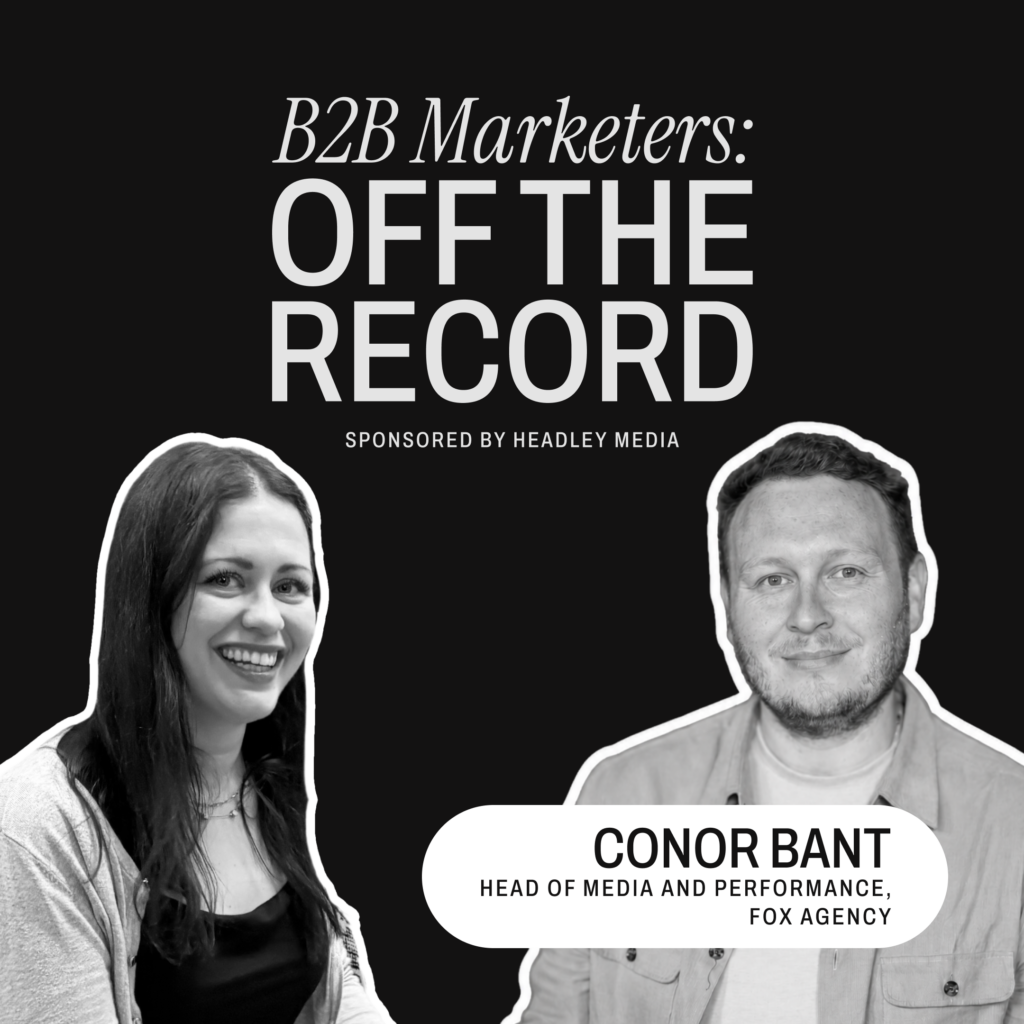
“Every channel, every piece, everything has a role at every step of the journey.”
— Conor Bant, Fox Agency
Conor Bant, Head of Media and Performance at Fox Agency, discusses the evolution of B2B marketing, the impact of AI, changes in search advertising, and the integrated approach to media planning and PR. He emphasizes the importance of a holistic view of marketing channels and budget allocation. The conversation delves into the intricacies of building high-quality leads, engaging the right audience, leveraging CRM and ABM platforms, adopting an account-based approach, aligning marketing and sales, lead generation, budget allocation, the state of B2B marketing, and the need for a holistic marketing approach in the current landscape.
Takeaways



Chloe Addis (01:16)
So welcome back to B2B Marketers Off the Record. I’m joined today by Conor Bant, Head of Media and Performance at Fox Agency. So welcome, Conor. Would you be able to tell us a little bit more about yourself?
Conor (01:30)
Yeah, first of thanks for having me.
So, yeah, I’m head of media at Fox. We’re an integrated full service agency working across kind of end-to-end campaign creation and execution. And my focus is really on looking at how we kind of plan and strategize and optimize media across paid organic media, but also kind of partnering really closely with our PR and media team. So we’re looking at a really holistic media ecosystem, if you will, to kind of drive results for clients.
you
Chloe Addis (02:03)
Amazing. That’s one of the reasons why I knew you’d a perfect guest to have on the podcast because there’s so much changing in the world of paid media, isn’t there? And also bringing in PR and everything like that, as you mentioned, to kind of get this holistic view, which is what I think we need now more in this kind of changing world and like the effects of AI, which I’m sure we’ll get into. But firstly, sticking with you, tell me, how did you get into marketing?
Conor (02:34)
Probably like most people, not by mistake almost. I wanted to be a copywriter bizarrely and now I do the complete opposite of that. So yeah, I think I decided I wanted to work in agencies and kind of ended up dabbling in various digital bits, wanting to do copywriting. I got frustrated that I wasn’t very good at copywriting and then started to do more digital marketing, know, really your pay platforms were really starting to scale up.
and kind of landed in tech almost by accident and then
Chloe Addis (03:07)
Mm-hmm.
Conor (03:08)
kind of wanted to stick with it because it’s sort of such a growing area with so much going on and so much opportunity I just thought long term it made a lot of sense and you know 15 years later here I am kind of thing.
Chloe Addis (03:19)
Yeah,
I think agencies just offer that don’t they? If you think you might be interested in marketing, there’s such a broad range of things that you can get stuck into in agency life, it’s fast paced. So it’s a good way to kind of set your roots really. And obviously you’ve stayed
Conor (03:37)
Yeah.
Chloe Addis (03:38)
there. But yeah, absolutely, we do get people saying that like they weren’t really sure what they wanted to do.
That copywriting really hits with me as well because I did a degree in English and I was like, I can do like
Conor (03:50)
Alright.
Chloe Addis (03:52)
copywriting. That’s almost what I thought at the beginning. And then it is, there’s a lot of, like whether it’s, you’re not very good. I’m sure you’re fantastic at copywriting, but there’s a lot of like, especially in marketing, a lot of eyes on and a lot of like edits and things like that. So you’ve got to be.
Conor (04:07)
That was it. That’s what I struggled with.
Chloe Addis (04:10)
Yeah, I think it’s, it’s not so much like the, that the writing is bad, but it’s the.
there’s so many people that can write. Like I think that’s the thing, isn’t it? like, don’t, there feels like there’s a skills gap, I suppose.
Conor (04:24)
I think that people were editing
something you’ve written, it feels quite personal, you’re like, hold on, this was good. So I think in the end I was a bit more attracted to the kind of more almost numerical side of like digital being able go that’s high, that’s low, that’s good, that’s bad, which obviously there’s
Chloe Addis (04:39)
Yeah.
Conor (04:40)
no subjectivity to a degree in that, but.
Chloe Addis (04:42)
Yeah, absolutely.
Conor (04:43)
bit big headed
than what to say or what I’ve done is a good thing. This is a good idea. So there’s a number to prove it. That’s
Chloe Addis (04:49)
Yeah.
Conor (04:49)
how I kind of ended up going into more media stuff.
Chloe Addis (04:54)
Yeah,
absolutely. It’s completely understandable. So as we’ve kind of mentioned, there’s been like huge changes in the industry, I guess, since kind of AI, but also, you know, marketing is always ever evolving and ever changing. So what’s one belief that you have about B2B marketing that you’ve changed your mind on recently?
Conor (05:16)
and
some, I think probably like the role of like search marketing. Like I’d always really thought of or viewed search as, you know, lower, lower volume, but higher propensity to engage. Like if someone’s actually bothered to go and Google, I want to buy this right now. Yeah, that’s
Chloe Addis (05:32)
Mm-hmm.
Conor (05:32)
pretty high intent. That’s pretty on the money that should convert. That should, you’d expect to see that for going for the funnel faster, but with just so much change in how both Google’s platforms being platforms of working, but also good old AI, all that good stuff.
the nature of how the platform is, the platforms themselves are working but also how the wider kind of world is changing is really shaken up how those campaigns run so I think it’s really kind of
changed how, where and why. look at search advertising, which I think has been really interesting, obviously, as we’re now starting to see ads coming to ChatGPT, which isn’t directly search based, but know, similar kind of feel.
Chloe Addis (06:12)
Yeah.
Conor (06:12)
yeah, that’s something that over the last year, we’ve seen a lot of change in, in terms of how that channel works and how it needs to be optimized.
Chloe Addis (06:19)
What
would you say are kind of some rules of thumb, I guess, for people looking into their ads at the moment? I mean, I can absolutely relate. We’ve seen the performance completely change over the last maybe 24 months. And so looking at different channels, how do we optimize this? It’s just, I guess, I think I’m just going to throw some words out there, even though it’s not my area of expertise, but things like…
performance max, AI max, like, you know, the change in of kind of Google advertising specifically has had a real impact on the more niche sectors, I think I’m right in saying. So
Conor (06:58)
Clicking great.
Chloe Addis (06:59)
what would you like, what kind of advice would you give the marketers looking at their results and thinking?
Conor (07:06)
I
think
part of it is almost expectation setting because one of the joys of Google earlier on was you can be very precise, very exact and exactly what you’re bidding. We have data behind to suggest that this means someone’s going to engage and this is historically what we’ve seen and almost it makes sense if someone’s Googling a very, very specific term.
Chloe Addis (07:23)
Mm.
Conor (07:24)
kind of the shift away from almost defined keywords to more like topical bases with overlays of data. I it’s almost like you almost have to just almost appreciate that you’re to have to do some testing and learning. It’s not going to be that I am exactly on the topic. So what keywords I to be on day one.
And almost being able to embrace the data that Google can give you so at first it might look a little bit scary But we have seen that mean them. We personally 12 months ago. I was absolutely no way doing P max. It’s crap. It’s waste and but the quality of the data and the Overlays and signals that it’s bringing now We see so much stronger performance and it almost feels like you kind of got a jump in bed with it a little bit because when you’re going to purely standard search we’re just seeing
volumes being lower, so you’re
Chloe Addis (08:10)
Yeah.
Conor (08:11)
not going able to the budget, you’re not going to scale your budget as well and you’re not going get that bid by efficiency and all that kind of stuff. So yeah, of almost having to play ball with the new ways of it going on, but we are starting to see results from, well we are seeing good results from taking those approaches.
Chloe Addis (08:28)
That’s
really interesting. You mentioned kind of the LLM search advertising there. Is that something that you have experience with?
Conor (08:38)
We’ve been dabbling with it a little bit. Yeah, I think, I think one of the difficult things with it is at the moment with the amount of pressure and scrutiny on budget and performance,
Chloe Addis (08:46)
Mm.
Conor (08:48)
when there’s limited data around the volume of search that goes into a platform, it’s almost like, we should invest X amount of your budget here. And particularly where the rate of attribution and like every dollar has to count more than ever. It kind of still feels quite early for people to be doing.
put a significant investment into a channel where there’s just very,
Chloe Addis (09:08)
Yeah.
Conor (09:09)
very little data behind it. And there’s question marks over people almost go for that almost direct answer.
the AI engine is that given the answer they want to people want an ad being deployed
Chloe Addis (09:24)
Yeah.
Conor (09:24)
in root space maybe maybe not I’m sure with everything I mean like like every app every platform though unless you want to pay for it you’re have to accept it and if people keep adopting it the way they will I’m sure eventually people will just become completely okay with it a bit like Google a bit like Facebook all these other platforms so we’ve kind of dabbled a little bit
Chloe Addis (09:41)
Mm.
Conor (09:42)
But I think as well, you think about the volume of search that is going into those platforms, the nature of the search, how commercial is it in different areas? There might be a very, I mean, know lots of people will talk about vendor selection consideration, which obviously does happen, but how much volume is that? How much spend does it
Chloe Addis (10:00)
Yeah.
Conor (10:01)
generate? A very small volume. So yeah,
a lot more to come, I think.
Chloe Addis (10:03)
Yeah, yeah, I think
as kind of you’re touching on that it’s so broad, isn’t it? Like this even just looking at like the search terms or search sentences, like, you know, it’s so broad, all of the the input that the LLMs are getting. So the output is so broad and kind of different every time. Like you said, do know where you’re actually going to be placed or not? And the data is
is new. So getting that buy in is difficult. Even though it’s a strong part of marketing that we always kind of have some budget for testing because that’s what it’s for. And I think people are like, are interested in it, which is obviously why I’m asking because you know, people want to know that other people have done it and seen results or anything first before like they don’t quite want to be the first people testing the waters with it. Yeah.
Conor (10:59)
Yeah, yeah,
I personally, I’ve I’ve not seen I’ve seen very, very few ads coming up.
Chloe Addis (11:04)
Yeah.
Conor (11:05)
Any, you know, like I don’t think we’ve seen huge, huge adoption in the UK in particular anyway of of the ad platform side. I know it’s only been more recently been put onto release and stuff like that, but I don’t think people jumped on it quite as quite as much as maybe LinkedIn have you believe maybe.
Chloe Addis (11:20)
Yeah, yeah.
It’s very interesting. There’s such a huge amount there to kind of that we could get into. But kind of, guess with LLMs and things like that, we’re mentioning about people searching. What shift are you seeing in how B2B buyers behave?
Conor (11:39)
So obviously there’s all the research that everyone probably wheels out and everyone talks about about changing buying cycles and changing
Chloe Addis (11:45)
Good night.
Conor (11:45)
buying committees and the people involved and the duration and all that kind of of stuff. Obviously there is a rise of people who are using AI to kind of assess their shortlist and things like that. But the way I always think about it is there’s so much that must go in. There’s so much that must happen before you get to the point of like I must make a search for a supplier.
Chloe Addis (12:06)
Mm-hmm.
Conor (12:06)
you’ve got recognise that you’ve got a need and stuff like that. I guess that’s not necessarily changing how buyers are behaving, but I think sometimes there’s an oversimplification and assumption that people are just going straight into chat GPT all the time asking what cyber security vendors should I buy from? I think there’s degree of, you know, I I always compare it to, I’m the kind of person who I buy a pair of trainers on my phone, but I wouldn’t book a holiday on my phone. That’s a laptop job. You know what mean?
Chloe Addis (12:33)
I think you’re showing yourself as
a millennial there, but yes, I do appreciate that.
Conor (12:36)
God.
And, you know, so I don’t think someone’s going to go, do you know what, I’m to invest over X million dollars infrastructure just off of an AI recommendation, like maybe
Chloe Addis (12:47)
Mm.
Conor (12:47)
for very, very small SAS license fees, people might take that approach. again, there’s still going be so much that goes before and after that search happens that as much as AI and LLMs is changing how people are finding information, I think fundamentally people risk aversion and…
pressure that goes on that, even if it’s a group of 20 people, still you would not want to be responsible for being…
part of the group that made a really bad multi-million pound purchase.
although
Chloe Addis (13:13)
Yeah.
Conor (13:15)
I think you know there’s a lot of also information I’ve been reading around about the caution and especially with know rough economic climates and stuff people don’t want to be making decisions quickly they need to feel incredibly reassured and trusted and you know a lot of kind of you know messaging and statements that you know we will know there will never be any problems with this product ever.
increasingly seeing a lot of stats say that that doesn’t actually engage and perform because everyone knows that’s impossible. We’ve all seen all these big kind of hacks and breaches and failures and stuff like that so people are cautious and I think it’s important that for know tech businesses trying to
generate more business, it’s been able to reassure them at every point. So I think just being omnipresent because not everybody is going to be using AI platforms as heavily as everyone else. Not everyone has made that jump. Some people are really, really leaning back into more traditional publications and things that they see as trust and authority because they’ve got the feeling that’s got less AI driven content. think, you know, as you know, you know.
millennials or even younger come into those buying committees and things like that, you can have such a breadth of different ways of finding information and what you base your views on. So I
Chloe Addis (14:28)
Yeah.
Conor (14:29)
think being really omnipresent to be able to catch whichever way an individual that’s in a company is changing how they want to buy is kind of captured.
Chloe Addis (14:40)
That’s really interesting. think to your point, like they’ve, we’ve underestimated the buyer, haven’t we? By saying, okay, they’re just going to chuck it into an LLM and go with whatever the search results pull up. Is this, is an oversimplification of what’s happening there. That’s part of that whole research thing. And we know that they’re spending a lot of time researching before they’re even, you know, coming or engaging with vendors and things more.
these days but yeah I think that makes a lot of sense is that they’re going to be looking towards other avenues too which they know are or it’s about trust isn’t it really it’s coming it’s
Conor (15:20)
Peace.
Chloe Addis (15:21)
and like you said that omnipresence reaching them throughout their journey because they will be more cautious as quite rightly as most people are like you said they’re kind of getting certain information in different places
So it’s a really interesting one. And obviously your role as head of media and performance encapsulates all of that. So where would you be recommending people place their bets and focus in that realm of media that is made up of so many different things these days?
Conor (16:03)
think the big thing for me is that you don’t want to over spread your budget you don’t want to under
cook things. So to
me,
Chloe Addis (16:10)
Mm-hmm.
Conor (16:11)
the real big focus that we always put into our kind of campaigns is how we target things. Because if you’re going after this number of people or this number of people, that’s a real level. If you’ve got a smaller basis, like you’re really confident on your ICP, your product fit, your business fit, all those different factors that, you know, are really important. That almost then levels out the requirement for budget. And that almost allows you to go, actually, we can still justify to be in multiple placements.
be running regeneration campaigns, still be having really active social campaigns. So it’s almost less about having to, I always try to think about it, less about trading off channels, but almost refining the audience that those channels aren’t overspread so that within each area, you’ve actually still got really good audience penetration and frequency and multiple touch points and all that kind of good stuff. So it almost allows you to still, even if you’ve got say like a mid-level budget, you can still retain like a really quite robust sophisticated media.
program that is touching
Chloe Addis (17:10)
Mm-hmm.
Conor (17:10)
people throughout the whole journey, brand to demand, all that kind of stuff, that becomes possible if you’re not trying to target every single person in the world.
Chloe Addis (17:18)
Yeah, absolutely. I think, I mean, that’s something that kind of runs through from Headley and targeting ICP as well. It’s a really interesting thing for marketers. think that there’s a real draw to want to test all different sorts of things. And like you said, like it’s almost the opposite of what you said is the obvious.
place that people would go, was like, I’ll, I’ll, I’ve got this amount of budget. I’ll separate it off with a small amount for each thing. but actually, and you know, through these conversations, I’ve been hearing that, you know, the most kind of marketing ops driven type of, of marketer, definitely wants to be spending more time and more effort.
on specific campaigns, giving them more budget rather than spreading across but give one thing a
Conor (18:15)
Get down.
Chloe Addis (18:17)
long amount of time and more budget and resource so that you can actually properly assess what impact that had. And I think kind of tying that back into the ICP is that you would only do that and you would only be confident in putting that much behind a campaign that you’re
you know, still new with and testing is if you know that it’s going to reach the right audience. What’s your kind of, so, I mean, you’ve mentioned as well within kind of media and performance, the PR side of things, you know, in relation to kind of trust and building that omnipresence. So that’s almost one that traditionally is harder to target with the…
you know, making sure that you meet specific audiences. So would you say that’s kind of changed in any way?
Conor (19:12)
I
think there’s some of the tech platforms out there are making this easier. But the way that we are increasingly looking at it is that often…
awareness media and PR and demand general kind of siloed. Like a
Chloe Addis (19:25)
Right.
Conor (19:26)
lot of companies where they’re running like distinct departments, they don’t always talk to each
Chloe Addis (19:28)
Yeah.
Conor (19:28)
other. And sometimes it’s kind of like awareness happens here and then hopefully it links up. But who knows?
Chloe Addis (19:34)
Yeah.
Conor (19:35)
So what we’re really trying to talk to people about is the idea of looking at your kind of the planning in a really centralized way. So your paid media planning should be done in conjunction with your PR planning because at a really, really simple level, if we know that our PR team are getting coverage and publications XYZ,
Do we have a double down on that and say let’s really take over of get really high share of voice? We know that placement is red hot for us and it performs really well or do we go that’s covered all that well like you know, we’ve earned that placement We’ll put our paid budget into other places that we can get come more your breath across the across the kind of the market so we kind of we kind of coordinate the planning of it and Helping to do that kind of are we targeting the end placements in the right way as we look at?
We have loads of platforms and tools, like I’m sure loads of people do, around top placements, where the affinity is, where does your audience lie, all that kind of stuff. We share that almost like what would maybe historically be seen more as a paid media platform. We work between our, my team logs into our sentiment platforms, our PR platforms as well, so that we start to think about coordinating the planning. Realistically, it might not always be the case that we can do everything.
for someone, well obviously we’d love to, but it’s always the thought process that we’re considering everything else that’s happening in your ecosystem because then if we can go actually, you’ve got really, really good organic search visibility, you drive loads of traffic that way for these types of terms and you’ve got a really, really strong PR program. We can actually really push more of our budget into, our paid media budget into demand generation.
because we’re like you know I know there’s all the know equality between brand and demand if that’s kind being taken care of elsewhere there’s an argument you can put more budget into demand generation and you know I know I know it’s not always about vanity numbers and stuff like that but I’m sure a lot of people if they knew if it would work they would like to put more of their budget into demand and brand and lead generation because ultimately markets has always been measured on the number of leads they deliver which are of good quality so but yeah looking at kind of coordinated we think we can actually help people
move where their budget sits and
Chloe Addis (21:39)
and
Conor (21:40)
seeing it as that one system for driving awareness but then through to demand generation.
Chloe Addis (21:47)
Yeah, absolutely. That kind of holistic view rather than, as you’ve mentioned, kind of viewing things in silos. And I think that is the way with a lot of tech companies and as you’re looking at kind of larger, broader enterprise type size companies, there will be just a huge amount of things happening on one side of the business and not being communicated to the other side of the business. But if that can be
accessed and understood and kind of viewed as part of the whole, then you’re right, there can be more focus on other things such as demand generation. And, and knowing that each part of that is contributing differently to the outcomes of the marketing team as a whole. like which parts are more reliable or can be more tied back to an ROI and which parts are more.
right, okay, well, we just know that we need that presence and that’s doing things that are less so, you know, overall, you’ve got the different goals of each kind of output and function.
Conor (22:48)
Yeah, and like I said, we know realistically, as much as we’d love to, might not be in every client engagement, we can be looking after their paid, their organic and their own media. But as an agency, really, I think it’s our job to be going, okay, well, what is happening over there? Because that will factor into how we, even if they just commission us for, paid media, it’s like we need to know what’s happening over there so that we can make the best plan to deliver the best results for you.
Chloe Addis (23:10)
Yeah,
100%. So what is something that when you work with B2B marketing teams that you think you look at on kind of on assessment and you go, right, I don’t think we should be focusing here anymore.
Conor (23:30)
think it’s almost a lot of time people looking at the channels in isolation. So looking at what is your LinkedIn campaign doing? What is your content syndication campaign doing? What’s your search campaign doing? And it’s almost getting to this backdrop of the complexity of buying and blah, blah, blah, and all the changes. like, it isn’t simple, it isn’t linear. And particularly when you’re talking about people buying these multi-million pieces of kit, they’re not just gonna click on one ad, they’re not just gonna go through and convert and blah, blah, blah. Like it really is to me looking at how you’re bringing it all together and…
what
are the more, all the different touch points that are contributing to high quality leads or open opportunities. know, something we talk about it as almost like looking at what is the kind of the makeup of an opportunity from a marketing perspective, like.
Who do we need to be engaging? What touch points? Other particular pieces of information that we have from a client that if we’ve got that, they’re more likely to become an opportunity. They’re almost working backwards and say, how can we almost work towards that ideal state? Because that is the kind of, it’s probably a little bit over scientific, but it kind of gets you thinking about, actually how many touch points, what touch points do we need? And then if you can go, well, actually this channel’s got a given zero leads, but actually really driven engagement or high on time dwell or whatever it might, onsite dwell, it’s all kind of building up that picture to build
a good quality lead and it kind of feeds into listen to the podcast that Max did a couple of weeks ago, the whole piece around MQLs are still relevant, it’s just a definition, I completely agree, I think it’s a really good point. We kind of need something to map to and then it’s like okay well what are the requisite steps to get through, what do we typically see correlating but yeah think to answer your question really I think something that I think you see success from is when you start to…
look at all the channels individually and sorry, collectively rather than an individual siloed, okay, well that’s not driving much engagement or that’s not driving this metric. If you’re delivering that elsewhere, but it is doing something positive, it’s that, you know, part of that surrounds that omnipresent approach.
Chloe Addis (25:23)
Yeah,
absolutely. So to get a little bit technical with that, I don’t know if there’s anything that you would suggest in terms of, mean, CRM, like reporting or what’s kind of your go-to for being able to…
see that information and again probably something that is a major challenge is probably having all of those siloed campaigns and different people working in the CRM and you know it being across marketing and sales but is there something that you kind of go to?
Conor (25:54)
Yeah, it’s really like your CRMs and your kind of ABM platforms and tools. And I
Chloe Addis (25:58)
Mm-hmm.
Conor (25:58)
think it’s almost like to me kind of almost almost in some ways, everything’s ABM because basically every single B2B account campaign you run as an account list. that make
Chloe Addis (26:06)
Yeah.
Conor (26:06)
it ABM? Does it not? Whatever. I think it’s almost taken as principles of looking at what’s happening at account level at scale.
Chloe Addis (26:12)
Mm.
Conor (26:13)
One of the joys of AI is it allows us to be able to extract that information and really start to take a list of 5,000 accounts that are being run through our broad brand awareness campaigns and seeing actually how many touches are there on those accounts and then starting to move, you know, full accounts through different stages. So, yeah, we would recommend, you know, lean pretty heavily on those kinds of platforms to see what’s happening at an account level and define how much of that’s driven by one person, two people, 10 people.
Chloe Addis (26:36)
Yeah.
Conor (26:37)
What are the number of touches? Is it, it kind of like, you know, one person who’s just mad for your content for some reason versus
consistent spread of the right type of people that you want to be talking to and maybe take almost take kind of like pushing that ABM methodology further up the funnel because we’ve
Chloe Addis (26:52)
Yeah.
Conor (26:52)
got the platforms we’ve got the technology to do it the scale that we didn’t do X number of years ago whatever so that’s kind of
something to me I think is really important is is really just buying into that kind of account based approach but not just sitting that as a like well they’re in this focused ABM campaign we only do it here it’s like why don’t you take that level of like precision and focus throughout the whole list because realistically
Chloe Addis (27:17)
Yeah.
Conor (27:18)
you even if they’re really big lists almost every B2B company of what we’ve had set target accountless because what’s the point in spending a media pound on a client that does not fit your ICP is at least the money.
Chloe Addis (27:30)
Yeah,
Conor (27:30)
same.
Chloe Addis (27:31)
that’s really interesting. We do talk about this kind of challenge that a lot of B2B marketers face, which is kind of that they’ve agreed with sales, the ICP and the OBM list gets agreed kind of at the beginning of the year or like, you know, in those kind of big meetings.
annually, you you hope that they’re more regular, but, you know, that they get kind of agreed at the beginning. And then there’s this sort of fallout or separation between teams and, know, that it then isn’t carried through. But what you’re saying is, you know, that account mapping piece, follow it through, you know, have a look in this, in all of the results from all your separate activity, but track that through the CRM or kind of, you know, all in one place so that you can tie it back.
Conor (28:20)
Yeah, and I think it’s almost like, really got to be realistic of the level and the place that like marketing can take leads to and the place that sales maybe need to get involved.
Chloe Addis (28:28)
Yeah.
Conor (28:29)
think it’s, you
On-site form completion. It’s just not really how people don’t really download website content from a brand site. It’s really hard to get that. So it really is looking at that like holistic picture of all the touches that you’ve got, all the contacts that are interacting and almost be able to surface that up early and be like, we’ve driven you engagement. We’ve driven you some leads. It’s like.
think in some ways I can always need to get sales involved in the the pick up process, pick up the lead a bit earlier, because you’re
Chloe Addis (28:58)
Mm-hmm.
Conor (28:59)
not just going to get that linear, they go through every different step of a journey, they’ll go through clean exactly as you’d like to have it on your nice flow chart on a pitch deck. And then it’s like, it
Chloe Addis (29:08)
Yeah.
Conor (29:09)
lands on the lap and it’s ready to go and they’re ready to get a phone call. I think there needs to be a bit more of a like, probably like marketing serving up more information and more. Here are the audiences, here are the touch
Chloe Addis (29:18)
Yeah.
Conor (29:18)
points. So marketing may be doing more to show what they’ve done and then maybe sales
meeting
a bit earlier to ultimately help push those down the pipeline.
Chloe Addis (29:26)
Yeah,
the context is the key part, isn’t it? And is often missing. And so there’s just that disconnect or the views that the sales team view those leads as poor quality, or it’s just because there’s not as much information as they needed. But also that we like exactly to your point, understanding that it isn’t a linear process. And, you know, looking at yourself and how you would buy something, you don’t just go from
awareness through to like, you you kind of sit with it for a bit, play with it, do some research and have different kinds of conversations from different influences. So actually, you know, marketing and sales working together, it gets handed over to sales, maybe it’s too early, maybe they have a conversation or they can’t get engaged with that and take it further. But then it gets handed back and there’s more work for marketing to do. I think by having that
those lines of communication that can kind of really change the outcome. But yeah, recognising that no lead is just going to be, you know, they come into your system, they get sent a flow of like three emails they’re not ready to buy.
Conor (30:38)
Yeah, exactly. And again, going back to the whole millennial analogy of booking a holiday and all that kind of stuff, you’re to look at it all times, you’re going look research on your phone, you might get some reviews. It’s almost like logically when you think about it, like why would that differ? all arguably there’s almost more pressure on a work, know, mess up a work purchase. That’s an even bigger deal than if you book a crap holiday, you know what mean?
Chloe Addis (30:58)
Yeah,
100%. Yeah, there’s a lot at stake, isn’t there? So what type of investment do you think that marketing leaders should be protecting if their budgets are tightened?
Conor (31:15)
It’s
a very good question. think, I mean, think a lot of people would say, is it brand or demand? Like which one do you
Chloe Addis (31:19)
Mm.
Conor (31:20)
keep? And to me, it would be really about making some hard track. I mean, I think you need to keep both because I mean, there’s an argument that if you’ve got money, you’re going to chase generating leads because like ultimately that is what marketing teams are going to be measured on.
But as we know, if no one knows who you are and all they get is a bunch of lead generation focused staff, they probably won’t engage. And if they do engage, they’re going to die very early in your CRM or whatever it might be. I think it would be, I had a, any time if it’s a finite budget, it just comes back to that pinching in here you’re going after. So you’re still doing the full funnel. still, whatever you want to call it, the whole end to end process, but you just going to have to scale it in and be really, really selective over exactly who do we think we can engage, exactly which markets and you know,
having those kind of trade-offs with like, I mean it’s not uncommon, we’ve worked with lot of like regional marketing teams where there’s 16 countries in Europe they want to target and some of them have got absolutely no interest, there’s very very few accounts
Chloe Addis (32:18)
Yeah.
Conor (32:18)
and there’s which hold budget and all that kind of stuff, it’s like having those more difficult conversations, be like this is what we can do with our budget, otherwise we are just kind of satisfying people’s needs and people’s wants.
Chloe Addis (32:30)
Yeah.
Conor (32:31)
I think it’s about really
refining who you’re going after and then still keep into that kind brand to demand, almost account based piece because otherwise you’re compromising what you think works well from a campaign perspective. it’s like, we would all say that if you just generate leads but we’ve got no awareness they won’t move, why would you continue to do that?
Chloe Addis (32:58)
Yeah,
that’s a really interesting answer. I think you’re the first kind of person who’s looked at it in that respect. know, there’s always, when you speak to kind of individual marketers, they’ve always got their kind of key thing, their favourite thing and what they’re good at. you know, they will say, like a lot of people have said the brand, a lot of people have also said, like invest in the people and then they’ll be able to, you know, instead of the specific kind of functions. But I think that’s…
What you’ve said is really interesting because it does provide that holistic view, as you’ve mentioned kind of all the way through. It’s almost the theme for our conversation today. And so, you know, don’t don’t cut anything specifically, but but kind of focus in like said, yeah, there’s there’s so many different ways of doing that. And you kind of regions instead of because obviously, you know, we kind of touched a little bit on like the the buying
committee, almost like there’s people involved in it, but having that really nailed in.
Conor (34:04)
Yeah, that’s like,
guess really part of then answering it is like something to retain is your ability to get that information and to be able to know that. So if that is investment in technology
Chloe Addis (34:11)
Yeah.
Conor (34:12)
or investment in the people that have that experience and know those markets well so that you can almost still do, you can do.
the same stuff, but on like a smaller scale maybe. Because I guess
Chloe Addis (34:22)
Yeah.
Conor (34:23)
if you’ve got your budget cut and you went just for awareness, which would be great, if the budget doesn’t lift, are you going to be able to then extend that into full funnel? And, you know, in a competitive space, are you able to get the inbound volume? You may be able to, but yeah, I mean, I’d really focus on that. Like to me, it’s always about.
retaining as much as you can without and the way to avoid over spreading your budget and not having any impact is just to always refine it.
Chloe Addis (34:52)
Yeah. So what three words do you think describe B2B marketing right now?
Conor (35:03)
conflicting.
Chloe Addis (35:05)
you
Conor (35:10)
exciting and
Chloe Addis (35:12)
Okay.
Conor (35:16)
like changing. I don’t know if that same is conflicting.
I say conflicting because I think there’s a lot of…
differing opinions and you know, I mean like there’s probably like an echo chamber of know agencies that I see on LinkedIn but just you know the amount of conflicting information and thought around you know, you know, you can go on to go on to LinkedIn and you’ll see that SEO is dead, PR is dead, media is dead,
Chloe Addis (35:35)
Right,
Conor (35:36)
everything’s dead and then you’ll also see a report from Gartner that shows the trajectory of where media budgets are going all this kind of stuff and it’s like which one is it? So
Chloe Addis (35:42)
Yeah. Yeah.
Conor (35:43)
it feels like there’s a lot of just like there’s so much change in the way that you know good old AI is changing everything. It’s
Chloe Addis (35:49)
Mm.
Conor (35:49)
like I think there’s a reality of like nobody
exactly knows exactly what is going to happen and where everything is.
Chloe Addis (35:55)
and
Conor (35:56)
But I think, you know, it’s probably like a lot of society, everyone’s becoming quite staunch in their opinions and it’s like, you know, one end of the spectrum or the other
Chloe Addis (36:02)
devices.
Conor (36:04)
in terms of what people’s opinions are and they’re being quite strong and staunch on them. yeah, it
Chloe Addis (36:09)
Yeah.
Conor (36:09)
feels like there’s quite a lot of conflicting beliefs and things like that in the industry. maybe, you know, over the last few years, you’ve had the changes of, almost, know…
ABM and brand demand and then the big push back to awareness, know, that these kind of like tent pole
Chloe Addis (36:25)
in
Conor (36:25)
themes that everyone’s kind of got behind it feels like maybe now there’s a bit more of a conflict of well actually what what does LLM onset mean
for my for the industry and for my business I think it’s interesting to look at I mean something we’ve been looking at is a bit about You know unsurprisingly a lot of people scared or panicking about what LLM is doing to their to their ability to attract business
Unless something dramatically has changed, I we did some research and compared I think it was like data center industry, CRM, somewhere else, cyber security maybe. Data
Chloe Addis (36:58)
Mm.
Conor (36:59)
center, like everyone’s saying, all you hear is they cannot build enough data centers fast enough because of the amount of compute that we need for AI. Nobody
Chloe Addis (37:06)
Yeah.
Conor (37:06)
Googles for it, no one searches it.
because it’s just like not the way that people transact business in that market. So, yeah, I think it’s really interesting that, you know, there’s quite big statements going out about how things are completely changing. Everything’s different than some areas.
Chloe Addis (37:20)
and
Conor (37:22)
Are people all of a sudden just going to LLMs and looking for data centers because they didn’t do it in Google 12 months ago? you know, is that behavior
Chloe Addis (37:28)
Yeah.
Conor (37:28)
shifted that much? I personally find it hard to believe that, you know, the way that we’ve consumed information around certain areas will have changed that much. Like if there’s something that was very
searched I would assume that it would be very heavily LLM’d. Make
Chloe Addis (37:43)
Yeah.
Conor (37:46)
a new phrase there we go another acronym and yeah that’s there a lot of conflict at the moment I think.
Chloe Addis (37:52)
Yeah,
yeah, I definitely agree with that. I think coming back to that point on it’s the human, like humans haven’t changed. So what they’re looking for and the way that they’re doing that might have changed, but really there’s still those kind of key drivers. Like you said, you still need to have trust. You still need to have like those emotions that are driving the decision-making.
are still there. And yeah, it’s just exactly right. There just seems to be more division among like what camp you’re in,
Conor (38:32)
Yeah.
Chloe Addis (38:32)
where you think, what budgets need to be protected exactly, the answer to these questions. So we’ll round off with what is one thing you wish you could change about marketing?
Conor (38:47)
I
think it’s almost like the division between if it is like brand versus demand or like performance
Chloe Addis (38:53)
Mm.
Conor (38:54)
versus creative like you know the reality is that every campaign that runs the performance could be really bad because it’s been
content messaging, creative, everything is rubbish. It could
Chloe Addis (39:07)
Mm-hmm.
Conor (39:07)
be deployed very badly. I think it’s removing some of those silos and seeing things as more collective.
Chloe Addis (39:14)
Mm-hmm.
Conor (39:15)
Because for the best one in the world, you could have had the most beautiful campaign in the world. If you don’t have to deploy it and you’ve not planned it properly from a media perspective, it’s going to flop and not do anything.
Chloe Addis (39:25)
Yeah.
Conor (39:26)
So I think, there’s probably, like I said, there’s obviously the kind of the…
you know, almost siloing things and putting things into buckets. I often think people like to bucket channels like, no, that’s an awareness channel. That’s a lower funnel channel. Like everything can be applied if you do it in the right way and you deploy it in the right way and use the right technology to target it. Every channel, every piece, everything has a role at every step of every journey of everything. So I almost think less about splitting things off and
Chloe Addis (39:53)
Mm-hmm.
Conor (39:54)
just things more collectively because it’s always going to be the case that the, you know.
multiple good things together are probably gonna be better, you know?
Chloe Addis (40:04)
Yeah. And I do think, obviously we’ve mentioned AI a lot in this conversation, but I do think that that influence has created a more, a need for this more holistic view because the LLMs do search sort of everywhere all at once. they’re not just, you know, with, with kind of traditional optimizing for Google search, you’ve got, right. Okay. Well, we’ll focus on our blogs and our website and you know, we can optimize there, but
This is like making, forcing marketers to look at their entire presence, know, the PR, the trust,
Conor (40:41)
Yeah.
Chloe Addis (40:41)
everything that comes with that, as well as the paid, where are we, you know, where are we surfacing in all different sort of like all the way through the funnel. So I think what you’re saying is so necessary for how the market is being shaped at the moment.
Conor (41:00)
Yeah, and guess like, you know, where we are now, like 12 months ago, adoption of LLMs was like, what? So well, it was much lower. Where are we going to be in five years time? And maybe, I guess maybe the people that put in the groundwork in now to start bringing those things together and, know.
pivoting adapting now are probably the people in five years time will see the fruits of that because if you’re still you know Running of again, it’d be like, you know running a really linear The generation process that would have people might have done five years ago. Now you’d see that as like a archaic and stockable form You know, it’s pretty probably some pretty fundamental shifts that are gonna you know They’ve already started like obviously there are changes and there’s a lot of people seen their web traffic being hit But just like there is surely could be much further bigger waves to come. I think it might play
like going in and out a little bit like as people’s
trust being a big factor will change.
Chloe Addis (41:50)
Yeah. Yeah.
Conor (41:52)
The value they get and you know for every great success story about you now you also see a know a problem where people have to then go and reinvest a little money to fix it and all that stuff.
Chloe Addis (42:01)
Hmm.
Conor (42:01)
I think there might be a bit of a plateau of like how people do and don’t use. I it’s obviously it’s here to stay and it’s not going to go away anytime soon and need to in marketing teams you need to be able to pivot to it but yeah I think putting groundwork in now has been pretty important because if almost like everything that’s been changed now there’s only going to be more so you might as well
might as well get on the bandwagon and you know answer it now.
Chloe Addis (42:21)
Yeah.
Perfect. That’s amazing. So thank you very much. So the one last thing we tend to ask is where can people find you?
Conor (42:34)
I’m trying to be more active on LinkedIn. It’s about this kind of, you know, my random thoughts. we’ve got really, at Fox, we’ve got a really, really good marketing team who credits them. They produce a lot of really good content, podcasts and this kind of stuff. So the Fox agency website is a great place for lots of new information, content, thought pieces. Yeah, we, I think the guys do a very good job of putting all the thoughts out there.
Chloe Addis (43:02)
awesome and we’ll make sure to follow you there. Thank you so much for being on the pod. Thank you.
Conor (43:07)
Thank you.
In this episode of B2B Marketers: Off The Record, Chloe Addis speaks with Conor Bant, Head of Media and Performance at Fox Agency. Drawing on 15 years in digital marketing and media, Conor explores how AI, changing search behaviour and increasingly complex buyer journeys are reshaping B2B media strategy.
A central theme of the conversation is the need to stop treating marketing channels as separate activities. Instead, Conor argues for a more holistic approach that brings paid media, organic, PR, brand and demand generation together around the audiences and accounts that matter most.
One of the biggest shifts in Conor’s thinking has been around search.
Traditionally, search offered relatively low volume but high intent. Someone entering a specific query into Google could be considered much closer to taking action, giving marketers a high degree of precision around keywords, targeting and optimisation.
That model is becoming less predictable.
Changes to Google’s advertising products, including Performance Max, alongside the growth of AI and LLM-based discovery, mean marketers increasingly need to become comfortable with broader signals and more automated approaches.
Conor admits that 12 months ago he was highly sceptical of Performance Max. Since then, improvements in the data, signals and targeting available have changed his view, with Fox seeing stronger performance from campaigns using these newer approaches.
The lesson for marketers is to be prepared to test, learn and adapt rather than expecting the same level of control they once had.
Advertising within AI platforms presents an obvious opportunity, but Conor believes it remains difficult for B2B marketers to justify significant investment while there is limited data around search volumes, commercial intent and attribution.
There is also a bigger question about user behaviour.
People may use an LLM to research vendors or create a shortlist, but that does not mean they will make a significant B2B purchase based solely on an AI recommendation.
For smaller SaaS purchases, that journey might become increasingly automated. For complex, high-value technology investments involving large buying committees and significant organisational risk, Conor expects considerably more research and reassurance to remain necessary.
For now, his approach is experimentation rather than wholesale budget migration.
AI is changing how people find information, but Conor cautions against assuming every buyer has abandoned their existing behaviour and moved entirely to ChatGPT or another LLM.
The reality is more fragmented.
Different people within the same buying committee may research through search engines, AI platforms, industry publications, social media, peer recommendations and other trusted sources.
The larger and riskier the purchase, the more important that becomes. Buyers do not want to be responsible for making a poor multimillion-pound technology decision, particularly in a challenging economic environment.
That makes reassurance, credibility and trust critical.
For marketers, the answer isn’t necessarily choosing the next dominant channel. It’s building enough presence across the buyer journey to be discoverable and credible wherever different members of the buying committee choose to research.
When faced with an expanding number of channels, the temptation is to divide the marketing budget into increasingly small pieces.
Conor recommends approaching the problem from the opposite direction.
Instead of deciding which channels to remove, marketers should become much more precise about the audiences and accounts they are targeting.
A clearly defined ICP and target account list can allow a business to maintain activity across brand, demand generation, social and other media without spreading investment across audiences that are unlikely to buy.
This becomes particularly important when budgets tighten.
Rather than choosing between brand and demand, Conor’s preference is to narrow the audience, markets or regions being targeted while maintaining an end-to-end marketing approach.
One of Conor’s strongest arguments is that paid media, organic activity, PR and demand generation shouldn’t be planned independently.
If a brand already has strong organic search visibility or is consistently earning coverage within important industry publications, that should influence where paid media investment goes.
In some cases, paid activity might reinforce a particularly valuable publication and create greater share of voice. In others, strong earned coverage might mean budget is better deployed elsewhere to increase reach.
The important point is that these decisions are made together.
Even when an agency has only been commissioned for one part of the marketing mix, Conor believes it needs to understand what is happening across the wider ecosystem to make better decisions about the area it controls.
The same thinking applies to measurement.
Looking at whether LinkedIn, search, content syndication or another individual channel generated enough leads can obscure the role each interaction played in creating an opportunity.
Complex B2B purchases rarely follow the neat funnel represented on a marketing flowchart.
Instead, Conor recommends working backwards from high-quality opportunities and understanding their marketing “makeup”: which people were engaged, how many interactions took place, which channels were involved and what patterns correlate with progression.
A channel might generate very few direct leads but consistently contribute valuable engagement within accounts that later become opportunities.
That makes account-level measurement increasingly important.
Conor describes modern B2B marketing as increasingly account-based, regardless of whether a campaign formally carries the ABM label.
If a company knows its ICP and has identified the accounts it wants to win, there is little value in spending media budget reaching organisations that don’t fit.
CRM, ABM platforms and AI now make it easier to analyse thousands of target accounts and understand the volume and quality of engagement taking place within each one.
That includes distinguishing between one highly engaged individual and meaningful engagement across several relevant stakeholders within an account.
Conor’s recommendation is to apply that level of account precision throughout the funnel rather than reserving it for a small number of dedicated ABM campaigns.
Account-level visibility also has implications for the relationship between marketing and sales.
Conor challenges the expectation that marketing should nurture every prospect until they arrive as a perfectly qualified, sales-ready lead.
Real buying journeys rarely work like that.
Instead, marketing should give sales richer context around the accounts showing engagement: who is interacting, what they have engaged with, how frequently and where those signals are appearing.
Sales may then need to become involved earlier, with accounts potentially moving between marketing and sales as their journey develops rather than following a one-way handover.
Asked what marketing leaders should protect when budgets are under pressure, Conor resists choosing between brand and demand.
Demand generation without awareness can create leads that fail to progress because buyers don’t know or trust the brand. Awareness without a route to generating opportunities can be equally difficult to justify when commercial pressure is high.
His solution is to protect the overall journey but reduce its scale.
That might mean targeting fewer countries, smaller account lists or a more tightly defined ICP. It also means protecting the technology, data and expertise that allow teams to make those decisions intelligently.
The objective is to keep doing the things that work together, but for a more focused audience.
Asked to describe B2B marketing today in three words, Conor chooses “conflicting”, “exciting” and “changing”.
Marketers are surrounded by increasingly definitive claims that SEO is dead, PR is dead, media is dead or that AI has fundamentally rewritten buyer behaviour.
Conor is more cautious.
Different industries already had very different search and buying behaviours before the rise of LLMs. If buyers rarely used Google to source a particular product or service, it shouldn’t automatically be assumed that they will suddenly use an LLM to do so instead.
There is significant change ahead, but exactly how that change plays out across different markets remains uncertain.
The future of B2B media isn’t about finding the single channel that replaces everything that came before it.
It’s about connecting the entire marketing ecosystem.
As AI changes search, discovery and media platforms, marketers need to understand their ICP more precisely, coordinate paid, organic, PR, brand and demand activity, measure engagement at an account level and recognise that complex purchases are built through multiple interactions.
Technology and buyer behaviour will continue to evolve, but trust, relevance and human decision-making remain fundamental.
The marketers laying the groundwork now to connect their data, channels, teams and customer journeys will be better positioned to adapt as those changes accelerate.
Conor Bant is the Head of Media and Performance at Fox Agency – an integrated marketing & PR agency for global B2B tech brands. Conor has spent nearly 15 years working in B2B tech agencies overseeing strategy, planning and activation of omni-channel media programs for brands such as Adobe, Lenovo, PayPal and SS&C. With both hands on and strategic experience across search, social, programmatic, media buying and organic, he has a key focus on channel and data platform evolution to deliver cutting edge, high performance connected programs for enterprise clients.
The conversation covers search visibility optimization, digital ads, marketing operations, and the importance of building…
Lindsay O’Brien, Head of Marketing at Pragmatico, shares her marketing journey, insights on B2B marketing…
The conversation covers the evolution of marketing measurement, the transition from PR to marketing, the…