

S02E02 – Simon Gould – B2B Marketers: Off The Record
In this episode, Simon Gould shares his extensive journey in digital marketing, emphasizing the transformative…
“You don't need to convince people, just find the ones who already need it.”
— Niall Ratcliffe, noticed.
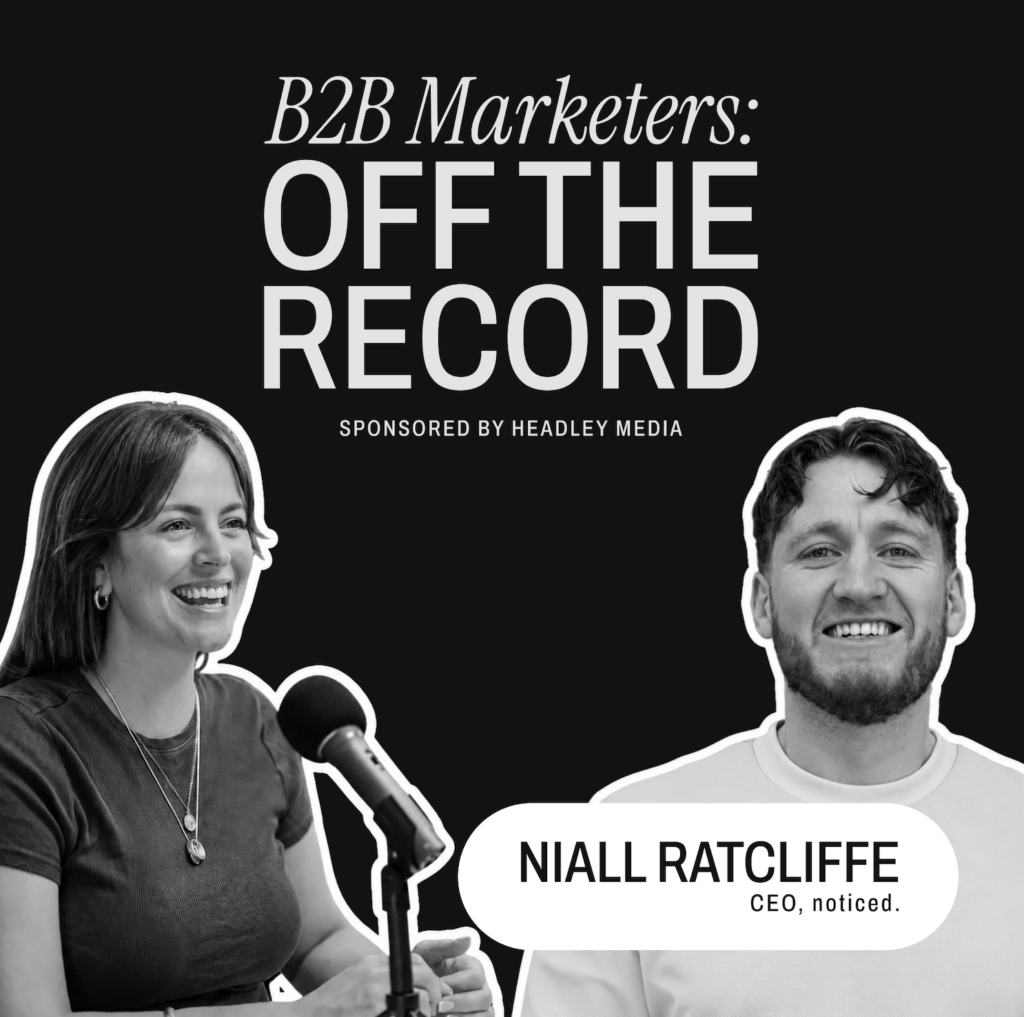
In this episode of B2B Marketers Off the Record, Freya Ward interviews Niall Ratcliffe, CEO of noticed., discussing his journey into B2B marketing, the evolution of marketing strategies, and the impact of AI on buyer behavior. The conversation highlights the shift from traditional marketing to a more technical, data-driven approach. In particular, emphasizing the move from personalization to relevance, the importance of understanding market signals, and the need for long-term investment in marketing strategies. They also touch on the challenges of leadership buy-in and the perception of marketing as a serious discipline rather than a fun endeavor.
Takeaways



Freya Ward (00:54)
Welcome back to another episode of B2B Marketers Off the Record. I am joined by Niall Ratcliffe, who is the CEO of noticed. which is one of the fastest growing LinkedIn marketing agencies. Without further ado, Niall, would you like to introduce yourself?
Niall Ratcliffe (01:09)
Yeah, I feel like I’m very much on the record Freya But yeah, my name is Niall Ratcliffe. I run noticed. one of the fastest growing B2B Marketing agencies and LinkedIn agencies in England, especially in the northwest of England. Essentially, the way I like to articulate it is if you’re a fast growing B2B brand in Europe, you come to us to help drive that growth. And probably best well known nowadays for our work with the NHS and Ocean Beach Ibiza, we work with a host of brands all in the B2B space.
Freya Ward (01:35)
Thank you, now. I’m so excited to have you on B2B Marketers Off the Record. This is very much on the record, you’re completely right. And it’s going to be a conversation where we’re going to unpack some of your experience, the experiences that you’re having with clients, what’s going on in the marketing space for you right now. But before we jump into those questions, I’d love to get to know you a little bit more. How did you get into the B2B marketing space in the first place?
Niall Ratcliffe (02:00)
Good question. So I got into B2B marketing in a bit of an unusual way, I would say. when I was 17, 18, I was playing football full time. thought I was going to be professional footballer. As you can see, didn’t make it. I played for Stockport County and I had a couple of football accessory brands send me their products to kind of try out and they me to create some videos around it. And one of them was this like lace brace. It was cool. It essentially went over your football boots and like stopped your laces coming undone. It was this stuff for kids. I recorded this video.
and ended up being one of the top performing…
piece of content on their channel, on their Instagram at the time. And they ended up asking me to create more content. And all of a sudden, as my football career was failing, my marketing career began to start weirdly in the social media space doing like these videos. But it when I was 19 that I got this unusual opportunity at a marketing startup in London, I say unusual, because it a personal branding agency. And at the time, personal branding wasn’t a thing at all. So I was like this, know, bright eyed, bushy tailed 19 year old going into this startup. I was employee number three at the time.
And we grew from three to sixteen very very quickly But I was essentially thrown in the deep end working with these massive founder in the b2b space On their personal brands. We were in their Instagram LinkedIn Twitter YouTube anything you can think of PR getting them on podcasts So yeah, literally I got thrown in the deep end and I got straight to the CEO level where I had this like one-to-one relationship with them and that really kind of Kickstarted everything in the b2b space and probably before that I couldn’t have told you what b2b meant
Freya Ward (03:31)
Hehehe.
Niall Ratcliffe (03:31)
but after I knew that
I think I’ll be there for at least the next 10 years.
Freya Ward (03:36)
That’s amazing. It’s so interesting though. The vast majority of people that we’ve had on the podcast have tripped and fell in some way into the V2B marketing space and then uncovered all of, you know, the science behind it and the psychology behind it and everything else. But so fascinating because personal branding is such a hot topic at the moment, right? And you were there before it was probably even called that. It was probably not even
really a thing.
Niall Ratcliffe (04:02)
Yeah.
Yeah,
it’s so funny that I almost cringe a little bit when I say personal branding now, because it has these weird terms. know a lot of like, I’m good friends with Astro and he runs great influence. And I know he’s almost been pivoting away from the word personal branding, even though he was there, when Stephen Bartlett was blowing up his social chain. And it’s like way before personal branding was the thing we think it was today. And but yeah, we were essentially, it was more of a PR agency, you think like a PR and social agency. But the term we used at the time is personal branding. And obviously that term blew up and I got to see kind of firsthand the impact it had on that agency.
but also on the industry. It’s funny you said, everyone trips into B2B and I’m like, when they ask a kid in school, what do you want
Freya Ward (04:40)
Hehehe.
Niall Ratcliffe (04:41)
to be when you’re older? I’ll say astronaut, football, they never say B2B marketer, but that’s where we end up for you.
Freya Ward (04:46)
Definitely
not. Yeah, that’s so, so true. I’ve heard Ash’s talk about his entry into the space as well. And it’s, it’s a similar thread, isn’t it? Where he was working with Stephen Butler on stuff that was PR and you know, B2B marketing as a whole is so cyclical.
Niall Ratcliffe (05:06)
Mm.
Freya Ward (05:06)
We just call it something else, right? So yeah, I align with the pivot away that he’s making away from calling it personal branding.
because it has to be called something else, but the tactics kind of remain the same.
Niall Ratcliffe (05:17)
And it’s funny
for the best in the industry are early and then get out early. Do you what mean?
Freya Ward (05:23)
He
Niall Ratcliffe (05:24)
Once the term reaches critical mass, everyone who was actually spearheading personal branding ends up calling it something else, which is the irony of what we do as marketers is we always like to find something that’s unique. So we’re always changing the word. I saw, this might be controversial for you. If there’s anything we’ve cut, might be this. everyone’s saying now, we use term GTM a lot and go to market and that’s like.
have a team called the GTM team and someone said on Twitter it was like why did men decide to rebrand marketing to GTM like it’s been marketing for years but we always have these cool terms or like a masculine term because like a lot of the engineering people coming in and we just had to create this new term or like embody it from somewhere else but ironic that is the industry of marketing isn’t it that we we like to brand things and stamp a different name on them.
Freya Ward (06:12)
Absolutely, yeah, completely. So there’s been a lot of change in the space during your career, I’m sure. Is there a belief about B2B marketing that you’ve changed your mind on in the last 12 months?
Niall Ratcliffe (06:26)
100%. I think if I actually expand that to probably, let’s say the last four years, I think it was 2022 when chat to BT exploded. And I think if it was a line, the sand you drew for when more marketing fundamentally changed, it was at the launch of AI. AI is a real buzzword nowadays. And everyone’s like, kind of talks about it almost like negatively of like, it’s AI. And it’s like, this is like a bad thing, but really completely changed the fundamentals of marketing. The way I see it now is that what’s one belief I have, I think a line got drawn in the sand there.
and there was old marketers and new marketers regardless of age it was two different types of marketing. My favorite distinction is the old marketer thought of creative ways to get eyes on their brand the new marketer thinks of technical ways to steal leads and the reason I say that is because I think marketing is becoming a technical sport it’s no longer this creative art where you sit and you dwell and you think on these great genius ideas because while you’re doing that you’ll get outcompeted by these very very
technical masters that are coming into the game. They’re able to do things at a much broader scale, much higher intent, and just generally at higher R1 activities. And you can get from sitting and thinking of a creative campaign. A good example of this is traditionally marketing functioned in campaigns. So you would sit at the start of the quarter or whatever time you did it and you’d be like, okay, what’s the aim of this campaign? Okay, let’s come up with ideas of how we can get that aim or communicate this message. And you’d spend six weeks mapping it out, getting all the assets together.
So if it was out of home, you’d have to get a billboard, whatever else. You’d launch the campaign, there’d be a massive spike, and then you’d stop and start again. And that is old marketing, as I would put it. New marketers would sit there, they’d have an outcome they wanted to have, they’d create a workflow that…
achieve the outcome, whichever channel it was, then at end of the six weeks, they would pause working on that workflow and move on to the next workflow. So in the first six weeks, the old marketer would win that this big creative campaign. Twelve weeks in the new marketer has two workflows while they’ve only launched two campaigns. But week three, there’s three workflows running for the new marketer. And there’s again one campaign going. And suddenly, as you get over 12 months, the new marketer has 12 workflows constantly going to these new outcomes. And the old marketer
is once again launching one new campaign. And it’s a great example of suddenly how these thinking in the old way of this creative art, you’ll suddenly get drowned out by the more technical marketers that are simply able to do more volume in the end of the activities that provide the right ROI.
Freya Ward (09:04)
Yeah, it’s, I love the way that you’ve explained that. And I think it’s, it’s, it’s obviously not as clear cut as the example
Niall Ratcliffe (09:11)
Yeah.
Freya Ward (09:11)
that you’ve given, but I think it’s a really, it’s a really interesting framework to work with and to compare. do you think that in that shift, well, it moves away from that stop, start marketing, right? And that
Niall Ratcliffe (09:25)
Yep.
Freya Ward (09:26)
also accurately reflects
I guess continuous review on performance over a longer period of time that then maybe reflects B2B buying journeys, sales cycles. Do you think it’s been pushed by the requirement for marketing to feed into revenue targets more than ever?
Niall Ratcliffe (09:45)
good question. think, yeah, I think, you know, I think that…
I’m trying not to be controversial today Freya. I think that bad marketers got away with bad marketing by telling you it was creative. Let me think of an example. So let’s say we were trying to market this podcast right and I pitched you Freya, I was going get this massive vinyl record that was 12 foot, I was going to crack it in half and I was going to put all your marketing mistakes or all your marketing lessons broken down and was a broken vinyl and we’re going to do billboards all over Manchester. You start to visualise this idea and think yeah that’s great and we’re going to communicate this.
idea this is amazing it’s gonna be all over Manchester and then the my god I see it on the billboard let’s get a photo of it we can do PR and social
And as I’m saying that, this is how campaigns used to be crafted. And we get to the end of it, and we’re like, God, that was an amazing campaign. We drove zero new listeners to the podcast. But they go, but look at what we did for the brand. Look how we got it out there. Did you not see us? We were in Pulifric North. Did you not see Manchester Evening News covered it? But there wasn’t anything. And it’s like, is marketing having to be tied close to revenue? Yes.
But how many years can you get away with providing not very much and not getting anywhere? And let me be clear, by the way, some people need the brand awareness. One thing I say to our clients when they come in and if they’ve already got a half decent brand, I say, you’re not perfect Ted. like perfect Ted came into London with this new drink of matcha drink and no one drank matcha. So there’s this equation in between marketing of the five and the 95. So 5 % of your market are actively buying, they’re to buy your product, 95 % aren’t
head. Essentially it was more like probably a 1 and a 99 % and maybe no one was trying to buy a matcha. So the only way they could grow their business is they had to essentially sell to the 99 % and convince them to buy a matcha and educate them. If you’re a CRM tool you shouldn’t be selling to this 95 % and trying to convince them to get a CRM tool. It’s probably not the best avenue you can take. What you actually can just do is hit this massive market which is the 5 % who are in market and that’s where you should be going for and that’s where the revenue comes from.
The only reason I should be splashing out on these big campaigns that generate no money and generate awareness is if I am a perfect ted and I’m trying to break into an industry or I’m trying to get started. I’m saying that we did something like 28 million impressions on LinkedIn just for our brand over the last four years. That’s just my personal profile. It’s not even across the team or anything like that. I about 28 million impressions in 2021 on LinkedIn. Why was it so important back then? Because we were breaking into the market.
No
one
f***ing
knew who I was. I was a nobody and the brand was a nobody and no one knew who we were. So was important that we did big bold things. We had a campaign where we built the largest envelope in the UK and we sent it to Go Cardless. Do you know how many clients we signed from that? Well I’ll tell you Go Cardless aren’t on our roster so they didn’t sign. It cost us probably two grand to put together but something like 150,000 people saw it. It was vital for our brand. So you can do that in the early days but for most of the people listening and most people in B2B
industries or companies, you’re not a perfect ted and your marketing should be driving revenue.
Freya Ward (12:54)
Yeah, that’s such good examples, such good examples. And I guess that is the clear difference, isn’t it, between either a business that is a startup or trying to establish themselves in an emerging market, somewhere that their brand isn’t recognized, then brand awareness, of course, and then you’ve got to measure that over a longer period of time to see when you can start playing in the actual revenue driving tactics and evaluating
Niall Ratcliffe (13:18)
some.
Freya Ward (13:19)
those metrics. But for
the majority of listeners I would anticipate as well that they are in established brands. And actually if you are, I think there’s still importance in awareness. just,
Niall Ratcliffe (13:32)
Yep.
Freya Ward (13:33)
you know, there is still importance in awareness, but if you’re only focusing on campaigns
Niall Ratcliffe (13:38)
Yeah.
Freya Ward (13:38)
that drive awareness, you shouldn’t be measuring them based on the ROI. You should
Niall Ratcliffe (13:41)
100%.
Freya Ward (13:42)
be accepting that that is a cost. That is what’s going to happen. It’s going to drive something. A lot of it is going to be dark metrics and compliment that with
or supplement that with activity that is going to be driving revenue. So let’s talk about the B2B buyers, because there’s a lot of change going on in that space as well. And you’ve alluded to AI a little bit already. You’ve talked about LinkedIn as the platform that really blew up your brand and it’s where you help your clients. What shifts are you seeing in how B2B buyers are behaving right now?
Niall Ratcliffe (14:15)
It’s a great question and you made a great point there, Frey, about the brand awareness thing. think the key differentiator that you made there was the fact of you have to know what you’re in it for. My biggest pet peeve is people who sell brand awareness and sell it as a lead generating channel, which I just wanted to go off my chest. My biggest pet peeve is like, I’m going to blow you up on socials and you’re get these magical inbound leaders. Like, yeah, if you’re a wizard, maybe they come up. But okay, how are buying decisions changing? So do you know
I
think the biggest thing I would say about buying decisions changing is I think they’ve gone too social to research. I think back in the day, right, the only channel you could go and AI as well, which I’ll get to, and the only thing you could do is like you go to Google and you start to review and it was a big SEO game. Now that pivoted a little bit to AI. This morning I was in the gym. I was looking at a new savings account and I’m like clawed in like, what’s the best savings account? I have these two bank accounts and…
research in AI. But the other thing we do from a lot of the B2B side is we’ll start to be curious about different brands in the market. So let’s say this morning it recommended this Goldman Sachs account, I can’t remember it was called, then the other one was Chase, and I will start then going to them. And in the B2B case, I’d go on LinkedIn, maybe not for banking, but let’s it was a marketing agency, I would start to look at that marketing agency, I’d connect with the CEO maybe, I’d follow the company page and start to have a look and be like, okay, what post they’re putting out? Do they seem like they’ve got some good case studies? So we do a lot of our research there.
I don’t know, TikTok is renowned for doing this on the B2C side is like people will search and review. I just went to the Cotswolds two weekends ago. My partner, she was like constantly on TikTok of like what’s the best cafe in Bibbery or whatever it was called. And that’s how we do our research. And it’s the same on B2B and people forget that.
My favorite thing about it that’s changed as well is while the buying decisions have become more social, we’ve also got more access to the data on the marketer’s side. So not only has the buyers become more visible to us because they’re now engaged on social often just Google where Google
owned all that data and sold it to you, we can now access the data of who’s engaging on your competitors at LinkedIn, who’s engaging on certain posts around the service that you sell. LinkedIn is a public forum and I think people don’t understand that they’ve suddenly got access to this data, virtually free of charge, whereas back in the day the conglomerates owned it and sold it to you at a premium.
Freya Ward (16:35)
Yeah, I think so we as marketers have more access to so much more market intelligence at our fingertips,
Niall Ratcliffe (16:43)
Yeah.
Freya Ward (16:44)
within our personal profiles on LinkedIn, within company pages, within I’m sure another hundred sources as well. But equally the actual buying journey has shifted. And do you think that the lines between B2C research and B2B research?
that journey is starting to blur? Or do think there’s still quite a clear cut between the two?
Niall Ratcliffe (17:09)
It’s a really good question. So one of our early advisors when we started the agency he was Don McGregor, who started social Chain Stephen Bartlett. And his biggest thing he would always say to us, he was like, if you want to find a B2B marketer, go to a B2C company and take their marketer. He always would say like, it’s just so far ahead of B2B. Another thing he would say is like,
If you want a good B2B campaign, do what B2C did five years ago. Again, it’s a joke around, it’s been so far behind on the B2B front. And I really believe with that, think especially on the brand awareness front, like I would really lean into what B2C are doing. They are ahead of the trends. But I think on a tracking and metrics, just talk about the boring things exclusively. Back in the day on the e-commerce, they were so renowned for, this is five years ago, for like tracking every single thing about, you know, website tracking, all this stuff. And then B2B we can’t.
just well we have a sales team you know they kind of just go after them it’s like we just kind of let everything else go especially on a marketing front. So think they are blurred but think they’re honestly not quick enough like I think B2B is probably still five years behind where B2C is and that’s a sad state of affairs because you know I don’t want be cliche it’s just people selling to people whether you have a B or a C at the end of your B2 it doesn’t really matter to me but yeah I think I think it actually goes
to show the interest in B2B, just like you actually can’t attract the best talent of the B2C kind and that’s why they’re still so far ahead. And transparently for it, I don’t think it’s going to be fixed anytime soon either.
Freya Ward (18:42)
I agree with you. I think that there’s always going to be that lack behind But then I would argue the other side which is it’s appropriate because we’re dealing with businesses I
completely
Niall Ratcliffe (18:53)
Hmm.
Freya Ward (18:54)
agree human to human. It’s people to people We’re marketing to people at the end of the day whether they’re sat in a suit or whether they’re sat Over their morning coffee playing with the kids.
Niall Ratcliffe (19:02)
Yeah.
Freya Ward (19:02)
Do you know what I mean? Like it’s it doesn’t matter
Niall Ratcliffe (19:06)
And this is something that really frustrates me at the minute.
If I went the top 1000 e-commerce agencies in the UK and US, I’m just using the e-commerce as a generalization, not one of those won’t have some sort of tracking on their website, some sort of tracking of visitors on their website. But if I went to the top 1000 B2B companies in the UK or US, I would say 40 % might have a lead forensics or tracking on their website. And it’s like, ironically, the tracking is drastically more valuable on the B2B side. Yet the action just isn’t taken.
behind that I’m honestly not knowing but I think B2B is so exciting there’s so much more money in it every deals worth more value and that’s the irony is like B2C they’re fighting over like a four pound lamp for your laptop they’re trying to sell they’re doing everything to get that four pound and here it’s like there’s a 60k deal it’s not worth paying you know a thousand pound a month to track the website and it’s it the maths don’t add up but like I I think it’s just the industry lagging behind
Freya Ward (20:08)
Which also presents opportunity right because if you start
Niall Ratcliffe (20:10)
100%.
Freya Ward (20:11)
and in its potentially noise free data as well and the competition is very different and What’s a strategic bet that you think that more marketers should be making over the next couple of years?
Niall Ratcliffe (20:25)
I think B2B Mark is in particular, over rate channels, under rate signals. And if there was one bet, I would bet on a signal based approach rather than a volume based approach. My best example of this is, let’s imagine I was a packaging company and I sold, I did like packaging for like cans, drinks, things that, boxes. And what I could do is I could stand on a box in the middle of Manchester and I could scream and be like, anyone want any packaging?
does anyone sell any cans that I can do packaging? And thousands of people would walk past me. And maybe if I got lucky, one might go, actually, I do have a brand. What do you guys do? And that’s the only conversation I’d had. And what you realize from that is no matter how much volume I did there, only one person would have the conversation with me. Maybe the person in market for a packaging supplier. And the same goes if you think about B2B channel. So let’s say I wrote the perfect cold email. I could write the best cold email ever for a packaging company. It was like guaranteed.
to be the best call-free email that’s ever been written. And I could send it out to every single industry in my town, my total decimal market. I could send out that email. The only people that would respond and sign from that are people that are in market for packaging company. If they’re not, they simply wouldn’t respond. On the other hand, what I could do is I could go onto Ocado, use their API to scrape their listing data, find which brands weren’t on it last month but are on it this month, they’ve just been added. And I could reach out to them and say, look, I you’ve been listed on Ocado.
going be a really competitive platform for you. Packaging is a massive key thing. It’s packaging something that you’re looking at right now. And I know that one, they’re doing well because they’ve been listed on a Ocardo. I know they’ve got money because they’ve been listed on a Ocardo. And I know that growing up or getting things right is vital right now because if they fail over the next six to 12 months, that’s going to be a massive negative for the brand. So what I actually should be doing is investing in the signals, understanding where the people are that are in market, and then investing the rest of my budget in actually targeting those. don’t need to stand
in the town square shouting about packaging, I can just go to the people that actually need packaging right now. I think that people will realise, especially in B2B over the next 12 to 18 months, is if you invest your budget in signals first, you can have a drastically higher ROI on every single other pound in that budget after it.
Freya Ward (22:40)
Yeah, that’s such a great example. It’s, it’s something that I think in my experience working in the B2B marketing space for more years than I’d like to admit. As I mentioned earlier, it is cyclical and we see this volume, you know, quantity versus quality, spray
Niall Ratcliffe (23:00)
Mm.
Freya Ward (23:00)
and pray into refined. had the ABM and the ABX boom. But a lot of the time that is just applied to
Okay, well, I’m just going to apply a target account list and that target account list for my ABM campaign is going to be net new companies that don’t currently exist within my CRM system. But there is so much more intelligence at our fingertips, identifying that 5 % or that 1 % or whatever it is that is the relevant ratio for your specific niche and targeting those, but also targeting them with relevance.
Niall Ratcliffe (23:33)
Hmm.
Freya Ward (23:34)
You know, the Ocado example that you used, I think one of the things we’re
especially as millennial marketers, self-admittedly, I’m proudly a millennial
marketer.
Niall Ratcliffe (23:46)
Self-admitted.
Freya Ward (23:49)
We have a tendency to not articulate where those signals have come from or expect the, or we trust the audience to accept that it’s a coincidence that we’ve just landed in their inbox. Whereas actually
Niall Ratcliffe (24:03)
Mm.
Freya Ward (24:04)
I think there’s a real opportunity to be transparent and say,
I see you’ve recently been published on Ocado, congratulations on the partnership, know, add that relevance without
Niall Ratcliffe (24:14)
Hmm.
Freya Ward (24:15)
feeling like you’re being creepy, right? Because everybody in, well, the vast majority of people, especially within B2B should have some kind of awareness, especially if you’re targeting B2B marketers, they should have some kind of awareness about the fact that they are being tracked and that, you know, it’s not that they’re necessarily crawling on the Ocado website, it’s the fact that they’re now in partnership with them and they’ve launched their product on there.
call it out would be my advice, highlight where those signals come from and why they’re specific and relevant to the reason that you’re reaching out. don’t worry about being creepy. mean, there are some excellent examples on LinkedIn. I’m sure you’ve
seen them
Niall Ratcliffe (24:52)
Yeah.
Freya Ward (24:52)
where it’s like, okay, no, that’s too far.
Niall Ratcliffe (24:55)
Yep.
So let’s talk about the death of personalisation as well, right? So I think that one thing that’s really interesting is personalisation versus relevance. So people get carried away when they have this data of personalisation. So I could go like, hi Freya, I know that your grandma went to this school and you live in this location and this is the company you work at and you’ve worked there for eight years. Do you want to buy my product? And people see that as a really relevant piece of outreach right now, whether it’s cold calling, cold emailing, LinkedIn DM, doesn’t really matter the channel. I’m channel agnostic. That’s a lie.
but I like to think I’m channel-agnostic. But the irony is that the personalisation isn’t what converts the deal to relevance. Why does the Ocado example work? Because I know it’s a relevant time for me to be buying packaging. It wouldn’t make sense if I was like, hi guys, I know you’ve just crossed a thousand cans sold, do you want to redo your packaging? It’s like, well no, we’re killing it, we just sold our first a thousand cans, why would we rerun it now? So both examples there have personalisation, a thousand cans of this list on Ocado but the key
understanding the relevant signals, which I think is what you’re mentioning there, is like it’s so vital and I think what you’ll actually see and what you’re already seeing is the death of personalisation. saw a study recently come out, I can’t remember the name, there’s a study came out that said that when you put a personalisation of their company, their name and one other thing, it was three things, you actually have a worse response rate than if you don’t personalise it right now, which again is a great example of marketers
have got this data and are using it in the wrong way.
for relevance but instead just to personalise it. It’s very easy to get a big data list and mention how many years you’ve been at company and that type of stuff but it’s actually a signal that you haven’t done your research. It’s like counterculture right? It’s like everyone wears skinny jeans, the cool kids wear baggy jeans and now I’m buying baggy jeans from buddy the shop. It’s like it’s counterculture so everyone went over top over top on personalisation so now what’s actually winning is a simple bit of relevance. Hi, you listed on a Ocado awesome. I don’t need to mention your job role or
think about everything like that, just focus on the relevance and that’s the death of personalisation.
Freya Ward (27:01)
Yeah, I can completely relate to that. You know, someone said, I think I’ve been converted and I’m not going to lie. It feels weird. I’m not
Niall Ratcliffe (27:05)
Are you buying baggy jeans as well, Freya I’ve just bought three pairs and I’m telling you what, I’m too old for baggy jeans.
Freya Ward (27:14)
sure, but I trust that again, life is cyclical and those skinny jeans will be, I haven’t thrown them away. They’ll be back out. The drain pipes will be back.
Niall Ratcliffe (27:20)
Yeah, we’ll keep them.
Freya Ward (27:25)
Now tell me three words that you think describes B2B marketing right now.
Niall Ratcliffe (27:29)
very simply beforehand and I was really trying to think of clever ones, not to be generic. I wrote down three.
And one of them is very counter to the other two. So I wrote down technical, innovative and slow. And I wrote down technical and innovative and was like trying to think of another word. I was like, I’m being fake here because the industry is slow. it’s like, so the three words I kind of use there is like, the first two represent the fastest growing, the ones that are scaling right now and seeing massive growth. And the slow was representing probably the other 80 % of the industry. Right now is the biggest opportunity, the best time
to be a marketer, best time to be in B2B and a marketer, best ever existed and yet the majority of the markets haven’t cottoned on.
The idea that AI is not something you search for, which tomato to buy in the supermarket, hasn’t got into a lot of marketing teams yet. And that’s why I think the beauty of working in an agency right now is actually really exciting. I tell a lot of our team, have a of young staff, our average age is probably just number 30. And I just think right now, as things are evolving and innovating, by being in an agency, you get to see so much. And ironically, sometimes we get to see a lot of clients come in who
really behind and it’s actually a massive risk. think it’s sad that a lot of amazing companies, family-owned businesses that have been around for years and doing 50-60 million a year in revenue will start to really struggle if they don’t have that kind of bird’s-eye view or that outside support of understanding what’s happening because sometimes you are in a little bit of a silo on your own in those like more traditional B2B businesses.
Freya Ward (29:10)
Yeah, absolutely. I like those three words and I think it sums up really, really well. The industry is slow when it comes to, I think there’s just a lot of resistance. People fear change.
Niall Ratcliffe (29:20)
Mmm.
Freya Ward (29:21)
And I think the speed at which AI suddenly became part of a B2B marketer’s responsibility is quite scary. And I think the fear of falling behind, but also the resistance to change, but also the fear of being replaced because marketing sadly does still have
a lot of it carries a lot of weight around it as being the cost department, which I hate, absolutely hate. you know, it’s a department that if you don’t work in, in showing those revenue metrics, then you it costs money. yeah, yeah, AI is expensive.
Niall Ratcliffe (29:55)
And AI is expensive. It really does rack
up at the minute, and I think it might only get worse.
Freya Ward (30:02)
Yeah. What’s something that you think B2B marketing teams are still doing out of habit that potentially no longer works or doesn’t serve them anymore?
Niall Ratcliffe (30:14)
I must go back to the perfect Ted example here. I think they’re trying to generate demand when the demand already exists. So if a client comes to us, I’m incentivized to get a win as quick as possible. So I will say to our team, what’s the law hanging through? And like I said, before you have the five and 95 equation, which kind of fits across the entire B2B industry. It’s very typical. And I’m like, what’s the 5 %? Who are the people in market and how can we get them right now? The simple ways I would do this, if I was anyone, three simple ways. One, I would add a website pixel. We use Snitcher. I would then cross check that.
against
any database. So for example, you want to get company level in the UK. I would take those companies. I’d find the people I could talk to that are able on LinkedIn. For example, let’s say, Amazon went on my website. I thought, okay, let me pull the entire marketing team. Probably a too big example. I’d the entire marketing team and I would then start to reach out to them because I know that someone in that team has been on my website. Someone’s chatting about it internally. Someone’s in the market and I’m going to get to them. Other examples I would use is I would, if you’re posting content on LinkedIn, I would use the social listening tool.
tool, we built one internally. You can get AI to essentially look through everyone who’s engaged with any of your content across any of your team, your company page. I would then again, add that to the sales team or add that to Outreach campaign, they’re in market, I’ll talk to them right now. And I would then pick my top 10 competitors, and I’ll do the exact same thing there. And anyone in my ICP that touches my competitors, I want to be talking to them right now. And I’m just essentially just mopping up the 5%. If they’re engaging with my competitor, there’s a very high chance they’re in the market for my service, and I want to talk to them before they do.
Same with the Engagers, same with the website. So that’s the 5%. I think instead we will sit there in the kind of boardroom thinking about this marketing campaign and they’re like, how can we create demand for this product? It’s like the demand’s already there. Start by mopping that up. And when you literally can’t exhaust any more, you’re growing already, but you want to exceed new growth targets. That’s when you need to start thinking about, okay, how can we generate demand? And I say that from a B2B perspective in particular, because if I’m an engineering firm that builds this, I don’t
metal, you can tell I’m not a handyman, this metal part for something. It’s like people, if you’re building it, people already need this part. It’s like find people who need it. Don’t try and convince people to get it. You don’t need to convince people, just find the ones who already need it.
Freya Ward (32:30)
Yeah, find that 5 % and there’s a lot to learn from that as well, right? Because if you’re, if you’re targeting the low hanging fruit, when using the signals, applying the logic of someone in this company, I don’t necessarily need to know who it is. I will find out for myself, someone in this company, I’m going to put myself in front of all of them and engage with them and find out what’s going on. And then when you start converting that 5 % and you want to turn your attention towards the 95, you want to start creating a need or, you know, change your messaging.
to focus on that 95%, you’ve got a lot of lessons learned from that 5%, right? And understanding their pain points, how they found you, why they started looking for you, all of those different things can start informing an intelligent approach to that 95 % rather than spray and pray, hope the person you’re shouting at, know, while you’re shouting in the street, hope that person happens to be popping out for a coffee at the same time. Let’s talk about leadership and the stakeholder engagement.
When
it comes to B2B marketing, can be really challenging to retain that buy-in from the leadership team. What is one thing that you wish leadership or you think leadership should understand about marketing?
Niall Ratcliffe (33:42)
I think leadership should understand that marketing takes time and tests. If I improve or change anything about my marketing, we see it as a three month test. So we’re like, we’re to do this. We’re going do it for three months minimum and we’re going to test it. And I actually think that’s probably too short. And realistically on my side, I’ll probably extend it usually for six months. Cause I’ll say that because my biggest pet peeve is this. We’ll have a massive talk with a client. We’ve pitched them. They love everything we’re doing. We’re like, great. Yeah, we do a 12 month contract and they go, great.
do that, how about a three month trial? And I say like, okay, so three month trial, so it takes us four weeks to get set up. And then we’re going to test for another three, four weeks to get stuff live. And then that’s when you’re going to have to hand in your notice for the three months and nothing’s happened. So you haven’t even got a test out of it at that stage. And it’s just like marketing isn’t a like, it doesn’t like idea success. It’s like idea, test, test, fail, test, fail, test, fail, we figured it out. It’s very much an experiment.
mental.
craft even today. Even with the technical aspects and the signals, it’s like, what if we’re, for example, I could scrape your competitor’s engagement. Maybe they don’t have the great ICP, maybe they don’t convert as well. Maybe I can scrape an influencer’s, it does work, or internal engages on LinkedIn. Or maybe it’s the website that works. These take weeks if not months to test just each signal. So as a leadership person, I think you need to start giving six months’ tests. One of my favorite clients on the roster, I won’t name them, but they have this amazing company that’s doing very, well and very profitable.
And he was like, look, I want to try this. I want to try it for six months. And he was like, I’m just going to pay you upfront for the six months. And he was like, that’s anyway, just be transparent. The six month test, if it works, we’ll negotiate new contract. This is six months. I just thought, what a great approach to marketing in terms of like, there’s something, he has a thesis. He thinks this is going to work. He wants to do a six month test. He’s not doing, you know, a monthly month retainer where he’ll turn it off when it’s not working. is normally six months and let’s just see from that. And I wrote it I think it’d spend a lot less money doing that than jumping around every job.
I’m going to try SEO. We’re a month into SEO. Why are we not number one on Google? Let’s jump and try PPC. And it’s like, you’ve got to try the six month test and just let it pan out.
Freya Ward (35:52)
marketing
isn’t a quick fix, is it? And there’s something really key in what you said, it’s an investment. It’s not just a budget allocation. And if you are truly investing in something, then you’ve, you’ve got to give it time. You’ve got to have the opportunity to fail. And I think that’s something that’s really, really important. Marketing isn’t a magic wand. isn’t, it’s an investment, but it pays off in the long run. And as someone who manages sales and marketing,
department that is a very entwined sales and marketing department. Sales sales can survive in our company without marketing and marketing can survive without sales. So it has to be a partnership and leadership have to understand that and I think treat it in as one and in with the same respect, the same time, the same investment being the key word.
Niall Ratcliffe (36:41)
Yeah, you said something really clever, can’t remember what you said, but it was something around, it’s not a quick fix what you said. I think that’s so true. Sometimes I get people come to us and they’re like, like, are we going to have a new deal signed in six weeks? And it’s like, if I could guarantee that everyone gets a deal signed in four weeks, first of you want me on the call with me because I’ll be on a yacht in
Freya Ward (36:57)
Yeah
Niall Ratcliffe (36:58)
the south of France and I’d be a billionaire if I could guarantee that. So it is, it’s a test every time and it’s a thesis that we’re testing out and it’s an experiment and it’s not a quick fix. And if anyone tells you it’s a quick fix,
and they’re lying to you unless they’re sipping champagne in Nice, France and very tanned.
Freya Ward (37:16)
I completely wholeheartedly agree. Unfortunately, there are people in the marketplace that do say those things. And that is part of the reputational damage, I think, to marketing departments and also
Niall Ratcliffe (37:26)
I agree with that, yeah.
Freya Ward (37:27)
vendors, agencies and everything else. Okay, what type of investment then should marketing leaders protect, even if budgets are being tightened? Because we know it’s the reality, budgets get cut, things are tightened within marketing departments. So what should they be protecting?
Niall Ratcliffe (37:43)
My honest take is if you cut our revenue in half and someone looked at me and said cut your marketing costs, anything and everything you can, I would cut everything but the tools that get us signals. The reason I say that is because right now if I’ve pulled apart Basecamp, our project management tool, our sales team has this ongoing flow of when anyone touches the website we enrich with a person and it drops in there and when anyone engages in our competitors drops in there and it’s like that’s my lifeline. Like it’s like right now there’s more juice to
squeeze out of that, we could go harder on those signals. What I wouldn’t want to do is turn off that tap. The second I turn off that tap, it’s like we all sat on our hands and then we’re like, should we just build a cold list and suddenly start going after people? It becomes very complicated after that. So I’d be willing to turn off SEO, turn off PPC, and even turn off LinkedIn content, turn off everything, but I wouldn’t turn off the signals that are tracking kind of who’s in market, because that’s where my next wins going to come from.
Freya Ward (38:41)
That
just demonstrates how strongly you believe in those signals and clearly why you’re in the successful position that you’re currently in, right? Because you’re really focusing in on the intelligence and what you know, what you already know about your potential next customer. What’s something you wish you could change about B2B marketing?
Niall Ratcliffe (39:03)
I wish people understood when I said the word B2B in general day to day life. Like my barber’s cutting my hair, was in the hairdresser’s last night and like, he’s always he’s like, what do you do? It’s like, I just marketing just anyway, what are you doing on the weekend? I mean, don’t want to say like, know, it’s also businesses. no joking aside, what would I want to change? What was the question? What do I want to change about B2B?
Freya Ward (39:25)
Yeah, what’s one thing or you wish you could just change about marketing if you could? That could be a perception that could be and by the way, I totally relate. My mum still doesn’t know what I actually do for a living and it’s just much easier to be like I’m in marketing. Full stop. Yeah.
Niall Ratcliffe (39:36)
Yeah, do you post on Instagram? Yeah, yeah, that’s what I do mum.
What would I want to change about marketing? Do you know what? is a map, it can be controversial. I hate that people think it’s fun. I hate that. My biggest red flag of the interview, and I will hold it against you, if you get on the call and you’re in a different industry and I say, why us? And you say, I really want to join marketing. I think it’ll be really fun. And it’s like, this is not a joke. Like it’s not easy. It’s not like jumping around and there’s a social media team and we all like jumping TikToks all day. Like no, there’s scary.
clients and angry clients on the end of the call and we have to provide value for them and that happens week in week out. I think that the it going more technical is going to have a massive impact on positivity. No one goes into computer science or becomes a coder and says like yeah I’m going there to have fun and I wanted to get a little bit of that in marketing. I’m able to come in and take it seriously and yeah this is a craft that drives billions of pounds every year to companies across the UK and yeah the odd time we have fun.
sometimes but the reality is it’s serious and I think people shouldn’t see it as like a fun craft. I went to university I don’t know what to do with my life let’s just be a marketer. Probably isn’t the best way to go into the industry no offence to anyone that did that. I went to uni to do finance and I ended up in marketing so maybe I’m a hypocrite but it is what it is.
Freya Ward (41:03)
Yeah, I agree with you. know, there’s a often when I ask this question, someone says something that I’ve had quite a few people that say, I wish people didn’t just see us as the coloring in department. I wish people didn’t think that it was an easy route. And I think you’re on a similar thread to that. It is fun. We get to do fun things that are the is awful, isn’t it? Absolutely
Niall Ratcliffe (41:19)
The colouring in department is hilarious by the way.
Freya Ward (41:24)
awful. Because, yeah, he’s serious. And you’re so right. It’s so serious that
is the backbone of most businesses. just unfortunately doesn’t always get the attribution that it deserves or the credit or the acknowledgement recognition.
Niall Ratcliffe (41:43)
And that’s why we rebrand it for her to go to market because we all sound really clever then don’t we? And it
sounds cool.
Freya Ward (41:48)
We said a lot, yeah,
exactly. Maybe we can start with small victories. Maybe after this recording, I’m gonna go and talk to my mom and try and explain to her what I actually do, and maybe you need to do the same with your father.
Niall Ratcliffe (41:58)
Just be like, do
you know money? Like, we make that. We make
Freya Ward (42:01)
Yeah.
Niall Ratcliffe (42:03)
that happen. You’re a banker? Kind of.
Freya Ward (42:06)
yeah, yeah, but also really creepy and in all the signals as well.
Niall Ratcliffe (42:10)
Yeah,
I know where you live.
Freya Ward (42:12)
Yeah,
exactly. But I won’t tell you that I will lean on something that’s much more relevant.
Niall Ratcliffe (42:16)
you
Freya Ward (42:17)
two final questions or three final questions for you. Who would you recommend that we speak to next on B2B marketers off the record?
Niall Ratcliffe (42:25)
Jack Frimston is my recommendation every time he wants to be at a meeting.
It’s a sales agency, one of the biggest sales agencies in Manchester. We also want to be having a podcast, which I believe is a top 50 business podcast in the UK. He’s also devilishly attractive and a really nice guy. I think he’d be an amazing guest. While he runs a sales agency, he’s a marketer at heart and they do some really interesting things. One of which is in a ransom letter saying, we’ve got your leads and if you want them, call this number, which I just thought was really funny. They sent that to some
Freya Ward (42:55)
reading.
Niall Ratcliffe (42:56)
massive companies and booked some great calls for it.
Freya Ward (42:59)
really cool. mean I love a marketer in a sales jacket, I’m one myself and it is very much a wolf in sheep’s clothing I think.
Niall Ratcliffe (43:07)
Yeah.
Freya Ward (43:08)
What’s a question that you would like us to ask our next guest? That could be him or it could be somebody else.
Niall Ratcliffe (43:15)
What’s the number one thing you’ve wasted money on over last six months?
Freya Ward (43:20)
Excellent question, excellent question. I look forward to asking someone that. Niall, it’s been a real pleasure having you on the podcast. If any of our listeners want to find you or find notice, where can they find you?
Niall Ratcliffe (43:31)
LinkedIn, I’m Niall Ratcliffe, you’ll find me there, post all the time, or go to noticed.co, you can hear a little bit more about what we do. I think they’re the best places to find me.
Freya Ward (43:42)
Well, thank you so much for joining us and yeah, thank you.
Niall Ratcliffe (43:45)
Thanks so much for it. I’m excited to hear this back.
In this episode of B2B Marketers: Off The Record, Freya Ward speaks with Niall Ratcliffe, CEO of noticed., a B2B and LinkedIn marketing agency. Drawing on his experience building personal brands and helping businesses grow, Niall explores how AI, changing buyer behaviour and access to buying signals are reshaping B2B marketing.
At the heart of the conversation is a challenge to how marketers prioritise their work: before investing in more campaigns or trying to create demand, understand where demand already exists and how to reach those buyers with relevance.
Niall believes the emergence of AI marked a fundamental shift in how marketing operates.
He contrasts the traditional approach of planning, launching and finishing individual campaigns with a model built around continuous workflows. Rather than starting again after every campaign, marketers can build systems that keep running while they develop the next one.
Over time, those workflows accumulate. A team might have several activities working towards different outcomes simultaneously, rather than relying on the impact of its latest launch.
For Niall, the opportunity is to combine technical capability with a clear commercial objective. Marketers need to understand how to build repeatable processes that support growth, alongside developing creative ideas.
Niall challenges the tendency to present brand awareness activity as a guaranteed source of leads.
He recognises that awareness can be essential, particularly for businesses entering a market or introducing an unfamiliar product. He shares an example from his own agency: creating an oversized envelope and sending it to a potential client generated attention, but did not win that account.
The activity still had value because the agency needed people to know it existed. That does not mean it should be judged as a successful lead generation campaign.
Freya reinforces the distinction: awareness activity needs appropriate measurement and can sit alongside activity designed to generate revenue.
The lesson is to be clear about what an investment is intended to achieve. Attention, recognition and commercial opportunities are different outcomes, and marketers should avoid promising one when they are primarily delivering another.
Niall sees buyers increasingly using AI tools and social platforms to research potential suppliers.
Instead of relying exclusively on Google, someone looking for an agency might use AI to explore their options, then visit LinkedIn to review the company, its leadership, its content and its case studies.
That creates another place where buyers form opinions before speaking to sales.
It also gives marketers access to observable activity. Engagement with relevant content, company pages and competitors can help teams understand who may be interested in their category.
Niall argues that B2B still has lessons to learn from B2C, particularly in how businesses respond to changing research habits and use data to inform their marketing.
Niall’s strategic bet is a signal-based approach, rather than a volume-based approach.
His example is a packaging company. Sending a well-written email to a large audience may reach a few businesses that happen to need packaging. Identifying brands that have recently secured a new retail listing gives the company a more specific reason to start a conversation.
The listing creates context: the brand is entering a competitive environment where packaging could become a timely consideration.
For Niall, the question is therefore less about which channel deserves more budget and more about which signals can help identify a relevant opportunity.
Once marketers have that understanding, they can make better decisions about who to approach, when to contact them and what to say.
Access to more data does not automatically make outreach more useful.
Niall distinguishes between personalisation that demonstrates knowledge of someone’s profile and relevance that connects an offer to a current business need.
Mentioning a prospect’s job title, employment history or personal details may show that information has been gathered. It does not necessarily explain why they should care about the message.
A relevant business development, such as a new retail listing, gives the conversation a clearer purpose.
Freya also highlights the value of explaining that context transparently. Referencing a public announcement and showing why it prompted the outreach can make the approach more understandable.
The aim is to establish why this conversation makes sense now, rather than demonstrate how much the sender knows about the recipient.
Niall believes some B2B teams spend too much time trying to generate demand while overlooking buyers who already need their product or service.
He uses the distinction between buyers currently in market and the wider audience that is not yet ready to buy. His priority is to identify and reach existing opportunities first.
He suggests looking at website visits, engagement with the company’s LinkedIn content and interactions with competitors as potential starting points for investigation and outreach.
Freya adds that conversations with those buyers can inform future marketing. Understanding their needs, triggers and reasons for choosing a supplier gives teams a stronger foundation for reaching a broader audience later.
Capturing existing demand can therefore support both immediate opportunities and a better understanding of the market.
Despite his emphasis on commercial outcomes, Niall rejects the idea that marketing is a quick fix.
Even a technical approach requires experimentation. Teams need time to establish workflows, test different signals, assess responses and improve their approach.
He questions short trials that leave little time for meaningful evaluation once setup and launch are accounted for. He favours giving an approach a sustained testing period, often six months, with transparent expectations.
Freya describes marketing as an investment rather than simply a budget allocation. Leaders need to allow room for learning and recognise the partnership between sales and marketing.
The shared message is that accountability matters, but so does giving teams a realistic opportunity to demonstrate results.
If budgets were cut, Niall says he would prioritise protecting the tools that provide buying signals.
For his agency, those signals create a flow of potential opportunities for the sales team. Turning that flow off would mean losing the intelligence that helps them decide where to focus next.
His closing argument also challenges the perception of marketing as an easy or purely creative profession. It is a serious commercial discipline that requires skill, judgement and responsibility for delivering value.
Ultimately, Niall’s message is that effective B2B marketing starts with identifying relevant demand, building systems to act on it and giving those systems time to improve.
Niall is the CEO of noticed, one of the fastest-growing LinkedIn marketing agencies in the UK. Niall started noticed with his brother Morgan in 2022 out of a spare room with £18 to their name. Today, the company works with some of the biggest B2B brands in the world, from massive organisations like NHS, Ocean Beach, SaleCycle and Dr. Will’s.
In this episode, Simon Gould shares his extensive journey in digital marketing, emphasizing the transformative…
Colin Stansbury, Partner Account Manager at Brevo, discusses the evolving landscape of B2B marketing. The…
Conor Bant, Head of Media and Performance at Fox Agency, discusses the evolution of B2B…