

S02E03 – Niall Ratcliffe – B2B Marketers: Off The Record
In this episode of B2B Marketers Off the Record, Freya Ward interviews Niall Ratcliffe, CEO…
More communication is not the same as more understanding.
— Colin Stansbury, Brevo
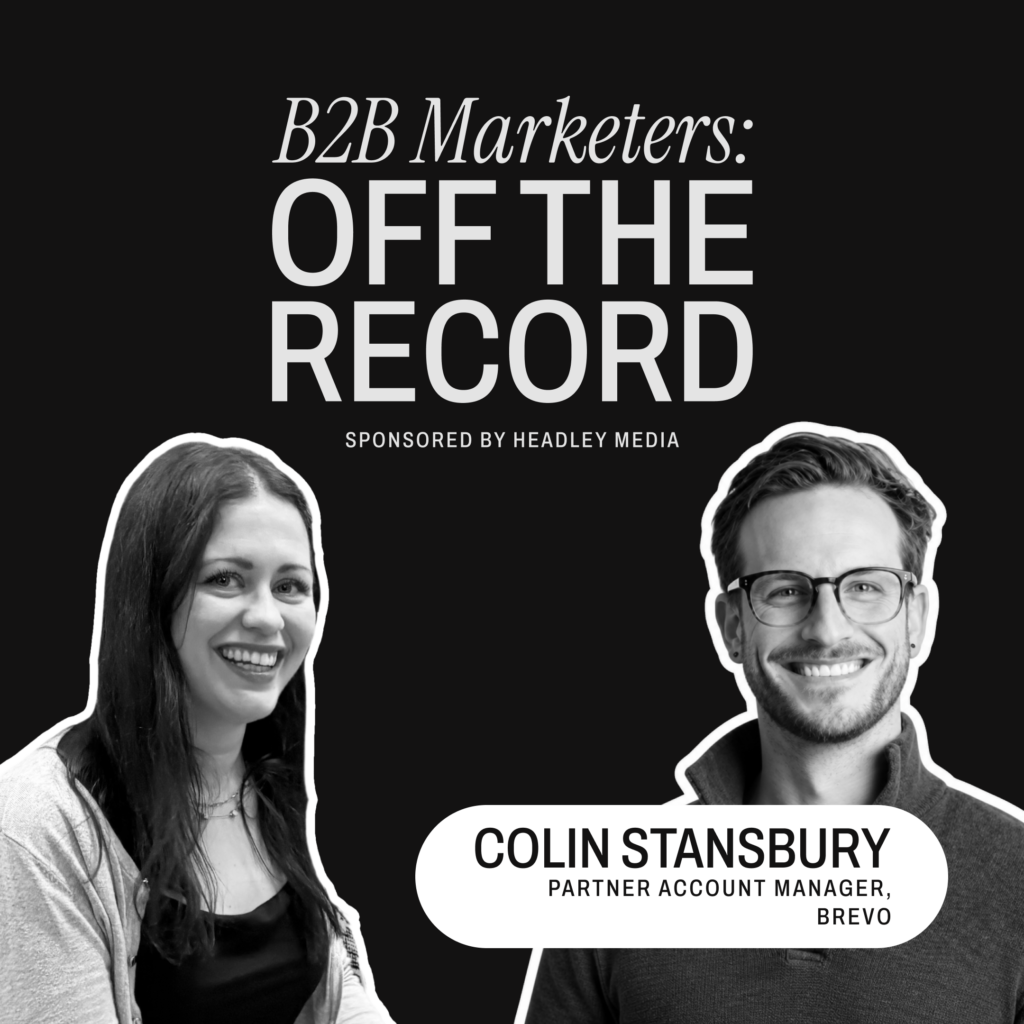
Colin Stansbury, Partner Account Manager at Brevo, discusses the evolving landscape of B2B marketing. The conversation delves into the challenges of B2B marketing, emphasizing the importance of understanding customer needs, and creating meaningful engagement. It also explores the role of partnerships and the need for more meaningful customer conversations.
Takeaways



Chloe Addis (00:51)
So welcome back to B2B Marketers Off the Record. I’m excited today to be joined by Colin Stansbury. Colin is the Partner Account Manager for Northern Europe at Brevo. Welcome to the show Colin, I’m excited to have you on. Could you give yourself a little bit of an introduction?
Colin Stansbury (01:10)
Chloe absolutely delighted to be joining you. Yes, so Colin, I work for Brevo, which is a partner sorry, a customer engagement platform. we’ve been around for the past fourteen years, formerly send in blue. And what we look to do is we look to be able to simplify the way that B2B and B2C marketers reach out to their customers and be able to have meaningful engagements. I spent the last 10 years in software as a service, before that, a professional musician.
and I’ve worked for companies such as in doing things like indirect tax compliance automation, integrations as a service, payments, and now I’m very fortunate to lead up Northern Europe for Brevo. So great to be here.
Chloe Addis (01:53)
Awesome, that sounds perfect. I’m excited to dig into all of that and all of your experience. And one of the reasons why, you know, kind of got you on the pod was your position in partnerships is going to be really kind of refreshing for most marketers that listen to the show. So I’m excited to get into it. Sounds like you’ve had some kind of different experience there, obviously kind of very much in the tech space.
So how did you kind of get into your position where you are now?
Colin Stansbury (02:25)
Well, you know, at the end of the day what I really love about tech is that it’s constantly changing, constantly evolving. And that tech and the customer behavior is actually evolving at I think at a parallel because how we used to be able to go and shop and to be able to, you know, make make purchases is is is mildly different than when we were walking up and down a high street or looking through a catalog. So
you know, even though that I’ve done multiple different types of jobs within different industries and different sectors, what I love about it is it’s always focusing on how data is being used and how that data is being interpreted to be able to influence buying decisions or to be able to support dis buying decisions that have already been made. what’s great about working with something like
with with someone like Brevo and working in the ad and Martech industry is that it’s not a nice to have, it’s an absolute need to have. one of my favorite quotes about marketing is from Absolutely Fabulous where Patsy says, Darling, darling, sales without marketing is like winking at a girl in the dark. You know you’re doing it, but nobody else does. So the ability to
Chloe Addis (03:36)
You
Colin Stansbury (03:37)
be able
To take that at scale is something that that I’m really quite passionate about and I’m excited to share some of my thoughts with you.
Chloe Addis (03:47)
That’s
really funny, thank you very much. I definitely appreciate the AbFab reference. The first time I’ve had it
Colin Stansbury (03:53)
Patsy, darling.
Chloe Addis (03:54)
on the podcast. I love
Colin Stansbury (03:56)
Ha ha ha.
Chloe Addis (03:57)
that. But absolutely, it brings out what we mean by that disconnect between sales and marketing and yeah, sums it up perfectly.
Colin Stansbury (04:08)
Yeah.
Chloe Addis (04:09)
So what’s one belief about B2B marketing that you’ve changed your mind on in the last 12 months?
Colin Stansbury (04:16)
Well, you know, it’s actually been more around visibility that I’ve really changed my mind. because I used to think that if we approved things like attribution tracking and reporting significantly, then we’d really be able to see the whole buying journey. But I’m really much less convinced of that now because like buyers and we we’ve been talking about this for over ten years now, maybe even more, that that B to B buyers are more informed than they’ve ever been.
Right. But now when you’ve got things like AI tools, private communities, and then of course the traditional like peer groups and internal conversations, you know, a lot of that journey really is gonna remain invisible to the marketer, to the vendor, right? So what I’m saying here is that the shift isn’t from like bad data, you know, to to perfect data. But instead the shift really is trying to see trying to see everything
to get much better at understanding the signals that we can see, right? So being able to to read and be useful before someone is ready to raise their hand and say, I’m ready to buy, right? Because that signal is is now really, I would call, you know, the golden goose in what we’re looking to accomplish here. Because w we had a a a panel recently that we did around retention and then the conclusion of that panel, which I thought was fabulous, was that most brands
already have the data, but the real differentiator is whether they can act on it quickly enough. You know, for for example, right? a late message can be bad as as no message. So if like an abandoned cart message arrives days later, or what really irritates me, if if someone gets like a generic follow up to very specific interaction, you know, the business may be technically using its data, but it’s not really understanding the customer.
So I’ve changed the way that I think about like lead nurturing in that way. So that the question is not always how do we convert this person now. Sometimes it is and really how do we remain useful and relevant until the timing is right.
Chloe Addis (06:26)
Yeah, there’s so much of that from a marketing standpoint that’s really difficult to get right. It’s such a huge problem. Data is a huge part of marketing and really easy to overlook, really easy to have different silos working on different areas and different parts of the CRM for different things or even two CRMs, one for marketing, one for sales.
Colin Stansbury (06:54)
dear.
Chloe Addis (06:55)
or more, you know, there’s so many different tech stacks, know, parts of your tech stack doing different things. So having clear data is, you know, is the ideal for most marketers and most teams, but actually getting there is a really tough challenge.
Colin Stansbury (07:16)
I mean at the at the end of the day, gu what we’re not trying to do is we’re not trying to say, look, we want to be spammed. We’re all being spammed at the moment, right? You look at you you look at your your personal email and you just see the amount of of nonsense that comes through that that’s not even relevant, just because once you looked at a once you looked at a website for a pair of, you know, I don’t know, running socks and then all of a sudden you’re being spammed for, you know, leggings or you’re being spammed for, you know, tank tops and whatnot. I I think that
marketers and you know, speaking on behalf of them, you know, they’re and the ones I’ve spoken to just wanna be able to say, I made a decision and it ended up in a good outcome. They don’t want they’re tired of spraying and praying really.
Chloe Addis (08:00)
Yeah, yeah, 100%. And I guess kind of the role there from your side of partnerships is to really, I guess, communicate that across different, you know, different technology and kind of open that space up to help marketers and other functions as well, kind of bring everything together to have kind of a joint view of things.
Colin Stansbury (08:26)
What’s brilliant about my role and and I love what I do is that I get to work with loads of different partners who are the ones who are creating strategy engagement implementation, you know, who are the ones who are actually responsible for how different customers engage with their with their buyers, right? So it means that my conversation isn’t so much of you do you introduce X and you’ll get Y. My conversation is more like, Look, I understand from your point of view, Mr. Agency.
that your reputation is the most important thing and the most important revenue that you can possibly be playing with here. So what I need to do is I need to convince these agencies that my solution and the outcomes that I provide are significant enough that if I am introduced to their merchant, that number one, it’s going to do everything we say it’s do, and number two, it’s going to make them look good.
You know, you you you hear some horror stories about, you know, ISV partners like like like ourselves going into a an opportunity where we’ve been introduced by a merchant and doing a really by partner and then doing a really terrible job. And then that ruins the ability for that partner to be able to increase the rate of recurrable revenue that they have through retainers or projects with them. So every time that I’m introduced to a merchant, it it has to be I have to think about so many different people. I have to think about
Brevo, I have to think about the partner and I have to think about the merchant at the same time ’cause, you know, being the tip of the spear, it means that you always have to be on. Right. And with that, you know, comes a certain level of certain level of, you know, difficulty and also a certain level of confidence that one needs ego that one needs to have in order to constantly do that.
Chloe Addis (10:10)
Yeah, of course. And, you know, it comes back to confidence in your own product and what you’re bringing to that partnership. And at the end of the day, like you said, you’re managing and balancing everyone’s goals and outcomes for the partnership. And it ultimately comes back to trust, which is, you know, the key part of selling and any relationship and any kind of…
Yeah, relationship. whether that’s a marketing relationship, sales relationship, partnership, the ultimate, it’s based on trust, isn’t it? So, yeah, it’s definitely like hyper relevant in this world that we’re in right now. So what shifts would you say you’re seeing in how B2B buyers are behaving?
Colin Stansbury (10:58)
I think I touched on that in the previous answer, the question, in
Chloe Addis (11:01)
in
Colin Stansbury (11:01)
that B to B buyers are arriving later and and they’re more what we would say like pre decided. They they already have an an understanding about what they want and what they need. They’ve done the research, they’ve made sure they’ve looked everything up, they’ve done the comparisons and they already probably have a short list in mind, right? You
Chloe Addis (11:18)
Mm.
Colin Stansbury (11:19)
know, usually when someone comes in an inbound, it’s I wanna look between X, Y, and Z and I pretty much know which one I’m going to be choosing.
But that because that means that then that the first conversation is less about explaining what the category is. It is more about helping the buyer validate a decision to understand what we’d say the you know the the risk of implementation, for example, really relevant, and then also to build that confidence internally. Because I also think that B2B and B2C, those lines
of the expectations, they’re getting much thinner. You know, people
Chloe Addis (11:57)
No.
Colin Stansbury (11:58)
may accept a complicated buying process at work, but they still experience it as as a human, right? As as a person. They
Chloe Addis (12:06)
Yeah.
Colin Stansbury (12:06)
expect to find useful information. They want to explore independently and they want to receive communications that reflect what they’ve actually done and what they’ve actually looked at. So the trigger is really not often we need a new platform. It is
That’s something in the customer’s own sorry, the company’s own customer experience has started to break, right? Maybe something like follow-up is too slow, teams are disconnected, or can’t they cannot scale the way that they need to. I always say that that kind of operational pain is what creates the urgency.
Chloe Addis (12:38)
Yeah. Yeah.
Colin Stansbury (12:40)
because at the end of the day, look, buyers are doing most of the journey themselves, but they are not necessarily looking for less help, right? They want
Chloe Addis (12:48)
Yeah.
Colin Stansbury (12:49)
the they want help on on their terms.
Chloe Addis (12:52)
Yeah.
Colin Stansbury (12:52)
and and at the point where they need confidence or clarity, right? People
Chloe Addis (12:57)
Yeah.
Colin Stansbury (12:57)
people buy from people. We have to always remember that.
Chloe Addis (13:01)
Yeah, 100%. So they’ve essentially done most of the work or the work that they used to, those conversations that they used to have
Colin Stansbury (13:09)
Mm-hmm.
Chloe Addis (13:10)
when they reached the sales team. So now it’s just a lot more specific. So they know what challenge they’re trying to solve when they’re talking to you, but actually they want you to be.
even more helpful than you could have been in the past. They’re like, well, this is my real bug, I need you to actually solve it and to tell me how you’re going to solve it. And like you said, that confidence piece.
Colin Stansbury (13:33)
Exactly. And I don’t know about you guys, but I’ve seen, you know, working at a B to B company, like that the the funnel, the sales funnel that used to be so formulaic over the years has kind of disappeared because you have so many different buyers who come in at different stages now. And
Chloe Addis (13:51)
Yeah.
Colin Stansbury (13:52)
and then what you’ll have is you might in the past you may have had only
you know, someone who is very low on the you know, very low on the list, who understands the problem, who then tries to be able to influence other tech leaders or other leaders within the business that this is something that we need to solve and this is a way to solve it. Sometimes now we’re getting, you know, CTOs, CIOs, chief marketing officers who coming over to us and been like, look, this isn’t working and we need to we would like a we’d like a demo in a in and some costings right away.
And it ca it panics us, you know, as salespeople,
Chloe Addis (14:28)
you
Colin Stansbury (14:28)
as commercial people, because we go, no, how can I, you know, explain the value of this? How are we gonna be able to make sure that you understand exactly what you’re getting out of this? But the reality is is we have to accept now that people are more clued up than they’ve ever been. And they’ve seen, they’ve heard, they’ve reviewed what works and what doesn’t. So when they come to us, we have to stop treating and and I’m not saying everyone does it by any stretch of the imagination.
But we have to assume that people know a lot about what they’re talking about and we have
Chloe Addis (14:59)
Yeah.
Colin Stansbury (14:59)
to ad pivot and adjust to that.
Chloe Addis (15:02)
think the worry there as well for marketers and the people that create the messaging for their audiences and customers coming on, the worry is that they might have missed something. If they’ve been doing their own research or that they’ve gone to chat GPT or an LLM and they’ve got to a certain level, the worry is, I suppose, that they’ve not got.
all of those key messages and they’ve not understood kind of those parts of the brand that you would really like them to. So what would you say is important at that stage? I think, I mean, you’ve mentioned as well, you know, digging into their pain points and really focusing on them. So is that how you’d say kind of you move that forward?
Colin Stansbury (15:50)
I mean, it is always, you know, so very difficult to be able to identify, you know, what sort of triggers that anyone is going to you know to to move on. I guess one of the things that I got taught very early on by a very smart person, one of my one of my mentors when I was in the early in the industry is not look for pain points specifically, but look for a certain scenario and say, What keeps you up at night if this isn’t solved?
Chloe Addis (16:17)
Mm-hmm.
Colin Stansbury (16:17)
What
what what would be the thing that would be the root cause of insomnia for you, you know, i i if this action, if this purchase isn’t being made? You know, and with that in mind, it’s about putting you into that person’s shoes to be able to try to think about, you know, how they operate, how they think, how they were looking to live their day to day. It’s not about what buying what about buying motions or what sort of
buying triggers that you hear. It’s about how is it going to, over the course of the contract and the course of the actual usage of that platform, going to make their life that much easier.
Chloe Addis (16:56)
me.
Colin Stansbury (16:57)
And but sometimes also with that is you just have to let people, you know, do what they want to do. If pe someone’s coming to us and they’re very clear about their expectations about how a sales cycle should work, we of course have to do our best to make sure that
they are getting everything that they need that they think that they need because at the end of the day you can’t if someone doesn’t want to know something, you’re never gonna be able to teach them it, right? But if you’re able to create that human to human relationship with somebody, as many of my partners say, they partners are not caring so much about, you know, specific features and functionality. They just want to work with people because the industry is is potentially skewing to such a way that everything is self-served, that everything is very inorganic.
And trying to being
Chloe Addis (17:43)
you
Colin Stansbury (17:44)
bring back that that that actual connection is something and to make their life easier by and also make their life more enjoyable is something that people want to get on board with.
Chloe Addis (17:53)
Yeah, % I’m hearing that through a lot of conversations and with like, know, you and I talking right now about kind of how things have moved and how they have developed. What do you think is a, what’s the strategic bet you think more marketers and, you know, people in partnerships and sales will need to make over the next couple of years as things continue to change?
Colin Stansbury (18:17)
Mm, strategic bet. I’d say I’d say put a strategic bet on speed of understanding and not volume of activity. Right? So like I’ll I’ll give you I’ll give you some, you know, context behind that. Marketing teams will will need to get better at at spotting intent and understanding context and acting quickly. And
And that might mean using AI and data enrichment and and automations, but I I wouldn’t frame it as an AI content strategy. I think the more valuable use of AI in this particular point is is helping teams i identify patterns, prioritize signals, and and decide what happens next. So you’ve got, you know, the sales
So effectively that you have the traditional sales funnel and you’re starting to get sort of a marketing, you know, a a reading intent signals funnel as well, to be able to work it down in a way that, you know, you be able to to create patterns that will drive people to the right content and then to the right actions with the commercial team, right?
Because it’s, you know, it’s it’s it’s it’s blinkin’ easy, you know, that and and the danger is that, you know, AI makes it simple to produce more campaigns, more content, more messages. So sort of flood the zone as as we would say.
Chloe Addis (19:35)
you
Colin Stansbury (19:35)
You know, but but if the underlying understanding is weak from the marketing team, then we just create more loy more noise at a potentially lower cost, right? So I would say bringing it back to the strategic bet. So I would say that the bet is to build a business that can move from
signal to relevant action quickly while still leaving room for human judgment and human interpretation. Because at the end of the day with that, and AI is of course going to be involved in it, you know, AI should be able to help marketers make better decisions, not simply help them make more mediocre content.
Chloe Addis (20:12)
Yeah, I think that’s something that’s definitely on a lot of people’s minds as we come, you you just see a lot more generated content and a lot more stuff basically, like you’ve explained, it’s spamming it, it’s too many messages, too much content, we’re asking so much of our audience all of the time that…
there’s gonna be like the resistance isn’t there now it’s like as you’re talking about kind of these real relationships and trust all of that becomes much more prevalent much more important as things change.
Colin Stansbury (20:58)
You think about LinkedIn, right? They’ve got, you know, they’re they’re they’re thinking about putting on, you know, the AI generated content, something that’d be able to see if something was just slopped. Spotify,
Chloe Addis (21:08)
Yeah.
Colin Stansbury (21:09)
for example, have just from next month they’re going to put in AI content generated warnings and they are not going to put AI generated content into things like new release playlists.
and they’re going to start letting people know that hey listen a human did not create this. So and with that in mind, it really is kind of like, okay, we know what we want and we want to be we want to feel important. We want to feel special. We want to feel of value in anything
Chloe Addis (21:43)
Good.
Colin Stansbury (21:43)
that we do. And if you just
throw enough crap against a wall to see what sticks as a marketing strategy. And with AI you have the ability and, you know, and and other you know, customer engagement platforms, you have the ability to do that en masse. And that’s not really what we’re looking for here because you could throw as much crap against a wall, but if none of it sticks, then wouldn’t it be better just to take small, incremental, targeted, you know, pot shot pots, you know, pot shots at the wall and s and something actually will, you know, be able to land much
more efficiently and much more relevantly.
Chloe Addis (22:20)
Yeah,
100%. And I feel like coming into this next question, it’s about what teams are doing that you think no longer works. I feel like we’ve kind of almost, we’re already talking about this subject, which
Colin Stansbury (22:33)
Yeah.
Chloe Addis (22:33)
is the automation and relying on content that’s being generated for specific purposes, but en masse that isn’t creating those relationships.
Colin Stansbury (22:48)
It it comes down to what I was talking about with the funnel, right? You know, we’ve behaved and we still believe that the funnel is li linear, visible, and measurable from, you know, first touch of clothes deal, but that’s that’s just not the case anymore,
unfortunately,
Chloe Addis (22:59)
Yeah.
Colin Stansbury (23:00)
because it leads to a lot of habits that really aren’t very helpful anymore. You know, we optimize for lead volume, you know, trust a form fill as intent, you know, send everyone to a similar nurture sequence and assume that a demo, right, is always the next natural step, but
know, as we’ve spoken about, sometimes buyers are not ready for a demo. Sometimes they move past it. They might be on trying to understand they might even be beforehand, trying to understand a problem, compare approaches or or build a case internally. Maybe they don’t want to understand from the technical perspective, but instead on the outcome. So if we force them into a premeditated sales process too early, sometimes we can create friction rather than demand. And that’s where marketing comes in, right? So and this is where we start asking ourselves better questions. Not
How many leads did we generate? It is, did we create preference, confidence, or something like useful progress? You know? And in and instead of and instead of something like how do we convert this person right now? Sometimes it is how do we remain useful until the time is right? How do we remain relevant until they feel like they’re ready to reach out for us?
that retention panel that I just mentioned, one of the panelists was talking about receiving three generic loyalty emails after a single transaction. So it proves, right? It proves one thing. It proves that the company knew technically who he was, but it had not understood what they’ve actually done. And and and B2B marketing really does the same. Someone downloads one report and suddenly receives a generic sequence designed for an entirely different level of intent, right?
So i I just guessed here that to sum it all up is more communication is not the same as more understanding.
Chloe Addis (24:45)
Yeah, I think there’s so much in that. It makes so much sense. We are constantly exposed to good and bad levels of customer engagement and you get that all of the time through your own, as a consumer. You could, like you mentioned earlier, you could be shopping for socks and then abandon your cart and get…
completely different messaging sent to you. And so you know what a bad experience is, or it could be just the barriers that are there. You’re trying to buy the socks and…
they’re making it as difficult as possible for you to enter your card details, you know, and you’re just saying, I just want to buy the socks, you know. And that’s the same in the B2B world. You know, there’s so many things that we don’t realise are barriers because we haven’t put ourselves in the customer’s or because it’s just always been done that way. A lot of it, you know, a lot of the kind of MQL problem is that marketers have been targeted on MQLs instead of targeted on
something
more aligned with the business goals like revenue or like, you know, a contribution. Yeah.
Colin Stansbury (25:59)
Or even or even SQLs or even what’s
the R O what’s the ROI on different activities that you’d be able to put in, right? And especially
Chloe Addis (26:06)
Yeah.
Colin Stansbury (26:08)
for events based marketing, which I would argue is probably on it. We’re seeing it trend up you know, more and more ’cause of people wanting to buy from people. but to your point here is that MQLs are they’re fantastic. Don’t get me wrong, as a salesperson I live and breathe and die on them and I love my marketing
Chloe Addis (26:26)
Thank
Colin Stansbury (26:26)
teams. And I I I wouldn’t
dare criticize the amazing work that they do right there. I would agree to your point there of having their you know, being more flexible with what success looks like from a marketing perspective, I think is something that that could and should be looked at in the in the near future.
Chloe Addis (26:44)
Yeah, that MQL issue is something that comes back to, as you’ve said, it can be tied into, or it can be enhanced with the directive of knowing your audience better.
So you kind of, as you were saying, it’s like, what else can we understand from them at that point in time? Could we ask them any more questions? know, at the point of a download, which you quite rightly said doesn’t mean that they’re ready to have a demo or that they’re ready to kind of, you know, go on and buy something. No, they just downloaded a piece of content, but.
what else are you getting at that moment? Like what environment did they download it in? Where were they? And can you get any more information on what signals are they giving? What they’re giving kind of first party to you that can really help you to identify what else they need at that point, kind of in a more specific way.
Colin Stansbury (27:45)
preach. I mean, yeah, absolutely
right. And, you know, and and it comes down to as well on that, you know, to a to another extent is like the demise of the SDR at that particular point
Chloe Addis (27:55)
you
Colin Stansbury (27:56)
in time because, you know, I know it’s slightly offhand here, but, you know, SDRs when when I we grew up, they they in marketing, you know, were were were ties in anything. And the whole point of the SDR is to be able to take these MQLs and be able to turn them into, you know, relevant you know, relevant opportunities as it go forth. But now, if you’ve got more content out there
And then people get a bit of a fatigue of having someone who just reaches out to you after all of this and be like, hey, I saw you did this. What would you like to know? How can I be of assistance? How can I help you have go into a demo? But if we’re able to, you know, and I’ll talk about this later, but if we’re able to be able to work on that more understanding and less volume here, then you know, we’ll be able to create niche content, thought leadership bits for people that when they read it and pick it up, then it’s a very
more s it’s a much more straightforward conversation after they pick up that piece of content to then it goes from okay, I know exactly because I was talking about a specific problem we’re solving here. So let’s try to have a conversation with you as opposed to a pitch. That would be nice, wouldn’t it?
Chloe Addis (28:59)
Yeah, 100 % I think. Yeah, most people would absolutely rather that kind of feel that there is a relationship happening or that, you know, they’re on the same page and trying to help both solve the same problem rather than, yeah, sitting down for a pitch.
So what type of investment should marketing leaders protect even if budgets are tightened?
Colin Stansbury (29:28)
Anything that keeps the the team close to customers. So things like, you know, customer research, useful content, customer conversations, good data and and and and and the people as well who can interpret all of that. Let’s be honest here. We need we need to protect our marketers, right?
Chloe Addis (29:41)
Yeah. Yeah.
Colin Stansbury (29:44)
Because, you know, w what you guys are capable of doing is is going beyond the pale and understanding what people are actually doing. To my point here about what keeps people up at night, you’re able to
Chloe Addis (29:53)
and
Colin Stansbury (29:54)
understand that more than
a bit of AI content can. AI content is extremely valuable in being able to get eyes on something, but they’re not able to get minds in on something. So so what I would do is, you know, is I would say that a small you know a smaller rel number of relevant interactions is is almost usually more valuable than larger generic ones because, you know, again to my point, we all want to feel special, right? So
Chloe Addis (30:20)
Yeah.
Colin Stansbury (30:21)
when budgets are constrained
the instinct can be, right, to buy more tech or add another program into it. You know, but you know, I mean, Chloe, tell me what you think here in a little bit. But I would say the stronger answer is to fix the customer experience itself. So,
Chloe Addis (30:37)
Yeah.
Colin Stansbury (30:37)
you know, for example, bringing it back to, you know, Brevo and some of the stuff that we do. So for example, a loyalty program cannot rescue a bad experience. But in the same way
No amount of pipeline tooling can rescue a marketing team that does not understand the prospect’s actual problem. So I would argue that we need to be more clever in how we understand the reason that a customer not only engages with our content but actually needs to purchase the product in the first place. So protect the capability to understand the customer. Everything else becomes less effective when that disappears.
Chloe Addis (31:14)
Yeah, I mean, yeah, again, preach, know, this is,
Colin Stansbury (31:19)
Mm.
Chloe Addis (31:20)
this is marketing 101 is understanding your customer, right? And understanding what is driving them. Again, like, you know, you’ve mentioned pain points, but it’s more about, you know, translating those pain points into their day to day and what is meaningful to them. Like you said, make them feel seen, make them feel heard, make them feel special.
because that’s human emotion, that’s the way that we are, whether it’s B2B buying or B2C buying or technology. And yeah, it’s really easy to say, some type of technology, like you said, adding something into the tech stack will solve the problem. But actually, if you don’t truly know what the problem is from the customer’s perspective.
then yeah, you aren’t solving anything, you’re just adding more noise as we’ve spoken about.
Colin Stansbury (32:16)
Yeah. I mean it we’re all we all have a job to do, right?
Chloe Addis (32:20)
Mm.
Colin Stansbury (32:21)
And you know, it’s okay to be persistent in reaching out to people. It’s okay to be persistent in wanting to get eyes on something here. People respect that more than anything. But you know, when you just try to shove it down someone’s you know, shove it down someone’s throat at that point in time, that’s what it all just gets a little bit like, Come on now, let’s just be a little more clever, shall we?
Chloe Addis (32:42)
Yeah.
So what three words at the moment do you think best describe B2B marketers right now?
Colin Stansbury (32:53)
Stressed, broke, and alcoholic. No,
Chloe Addis (32:56)
Hahaha
Colin Stansbury (32:59)
I’d say I’d say something more along the lines of
Busy. Busy and busy. I mean I I I could think of something cleverer, but I’ve never seen marketing teams work as hard as as you guys do at the moment, with budget constraints coming through, with more competition, with more with more educated buyers coming in right here. It makes creating some content that’s actually relevant much more difficult. And of course, as is most
you know, most organizations we’re being asked to due to the you know, the macro economic climate, we’re being asked to do more with less.
Chloe Addis (33:38)
you
Colin Stansbury (33:39)
and that that can cause incredible strain on creatives. I know I’m a creative as well. And the last thing I want to do is be told, why isn’t this happening? Why isn’t this happening? This isn’t good enough. We just want to be able to go out and and make things that people interact with, things that people engage with. So I’d say that busy, busy, busy because at the end of the day
n the the work never stops at the moment. Even when you’re on holiday, even when you’re over, you know, with with your kids, even if you’re on your honeymoon, the work is it’s always there. There’s always something to do.
Chloe Addis (34:12)
Yeah, 100%. And I think that’s, it’s got like more intense, hasn’t it? With AI being able to help you do more. And as you said, do more with less and be able to surface that information that we were talking about. It’s now then working harder to understand what it is that you have to do with that information and, you know, having a louder voice or a clearer voice or a
you
know, something more compelling against the rest of the AI slop, as we’ve called it. It’s that much harder. So busy, busy, busy definitely describes that really well. What is one thing, and I guess maybe like from your role in partnerships, we can change this a little bit, but like what is one thing you wish you could change about marketing if you could, but also, you know, I guess maybe kind of partnerships in that whole relationship.
Colin Stansbury (35:11)
So I would definitely say so it
what I’m about to say is fundamentally different for marketing and partnerships, right? So for
Chloe Addis (35:17)
That’s cool. Yeah.
Colin Stansbury (35:19)
marketing, I would say that I would I would retire and and and and and kill the idea that more visibility automatically creates more understanding. Right?
Chloe Addis (35:28)
Mm-hmm.
Colin Stansbury (35:29)
I would definitely say that while in partnerships, visibility is one of our most important aspects because
You know, what we do is we educate, enable and motivate our partners to be able to have conversations with their merchants about the positive outcomes of our platform. Right. And with that, we tie in so many different stakeholders into that to be able to create a narrative that says, look, this is going to help you do X, Y, and Z. So
Chloe Addis (35:56)
Yeah.
Colin Stansbury (35:57)
whenever I’m out and about, I want my partners to think when they hear or have a conversation with their merchants.
about something, a problem that my product solves, I want that visibility to automatically link to, there’s Colin. He does customer engagement. We’ve got an all-in-one loyalty retention wallet outreach
Chloe Addis (36:21)
Mm-hmm.
Colin Stansbury (36:21)
program that is going to be perfect for what these guys need at that point in time. While with marketing, right? So we’ve got more dashboards, more attribution, more data than we’ve ever had.
But it doesn’t necessarily mean we understand what a customer is trying to do or what a partner is trying to do in that regard. You know, sometimes we’re just trying to be confident in assumption that’s not been tested properly. So I would love to see marketers and and you know people who you leveraging, you know, Martech platforms be more comfortable in saying, This is what we think is happening, this is what the evidence we have, and this is what we have to learn. So the ability to be able to A B test.
certain things at scale becomes incredibly valuable.
And and it means by instead of, you know, marketing being completely reliant on, you know, what they think, which and of course, you know, marketers have got, you know, you know, strong opinions as they need to, because it’s it’s their mouthpiece that’s going out. But it means just spending the time to ask more questions, talking to customers, paying attention to
a a small number of meaningful signals and in and and again what I told about testing, you know, changing actual behavior. I’d, you know, I think we’d all rather see a team act on three good signals than collect another hundred weak ones, right? because I heard something really I mean, this is this is something I really liked the other day. And and it’s and
it was said that the experience itself becomes the market, right? And and by that it means that if the experience is good, customers remember it, come back and talk about it.
If the experience is poor, then no amount of clever messaging can compensate for it. And
Chloe Addis (38:02)
Yeah.
Colin Stansbury (38:02)
and that’s equally true in B2B, Chloe, because marketing should not be treated as a as a layer that decorates a broken customer journey, right? It’s not gonna fix any cracks in the holes. Really, it just needs to help the organization understand and improve that journey wholesale.
Chloe Addis (38:21)
Yeah, absolutely.
Colin Stansbury (38:22)
And th and I’ll get off my soapbox here now.
Chloe Addis (38:24)
No, I like stand on your soapbox. It’s absolutely, yeah, it’s a multifaceted problem, isn’t it, where scale is really important, you know, and the quality of information. And I think that’s definitely come through in our whole conversation is, you know, exactly that you’d rather have.
like
a lesser, a lower frequency of better customer conversations of higher quality information coming into the marketing team and the partnerships and the sales teams to be able to make good decisions off of, from. And yeah, that’s, it’s a real.
interesting and refreshing way to look at things from a perspective that’s just slightly outside, that’s not kind of so blinded by all of the work that marketing has to do or all of the challenges that we are trying to face, actually bringing it back to what’s most important, which again is the human relationships and the trust that is there underneath everything.
So yeah, this has been such an interesting conversation. Thank you so much for joining me. The last couple of questions I have here are about the next guest that you think we should have onto the podcast. do you, can you think of anybody that you think we should invite on that?
Colin Stansbury (39:58)
Yes. I’ve got
Chloe Addis (39:59)
Thank
Colin Stansbury (39:59)
someone great for you. His name is Matt Sandom. He’s the founder at Bespoke, B E S P O Q. they’re a customer engagement and SI agency based up in Aberdeen in Scotland. So what makes him unique is he tends to win a lot on B2B, and where he’s really unique is that he actually joins the board of some of his customers to be able to
Positively influence marketing decisions and outcomes specifically and then and then be able to use his agency to be able to deliver them. So it means that he understands customers’ data and customers’ problems probably better than, you know, a a lot of the guys out there. Not saying that agencies don’t understand their customers’ problems, absolutely, but by being able to sit on a board and being privy to those sort of conversations makes it
you know, really fascinating. So I would highly recommend you reach out to him and get him on.
Chloe Addis (41:00)
100 % I will be reaching out. I’ve never heard of that approach before. It definitely sounds unique, but I can see how it would be really useful to be able to have that level and that not only the influence of course of being kind of peer to peer with the board, but having the understanding of what is driving the business to then help reflect and kind of instill in the marketing that
makes so much sense. So yes, definitely we’ll be reaching out to him. And can you think of any questions that you’d like the next guest to answer, whether it be him or not?
Colin Stansbury (41:43)
I just guess I’d love to be able to understand, you know, what’s keeping them up at night, you know.
Chloe Addis (41:48)
Mm-hmm.
Colin Stansbury (41:48)
understand, you know, point blank, really, you know, what’s stopping them from being able to get a good night’s sleep? Is it related to, you know, the the pressure of getting results? Is it finding new content? Is it not being able to to properly test out their campaigns and and and how they want to move forward? I just love to
be able to understand and d that that level of vulnerability is is is really interesting and engaging, isn’t it? And that’s I suppose what what yourself and what you the you know, the friends of the pod who are listening right now want to understand, right? Is really where can we and then they want to be able to relate to that and then be able to come up with and be able to drive some meaningful direction at this point.
Chloe Addis (42:27)
Yeah, it really is. I think that’s such a great question. And I think one that I’m gonna start like adding into all the conversations that I have, because you’re right, it really gets to the core of why we’re here, why we do what we do, and what is driving you. Something that I’ve learned over the last kind of few episodes or doing this podcast is that everyone…
comes to work with a theme, you know, whatever part it is, it’s not just your role, but it’s what you want to get out of your role. So some marketers are very focused on the human element of protecting the human side of things. Maybe that’s in the face of AI, et cetera, but it’s also, you know, it comes down to being a marketer because of psychology and because of relationships and all of these things that we’ve touched on today.
That’s a perfect question and I think it’s a great one to kind of keep close. But yeah, thank you so much for the conversation today. There’s so many snippets in there and some really good advice and like I said, really kind of a fresh perspective for lot of marketers. So thank you so much for coming on.
Colin Stansbury (43:46)
Pleasure. Thanks so much for having me.
Chloe Addis (43:48)
One last thing, would you be able to tell people where they can find you?
Colin Stansbury (43:52)
Yes, absolutely. So brevo dot com, feel free to grab me. And also if you wanna look me up on LinkedIn, you know, Colin Stansbury slash connections matter. and also if anyone is out and about at an event near you, I’m usually the one of the ones who is is is rather loud with a bright and colorful shirt on.
Chloe Addis (44:14)
you
Thanks so much Colin.
Colin Stansbury (44:16)
Thanks so much.
In this episode of B2B Marketers: Off The Record, Chloe Addis speaks with Colin Stansbury, Partner Account Manager for Northern Europe at Brevo. Drawing on more than a decade in SaaS and his experience working across partnerships, customer engagement and MarTech, Colin explores how increasingly informed buyers, AI and changing expectations are reshaping B2B marketing.
At the heart of the conversation is a simple idea: marketers don’t necessarily need more data, more content or more activity. They need a better understanding of their customers and the ability to turn the right signals into relevant action quickly.
Colin has changed his perspective on how much of the buying journey marketers can realistically see.
Better attribution, tracking and reporting can improve visibility, but buyers are increasingly researching through AI tools, private communities, peer groups and internal conversations that vendors may never see.
Rather than trying to achieve perfect visibility, Colin argues that marketers should become better at interpreting the signals they do have and remaining useful until a buyer is ready to engage. The differentiator isn’t necessarily who has the most data, but who can understand and act on it at the right moment.
Buyers increasingly reach sales conversations having already researched their problem, compared potential solutions and developed a shortlist.
That changes the role of sales and marketing. The first conversation is less about explaining a category and more about validating a decision, reducing perceived risk and giving buyers the confidence they need to move forward internally.
Colin also sees the expectations of B2B and B2C buyers moving closer together. People may tolerate a more complicated buying process at work, but they still expect useful information, relevant communication and the freedom to research on their own terms.
As Colin puts it, buyers aren’t necessarily looking for less help. They want help when they need it and on their terms.
Colin’s strategic bet for the next few years is speed of understanding, rather than volume of activity.
AI makes it incredibly easy to produce more campaigns, content and messages. But increasing output without improving customer understanding risks creating more noise at a lower cost.
Instead, Colin sees AI’s biggest opportunity in helping marketers identify patterns, prioritise signals and determine the next best action.
The goal should be to move quickly from a meaningful customer signal to a relevant response, while retaining room for human judgement. AI should help marketers make better decisions, not simply help them create more mediocre content.
One marketing habit Colin believes needs challenging is the assumption that the funnel is linear, visible and measurable from first touch to closed deal.
That assumption encourages teams to optimise for lead volume, treat form fills as intent and put prospects into standard nurture sequences regardless of where they actually are in their buying journey.
Someone downloading a report doesn’t necessarily want a demo. They may still be defining the problem, comparing approaches or trying to build an internal business case.
Forcing those buyers into a predetermined sales process can create friction rather than demand.
Instead of always asking, “How do we convert this person?”, Colin suggests marketers should sometimes ask, “How do we remain useful until the timing is right?”
More communication isn’t the same as more understanding.
Colin also brings a partnership perspective to the conversation.
When an agency or partner introduces Brevo to one of its customers, Colin isn’t only representing his own organisation. The partner is putting its reputation and customer relationship on the line too.
Successful partnerships therefore depend on trust, confidence and delivering on what has been promised.
That relationship-led approach becomes particularly important as more of the B2B journey becomes automated and self-service. While buyers may research independently, Colin believes people still ultimately want to work with people.
If marketing budgets tighten, Colin believes leaders should protect anything that keeps teams close to customers.
That includes customer research, conversations, useful content, good data and, importantly, the marketers capable of interpreting that information.
His argument is that adding more technology can’t compensate for a weak understanding of the customer. Neither a loyalty platform nor another piece of pipeline technology can fix a fundamentally poor experience.
A smaller number of relevant interactions can therefore be far more valuable than a large volume of generic ones.
Colin’s overarching argument is that marketing cannot be separated from the experience a company creates.
If that experience is good, customers remember it, return and talk about it. If it’s poor, clever messaging can’t compensate for it.
For B2B marketers, that means marketing shouldn’t simply be a layer placed over a broken customer journey. Its role should include helping the wider organisation understand and improve that journey.
As AI makes it possible to generate more content, collect more data and automate more interactions, the competitive advantage may come from doing the opposite of simply creating more: listening more carefully, identifying the signals that matter and responding in ways that make customers feel understood.
Ultimately, Colin’s message is that better B2B marketing comes from more understanding, not simply more activity.
Colin Stansbury is a partnerships and commerce leader with a passion for building meaningful relationships and creating opportunities across the eCommerce and MarTech ecosystem. Currently at Brevo, Colin has built his career around partnerships, commercial growth and the belief that great business starts with great connections. Known for his infectious energy and people-first approach, he brings plenty of personality, experience and straight-talking insight to the world of B2B.
In this episode of B2B Marketers Off the Record, Freya Ward interviews Niall Ratcliffe, CEO…
In this episode, Simon Gould shares his extensive journey in digital marketing, emphasizing the transformative…
Conor Bant, Head of Media and Performance at Fox Agency, discusses the evolution of B2B…