

S02E03 – Niall Ratcliffe – B2B Marketers: Off The Record
In this episode of B2B Marketers Off the Record, Freya Ward interviews Niall Ratcliffe, CEO…
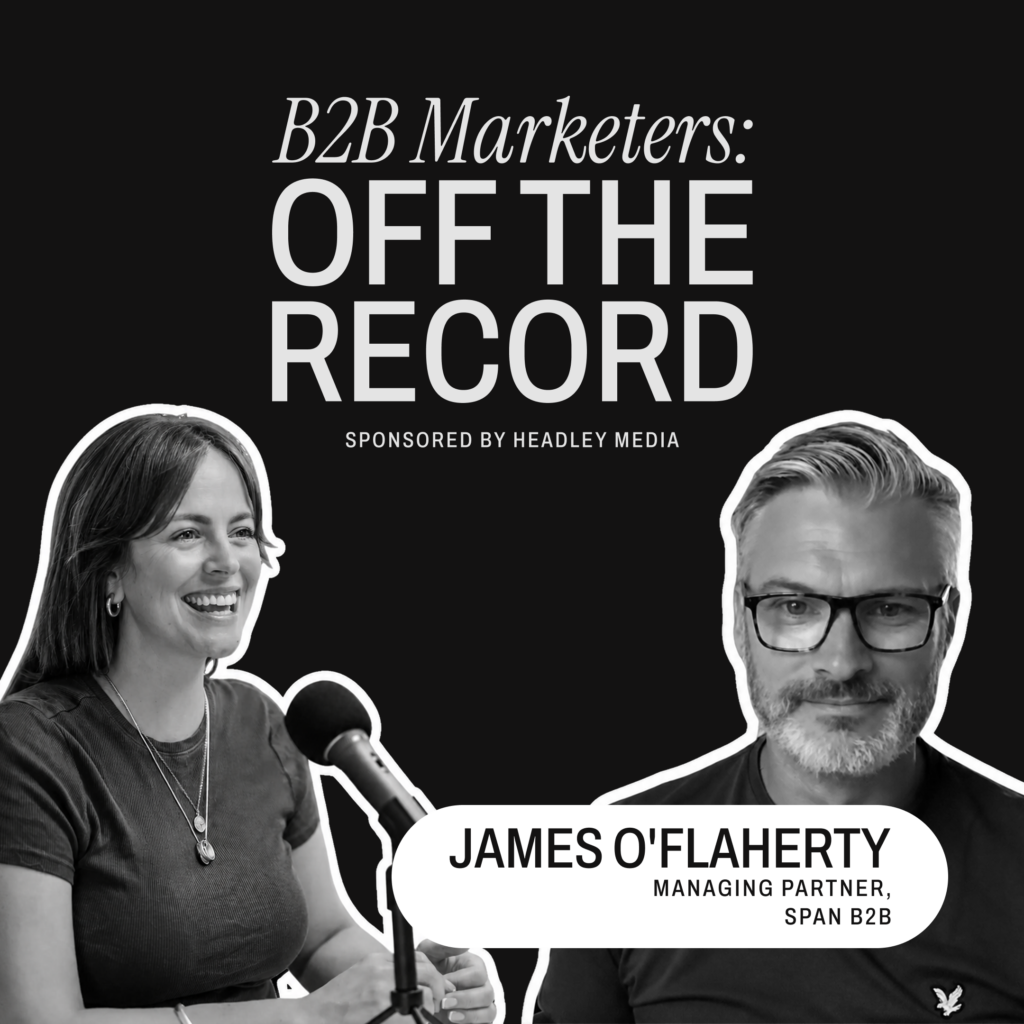
"You can automate as much as you can, but once those foundations are there, you have to be like: how do I, as a human being, help my business connect to the other human beings?"
— James O'Flaherty, Span B2B
The conversation covers the introduction to Span B2B, the evolution of B2B marketing, the importance of human connection in marketing, and advice for B2B marketers. The conversation delves into the challenges of success-reporting and storytelling, the dynamics of agency-client relationships, the evolving agency model in B2B marketing and the need for naturalistic communication in B2B marketing.
Takeaways
Chapters



James (00:00)
worked with a couple of our clients and got really deep into the the guts of their data as well and it’s this gap between MQL and SQL or MQL and S1 or whatever it is that exists and that that’s the one
thing that keeps getting bigger and also the thing that’s getting smaller is the total order value.
So customers may maybe they’re learning how they buy from how they buy agencies because they’re beating up their clients and their clients are beating them up on rates. And that’s having an impact on the total order value as well. So there is literally every single pressure that could exist on that selling process and it’s exacerbated by everything going on in the economy and technology and all of those things. So I think when you actually get to the point of like the the sells the sales
part of it, you have to have given all of these people the really specific the one the one line elevator pitch, I need this product because it will do this for me
Freya Ward (01:15)
Welcome to B2B marketers off the record. I am Freya and I’m joined by James O’Flaherty who is managing partner at Span B2B. It’s a new type of agency. James is going to introduce himself, but before you do James, we have worked together for many years through various roles, geographies, clients and campaigns. And it’s a pleasure to have you on the podcast.
James (01:39)
Thank you very much. Lovely to be here. And I and I have actually been watching religiously this so far, so I’m really, really excited to be here.
Freya Ward (01:47)
Amazing. Thank you, James. I’d love it if you can introduce yourself to our listeners and maybe explain a little bit about Span B2B.
James (01:54)
Yep, would love to. so my name is James. Nobody can say my surname, and you did a really good job of it by the way, but like O Flagherty or O Flati or Oflagerty or anything like that.
Freya Ward (02:06)
I’m
James (02:06)
so I am a managing partner at Span, like you like you mentioned. I’ve only been at Span for a number of weeks now. so really excited to get going with that.
Previous to that I was at a bunch of media agencies, Carat, Starcom, all the usual guys. and then I went to Enigma Marketing, I went to Australia and set up the business there. and then when Just Global acquired us, I was lucky to work for them as head of strategy, head of growth. so yeah, that’s that’s a bit of my background. that’s my LinkedIn profile anyway. I am more interested
Freya Ward (02:42)
you
James (02:43)
than that, I promise.
Freya Ward (02:45)
You
definitely are. As someone who has worked with you for many years, I can vouch for that for sure. Before we dive into the questions on the podcast, we’d to play on little bit of nostalgia. So what I’d like to ask is, tell me you’ve been in B2B marketing for many years without telling me. The example that I’m going to give today is mail merge. Back in the days of mail merge, love it or hate it, I actually miss it to a degree. What would yours be, James?
James (03:11)
Ooh. I think when I f my so my first job was at just media, and I was a media exec there, and the big thing for us was to get the belly band on the grocer. So that was like you
Freya Ward (03:23)
Sorry.
James (03:24)
I well no no no, it’s nothing rude. It was just like it was a magazine and it used to be like you used to get the belly band wrap on it.
Freya Ward (03:31)
See.
James (03:32)
and you would have to book it like eighteen months in advance. It was the big th so if you’re like, I don’t know, the the the head of marketing of I don’t know Cadburys UK, that was the thing to have that. So yes, I guess that’s it. So I know the dimensions, the specs, the print rounds, all of that kind of stuff for a belly band for the grocery. So please don’t test me, I’ve said it, but I’m not sure I actually do. But yes, that
Freya Ward (03:52)
You
James (03:54)
was my that is my 2007 self.
Freya Ward (03:57)
I absolutely love that. Well, if it’s anything, B2B marketing is cyclical. So if it comes back round again, we know the guy to go to for the belly band measurements.
James (04:05)
Thing they’re probably gonna have to call it Yeah, they’re probably gonna have to call it something different to a belly band now. I don’t know what it’ll be, but yeah.
Freya Ward (04:12)
So you mentioned that your first role was at Just Media. Tell us a little bit more about how you started in the B2B marketing landscape.
James (04:20)
yeah, and I was thinking about how to answer this because it’s actually I sort of fell into it. I guess like most people I fell into it, but I left school when I was eighteen. I didn’t work hard enough at my A levels, so I had to go get a job.
So I got a job as a technical apprentice at Reuters and I was the first I think I was one of the first apprentices they ever took on in like 150 years. And it was really cool because you get placed around the the business and I’m like, I want to be a writer, I want to be a journalist. So they put you in the newsroom for about six minutes and then they go, right, that’s enough of that. Now you’re going to field sales. Then you’re going to technical. So I spent three years at Reuters actually like fixing multiplexes in in store in server rooms all over the city.
and then I ended up in IT for like six or seven years and I came back to the UK after a bit of time in Australia and I was like, I really want to do something I actually enjoy. So there were these publishing jobs, company called CMP who are by UBM. I was in the interview, I’m like, okay, I’m in a tele sales interview, I didn’t realise this. And I ended up selling recruitment ads for about 18 months. That could have been another one of my B2B I I can sell you a half page in construction week if you like. so I ended
up doing that and like through a series of the right connections I ended up getting the job at Just Media and they were a really cool media agency to work with like very B2B and since then it’s just been like a progression through a whole bunch of agencies working with some really cool people and yeah I I fell into it and I still I think like the lot because the last for a period of time last year I was consulting I was like what do I consult? I was just like it’s just a lot of stuff that I’ve done and there’s no kind of specific role but you
Yeah, it’s it’s an accumulated experience base, I would call it.
Freya Ward (06:06)
I love that though, and I think I probably say this on every episode, but I want to reaffirm it, the amount of individuals I’ve spoken to that tripped and fell.
You know, they fell into this space. And I think I’ve had one, maybe two conversations with people that were like, I went to university and I did business and marketing and marketing was what I always wanted to be in or where I wanted to be. Everyone else, the vast majority, either someone opened a door for them. They did an apprenticeship that gave them exposure to multiple departments and they were like, actually, I quite like this one. Or they saw someone else doing something cool and they thought, hold on a minute, I could do something like that. And then they uncovered the
the psychology and everything else behind it and that’s where it’s stuck.
James (06:50)
It it was only when I was about thirty five that I accepted I would never play up front for Tottenham. So I had to so I had to find something else to do.
Freya Ward (06:59)
you
James (07:00)
but like yeah, I I but I’m I’m really I I actually like not to be too reflective, but like in twenty years I’ve met so many good people and done so many cool things and been all these places and yeah, it’s given me a really good life, so I’m really happy what what what I’ve kind of got from it.
Freya Ward (07:17)
Yeah, that’s amazing, James. And I think…
The B2B marketing, especially in the tech space, it is so incestuous and everybody does know everybody, but there’s something really special about that as well.
James (07:28)
Mm.
Freya Ward (07:29)
yeah, when I reflect on my journey in this industry, one of the things that always comes up is the people. And it’s the people that you’ve worked with for a long time or you you bump into at an event, you might not have seen them for a couple of years and there’s so much to be said about that community behind everything within the B2B tech space, especially within the marketing sphere.
James (07:49)
Well yeah, and we work in a very t like I mean, technology is obviously one of the biggest sectors in B to B and technology is the thing
changing the industry, changing the world, all that kind of stuff. But I think like what I’ve found certainly the last couple of years is that the relationships you have with people that you like and trust and all those kinds of things. They’re so beneficial because there’s somebody to listen to you or somebody to listen to and be a shoulder all that kind of stuff. But also they are your professional network and they will help you. It’s not like a a c it’s not a commercial or a transactional thing, but the thing that I
I’m finding and I know we’ll probably talk about this a bit later as well, is that the relationships you build are the things that you sell on. So all the technology and all the programmatic devices that we use in the world, everything that we end up doing is still to basically help the companies that we work with to have those sorts of relationships with the people they want to sell to. So I think this is this is one of those things where I’m like, it’s it’s just a it’s a it’s a brain worm in me about like how do we actually make that a
a thing that we sell as a service. and it’s really difficult but first
Freya Ward (09:02)
Mm.
James (09:02)
of all you just gotta be interested in other people. and I’m really interested in other people.
Freya Ward (09:08)
Yeah,
yeah, I completely agree. So the market has changed quite a lot, think even more quickly in the last sort of 12 months, two years, especially introduction of AI and everything else. Are there any beliefs about B2B marketing that you’ve changed your mind on in the last 12 months?
James (09:29)
Yeah, I mean every every three minutes I change my feelings on AI.
Freya Ward (09:34)
Yep.
James (09:35)
so I go from my granddad to my grandson in about six seconds and I’m just like there’s so there is so much value to it and I honestly I organise my life through it and it you know, I know you were talking with Tony last week and I think he was saying similar things about it as well. Like the ability to make the mundane stuff go away is awesome.
And I also think the ability for it to make you dumb is exponential. And I and I’ve been really working hard recently to be like, I want you to do this, I don’t want you to do this, because I have to do that. and it’s just it it’s I think that’s obviously reflected in B2B in a in a kind of a a greater, wider tranche of things. I think like going back to the thing we were just talking about.
the relationship piece. Like we’re not in B2C, B2B is very relationship based. And
I kind of come back to that thing that the technology is great to be able to give you the air cover and the data and the intelligence but I don’t think the fundamental changes which is how good are you at talking to someone who might buy your product in a convincing way and then how good are we as marketers? Like the clue is in the name, we’re there to make markets. So we have to say to people, We’re your kind of business, we’re your kind of brand, you should be interested in us and then this is the product and this is the solution for you.
And this is where again I’m wandering all over the place, I know, but like our job is to get people in front of other people, and marketers have this habit. It’s almost like this I’ve got to prove that I can do everything because otherwise you won’t buy me and you’ll think I’m rubbish. But like, we’re not there to sell, we’re there to enable sell, and it’s getting people to that point in time. so yeah, I’m not answering your question, but I just think like that’s that that constant like is it changing?
changing enough or is it changing too much? But the fundamental thing is does that guy or does that person talk to that person, does that make sense when they actually have that connection? Like that’s that’s the job
Freya Ward (11:39)
Yeah.
James (11:40)
work and that doesn’t change.
Freya Ward (11:43)
think you are answering my question because my question was, are there any beliefs about B2B marketing that you’ve changed your mind on in the last 12 months?
I guess your answer is yes and no. There are, there are things I’ve changed my mind on. change my mind on AI all the time, but actually what’s really important and what I hear in what you’ve just said, James is the fundamentals remain the same and the human connection remains the same. And actually maybe we’re all getting a little bit carried away in the hype of how much everything is changing when actually let’s strip it back to basics. Marketing are here to enable sales. Marketing are here to bring the customer to sales or
to a point and sales are here to build that rapport and that relationship and sell. Does that summarise?
James (12:27)
Yeah. That’s
that’s it. And it also it also makes me feel like I did do a good job of being a consultant for that period of time. If I was managing to answer your question with yes and no, like I I I was I’ve obviously learnt a lot in the last year that I didn’t even realise I learned.
Freya Ward (12:43)
Definitely. So let’s talk about kind B2B buyers. What are you seeing change in the B2B buyers from Span B2B’s point perspective, from the consultancy work that you’ve done in the last year and the marketers that you’re working with? Or maybe the questions, what are your clients seeing change in B2B buyers?
James (13:03)
Yeah.
So there’s some obvious things and you know, you can find an infographic on LinkedIn for most of this stuff around there are more people involved, the buying cyc the buying stages take longer. But then we’ve also looked at some stuff around like some Forester and some Gartner insights and we’ve
also worked with a couple of our clients and got really deep into the the guts of their data as well and it’s this gap between MQL and SQL or MQL and S1 or whatever it is that exists and that that’s the one
thing that keeps getting bigger and also the thing that’s getting smaller is the total order value.
So customers may maybe they’re learning how they buy from how they buy agencies because they’re beating up their clients and their clients are beating them up on rates. And that’s having an impact on the total order value as well. So there is literally every single pressure that could exist on that selling process and it’s exacerbated by everything going on in the economy and technology and all of those things. So I think when you actually get to the point of like the the sells the sales
part of it, you have to have given all of these people the really specific the one the one line elevator pitch, I need this product because it will do this for me
at this
at this rate or whatever it’s gonna be. And I think like it’s just making sure that that personalisation is specific, but it’s also personal. and again this is where the technology can sometimes be a little less personal than it needs to be. I’ll go back to it. I think our job’s still to warm salespeople. and yeah.
Freya Ward (14:41)
Yeah,
I think it’s a really good point and I think there’s…
There are so many negative things that are happening, like you said, Elongated sales cycles, MQL to SQL is taking longer, value is down, B2B buyers more educated, it’s becoming harder to get in front of them, you know, more channels. Does that present opportunity or not? But I think as marketers, everything presents opportunity, right? Because it’s not like we don’t know these things are happening. So MQL to SQL is getting longer. So how can marketers get closer to that SQL, but also keep the lights on over here and have that top of the funnel still coming?
through the opportunity around kind AEO and everything else. That’s a completely new channel and a new opportunity for us. So the fundamentals remain the same and in these changes and what could appear quite negative within B2B buying cycles, I think it presents us with more opportunity to be creative, more opportunity to get in front of them.
James (15:38)
It it it presents the value of brands.
front center and like you know I I’ve seen I w I worked with somebody a couple of weeks ago they created like two hundred pages for their website in about three hours and it was basically to feed every single query that might exist if somebody’s searching or if somebody’s in an LLM or whatever it’s gonna be. And yes you can get that level of content and there is so much content now. Like there are so many words and there are so many videos and there are so many pictures and like as good as the
LLMs are they still gotta like figure out all of that stuff and I can’t remember where I saw the stat recently but it’s like nearly two-thirds of what bends their recommendations are brand so it’s like you know are they showing up on third party sites are they getting good reviews like these are the things that so you you you still need to focus on your product and doing well by your customers because ultimately that is your brand. If if all of if all of this content is basically there to be surfaced to go like these are the three companies you should
work with next year with this particular s problem that you’re trying solve. But brand is the solution and I think for marketers we really have to push
P clients we have to put we have to push ourselves as well because there is this exponential ability to track and report and measure. and it’s always easy to go right if I can track and report and measure it, then I can prove that I did a good job. So I’m gonna do that. The the the big thing to track and report and measure is the impact of brand, and like this is this is just this ongoing thing about is the value of branding B2B blah de blah de blah. But it really is that more than ever. So how do you say
that th how do you reach people in a way that actually connects with them? Because that’s the way that you’re going to influence the influences, that’s the way you’re going to influence the algorithms, that’s the way you’re going to grow your your your business. and you then kinda go from you have to be really good at telling a story, but you also have to be really good at delivering one. Those those are the two fundamentals.
Freya Ward (17:41)
Yeah. Yeah. So what’s a strategic bet then that you think more marketers are going to have to place in the next couple of years? Brand?
James (17:51)
so I think well again, LinkedIn. it’s a necessary evil in our lives, I think. but there’s a load of stuff on there recently that I’ve you see about, you know, tomorrow’s CMO is running five hundred agents. They’ve got three people and they’re basically just pulling the strings and Claude (cough) a CMO is running all of this.
I think it’s more important than ever that CMOs, whatever they’re hearing or however they use the technology, but that that strategic shift needs to be how human can you be, how empathetic can you be, how persuasive can you be? Because ultimately it all comes down to that judgment piece. And to be a really effective marketer in a really crowded market where returns are harder to get, where there is more disruption in the market, where all of these things that exist, you
have to like show up and be really really empathetic and empathetic to the people around you, empathetic to the customers, empathetic as a brand, because those are the things that are actually going to get you noticed. and it’s it’s it’s sort of only a matter of time until all of the digital platforms we use and all the technology we use to target people are just as distrusted as the media or in the governments that people like zone out of their heads. So I think I think the biggest thing is yes have a technology platform and solution layer and automate as much as
you can and you still have to have at the heart of it you have to work harder than ever like once those foundations are there you have to be like how do I as a human being help my business connect to the other human beings so it sounds obvious but I see it every day is that like you’re losing that well we’re not losing it because I know there’s a lot that we’re gaining but there is that capacity to lose that basic humanity that’s meant to be in the middle of all of it.
Freya Ward (19:46)
I think that’s… No,
James (19:46)
Is that too flippant or is that too grand? I don’t know.
Freya Ward (19:50)
no, I think it’s human to human at the end of the day, isn’t it? Like if we break it down, I don’t want to introduce another category, but human to human, human to human selling, human to human…
There’s been a lot of talk on this podcast actually with other guests about emotional marketing and how, you know, how important emotional marketing is now.
James (20:13)
Yeah.
Freya Ward (20:14)
Because yes, you need to do all of the things to serve the discoverability and everything else, but actually having empathy in your artwork and your creative, having empathy in your messaging, having human emotion in, and that’s not to say,
the classic cyber security, hoods up, threat, you know, that is an example of emotional marketing, right? I’m not saying we should carry on doing that. I think that’s had its time potentially, but that emotional piece and that human to human piece, that’s where your brand starts standing out. And you can gain sentiment through discoverability through,
Like we were saying earlier, your customer reviews and all of that side of things is so important. But I think what I really like about what you’ve just said, James, is not only the external facing empathy, but actually as a CMO inside of a business, you need to display that empathy to your colleagues, to your team, to your peers,
What’s one thing that you think then that B2B marketers should stop doing? Maybe it’s something that they’re still doing out of habit or something that is no longer working. What would be your advice?
James (21:23)
I think one of the big things that I notice, and it still amazes me actually, is the way that success is reported. And we have all the data in the world, but not all of the insight.
and that ability to actually tell a story through the information that we’re presenting, I think it does end up… It’s kind of… I think it’s a reflection of just where things are because people are obviously a little…
Panic is the wrong word. Panic is also the right word about where they are with their jobs and with their business. So the constant thing is like, need to prove that I did it because that’s the most important thing. And then it’s like, and now I need to prove whether it works or not. And doing it is like impressions and clicks and leads and like the basic stuff. And the insight is that these seven people read these three things about these two topics. And then our sales guys spoke to them and it’s just telling that
story a little bit better through the data that is available to us now. And it’s not like everybody doesn’t know how to report. It’s not that at all. it’s, I think it’s still kind of, it’s almost the secondary element because I think their peers outside of marketing are used to receiving information in a particular way. And that makes it hard. And it’s the same as, you you had Mike on a few months ago for a procurement.
like it’s the same when it gets to procurement it’s like well what’s your hourly rate and like what’s the business outcome that you’re looking for so those are the sorts of things I think that are still a challenge and it’s just almost that it’s that education of the rest of their business to how we’re going to tell you what we’re doing rather than what you’re going to expect to get to prove that we’ve done it that’s I think that’s that’s kind of it in
It in essence, and I’m sure there are layers to it, and it’s very easy for someone in an agency or outside of a business to say, oh, why don’t you do it like that? And I know that there’s a million pressures on these people, and they’re just doing what they have to do. that would be my, do that anymore.
Freya Ward (23:37)
Yeah, it becomes habitual, doesn’t it? And I think you’re so right, James, like it’s really easy on the outside to say to challenge and that’s that’s half half of the reason I believe that you speak to external voices, right? When you’re inside of a business, you’re sometimes blinkered and you need to get that perspective on what we should be doing differently or how we should be communicating differently or whatever it might be. But
That is a whole transformation as well, isn’t it? Because as a marketer, we know that we need to be bilingual, I like to say. We need to be able to speak multiple languages. We need to be able to speak C-suite. We have to be able to speak stakeholder. We have to be able to speak customer. We have to be able to speak sales, if you’re in a marketing position, and of course, speak marketing as well.
So we know that we have to be bilingual, but we all fall back into the same habit of measuring on those same metrics and those metrics don’t no longer necessarily determine outcome. And they’re a contributing factor. Of course, I work for a lead gen company, a volume of leads is a contributing factor to an end result, of course, but talking about them in isolation and talking about them as though they’re going to, or impressions or clicks or whatever it might be.
Is your advice that they start speaking in outcome, in business outcome? Or have I understood you correctly?
James (24:55)
But
yeah, I think it’s showing why you’re doing something and then the implication of that.
you can tell that story through the reporting that you put together, just as well as you can tell it through a strategy document. So I think that’s one thing. But actually something just triggered in my mind, I’ve got a question back to you on this,
Freya Ward (25:14)
Go for it.
James (25:15)
because I’m talking about how if you are consulting a business, whether it’s as a loan individual or as an agency and you’re providing data and they’re like, we need it in this way, in this fashion. And it’s almost like they’re not listening to the thing that you think is the important thing to hear. What about when your work
with an agency because I bet there’s a million times when it’s like well we bought this so we want this but all of that insight do you find that the agency hears what you’re saying as well do you find that like the value that you’re trying to create by giving them additional data is that being consumed or are they just focusing on the thing they bought?
Freya Ward (25:53)
It
varies in all honesty, varies agency to agency.
don’t want to get myself in trouble here. But if I’m speaking with one agency, for example, may just purely want the factual information. So they just want to know how many leads are delivered each week? What’s the pacing? Are there any problems? That’s it. And then we’ve got other agency partners that will utilise all of our understanding and experience of our audience, right? So they will come to us and run workshops. We will run workshops for them about
hidden buyers, persona mapping, ICP engagement, if it’s emerging markets, what’s going on in that market, what could be a priority for that ICP, all of these things, because we have that rich wealth of data. And it varies agency to agency. I would say more often than not, agencies are working with so many vendors and providers that they…
don’t want all of that intelligence because it comes through in 50 different formats, right? And then they’ve got to try and articulate it and generalize it and group it together to present it to the client. But when we work with clients direct, they really value the quality of our insights. So bit of a woolly answer for you, but it varies.
James (27:08)
No, that’s why I’m will put the links to the agencies that you don’t like in the comments of this. But but I also like I suppose the thing that I’ve had the last year is as well that perspective, just not being part of a business for a long period of time. It also meant that when I spoke to somebody like yourself or anyone else, you know, providing a service and being able to provide over the top services and insights and data and things like that. I’m really trying now to carry that into
a job again, because you do get into this place. And I guess this is why going back to like the reporting piece internally at clients, you have a limited amount of brain space with the people that you’re telling this stuff to. So you have to be really, really specific about it when you’re in that environment. But I think the thing that it almost conditions you into when you’re in the middle of all of that chain of things is you just want the thing you said you were going to do to give the person who
or might not be happy with you if you do or you don’t do it and you don’t look at that value so I’m really trying my very best now to like give everybody we work with from partnership perspective the time of day to actually go for all this if this does this and these are the three things it’s amazing what you learn when you listen and it’s amazing what I wasn’t learning because I wasn’t listening and like it’s a it’s a life skill that I’m trying to relearn I think is just hearing other people and all the ideas they have and all the cool stuff they do.
you
Freya Ward (28:38)
I think it’s amazing the perspective you can gain when you can step out of the hamster wheel, right? And you can kind of go, actually, there’s some real value in a lot of this. But it’s completely understandable. You know, the agencies that I mentioned that just want us to deliver on what we promised we’ll deliver on, I get it. Like I completely understand. I come from the agency side prior to moving over to supplier side. And I understand.
It’s a time thing, it’s a capacity thing, and we don’t expect them to be experts in every part of the Headley Media portfolio. That’s our job. But what we would like is a seat at the table or an invite every now and again to…
break down exactly what success looks like because we’re all just trying to do a good job, right? We all want to do the best of our, the best to the best of our ability for the agency, for the client, for, and so on and so forth. So treating it in a true partnership, I can speak on behalf of all vendors and say, thank you for carrying that forward, James.
James (29:32)
Well, thank you in advance, but caveat, maybe
I won’t. But no, I really want and I did like I kind of said what I was doing on the post last week. And I think with the third of the three points I was making was like, we want to work as a partner to your part to our partners, rather than we bought this thing from you. Have you done it? And it’s just it’s just adding the value and passing that value on.
Freya Ward (29:58)
Yeah, I appreciate that.
So James, your experience is slightly different to some of the other guests that we’ve had on B2B Marketers off the record so far, in the sense that you have a wealth of experience on the agency side, working with B2B Marketers across a variety of different agencies throughout your career. So I want to ask you a slightly different question that I think will help our listeners. What is one or a few things that you think stakeholders or B2B Marketers should understand about the agency?
landscape or the agency model.
James (30:33)
Okay, well I think before they talk to an agency, think they need to think about one thing. it’s like RFP or whatever, I think they need to think about what they actually want an agency to do for them. Because if it’s like services, you know, if it’s buying paid search, then why are they not enhancing it or automating a lot of it? Or if it’s systems that they’re looking to build, how do we build something that goes right across the buyer layer? Like why are we not already building that internally? If it’s the thing
that I think they really want, which is the ideas and the kind of the capability to turn their brand into a brand that stands out, whether it’s at a brand level or demand level, ABM level, CRM, whatever it’s going to be. Then they’re buying ideas. And I think the thing that has become too commoditized in some of the larger groups is that piece. And it’s become commoditized because I think from a kind of an ownership structure, there is demand on businesses.
to make a set growth profit every single year that puts pressure on businesses and they strip layers and then you end up with people who are a bit frazzled and look every agency’s frazzled let’s get that right straight away so I haven’t got a solution to that right now but I wish but I mean I’m 23 but like but
But I think the big challenge that I think we find, or I feel, is that you want somebody to come in and perform marketing services for you, whether it’s strategic services, or creative services, or activation services, whatever it is, they have to have that like judgment layer above whatever they do.
And you want people who are really passionate about it and everyone’s passionate about it. That’s why they’re doing the job. But you want them so like we are marketers. We want to succeed. We want to be your partner. We want to do this for you. And they have to also feel invested in why they’re doing it on the other side of things. And that’s why like not to be too pitchy about it. But that’s why we built the agency that we built, because we really believe if you put the marketers at the center of everything, the people who have the expertise and the
kind of the care and the love of the craft. And they’re the ones working with the clients and they’re also the ones working as a business. Then the business is structured around what clients need and you still need, we want like a fractional CFO and we want people who can help us from an operations perspective to make sure we don’t lose cash because obviously that’s not smart. But we want the work to be the center of everything. And I think before a client actually goes briefing, don’t think about like my comfort zone is these people have 200 people and they four people.
here and seven people there and they sell these three sets. Like who are the people you’re actually going to be trusting to help you do your job better? Because if you’ve got that relationship right, everything else will work. But if you get that wrong, then you’re basically in for a long 12 months of realizing you’re with the wrong partner and you need somebody else to come along. So that would be my yeah, in a a as short a period of time as possible. I hope that makes some degree of sense.
Freya Ward (33:48)
It absolutely does.
And I think it’s the same across so many different industries as well. You know, it’s very relatable, especially on the lead gen side of things when there are people, people I think often make decisions because they feel they feel I want to partner with this company because they are big or they’re one of the top five or they’ve, know,
actually who are you working with and what is the motivator behind that partnership and what is that skills and expertise and I guess this comes full circle back to some of our earlier answers you know if you think
We’re advising B2B marketers here about decisions for their marketing efforts. But if you think back to what we were saying earlier about target audience and how do we build relationship with them, it’s human to human. It’s connection, it’s relationship, it’s all of those things. And I think one of the key things when a B2B marketer is evaluating an agency is knowing who you’re working with, understanding who those individuals are, what gets them out of bed in the morning, you know, what motivates them and are they going to be as passionate about your campaign,
your whatever it is, your partnership, as you are. Because that’s really where your investment should be, right?
James (34:58)
Exactly and I love the fact that like and I’ve had this pretty much my whole career working with people who are just so invested in the work and I think the thing that I want for what I do in my future as well as the business I now when we’re part of like
I want us to always be invested in the work and invested in our business and invested in our client, each in equal part, because if you can do that, you will do a good job, you will make money and you will be happy. So like
Freya Ward (35:27)
Yeah.
James (35:28)
that’s the focus.
Freya Ward (35:31)
Excellent, thank you James. What’s one thing that you wish you could change about B2B marketing?
James (35:39)
Well, you so early you talked about being bilingual and speaking to the C-suite and I would love to change the language of B2B marketing, which as an English A level, I mean, that’s the only A level I finished. So I’m going to hold on to it. Right.
Freya Ward (35:50)
Yeah.
James (35:51)
As an English A level student, I’m like, what does driving success and ramping up and what did why do people not talk English anymore? And I find like, I’m really trying my very best. Like when you write a website copy, God, I sound like that, don’t I? And you just scrubbing stuff out. Why can’t
I just talk like I would talk to my mate in the same way as I would talk to somebody obviously professional guardrails incorporated but like you just have to be able to talk to each other and we’re meant to be in the business of communication and I mean some of the ads that we create I’m like what is that? Like why are you saying these words? like that’s
Freya Ward (36:29)
words.
James (36:32)
that would be my thing.
Freya Ward (36:34)
I love that. am preparing for a Ted talk and one of the best pieces of advice that I’ve been given so far through the coaching is anything, anything you’re working on, anything you’re writing, use Anglo-Saxon, use Anglo-Saxon English because that is the closest to spoken, spoken word. And I have years and years and years of bad habits of, you know, we communicate.
verbally right and when we when we articulate ourselves and we talk we don’t use the buzzwords and we don’t you know i don’t tell you i’m going to delve into something and i don’t tell you that i’m going to you know the the transformation just words it’s just word vomit
James (37:15)
Yeah.
Freya Ward (37:15)
but as soon as it comes to ad copy website creation all of those things we fall into this trap i love that i love the one thing i wish i could change just talk normally
James (37:26)
I exactly.
And I’m looking forward if it’s the Anglo-Saxon that you’re going for. I guess next week’s guest is like Alfred the Great or something. Is that what’s happening?
Freya Ward (37:34)
Of course, yeah, yeah, absolutely. If we get him on. That brings me nicely onto my closing questions. So this can be someone aspirational or it could be somebody that you know. Who would you recommend, James, that we invite onto the podcast next?
James (37:49)
Yeah, I’ve been thinking about this and like I want to say something amazing, know, Satya or like I don’t know something like but I was thinking the people that have made the biggest difference to me who I think embody all that stuff we’re talking about humanity and things like that earlier so there’s a wonderful lady at Just Global called Alison Watson who is the EVP of media there and She’s brilliant
but she’s also one of the most generous, nice human beings that I’ve ever come across. And I just think that’s such an important trait these days. And I’m not saying other people I work with haven’t had it, but she just embodies it. that would be my pick, because also, I say all these things about her as a person, she’s so amazing as a professional. So that would be who I would talk to next in the world, if I knew you.
Freya Ward (38:42)
Amazing. would love, Alison, if you are listening, we would absolutely love to have you on the podcast. can, no.
James (38:46)
She never listens to me. That’s
why she’s so smart. She never listens to a word I say.
Freya Ward (38:53)
James, obviously I know Alison, I’ve worked with Alison for many years and I completely agree with everything that you’ve said. She embodies the humanity side of things, but she also is incredibly skilled in her craft. So we would absolutely love to have her on B2B Marketers off the record. Final closing question for you, James, what question would you like us to ask our next guest, if that is Alison or somebody else?
James (39:17)
I
mean, if it’s Alison, it’s like, who’s your favourite person and why is it James? I think, like, again, because obviously she’s such a kind of…
good mind from a media perspective. It’s like, how are we actually doing that personalisation without making it feel impersonal from a media perspective? Because that’s one of the things, I don’t have an answer to that question myself. It’s like, how do we do things more naturalistic, naturally, naturalistically, I don’t know what the right word is, but how do we make the technology feel like it’s human? That is something that I don’t think anyone has really solved for right now.
Freya Ward (39:56)
I think that’s a great question. I look forward to asking it. All that’s left to be said is thank you so much for joining us on B2B Marketers Off the Record. It’s been an absolute pleasure.
James (40:07)
Pleasure to thank you so much for air and yeah, thank that. love the podcast. I’m very privileged to be part of it.
Freya Ward (40:13)
Sorry James, didn’t ask you. Where can people find out more about you? Or to speak with you or to learn more about Span B2B?
James (40:20)
Well, spanb2b.io is the website address and then like my my LinkedIn profile is the first place to come and yeah I’d love to talk to anyone about anything.
Freya Ward (40:33)
Amazing. Thank you so much, James.
James (40:35)
It’s a pleasure. Thank
you.
The conversation is a podcast interview between Freya Ward and James O’Flaherty, Managing Partner at Span B2B, focused on how B2B marketing is changing and what remains fundamentally important.
Technology is changing how B2B marketing is executed, but it shouldn’t change what marketing is ultimately trying to achieve: helping humans connect with other humans.
His view is that marketers should automate the repetitive work, use data intelligently, strengthen their brands and embrace new discovery channels—but put empathy, judgement, relationships and compelling communication at the heart of the work.
James effectively frames the future B2B marketer as someone who combines technology + data + human judgement, rather than choosing between automation and human creativity.
The closing question he proposes captures the unresolved challenge: how can marketers use increasingly sophisticated technology and personalisation without making the experience feel impersonal?
James is the Managing Partner at Span B2B, and has worked in the industry for 20 years, starting in publishing and then media agencies before moving into creative and strategic marketing services. He has worked with some of the biggest brands in the world including PayPal, Palo Alto Networks, Phillips, GM and Hitachi. He has also worked in a range of roles – from managing clients and media planning through to Head of Growth and MD, APAC for Just Global. He loves working with people, learning about new ways of doing things and trying to keep work in perspective, no matter what is happening – empathy is a core value of his, he believes it is important in making your job manageable.
In this episode of B2B Marketers Off the Record, Freya Ward interviews Niall Ratcliffe, CEO…
In this episode, Simon Gould shares his extensive journey in digital marketing, emphasizing the transformative…
Colin Stansbury, Partner Account Manager at Brevo, discusses the evolving landscape of B2B marketing. The…