



S02E07 – Beth Norton – B2B Marketers: Off The Record
In this conversation, Beth Norton shares her journey from a marketing professional to a strategic…
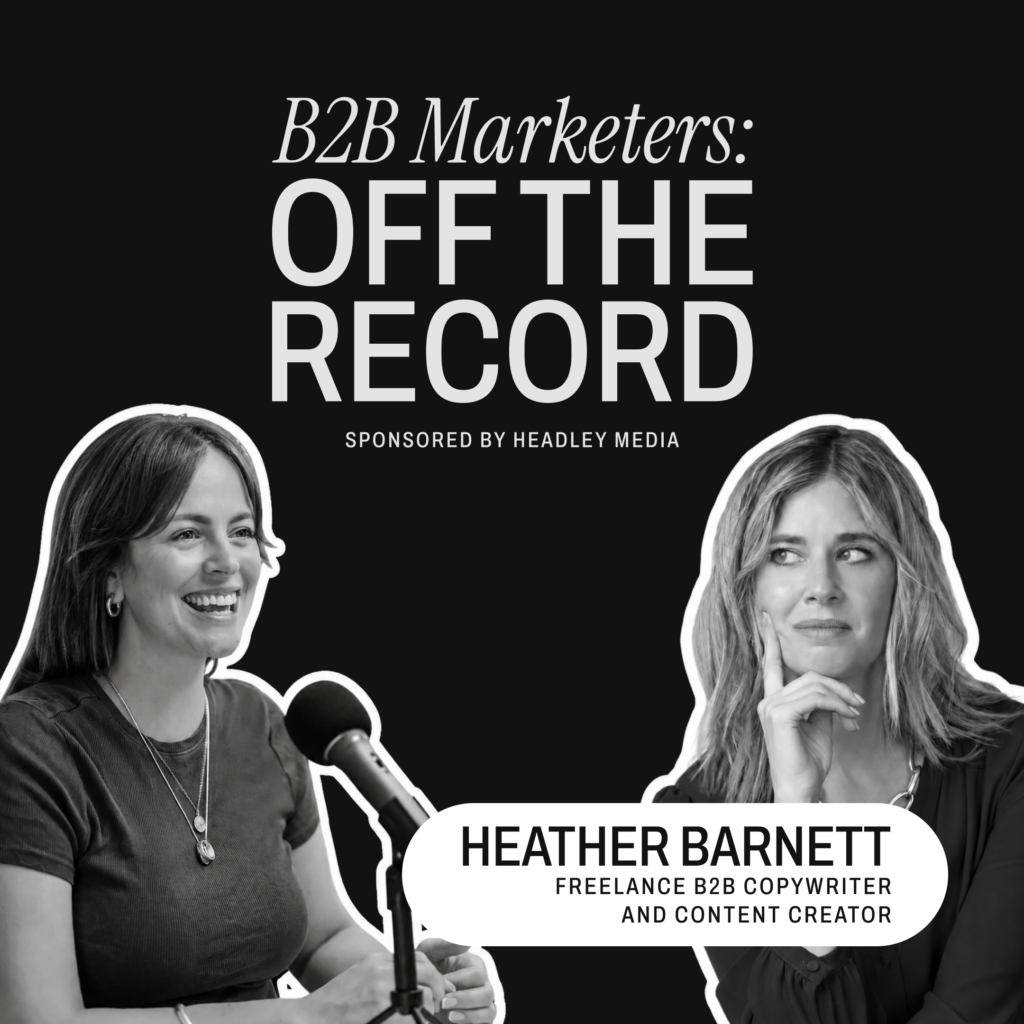
You have to be distinctive so that people remember you. You have to position yourself properly so they remember you for the right things.
— Heather Barnett
In this episode, Freya Ward interviews Heather Barnett, a seasoned B2B copywriter and content creator, discussing her journey into B2B marketing, the cyclical nature of marketing trends, and the importance of trust and brand investment in today’s landscape. They explore the evolving buying behaviors in B2B and the challenges marketers face in justifying brand investments amidst pressure for immediate results. In this conversation, Freya and Heather discuss the evolving landscape of B2B marketing, emphasizing the need for creativity and a deeper understanding from leadership. They explore the challenges marketers face with internal communications, the importance of brand investment, and the impact of organizational politics on marketing effectiveness.
Takeaways

Freya Ward (00:46)
Welcome another episode of B2B Marketers Off the Record. I’m delighted to be joined by Heather Barnett, who is a B2B copywriter and content creator with over 20 years of experience in the B2B marketing space. Heather, would you like to introduce yourself?
Heather (01:22)
I’d love to. So yeah, I should say I’m a copywriter and content creator. So I’ve been working in B2B marketing for about 20 years. I’ve worked client sides, had head of marketing as kind of technology companies. And then I’ve also been agency sides. I’ve seen that side of the fence as well. So I’ve kind of led client teams and worked as head of marketing at a marketing agency. And then four years ago, I left.
to focus full-time on copywriting. So I do that freelance and over, I’m sure we’ll probably touch on this, but over time I’ve also started doing videos as well, which is, that’s a kind of a new little avenue for me as a content creator.
Freya Ward (02:02)
Yeah, amazing. think you’ve got a wealth of experience and we’re definitely going to unpack some of that in the podcast recording today. Let’s take it back to when you first joined the industry. How did you get into B2B marketing in the first place?
Heather (02:16)
I
fell into it, which I imagine is what 99 % of people on your podcast will tell you. don’t think people go into B2B marketing as kind of like, this is the career that I want to do, you know, from a child, talking to your careers advisor, this is my dream. Not to say don’t enjoy it, I do, but it was kind of like, I didn’t even know it existed. So even when I started doing B2B marketing, I don’t think I realised that’s what I was doing for about the first year with that label.
Freya Ward (02:27)
you
Heather (02:41)
I basically wanted to do a job that allowed me to be creative. So I thought marketing is probably a good chance to do that, but it was quite hard to get into. So for a couple of years, I worked at Intel doing a completely uncreative job. Then I moved to London and I did lots of tempting, advertising agencies and marketing companies and stuff. And I ended up starting to get marketing manager jobs. And I worked for a guy who’s quite interesting, who was like an angel investor.
So he had lots of small companies, lots of startups. And I worked in a very small team that did every aspect of marketing for those startups. So literally for things I definitely shouldn’t be doing, like designing logos. When I look back now and I just think, my God, I’m absolutely not qualified to do that. So yeah, the branding, the value proposition, the advertising, setting up website, everything. So it was a great grounding because I think as a B2B marketer, you often do have to do an awful lot of roles because there aren’t many people in your team.
Freya Ward (03:21)
you
Heather (03:38)
And it was yet during that job that I think I saw a copy of B2B Marketing Magazine. It was like, that’s what I’m doing. Businesses to businesses. That’s right. So then suddenly realized that’s what I was doing. And then, it kind of, it went from there. So I just carried on, as I said at the beginning, went on to the kind of other client side marketing roles.
Freya Ward (03:56)
It’s crazy, isn’t it? You’re so right. The amount of people we speak with that are like, I tripped and fell. I don’t think we’ve had anybody that went to that careers coach and said, B2B marketing. was exactly right up my street. I had a similar journey in where I don’t think I quite realized that that’s what I was doing until similar to you. Suddenly the realization that this is the industry I’m working in. And then you start finding the science behind it, the psychology, the creative sides of it. And then you’re very invested in and you’re in it.
Heather (04:05)
Yeah.
Freya Ward (04:28)
Lots of change going on in the B2B marketing space, or so we’re told, you only have to go on LinkedIn to find out that some other B2B marketing tactic has died. And there’s all those changes going on and I’d love to get your take on it. What’s a belief that you’ve changed your mind on in the last 12 months?
Heather (04:47)
So we talked about this beforehand, didn’t we, Freya? And I said, actually, I don’t know that I have changed my beliefs, which is, you know, in itself, I think is interesting because I’ve, at its heart, as you say, if you think about the science of marketing, you know, the principles of marketing, they don’t change. I think one thing that is always true in B2B marketing is that we are, what call it, squirrel syndrome or something. So it’s like shiny new objects.
syndrome. So you’re always looking for the shiny new objects. And I think, and I’ve always seen that people have always been like, this will be the silver bullet. This will be the thing that’ll solve everything for us. And I think that is still true, but what’s changing is what we think it is. So, maybe we used to think it was, ABM or we thought it was marketing automation or whatever. now it’s AI. So that’s what I’m seeing, I suppose, is everyone going like, almost like a fear of missing out as well. If people kind of say, I’m using AI to do this and everyone’s going, my God, quick, we must use AI to do this as well. Otherwise we’ll get left behind. Which is what it’s always been like.
I can remember that with marketing automation as well. that’s already answering the question that you asked me, but it’s what I wanted to talk about. there you go. Yeah.
Freya Ward (05:50)
Yeah,
I agree. think it’s a really strong observation. If you’ve been in the industry long enough, then you know it’s cyclical. know that everybody, yeah, it’s that squirrel syndrome. It’s shiny thing. It’s going to disrupt everything and I have to be involved in it. And the pressure comes from leadership as well because then they suddenly become marketeers and want to work with the shiny things as well. But the reality is, I attended an event last week and
Heather (06:10)
Mm. Yeah.
Freya Ward (06:19)
We were talking about the decline in organic traffic and everything else and the panic. Do we need to panic? And almost every talk throughout the day was a reminder that the foundations are the same. Good marketing is good marketing and it will stand the test of time. So I think you have answered my question. It’s an interesting as much as you tried not to exactly.
Heather (06:31)
Mm.
much as I tried not to.
Freya Ward (06:44)
With the copywriting that you’re doing and the clients that you’re working with and the content creation as well, are you seeing any shifts in B2B buying behaviour?
Heather (06:54)
I think there is a real kind of craving for certainty. I think for some extent, you know, can go all the way back to like, one got fired for buying IBM. Like that’s always been the thing in B2B marketing is like, you know, there’s a fear that drives some decisions, but I think maybe even more so now because of AI. So because of the fact that everyone’s a bit like, God, we don’t know what’s going to happen. You’ve got all the kind of economic volatility going on as well. So various kind of like issues are weighing on people. I think people are worried about their jobs.
So I think when people come to make decisions, they’re looking for reassurance. So there’s a lot of people wanting to hear from their peers or wanting recommendations, you that might be analysts and, know, whoever else is influencing them. but I think certainly the way that people are choosing perhaps people to go on RFP, or RFI rosters, whatever, it’s so influenced by
Will I feel, is this someone I can feel secure with? Is this a company that feels like I know other people who work with it or it’s been recommended, you know? So I think the difference maybe now is that there are more ways of people getting those recommendations. Because, know, maybe before it was purely word of mouth, your peers, I think social media and, you know, influencers, creators, people, so many people able to have a platform.
podcast, it means that you’ve got more places that you can get those recommendations from. think people are really desperate for that.
Freya Ward (08:25)
Yeah, I agree. think trust is a big thing right now and whether that’s trust from your peers, it’s the referral, the recommendation, or somebody that you have built from familiarity with online because they’re an influencer or creator, whatever it might be, that trust is so important. But it always has been, but like to your point, there’s more channels for it now. There’s more accessibility. It’s not just within your immediate network. Instead, there’s so much.
Heather (08:39)
Yeah.
Mm.
Freya Ward (08:53)
more opportunity to influence but with that comes more noise, more… yeah, more fear I guess in, know… yeah.
Heather (09:03)
Yeah. How do you decide who to trust? it is kind of like
being able to, I suppose as someone who is trying to, a creator on that side of my job, as someone who is trying to influence people, it’s like, do you show that you know what you’re talking about and that you are authentic? suppose that’s the thing about, know, vague word, authentic, but like you wouldn’t trust an influencer or a creator who
recommended this thing over here and then this thing over here and then this thing over it has to go, it has to align with what you’re already saying and what you’re already putting out there as your views. So I think people are incredibly sensitive to that as well. So I think they, you know, we have an instinctive thing in us that helps us to determine who is just pushing something and who truly believes it. And so we’re constantly, we’re having to listen to all that noise, but I think we’re actually quite good as individuals at working out who you can believe and who you can’t.
Freya Ward (09:57)
Yeah, yeah. And that’s a responsibility as a content creator as well, right? Because you’ve got to align with brands that doesn’t, you’ve got to be mindful of your own reputation. And if you were only doing sponsored posts all of the time with competing brands and you you might’ve done a post six months ago that talked about how much marketing automation frustrates you. And then if you’re then recommending a marketing automation system, that you have to be mindful of that authenticity and…
Heather (10:07)
Mm.
Yeah.
Freya Ward (10:26)
and be genuine in that, which is quite a responsibility as a content creator, I think. Okay, what’s a strategic bet then that you think more marketers need to make in the next couple of years?
Heather (10:27)
Yeah.
I think again, just really annoying and boring. It’s the same one they always said, which is brand. And I think that’s the one that people really struggle with because it’s kind of like, I think there’s a certain amount of people. And again, I’ve witnessed that this has always been the case that I think marketers know you have to invest in your brand. You have to stand out. You have to be distinctive so that people remember you. You have to position yourself properly so they remember you for the right things. You know, you have to keep doing it time and time and time again so that when they are
finally in market, they go, that’s the person that I have a good feeling about that brand. I’m going to add them to my list of people to talk to, or I’m going to, you know, shape my whole RFP around this company because I already know about them. And I thought I liked what they do. So it makes logical sense to marketers to do that. But I think, and I saw a stat yesterday, actually, I cannot remember, was it a LinkedIn post, LinkedIn post, LinkedIn report, something like 70 % of VTV marketers
believe that it’s important to invest in brand. Only 8.5 % are managing to get that budget signed off, something like that. which is kind like, it doesn’t really surprise me because I think when it actually comes down to brass tax of putting my marketing plan in front of the CEO and saying, this is what I want to spend on and getting pushback from people kind of going, well, sorry, I don’t understand how are going to measure that brand stuff and how do we, what are we getting out of that? it’s just like, you’ve got all this stuff over here. could be doing AI could be like multiplying your outreach by a thousand messages a day.
You could be filling the short-term pipeline for us because we’re desperate for pipeline You know, you’ve got so much pressure in the reality of the day today that you that strategic bet you’re talking about It’s kind of like you you have to make that I think if you’re gonna manage to grow long term and stand out from your competitors But it’s incredibly hard when today you’ve got someone standing over you saying sorry How much how many leads have you created and how much pipeline have you got for us? They really care about like two years down the line
Freya Ward (12:31)
Yeah, absolutely. I saw the same stat and I too can’t remember exactly where it came from but it definitely stopped my scroll and I thought, my goodness, I mean it’s not a shock, it’s reflective of what we already assume and know but to see that in an actual statistic is… yeah, it’s alarming, isn’t it? I agree with you. Brand is a long-term strategy as we know and you won’t… to a degree it’s immeasurable which makes it really, really difficult to…
Heather (12:34)
Right.
Freya Ward (13:01)
create attribution, you we don’t have to get into the attribution debate, but there is there’s so much pressure on marketers to contribute to pipeline, quick wins, short term tactics, different methods, different channels. And there are obviously so many options available for that. But brand is what’s going to build your customers of tomorrow, right? That’s going to build the brand loyalty and everything else you may collect their data and collect the sales conversation through a short term tactic.
Heather (13:30)
Thank
Freya Ward (13:30)
But if you
haven’t got that underlying current of reputation being in the right places, you won’t even make the shortlist. it’s the age old marketing debate of brand versus immediate results and attribution. But I agree with you. think with all the noises in the space and all the different channels now and with AI search, everything else, all these other things loaded into it and those changes in research behaviors and more informed buyers, all of those things.
Heather (13:44)
Mm.
Freya Ward (14:01)
Brand is becoming even more important and the PR side of it is becoming even more important and the stuff that isn’t, is more of a dark metric is going to help your brand stand the test of time I think.
Heather (14:05)
Yeah.
But also it’s,
you know, it’s always been so brand versus demand has always been such a conundrum, hasn’t it? Because it’s not, of course it isn’t brand versus demand. It always, makes me laugh. Why would it have to be versus? It’s like, it is always both. And because yes, it is creating the customers of tomorrow, but it’s also making it easier to sell to the customers today. Because if they have heard of you and somebody then like calls or in mails or, know, whatever you’re doing for your outreach, if they know of you, it’s that, you’ve got that first step.
done already rather than having to explain who that person is. And I find it bizarre as well that people don’t recognise that from their own behaviour as a consumer that we naturally trust or are likely to buy from a brand. if you’re looking for insurance, for example, and you see five and the first two might be the cheapest, you’ve never heard of them, you’re probably going to go, watch them, maybe it’s just me. But I think you’re then going to go more likely for the next one that’s slightly more expensive, but you’ve heard of them because you feel that reassurance or you understand what they stand for, whatever. A lot of B2Bers.
seem to struggle to transfer that instinctive understanding of how they operate to what they’re then doing as marketers. Did you want me to rant? that’s what I’ve decided to do.
Freya Ward (15:17)
Yeah, absolutely. the thing, please, yeah, it’s a safe space. Please do.
No, it’s a safe space. Absolutely. Please rant. We love a rant. But it’s so interesting, isn’t it? Because you as a consumer would probably never tell that third vendor that you recognize that the reason you chose them is because you recognize their company. So that then feeds into the whole attribution side of things and
Heather (15:38)
Mm.
Freya Ward (15:43)
Leadership, there’s some wins that you can get with leadership when it comes to brand because, if your competitors there or doing something similar, they want to be there, there’s those kinds of wins that you can get to get that onside, but there’s just so much more to it. And I think it’s really hard. It’s really hard for marketers to justify that investment is why that statistic is there. Right.
Heather (16:04)
Yeah, yeah, yeah, definitely. Yeah, I get that completely. It’s really
hard. But that’s why it’s like…
I don’t know, it’s almost half the marketer’s job. It’s like working out how to persuade the people above them that it’s worth spending the money on.
Freya Ward (16:19)
Yeah, it’s the hidden tasks of internal marketing, it? And stakeholder
engagement and everything else. What three words do you think describes B2B marketing right now, Heather?
Heather (16:23)
Yeah.
Pressurized, complicated, hopeful.
Freya Ward (16:35)
I’m glad you threw in hopeful because we’re going on a negative trail. No, I’m joking. I think those three words sum up really well. Do you want to expand on them at all?
Heather (16:37)
Hehehehehe
So pressurized, suppose, for everything I was saying before, know, a lot is expected from marketing, but there are an awful lot of things that you’re so actually, you know, the internal marketing, just having to sell what you’re doing before you can even do it. It’s really pressurized. There’s AI is complicated. Everything, you know, I think.
budgets have probably got smaller, buying groups have got bigger, sales cycles are getting longer, all that kind of stuff that you’re having to deal with means that it’s not as simple as, know, here’s what we do, let’s go out and sell it. It’s you’ve got so many things you’re trying to map in your mind at the same time. So that links into the complicated thing. So it’s pressurized because it’s complicated and because of the, economic stuff that’s going on. And then
But hopeful because I think the reason people go into B2B marketing is because they like a complicated challenge. They like dealing with complexity. Otherwise you’d go and sell soft drinks or something. I’m sorry. Sorry B2C marketers just ruling you all out. They don’t want a challenge. They don’t care. But I think, you you do go into B2B because you’re kind of thinking, okay, everyone’s saying this is a really boring subject or a really dry topic or a really complicated thing to explain. Maybe I can do it though. Maybe I can find a way to explain it that people will get within the first two seconds and…
Freya Ward (17:45)
You
Heather (17:59)
maybe I can understand is this incredible value proposition that this company hasn’t even thought about yet that I can then kind of bring to the surface and, you know, get people to want to buy into. So I think that’s the hopeful thing is that, is no matter how complicated or pressurized it gets, the reason people are here is because they like dealing with those kinds of challenges. And, you know, they’re always, that’s another reason I suppose they’re always kind of…
chasing after the shiny new thing is that we’re all quite enthusiastic about stuff and we’re kind like, this might be good over here and that might be good over there. And yes, you need to rein that in and focus on the kind of principles. But the reason people do that is because they are enthusiastic about what they do and they’re excited about the possibility of new tech and, you know, new approaches and tactics and whatever that might be.
Freya Ward (18:42)
Yeah, yeah, absolutely. Hopeful, I think is a really, is a really solid word because we have to be hopeful as well, right? Because we do enjoy a challenge. You’re not in B2B marketing because it’s an easy ride. You’re in it because you want to be able to either articulate a really tech heavy something into something that is readable. You can listen to, know, you can, you can digest, understand, and then it’s a
Heather (18:54)
Mm.
Freya Ward (19:11)
It’s the psychology of it, I think, that makes it so interesting because at the end of the day in B2B, you’re still dealing with people. They’re just not spending their own money on something. There’s a different priority and I think that makes the space not boring. It has a terrible reputation for being boring, but it really doesn’t have to be. I mean, when was agency side very early in my career, my responsibility was all around press releases and…
Heather (19:13)
Mm.
Mm.
you
Freya Ward (19:38)
I worked in
the electronics field and yeah, that was quite boring. But then we get into some creative direct mail campaigns and we start pushing the boundaries on some of these core electronics companies and they start really standing out and that’s exciting.
Heather (19:51)
Yeah, and you do have the opportunity to stand out, you, in those fields?
Because so much of it is boring, so it’s kind like, something a little bit different, and everyone’s like, wow, okay.
Freya Ward (19:58)
Yeah, you don’t have to do anything crazy. It’s just a little tweak, exactly. What’s something then that you think B2B marketing teams are still doing out of habit that no longer works or doesn’t serve them?
Heather (20:01)
Yeah.
I think people are still creating a lot of content and obviously I’m doing it from that angle because that’s what I see a lot of, but I think people, a lot of content that I see coming out on LinkedIn for example or on websites or wherever I’m reading it seems to have been produced for internal stakeholders, not for the customer. And that’s never served them, but it is something that people have done for a long time. So I think…
Some of that again probably comes down to all the pressures that marketers are under.
So they’ve got people internally saying, yeah, but we’ve got this new product coming out. So you need to put the new product feature in this, I don’t know, billboard you’re doing. Something completely irrelevant is being pushed into an asset. And after a while, there’s probably only so much pushback the marketers feel they can do. And there’s probably whole…
I don’t know, blog series or web pages or whatever they’re being created because somebody internally is saying, I think we need to tell people about this and marketers aren’t able or haven’t thought about, or I have given up on explaining that just because you want to tell that to people doesn’t mean to say that people are sitting there waiting for you to kind of like produce this like one page or whatever it is and kind of, my God, I can’t wait to read this like product spec sheet that’s been put out on the website
Freya Ward (21:24)
you
Heather (21:25)
or, know.
Whatever it is. So the marketer’s job is to translate all those internal things, push it through a filter, I suppose, to say, okay, these are the things that you feel like we need to tell the audience. It’s my job to prioritize those and decide actually, do we or do we not? Is it going to help us sell more? Is it going to help us grow as an organization? And then if we do, I need to decide how and when we do that. I can’t just kind of say, fine. You want a blog on such and such? Yeah, right. Put that out. Cause you’re just wasting time. I’m producing a blog that nobody’s going to read.
And it has just been done for somebody internally.
either their ego or because they fully believe that whatever they’re working on is most exciting thing ever and haven’t realised that the audience don’t care about it.
Freya Ward (22:04)
Yeah. Yeah. Really interesting. I’m just having flashbacks to when I was electronic side and it was so all the content we created was so heavily prescriptive based on the individual stakeholders or we’d create something really creative. It would go through stakeholder sign off. By the time it got background to us, it was why would anyone care about this? Why would the customer care about it? Unless they are the, you know, so
Heather (22:22)
I’m go.
Yeah.
Freya Ward (22:33)
technical and so product sheet for example, it’s a tick box exercise to a degree. It’s part of the launch product launch package, but it shouldn’t be the biggest focus. It shouldn’t include all of that internal messaging. It’s really interesting. And I think when you’re in a marketing department, it’s often legacy stuff. So like you said, you’ve pushed back for so long that it’s actually, do you know what? I’m a marketer, you’re not, you’re never going to be a marketer. And so therefore I shouldn’t have to try and explain.
Heather (22:53)
Mm, yeah. Yeah.
Freya Ward (23:03)
the thoughts behind marketing and everything every single time exactly. And they just know that they’re not going to get it signed off, it’s, is why I think third party is so valuable, valuable, because they can have zoomed out perspective, they can come in with the same argument that that marketer might have had internally for years, but sometimes hearing it from a third party can really help and just have that bird’s eye view and also the view on the wider market.
Heather (23:03)
every time.
Freya Ward (23:32)
as well, right? And say, well, your competitors don’t communicate in that way. Or because that is always a, it gives us a little bit of leverage as marketers, if we can talk about our competitors that are doing things slightly differently to those individuals that are pushing for very heavy internal or product specific features as opposed to benefits.
Heather (23:35)
Mm.
Yeah, definitely.
Yeah. Yeah. And that’s another reason why I think AI will never take over completely because like when people say that’s, AI is going to produce content, so much of content production is organizational politics. Actually, it’s kind of like understanding the different characters internally, understanding who you can push back on, how much you can push back on them, how you can persuade the individuals, you know, what should go in your marketing, what shouldn’t, how to get extra little bits of nuggets of information out of various people. So.
Yeah, I think that that is an interesting, because I’m thinking back over some, things I did a few years ago where it was really having to it was almost more of a negotiation than a creative content production thing. And that’s just something that humans have to get involved in.
Freya Ward (24:33)
Yeah, absolutely. Let’s talk about leadership a little bit then. So what’s something that you think leadership should truly understand about marketing?
Heather (24:43)
that it isn’t a science. think, particularly in B2B organizations, you quite often get people who’ve come up, they’re maybe the CEO that they used to be the CFO, or they used to be the sales person or something. They probably weren’t in marketing, and they might have come from quite a black and white background. So they think, you know, X activity plus X number of pounds equals X results. And, you know, I think to be able to explain to them that actually, if marketing was so much of a science is that we would all be doing perfect marketing all the time, you know, it would
It would be really easy. The reason why things don’t work or lots of reasons why things don’t work, but one reason why things don’t work always is because there has to be some tests to learn in it because it’s not a science, it’s science plus art together. I think if you could get more people to kind of say, okay, we’re comfortable, we’re committed that this is your budget, you’re trying stuff with it. We believe that the principles you’re trying on are correct.
But you’re going have to tweak stuff along the way to see what actually lands properly. That would be great. And then we’ll leave you alone to do that. I think there’s far too much of okay, give me a quarterly update. What did you spend? What did it return? Why didn’t it all return, 10 times what it did. So yeah, I think that’s, that’s probably the main thing would just be a bit more of understanding of how marketing works and that you can’t treat it in same way as you can accountancy or something.
Freya Ward (26:03)
Yeah, yeah, yeah, I think that’s a really, really good observation. And you’re so right about the C-suite, the vast majority of them aren’t marketers, although in some instances they like to think they are. But they’re not marketers, they’ve not come from a marketing background, they don’t have, and they don’t have that experience. And I think sometimes in internal comms as well from a marketer’s perspective, when you are doing that reporting, you, I’ve seen it where marketers sometimes assume that they will understand.
Heather (26:12)
Mm.
Hmm.
Yeah.
Freya Ward (26:33)
in showing the metrics that they care about that the stakeholder cares
about that they will understand that that takes longer or this and the other or they try and over rationalize and over explain the marketing thought process. And I don’t know if you’ve had it, Heather, I’ve had it where I’ve been in meetings where I’ve been told, well, that’s too clever. that that your thoughts behind that are too clever. No, we trust our audience to be able to fill in the gaps. You know, we don’t have to explain over explain absolutely everything. Yeah.
Heather (26:55)
Mm.
Yeah, it’s like jammer. Yeah.
Freya Ward (27:02)
Exactly, Okay, so budgets are being cut. We’ve seen this across the board, things are getting tighter for marketers. What’s an investment that you think B2B marketers should protect even when those budgets are being slashed?
Heather (27:18)
it
comes back to the zones before is brand. You know, I can’t help but see some people really not investing in brand. And it’s just a race to the bottom. Basically, it’s just kind of like, how many messages can we send? How many leads can we generate? Not understanding that that’s only going to work for a short period of time. And then you’re going to run out of people in your immediate market and then maybe know who you are or why they should buy from you. That’s a big thing. It’s kind of like, think about why people should care.
what is different about you? Because often there isn’t anything particularly different about a B2B firm from another B2B firm, but there are creative things you can do when you’re thinking about a value proposition where you can start to decide you’re going to own a certain area. So yes, it isn’t massively different, but none of your competitors are pushing that particular bit that they do. So you can start being the one that is known for that, put that out there in your brand materials, make sure that it’s consistent, make sure that it’s coherent, that it’s…
being pushed out regularly, all that kind of stuff so that people can very easily just kind of think, yeah, that brand X, I understand that. And I think, I don’t know, I just feel like people don’t think about that enough or it changes a lot. maybe as in like the way people talk about their brand is not, if you look at big B2C brands, you you tend to know what they stand for and they just do it year after year after year after year. I think B2B brands, they might do it well once.
And again, I must be generalizing that obviously some good ones, but like, I feel like there’s, there’s some kind of like impatience or there’s people get bored of stuff very quickly internally. they’ll kind of say, no, let’s rebrand and change it to this thing instead. And then they go through all the process again and it becomes quite messy. So I think, you know, if you were a company that could put a good investment into brand, find what your
And obviously it evolves over time, but I think find what your core brand differentiator is or what you want it to be and just push that relentlessly. You’d have such an advantage over all your competitors. And it sounds really simple and you know, it’s having worked in B2B organizations, I know it’s harder than that, but I think that is something that I would, you know, if I was head of marketing again, I’d be investing in.
Freya Ward (29:34)
stick really firm with that North Star if you will and that is your identity and then everything else can thread off of it and that allows you to be agile and to move but that stays the same consistently I think there’s a lot to learn from our B2C friends in that space there are some brands that just come to mind that do it and obviously in B2B there are brands that do it well as well but there are some brands in B2C that just do it
Heather (29:40)
Mmm.
Freya Ward (30:01)
really well you know who they are and
Heather (30:03)
When you say just
do it, is this like a subconscious?
Freya Ward (30:08)
my goodness, I’ve been so heavily influenced. It’s now just coming into my dialogue or you have, which is why you picked up on it. Amazing. But they do, they do it really well. And I think there’s, there’s just, there’s so many different things that impact that if you go in somewhere and you’re completely green into a company and you’re a hungry, enthusiastic marketer, and you haven’t got that legacy within that company and the internal politics and everything else, then you might be making that claim.
Heather (30:13)
Ha ha ha!
Freya Ward (30:36)
but somewhere along the way it gets diluted or somebody comes up with a different idea or the state, sorry, the leadership team take it in a different direction or whatever it might be. And that, those threads get loose. And then you do just become the same as everyone else or you’re trying to rebrand constantly. And then that causes, that has an impact on trust for your audience and everything else.
Heather (31:01)
Mm.
Freya Ward (31:04)
What’s one thing that you wish you could change about B2B marketing?
Heather (31:09)
I
think I was like something that you referenced, it’s the committees, internal committees. think if you could, you can’t get rid of internal sign of committees, but if you could limit their power, that would be great. Cause I think so often that is the thing of like, you know, there’s a brilliant idea that gets thought of and it’s a bit out there and it’s a bit kind of like, then by the time it’s gone through feedback from often from people who have no.
business feeding back on it, quite frankly, it’s gone, it’s like all the kind of like interesting little edges have been smoothed off it. It’s become this kind of like, it’s just like a bland bit of mush now that we’re to put out into the market along with all the other bland bits of mush. So, you know, I’d love it to see more of those slightly weird, slightly kind of out there ideas, just getting put into market and to see what happens. Cause I just, I generally like talk about this a lot, but I don’t think.
the risk is as bad as people think it is. I don’t think if it goes wrong, the world is going to collapse. kind of like, yeah, it might go wrong, but it might go right. And like, they won’t have put a piece of like bland mush out into the market. You’ll have put something out that people actually stop and look at and kind of go, wow, that’s really interesting or whatever, whatever you’re trying to impact you’re trying to have. And I think it’s a bit like you were saying, know, a lot of people have an opinion on marketing without necessarily knowing
much about marketing. So it would be nice to keep that out of it or allow people to have some feedback. But then the marketer ultimately, is able to say, thanks for feeding back, but actually I don’t agree or in this case, it’s not relevant or, you know, I don’t want to add the word leverage here. Thanks very much. You know, whatever it is, it’s just kind of like, yeah, okay, well we’ve, we’ve heard you, but we’re going to go for this and see what happens. And it all links back to the same stuff I’ve been talking about, suppose of like having the support of leadership to do that, having the investment to do it.
being supported throughout over a long time to test and learn. It’s all wrapped up in the same stuff. And I think those committees are just insidious because I don’t think the individual people within it realize the impact that they’re having because they’ve just got one bit of feedback. But unfortunately, they’re normally one of 10 different people who all have a subjective opinion on something that they don’t really need to have an opinion on. And it just waters things down constantly.
Freya Ward (33:16)
Yeah, yeah, it’s really frustrating, isn’t it? It really does have that impact. And I think that comes down to the hierarchy. It comes down to fear as well, like you said, you know, if this does go to market, how detrimental could it be to our brand? So it’s a risk assessment. Maybe we should just take some advice from HR, take some processes from HR, build a risk assessment for marketing.
Heather (33:27)
Mm. Yeah.
Don’t tell HR what you do, whatever you do.
Freya Ward (33:43)
Don’t tell them about it, just take some of their processes, build a risk assessment, like a brand reputational risk assessment for a slightly out there campaign and that’s how you should get feedback from the other stakeholders. So, cause then it’s like, well, is it going to damage anything? Could it go really right? Yeah, there’s no such.
Heather (33:59)
Mm.
Yeah, you’re Just have a framework
upfront, actually, without asking people each time, just say, okay, we commit to not, you know, break any laws, swear, know, whatever all these things are. And then you don’t need to look at it because we’ve agreed we won’t do any of that. And within those parameters, we’re happy with the risk. Yeah.
Freya Ward (34:12)
Yep.
Yeah,
maybe that’s it. Maybe that’s how we can do something. Roll it out. Do it. We get AI to create the checklist for us. I’m joking. I’m joking. Yeah, maybe it’s as simple. Maybe, yeah, and leave the podcast. Okay, two final questions for you. Who would you recommend that we invite to speak on the podcast next? It can be someone you know, or it can be someone aspirational.
Heather (34:22)
We’ll roll that out for her after this. Yep.
No! We will not! End meeting.
So I think Kate Waterfall Hill would be interesting. If you’ve come across her, she is, she used to be, MD of a marketing agency. And then she now is a leadership coach, but I came across her a couple of years ago because she’s got a character called Linda, bad manager, which regularly goes viral on Tik Tok and Instagram. She’s got a hundred thousand followers over there. it’s basically showing you what a bad manager is like. So through that, she’s kind of helping to coach people and promote her coaching business.
Freya Ward (34:50)
I haven’t.
Heather (35:13)
But because she’s got that dual thing of she knows marketing, she’s led a marketing agency, but she’s now thinking a lot more about the kind of the psychology of people and, you know, how to run teams well. So all those organisational factors that we’ve talked about that are really important in getting good marketing done, between marketing, any kind of marketing done. You know, she’s got a really good eye for that. So I think she would be someone that’d be really interesting to talk to.
Freya Ward (35:39)
Amazing, thank you so much. And what’s one question that you think we should ask a future guest? It could be your recommendation or it could be someone you don’t know yet.
Heather (35:50)
Which bit of B2B jargon really makes you cringe? Because there’s a huge amount that makes me cringe, but I’d like to know if it’s the same for other people.
Freya Ward (35:53)
that’s a great.
Yeah that’s amazing, I can’t wait to ask that question. If any of our listeners would like to find you Heather, where can they find you?
Heather (36:00)
Hahaha.
LinkedIn is the main place. So that’s where I’m posting most of my content. I am on TikTok and Instagram as Heather B2B. It’s slightly less prolific on there. But yeah, LinkedIn is probably the best place.
Freya Ward (36:21)
Excellent. Perfect. Well, all that’s left to say is thank you so much for joining us on B2B Marketers Off the Record.
Heather (36:27)
Thanks for having me.
In this episode of B2B Marketers: Off The Record, Freya Ward speaks with Heather Barnett, a freelance B2B copywriter and content creator with around 20 years of experience across client-side and agency marketing roles. Heather explores why the fundamentals of marketing still matter, how internal pressures weaken customer-facing content and why businesses need to protect investment in brand.
At the heart of the conversation is a familiar tension: marketers understand the importance of distinctive, customer-focused work, but often struggle to deliver it within organisations driven by immediate pipeline targets, competing opinions and lengthy approval processes.
Heather challenges the idea that marketers must continually change their beliefs to keep up with the industry.
While tools and tactics evolve, she believes the underlying principles remain consistent. What changes is the technology being presented as the answer to every problem.
She recalls similar excitement around marketing automation and account-based marketing, and now sees the same pattern with AI. Businesses hear what others are doing and feel pressure to follow, sometimes before establishing what they need to achieve.
Freya connects this to conversations about declining organic traffic and the pressure to respond quickly. Both argue that new capabilities still need to serve a sound marketing strategy.
For Heather, the recurring risk is expecting a tool to solve problems that require clearer thinking about customers, positioning and communication.
Heather sees a strong desire for certainty among B2B buyers.
Economic volatility, uncertainty about AI and concerns about job security can all influence how comfortable someone feels making a purchasing decision.
Buyers want reassurance that they are choosing a company they can trust. Recommendations from peers, analysts and other credible voices can help provide that confidence.
The underlying behaviour is familiar, but the routes to those recommendations have expanded. Social platforms, podcasts and creators give buyers more places to find opinions and assess suppliers.
That creates opportunities for brands to build familiarity before a formal buying process begins. It also makes the credibility of the people offering recommendations increasingly important.
As a content creator herself, Heather recognises the responsibility involved in recommending a brand.
An endorsement needs to make sense alongside the creator’s existing views and content. Repeatedly promoting competing products or recommending something that contradicts an earlier position can weaken trust.
Heather believes audiences are sensitive to that inconsistency. People assess whether a recommendation reflects genuine conviction or whether someone is simply being paid to promote a product.
Freya reinforces that creators need to consider their own reputation when choosing partnerships.
For businesses working with creators, the implication is to look beyond reach and consider whether the relationship is credible, relevant and consistent with what that person already stands for.
Heather’s strategic priority is continued investment in brand.
Businesses need to stand out, be remembered and establish clear associations so that buyers think of them when a need arises.
However, she recognises how difficult that investment can be to secure when leadership wants immediate leads and pipeline. Marketers may understand the long-term value while struggling to explain it through short-term reporting.
Heather also challenges the framing of brand and demand as competing choices. Familiarity can make current sales activity more effective because a prospect already recognises the company and has some sense of what it represents.
Freya adds that buyers may never explicitly identify familiarity as the reason they chose a supplier. That makes its contribution harder to capture, even when it influences the decision.
One of Heather’s strongest criticisms is that too much B2B content appears to have been produced for internal stakeholders.
A new feature gets added to an asset because someone wants it mentioned. A blog series is commissioned because a department believes its work deserves attention. Over time, the customer’s needs can become secondary to satisfying those requests.
Heather sees the marketer’s role as applying a filter.
They need to decide which information matters, whether communicating it will support growth, and how and when it should reach the audience.
An internal desire to announce something does not establish that a buyer wants to read it.
Freya recognises the pattern from her own experience, describing creative work that becomes less compelling as it passes through stakeholder sign-off.
Heather argues that creating content involves much more than writing.
Marketers and copywriters need to understand internal relationships, draw useful information from subject matter experts and judge where and how to push back.
They may need to persuade a stakeholder that a particular detail does not belong in an asset, or find a way to preserve a strong idea through several rounds of feedback.
That organisational work is one reason Heather believes AI cannot take over the process completely.
Freya also highlights the value of an external perspective. A third party can sometimes make an argument that internal marketers have struggled to get heard, while bringing insight from other businesses and the wider market.
The quality of the final content therefore depends partly on the conversations and decisions that happen before it is published.
Heather wants leaders to recognise that marketing combines science and art.
Evidence and established principles matter, but there is no formula that guarantees a fixed return from every activity.
Teams need to test ideas, assess the response and make adjustments. Heather would like leaders to commit to a budget and an agreed approach while giving marketers space to refine the execution.
That becomes difficult when every reporting conversation demands an immediate explanation of precisely what each pound returned.
Her argument is for a more realistic understanding of how results develop, alongside accountability for the work.
Marketers also have a role in explaining that process in terms leadership can understand.
When budgets tighten, Heather would protect brand investment.
A business focused exclusively on sending more messages and generating immediate leads may eventually exhaust its available opportunities without building recognition among future buyers.
She encourages companies to identify a clear territory they can become known for. Products and services do not always need to be radically different for a business to emphasise an aspect of its value that competitors have overlooked.
The important part is communicating that position coherently and consistently.
Heather sees internal boredom as a risk. Teams may become tired of a message and change direction before the audience has had enough exposure to remember it.
A clear core position can evolve, but repeatedly replacing it makes it harder to build lasting associations.
The change Heather would most like to see is less dilution through internal approval committees.
A distinctive idea can lose its character when numerous people add subjective feedback. Each contribution may seem minor, but the combined effect can leave the final asset looking much like everything else in the market.
Heather would like marketers to have greater authority to assess feedback and explain when it is not relevant.
She also questions whether businesses overestimate the risk of trying something different.
Towards the end of the conversation, Heather and Freya discuss agreeing boundaries in advance. Clear parameters could give teams more freedom to experiment without reopening every creative decision to a broad committee.
Ultimately, Heather’s message is that effective B2B marketing needs customer focus, consistent brand investment and the organisational support to produce distinctive work.
B2B Marketers: Off The Record is a podcast providing honest, practical conversations about what’s really working in B2B marketing. We know that many marketers can feel isolated within their businesses and constantly facing an uphill battle for marketing to be heard and understood. Off The Record was created to bring conversations to light that usually stay off the record, but are also the ones that make marketers feel less alone in what we know to be very common challenges and also uncover some interesting takes.
B2B Marketers: Off The Record is sponsored by Headley Media.
Headley Media helps technology marketers get more value from their content investment by creating engagement with audiences that are actively researching technical challenges and solutions – providing opportunities to educate, engage and nurture potential buyers, build net-new pipeline and demonstrate ROI.
In this conversation, Beth Norton shares her journey from a marketing professional to a strategic…

In this episode, Joe Fontana, CMO of Amzai, discusses the evolving landscape of B2B marketing,…
In this conversation, Mark O’Donnell shares insights on the evolving landscape of B2B marketing, emphasizing…