


S02E08 – Heather Barnett – B2B Marketers: Off The Record
In this episode, Freya Ward interviews Heather Barnett, a seasoned B2B copywriter and content creator,…
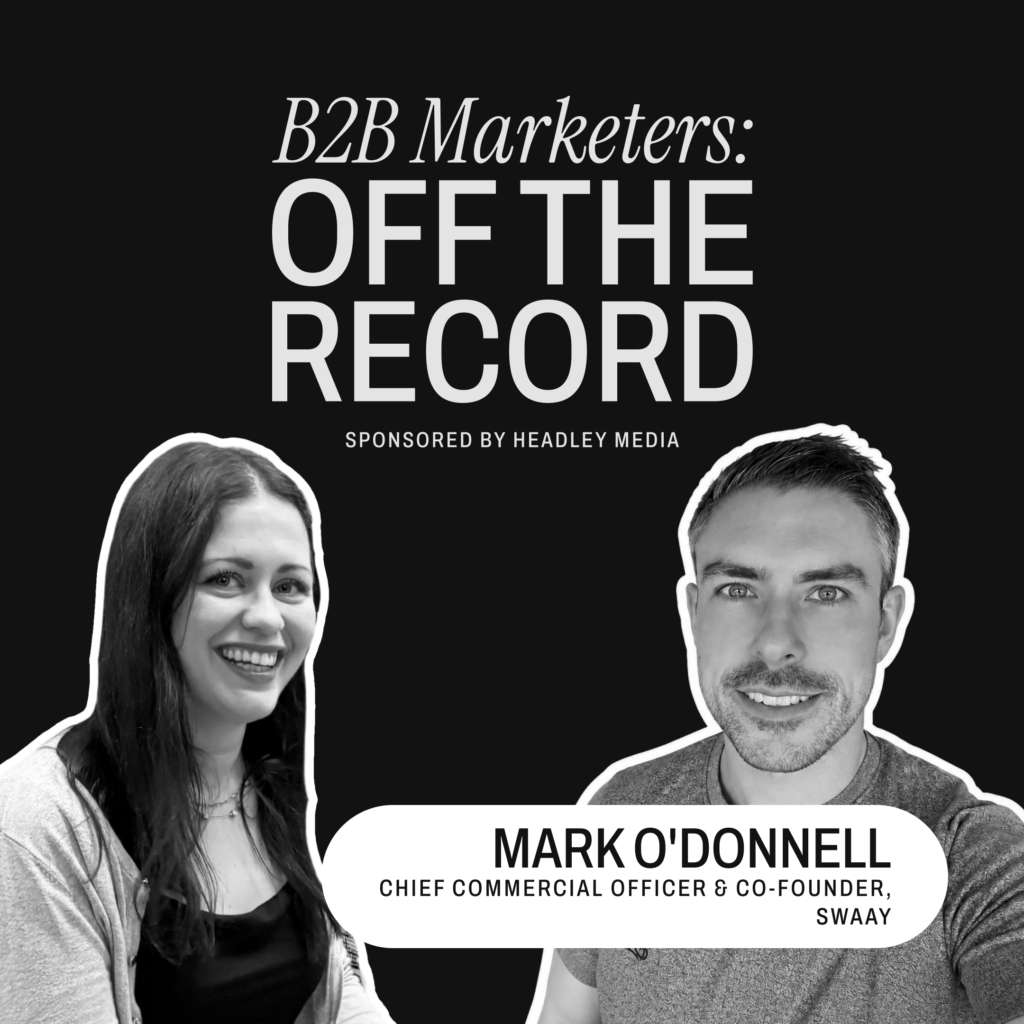
"The network as a channel in marketing is going to be so important as people look for really authentic voices and authentic content."
— Mark O'Donnell, Swaay
In this conversation, Mark O’Donnell shares insights on the evolving landscape of B2B marketing, emphasizing the importance of human connection, the impact of AI, and the need for alignment between marketing and sales. Mark and Chloe discuss the need for marketers to adapt to new challenges, and the significance of content creation and personal branding. They explore practical strategies for optimizing budgets, testing campaigns, and re-engaging existing customers while highlighting the role of AI in enhancing marketing effectiveness.
Takeaways


Chloe Addis (01:03)
welcome to B2B Marketers Off the Record. I’m delighted to be joined today by Mark O’Donnell, who is the GTM Marketing Consultant and Co-Founder and Chief Commercial Officer at Sway. Would you
Mark (01:16)
yeah.
Chloe Addis (01:17)
be able to introduce yourself, Mark, better than I can?
Mark (01:20)
Sure.
Thanks so much, Chloe. yeah, so my my role at the moment is some go to market consultant. very much working with small small tech tech startups essentially. I’ve
Chloe Addis (01:35)
Mm-hmm.
Mark (01:36)
been doing that the last just over a year. Previously, before that, I’d worked for about fourteen years in B2B Tech. so worked across HubSpot, LinkedIn, Oracle.
So very much enterprise marketing and sales. and more recently I’ve gone down the entrepreneurial route. So as Chloe pointed out, also building a company called Sway, so chief commercial officer looking after sales and marketing. So yeah, could kept kept busy, which is great, but it’s it’s an exciting space to be, for sure. And I think B 2 B marketing continues to evolve and throws new challenges that are always that always quite exciting. So here I am.
Chloe Addis (02:18)
Absolutely. And you’ve got that unique perspective, I think, now of having, you know, all of the history and experience in marketing. And now you’re kind of you’re having an identity shift, like coming going into founder mode. So that’s got to be throwing up all sorts of.
Mark (02:36)
Yeah.
Absolutely. But I I think from from my experience I’ve I’ve done a little bit of consultancy on the side for the last few years. So it’s not a leap of fate per se. It’s it’s kind of continuing doing a little bit more of what I was doing. my kind of goal was always to to move into the into my own into my own realm essentially, my own consultancy. So last year I decided, look, if if now then
you know, than never, or if not now, then ever. So
Chloe Addis (03:06)
Yeah.
Mark (03:08)
I kinda worked out that way. But yeah, one one of the things that I would have worked on over the last ten years specifically is in demand generation. I would have worked with sales and and business development very, very closely. So having to build marketing campaigns to drive sales
Chloe Addis (03:23)
Mm-hmm.
Mark (03:24)
has has been something very, very close to me and working with those teams very, very closely has has helped me to really
you know, dig into that end of the comp and the business and,
Chloe Addis (03:36)
Yeah.
Mark (03:37)
you know, t tie things together. So it’s
Chloe Addis (03:39)
Yeah.
Mark (03:39)
it’s a natural fit of course and it’s not natural to to every marketer to go that route.
Chloe Addis (03:44)
No, but having the, you’ll be able to build in that alignment, won’t you, with your commercial head on, and then apply that back and build the marketing in a way that you know it’s going to have an impact from the start.
Mark (04:01)
Yeah, for sure. And
I I think even with with startups like working with some of the startups as well is, you know, the first discovery call that you have with with some of the founders is, you know, we have this issue with the business or we have this issue with you know, with trying to get into a new market. And, you know, in in many ways it’s it could be seen as a as a sales and marketing problem. So straight away you’re you’re in problem solving mode when you’re looking at it from from many
different perspectives and there’s a lot of value you can bring then to to a co to a founder or a co founder which
Chloe Addis (04:37)
Yeah.
Mark (04:37)
really just want to understand what way their business needs to go and then what needs to happen. not only from from a marketing perspective, but how they get the sales team enabled, what type of, you know, materials and what type of insights that they need to actually, you know, drive business in in different markets with different products. So it’s a very kind of organic conversation that that
Chloe Addis (04:59)
Yeah.
Mark (05:00)
that kind of unfolds but again you need the you need the i the insight from different parts of the company to be to be there, you know.
Chloe Addis (05:07)
Yeah, sounds like you’re well placed to have that understanding. So how did you get into marketing in the first place?
Mark (05:15)
Yeah, so I suppose I’ve always been interested in the business side of things. I’ve always liked cool ads. So back in
Chloe Addis (05:24)
You
Mark (05:25)
the nineties like the Guinness ads were always really interesting and you know, there was there was a whole storytelling part behind the ads themselves that you could you could cram into, you know, thirty seconds. you know, obviously I wasn’t the target market when I was, you know, a kid, but
I mean the the the creative resonates. but then things like the Nike ads around the World Cup where all your your global soup superstars are
Chloe Addis (05:53)
Yeah.
Mark (05:53)
kicking a ball around the stadium or whatever like that, they’re they’re things that’s stuck. So I think from an early age it was like, I could could I could probably do something like that, I think.
Chloe Addis (06:02)
Yeah.
Mark (06:03)
like not really knowing what actually goes into being a marketer. that’s just the that’s the the dream that you’re sold, I suppose I suppose.
Chloe Addis (06:11)
Yeah.
Mark (06:12)
but I’ve I’ve s I’ve supposed I’ve always been an entrepreneur at heart. you know, like even even as a teenager, I’d cut cut lawns and wash cars and things like that. So you
Chloe Addis (06:23)
you
Mark (06:23)
kinda have to be out there selling your services essentially. And
Chloe Addis (06:27)
Yeah.
Mark (06:28)
you know, like if if you cut someone’s lawn, you upsell them to getting their car washed as well. So it’s it’s it’s
Chloe Addis (06:34)
You
Mark (06:35)
I mean, you’re doing on a bigger scale now, but it’s it’s it’s was always gonna give me energy and
Yeah, I just always found it interesting. So, I was never gonna be an accountant or you know, I was never gonna go around that end of business. So it was always gonna be something a little bit more so scrap scrappy in a way, but also more
Chloe Addis (06:56)
Yeah, yeah.
Mark (06:57)
more exciting, more where you’ve got a little bit more creative license to to to try things. So yeah, that’s
Chloe Addis (07:04)
Yeah.
Mark (07:04)
kind of that’s kinda where I where I started.
Chloe Addis (07:07)
Interesting. But not surprising that you’ve ended up where you are now with kind of all of that experience and it all kind of ties together. It makes it makes a lot of sense if those are your kind of drivers of something that you can see the growth in and you can have that impact then you know it all makes a lot of sense.
Mark (07:25)
Yeah. Absolutely. And
it’s you know, it’s it’s not you know, setting up your own company or doing your own solo consultancy is definitely not for everyone, you know, and it it
Chloe Addis (07:34)
Yeah.
Mark (07:35)
takes I mean it takes it takes first of all the person really wants to do it, you know, and
Chloe Addis (07:40)
Mm-hmm.
Mark (07:42)
I think when you’ve come from some great companies like HubSpot and LinkedIn and Oracle, you come with a bit of a brand. So you you do have
Chloe Addis (07:48)
Yeah.
Mark (07:49)
you’ve worked with a lot of really, really good people in their space and really good salespeople, you know
you’ve brought a lot of processes along. and then it’s a mix of whether the person really wants to do that or whether they just want to stay working for a big enterprise. And there’s obviously lots of merit to do that as well. So
Chloe Addis (08:07)
Yeah.
Mark (08:07)
yeah, that’s kind of brought to me to where where I am with with with the company I’m I’m co founder on Sway. I’m working with with a few of my buddies from school. Do you know
Like who who did who did s who
Chloe Addis (08:20)
Yeah.
Mark (08:21)
did who I was who I grew up with essentially. So in a way it’s an opportunity came up and we all have very different skill sets.
Chloe Addis (08:30)
Mm-hmm.
Mark (08:32)
but it just makes sure it makes sense that we’re we’re kinda back together and we’re we’re doing something a little bit different than what all of our careers were doing before. So it’s
Chloe Addis (08:41)
Yeah.
Mark (08:42)
it’s exciting. But look it again, it’s it’s not something that happens for everyone and you know, you
there’s a bit of luck that comes with it. But yeah, it’s it’s interesting. It’s an interesting path that I’m on.
Chloe Addis (08:54)
Yeah, it’s going to be
a very, very interesting time. And you you need that mix of different levels of experience and yeah, it will benefit the business, no doubt. So what’s one belief about B2B marketing you’ve changed your mind on in the last 12 months?
Mark (09:12)
Yeah,
I think it’s so obviously there’s there’s lots happening with with what AI is doing in general. you know, it’s brought up a lot of opportunities, and it’s obviously brought up a lot of threats in terms of what what areas different markers need to focus on and you know how how efficient operations and things could be. So one of the things that I was sort of on the fence with whether
I really understood it or not what was happening is specifically around the drop to like web the drop in traffic to websites in particular. So there’s there’s been a huge drop. A lot of people have seen a large drop to like blog content
Chloe Addis (09:56)
Yeah.
Mark (09:57)
and things like that across their website. I think even HubSpot came out, was it two years ago or something? They like eighty percent drop of traffic to the website. But what
Chloe Addis (10:04)
Yeah.
Mark (10:06)
what I’ve seen across a lot of my
my clients that I’ve worked with is the amount of traffic that they’re getting directly or that they’re getting pushed through from their activity on LinkedIn or other social channels. but also just coming through you know your your organic search. so one of the things I was kind of on the fence is like is SEO as important now as it used to be? And I think it’s actually nearly more important.
Chloe Addis (10:35)
Yeah.
Mark (10:38)
Whereas like it’s kind of it’s kind of counterintuitive to think like, okay, do we need to how do we how do we try and measure all of the the dark social that happens? So obviously there’s been you know, there’s been increase in like Reddit communities, Slack groups, WhatsApp groups
Chloe Addis (10:54)
Mm-hmm. Yep.
Mark (10:56)
where where these conversations are happening. but when when people actually come to your website, they’re converting better. They’re doing the pre qualification on other sites.
Chloe Addis (11:03)
Yes.
Mark (11:05)
and other other mediums or or in person. whereas a few years ago there was always that that that trend was was starting where it was like, look, these are all happening, but we don’t really know how to measure it. So we’re just going to continue
Chloe Addis (11:22)
Yes.
Mark (11:23)
to measure like our our our meta ads or our PPC. But
Chloe Addis (11:28)
Yes.
Mark (11:28)
now it’s actually becoming far more evident because obviously people are getting ranked in the LLMs.
Chloe Addis (11:33)
Yeah.
Yeah.
Mark (11:36)
and those leads are they they they can work very, very well because they’re very qualified. They’re very f very qualified leads. So
Chloe Addis (11:40)
Yes.
Mark (11:44)
that’s one thing that’s I suppose has changed my mind has changed and and it to be honest, it’s actually continuing to change. The more data comes out, the more then you can you can see what works. but then
Chloe Addis (11:54)
Yeah.
Mark (11:55)
peop the way people use AI is is is shifting as well. So that
Chloe Addis (11:59)
Yes,
Mark (11:59)
could change again.
Chloe Addis (12:00)
it is. Yeah. I think it’s sort of, yeah, every week you see a new LinkedIn post with, you know, they’ve updated the algorithm. And so now this is less important. And I think there’s obviously marketers will identify with the need to be really flexible and agile with, you know, their strategies around it, because like you say, it’s changing so frequently. And yeah, you can, I mean, that’s a, that’s a good way to.
look at it because it did raise questions of okay what’s going to be important in making sure that we rank in LLMs and it is a whole process and then now I think most people are sort of erring on the edge of well actually it is still really important those core principles of SEO of making sure that the content is unique and valuable and you know has expertise within it is even more compelling for LLMs now.
But it is, like you’ve said, it’s more about making sure that the wider picture and all of those things are working together so that you have that level of influence. But it’s harder, like you’ve just said, that people are doing their own research in their own time with their whichever LLM chosen chat of choice. And so you have less controls, but you need to obviously, as marketers, retain that level of influence.
wherever they are. So knowing your customer and understanding what they want
Mark (13:32)
That’s it.
Chloe Addis (13:33)
at what particular time is just, it’s only growing in importance, isn’t it?
Mark (13:38)
Absolutely. And I think with you know, it it puts so much importance onto the website because if there’s less traffic to the website, the traffic that does get there is highly qualified. They
Chloe Addis (13:49)
Yes. Yeah.
Mark (13:51)
they genuinely have a requirement for what you’re selling. So
Chloe Addis (13:55)
Mm.
Mark (13:56)
making the conversion at that point is crucial. You know,
Chloe Addis (13:59)
Yeah.
Mark (14:00)
you can’t afford to have broken forms or broken workflows, you know, at that point. It’s
It’s it’s nearly
Chloe Addis (14:06)
Yeah.
Mark (14:07)
more important that the the user flow is is watertight then on the website. But obviously like getting the
Chloe Addis (14:13)
Yeah.
Mark (14:15)
person to that point, there’s a whole world of of channels there that you know, I don’t
Chloe Addis (14:21)
Yeah.
Mark (14:21)
think anyone has fully cracked them all. There’s no playbook at the moment, there’s ideas. but yeah, absolutely, absolutely. And
Chloe Addis (14:26)
No, Yeah, lot of testing going on.
Mark (14:33)
you know, some of the tests are are great and then
Many of them,
Chloe Addis (14:36)
Mm.
Mark (14:36)
you know, were not really resulting in a lot, but it’s
Chloe Addis (14:40)
Yeah, yeah.
Mark (14:41)
just a it’s an interesting space at the moment.
Chloe Addis (14:43)
It is really hard. think marketers are being tested, aren’t they? They’ve always said, well, I’d rather less traffic that’s actually more, you know, that’s going to deliver something that’s more engaged. And now that we have that, you know, but where’s all the traffic got, you know, you’re still asking
questions.
Mark (14:59)
Yeah.
Chloe Addis (15:00)
So yeah, there’s, there’s a lot of tests. so what shifts would you say you’re really seeing in how B2B buyers?
are behaving, you know, we’ve mentioned a few there of like the research stage.
Mark (15:14)
Yeah, yeah, that’s it’s a great one because again this is this has changed as well. I think what what I’m seeing is buyers are they’re jaded with online. You know,
Chloe Addis (15:28)
Mm. Mm.
Mark (15:30)
like thankfully LinkedIn have tidied up their their algorithm and what gets what gets shown
Chloe Addis (15:37)
Yeah.
Mark (15:37)
at the moment because until about six months ago it was just all
AI driven lead magnets that provided very little that very little value. some of them some of them like you know, like when they come out you you you test them out and you figure out pretty quick that like these are no good. Now there’s probably some
Chloe Addis (15:58)
Yeah.
Mark (15:59)
of them that probably were great, but it’s it’s refreshing now that the content has gone more back to promoting actually like human written content, like focusing
Chloe Addis (16:11)
Yes.
Mark (16:11)
on on
problems that customers or process might have.
Chloe Addis (16:16)
Mm-hmm.
Mark (16:17)
so like the it’s great to see that come back up. but what what I think the the shifts are are showing to me is that, you know, there’s problems still need to be solved and there’s solutions out there and it’s trying to connect up those opportunities. And with with the move, I suppose, you know, you’re coming out of the post COVID area where where everyone’s just been online all the time.
Chloe Addis (16:40)
Yeah.
Mark (16:41)
There’s lots like there’s there’s a big appetite for, you know, the for round tables, going to events, micro events,
Chloe Addis (16:50)
Yeah.
Mark (16:51)
or like, you know, just like break not even breakfast briefings, but things are a little bit even more informal than that, like a coffee before work, where
Chloe Addis (17:00)
Yeah.
Mark (17:00)
you go and discuss things in in your industry or or in your in your function or in your in your career.
Chloe Addis (17:07)
Yeah.
Mark (17:08)
there’s a lot of I see a lot of value in those and
I’ve I’ve gone to quite a few myself.
Chloe Addis (17:13)
Yeah.
Mark (17:14)
and what I’m finding is I actually make the effort now to to travel to these events where before it’s easy to jump on a webinar, you know, on your lunch break or or
Chloe Addis (17:23)
Hmm.
Mark (17:23)
even at work. but you know, I I’ve gone over to London a few times in the last year. I’m I’m in I’m just outside of Dublin in Ireland, but it’s it’s worth me flying over, going
Chloe Addis (17:35)
Mm-hmm.
Mark (17:36)
and actually speaking with people and discussing
important topics in person and networking
Chloe Addis (17:39)
Yeah.
Mark (17:40)
in person and it’s worth that time investment. you know, I can get over to London for fifty quid with Ryanair, but I mean, that’s not really the point. It’s it’s the it’s the in-person. and I
Chloe Addis (17:50)
Yeah. Yeah.
Mark (17:52)
see that across a lot of my other, you know, colleagues and and on network as well.
Chloe Addis (17:57)
Yeah.
Mark (17:58)
so I think I think that will continue for sure. you know, people want to be out and about and kind of have
Chloe Addis (18:04)
Mm-hmm.
Mark (18:05)
like tangible results.
So I see that being that being a big one as well. and generally even like, you know, from from a sales perspective, it’s much easier to sell in person in general, you know, than than it is over, you know, if you meet someone online or whatever, it’s it’s you know, it can be done of course and it is done. But it’s far easier to do it if you can get in get out in front of per of a person, go
Chloe Addis (18:31)
Yeah.
Mark (18:31)
for a stroll with them, go for a coffee, you know, it’s it’s far more organic that way.
Chloe Addis (18:35)
Yeah, think that, I mean, absolutely from the conversations that I’ve been having that definitely reflects what you’re saying. The rise of the importance of communities and these events that build real human connection because you’re absolutely right. People are struggling to wade through all of that content, all of the AI influence and actually, you know, be able to identify.
what the best solution is for them. So yeah, these things are becoming far more, it’s just a huge change. It’s almost going back. Like we’ve waited long enough and then we’re kind of going backwards in time to how things used to be and much more kind of on a personal level, doing those kind of like having those sales conversations as you’ve said.
What do you think, what’s the strategic bet you think more marketing leaders will need to make over the next couple of years?
Mark (19:40)
I suppose I think it touches nearly back on one of the last points it made was how to to drive more events and like more investments into the channels that the buyers are going to and that they’re engaged at. So I think
Chloe Addis (19:56)
Yeah.
Mark (19:58)
one of the great hybrid ones is like just the webinar, the basic webinar. Do you know?
Chloe Addis (20:04)
Mm.
Mark (20:05)
It’s it’s low cost,
can be very much a digitally driven event. but it can pack in a a ton of value into into an hour or into forty five minutes.
Chloe Addis (20:19)
Yeah.
Mark (20:21)
so I like I I really think that from from a cadence perspective as well. Like I mean most most small companies can can have something maybe you know once a month or once every two weeks. But I think it’s the the cadence that
once sales and marketing are behind it, it’s something that
Chloe Addis (20:39)
Mm.
Mark (20:39)
happens every two weeks and then over time the operations get more slicker and more efficiency are gained out of it. So I think simple things like webinars or something that happens on a regular basis is crucial because you’ll know yourself, Chloe from from your agency that, you know, you produce a one hour, you know, one hour show and then you get like seven or eight clips from it.
be seven or eight posts, seven or eight
Chloe Addis (21:08)
Yeah.
Mark (21:09)
angles. you’ve got your your you know your email marketing content you might have a nurture stream that comes out of it
Chloe Addis (21:18)
Yeah.
Mark (21:19)
but also it’s just another it’s another touch point for any open sales that’s not really like it’s not selling to them directly but again it’s it’s it’s
Chloe Addis (21:27)
Right.
Mark (21:28)
adding value I think that type of format will will continue. And the fact is that
it can be done at a low enough cost.
Chloe Addis (21:37)
Yeah.
Mark (21:39)
but it’s it’s again it’s it’s focused around people, it’s focused around bringing in, you know, if it’s if it’s like reference customers, which they can talk through their challenges and their solutions. or if it’s someone who is like a thought leader in the space that they sell to, you know,
Chloe Addis (21:55)
Yeah.
Mark (21:55)
there there’s value to be had there. and I think that complements with the
You know, like anyone who’s who’s gone to a few webinars, I think it’s it’s a good next step is to get them into a room somewhere where you have like ten, fifteen people and then you discuss some of the the core topics within the industry in person. now it can be it can be a lot of value for the visitors, but also it can be quite a powerful sales tool, obviously, as well. So
Chloe Addis (22:22)
Yeah,
absolutely. That’s really interesting that you said that because, you know, it’s a tried and tested format, but they’re the ones that kind of get overlooked a bit really.
Mark (22:33)
Absolutely.
Chloe Addis (22:34)
You know, from a lead generation perspective, they work, as you’ve mentioned. it’s
Mark (22:39)
And
Chloe Addis (22:39)
a really interesting one to beat the drum for the good activity that really does contribute.
Mark (22:47)
Absolutely.
And and even, you know, if you think if you think about it like in a world of AI, it’s it’s quite it’s still quite a human it’s a human driven one.
Chloe Addis (22:56)
Yeah.
Mark (22:56)
Like the the the marketer or the the creative is going to come up with what’s the topics that are most important? What does the data tell me where the topics are most important? What are what are customers asking for? What’s their pain points and what do we actually need to address that if ten of our customers have customers have this particular issue and we have a solution.
There’s probably going to be another 500 out, you know, in in the in the market that could do with this information.
Chloe Addis (23:21)
Yeah.
Mark (23:23)
But I think where where AI comes in there as well is the the help on just the operational lift on it. Because even w
Chloe Addis (23:31)
Okay, yeah.
Mark (23:32)
we’ll take, for instance, you know, you know, like a lot of we’ve seen a lot of people write AI generated stuff and generally it’s not great. Like, I mean, there’s there’s varying opinions on that.
Chloe Addis (23:45)
you
Mark (23:45)
It can get you a good bit of the way there, but I need someone who’s actually a a copy copywriter
Chloe Addis (23:49)
Yeah.
Mark (23:51)
to to to pull out the most value and get an actual piece that’s that’s compelling to read.
Chloe Addis (23:57)
Mm-hmm.
Mark (23:58)
so there’s that part that needs to go in there. But in terms of getting an operation in the background run to produce, we’ll say like a regular event, that’s where like that’s where Claude within the company is really, really important. and I
Chloe Addis (24:11)
Mm-hmm. Mm-hmm.
Mark (24:13)
think can really help there.
but again it’s that human layer still that is that’s gonna create a good content, you know.
Chloe Addis (24:22)
Yeah, yeah, coming back to it, putting humans and like you said, you know, in front of the camera and having those real life conversations, but using AI, that’s a really good kind of practical example of actually how to use AI to make things faster and level up. And like you said, get that kind of cadence and organisation structure behind it. That’s
Mark (24:43)
Yeah.
Chloe Addis (24:44)
yeah, really good example.
Mark (24:46)
I think one one of the things I just add there as well is that I think even not not to say that not to hang my hat on webinars, but it’s more just like that regular event because I think that’s one thing that really gets sales behind a marketing initiative because it’s like we’re driving this webinar, it’s focused on your customers’ problems.
Chloe Addis (25:05)
Yeah.
Mark (25:08)
you need to go and get these customers into the room or these prospects that you’re speaking to into the room for the webinar because it’s going to get them value.
gonna help you you know move along a deal if if that’s what their challenge is.
Chloe Addis (25:20)
Yeah. Yeah.
Mark (25:22)
but again it’s like it’s metrics driven, it’s aimed at driving you know pipeline into a room. It’s it’s a very logical conversation for
Chloe Addis (25:30)
Yeah.
Mark (25:31)
you know in terms of getting sales on board because in fairness in in many smaller companies where it’s a small marketing team, you need to work hand in hand with sales to to drive your marketing initiatives, you know. So
Chloe Addis (25:46)
Yeah.
Mark (25:44)
It’s a it’s an important one to add as well.
Chloe Addis (25:46)
Yeah, I think, I mean, it’s just so important and it’s really valuable to get your perspective on that as someone who is obviously creating this function that you, where you like we’ve, we’ve spoken about where you want to have marketing and sales kind of aligned from the beginning, but you’ve worked at HubSpot in the past and kind of, know, with that focus on MQLs and like,
lead generation and inbound methodology. Things are changing, but it’s important to retain, like you said, of the, it’s the alignment piece, I think, isn’t it? That’s the the piece that most frequently goes awry is marketing focusing on like, you know, running a webinar for webinar’s sake and to generate, you know, numbers.
But I think that’s kind of what I’m getting from what you’re saying is the important pieces there is the sales alignment.
Mark (26:45)
Yeah, for sure. And I think one of the other areas from a marketer’s perspective in this age where we’ve got where everything is so digitally run, the mark the
Chloe Addis (26:55)
Mm-hmm.
Mark (26:56)
marketer essentially they’ve they’ve nearly as much information in the company as the CFO or the CEO. You know, they they’re more information than sales. So I think
Chloe Addis (27:03)
Yeah.
Mark (27:06)
in in many scenarios where the marketing team own, like the CRM and the products in the CRM
they’re in that unique space to be able to go with a, you know, consultative approach to the sales team. It’s like we’re seeing these is the trends we’re seeing. This is where, you know, these are the the hot topics that we need to create a marketing care campaign around. And we’re gonna need your help to be able to run that. And I think where you’re going specifically to hear like your outbound reps, most reps obviously will will have a big outbound part of their job, but if you can go to them
with a bunch of accounts with a bunch of messaging and insights to say like, okay, when you open up your your HubSpot or your or your sales force of a morning, where do you start? And like usually that’s a good place to say like, okay, we’ve got an upcoming webinar or X competitors doing X, Y, and Z. We need to respond or we need to get our prospects in in this cohort on the phone to do X, Y, or Z. You know, Mar marketers are in the position to be able to to give that.
You know, and that’s one area that I think the more insights we get, the more that the teams need to need to look at that part of how they support sales, rather than just chucking leads at sales, which is obviously a big part of marketing and getting more qualified qualified leads. But if you can
Chloe Addis (28:26)
Yeah.
Mark (28:27)
get something in between that’s direction and insights, I
Chloe Addis (28:29)
Yeah.
Mark (28:30)
think that’s that’s a big area that we can help from marketers.
Chloe Addis (28:33)
Yeah, yeah, it all slots together when you’re looking at it from this wider perspective, really, the business commercial aspect, which is, you know, it should be one of the things that marketing really does focus on because they’re so instrumental in that contribution to revenue. yeah, it can be it can be kind of masked by the activity overall and kind of achieving different goals.
So what is something that you think Teams is still currently doing that no longer works?
Mark (29:10)
So
I reckon in a lot of places, teams are probably just still running the the old playbooks, you know.
that would have worked five years ago. and then wondering why, you know, there’s diminishing results.
Chloe Addis (29:25)
Yeah.
Mark (29:25)
and it it to be fair, it’s it’s it’s a hard shift because in a lot of these bigger companies there’ll be there’ll be processes and teams set up around these these workflows.
Chloe Addis (29:35)
Yeah.
Mark (29:35)
And
You know, like when when the CFO or when the you know, when the leaders look at the the numbers and understand it’s like, look, okay, we’ve produced this amount of revenue and pipeline over the last four or five years from these channels. what way are you looking at the next year? You know, and and
Chloe Addis (29:58)
Yeah.
Mark (29:59)
from a if you’re looking at it from a startup’s perspective, you can go, okay, we’re just gonna completely do something different and see
how we go.
Chloe Addis (30:05)
Yeah.
Mark (30:07)
not as hard not as easy to obviously, you know, in in a larger company.
we’ve
been able to to tell that story from the data to say like look
While we do have less traffic to the website, it converts much, much better. And then
Chloe Addis (30:22)
Mm-hmm.
Mark (30:23)
if you can demonstrate then the work that you’re doing off site and how that comes back to the website, again it’s it’s a it’s explaining to someone who’s in sales what direct what direct traffic is. Not everyone knows what
Chloe Addis (30:35)
Yeah.
Mark (30:35)
direct traffic is, but we know as marketers that it’s one of the most highly efficient traffic you’re gonna get to your website. So
Chloe Addis (30:42)
Yeah.
Mark (30:42)
explaining the story of how how that
comes
about is is going to be really important.
Chloe Addis (30:48)
Mm.
Mark (30:49)
so I I think there’s there’s there’s a shift in my mind where it’s been able to take those little steps toward solving where their buyers are.
Chloe Addis (31:00)
Mm-hmm.
Mark (31:01)
but I think marketers really need to get like literate in in in numbers and sales speak.
Chloe Addis (31:10)
Yeah.
Mark (31:10)
I see that as a big gap still.
Chloe Addis (31:13)
Yeah.
Mark (31:14)
So we’ll take we’ll say like marketers who are not in demand gen or like even field marketing, if they’re
Chloe Addis (31:22)
Mm.
Mark (31:22)
very from a very creative end of marketing, I think
Chloe Addis (31:25)
Yeah.
Mark (31:25)
to help those conversations, a leader should be saying to like, look, we’re doing this because it’s going to fit into this campaign. These are the business results that we’re we’re communicating to the board, we we need to get out the back of it. And then it helps them put more commercial value on their work, if that makes sense.
Chloe Addis (31:41)
Yeah.
Mark (31:43)
And again then it’s it’s more defensible then from you know, sales comments like let’s get onto the the colouring in department and see what they have for us. You know, we’ve
Chloe Addis (31:52)
Yeah.
Mark (31:53)
all been through that. So I think it’s it’s the the whole function has the ability to step up in terms of their credibility and how they show up to sales. So I think this is a great time to be able to do that. But yeah, I th I think that’s where where marketing will continue to to gain more credibility and
in
how they commercially look at the business. now I can
Chloe Addis (32:15)
Yeah.
Mark (32:15)
probably say that from my perspective ’cause I’ve seen it, but it’s it’s kind of what I’m seeing a lot at the moment.
Chloe Addis (32:23)
Yeah, it’s, I mean, it’s difficult, isn’t it? There’s so many things that marketers have to deal with. like, you know, we’ve mentioned a few of them being, you know, everything has changed in such a relatively small amount of time. Like you said, the playbook from five years ago, it’s not working now, but you know, these
Marketers who are in these larger organizations that move a lot slower are probably finding that they’re coming up against these challenges more than as you’ve said, kind of these smaller, more agile teams who are able to work closer with the rest of the business. So like you said, marketing has more knowledge of that they can share with sales in a smaller business. That’s that transition often is there because you know, it’s just
going to speak with your colleague, whereas in large organizations that you all have worked with and we work with in kind of technology spaces, it’s easier said than done, isn’t it? like, yeah,
Mark (33:24)
It is.
Chloe Addis (33:26)
being able to kind of test and, have, like you said, be being literate in the finances, but also in like, as you’ve mentioned as well, you know, justifying why brand needs the spend and kind of all of those.
things are difficult to not only express, to express
Mark (33:46)
Horse.
Chloe Addis (33:47)
to the right people at the right time. Like, you know, there’s so many elements to it, isn’t there?
Mark (33:52)
Yeah. I think even you know, like I’ve I’ve I’ve worked a lot obviously with startups, but from when when I worked at LinkedIn and HubSpot say for instance,
Chloe Addis (34:04)
Mm.
Mark (34:04)
one of the ways that we’d get tests done is essentially looking at, you know, your your your media budget for for the region or whatever and saying, Look, if we were to take ten or fifteen percent away from that, what would that mean in terms of
you know the projections from from a pipe or revenue perspective and what we do is essentially go and we’d look at everything and say could we could we reduce costs here or could we get better creative or could we get better targeting in our audience and in most cases you can like especially
Chloe Addis (34:41)
Mm.
Mark (34:42)
with big with with bit large demand gen machines which is like a global playbook slightly regionalized not even localized
Chloe Addis (34:50)
Yeah.
Yeah.
Mark (34:51)
So
especially at Plural Site, educational technology company I worked with in the past,
we used to take ten percent a minimum of our media budget and run on tests. So it could be
Chloe Addis (35:04)
Mm.
Mark (35:05)
a local language test or it could be a specific segment of the UK which would have completely different needs to the rest of the market. But in most of the tests we run, we just we’d simply get better metrics. We’d spend less and we get more out of it.
Chloe Addis (35:21)
Mm.
Mark (35:21)
And then
we go, okay, next quarter we’re moving that into our controlled programs. And
Chloe Addis (35:26)
Yeah.
Mark (35:26)
it would be no it wouldn’t even be it wouldn’t even be challenged. It would be like, how do we do this in other areas? So it’s kind of as long as the as long as there’s that testing culture within some teams, that’s it’s possible.
But it again, it’s it’s it is slower.
Chloe Addis (35:45)
Mm.
Mark (35:46)
and you have to make sure if you’re taking budget off
of the tried and tested, you you need to make sure that over all your tests that you’re going to come out on top. but in most cases you will because you’ll have a team behind you and you’ll have insights and
Chloe Addis (36:01)
Yeah.
Mark (36:02)
it’s going to be it’s going to be better for your for the bottom of your of your target accounts we’ll set.
Chloe Addis (36:08)
Again, that’s a really good practical thing to implement and go, right, okay, well, this is how you prove it, because money talks, doesn’t it? If you’ve actually managed to test it and you’ve got that kind of budget cordoned off for things like that, then that’s the quickest way to find out, isn’t it? You’re not saying I’m…
this is the full strategy that you won’t buy in for. It’s actually just a little bit. I’ve already proved it works. So it’s a no-brainer, isn’t it, when you’re then going
Mark (36:41)
Exactly.
Chloe Addis (36:42)
back? Very, very clever. And a good reminder, know, for that’s how you communicate in terms of money and with the kind of people that are going to be making those decisions.
Mark (36:53)
That’s that’s
absolutely it. Yeah. and I think it’s that’s it kind of goes back to, you know, the obviously people who are in demand gen will do it’s more natural to them. They have to they
Chloe Addis (37:07)
Yes.
Mark (37:08)
have to make get the most out of all their programs from a from a commercial perspective. but again, if we’ll say someone on the team who mightn’t be commercially as driven as others might come up with a great
Chloe Addis (37:18)
Mm.
Mark (37:19)
marketing campaign and be like, I’d love to run this, but sure
Nobody’s gonna give me budget. Well, maybe they might. You know, if
Chloe Addis (37:24)
Yeah.
Mark (37:26)
if it’s framed in the right way and
Chloe Addis (37:28)
Yeah.
Mark (37:30)
I think if it’s communicated and it’s story, like marketers are good storytellers.
Chloe Addis (37:34)
Mm.
Mark (37:35)
so it’s it’s trying to land land a story and say, by the way, this would be the output over time and this is what we’re measuring ourselves against. So there’s
Chloe Addis (37:45)
Yeah.
Mark (37:46)
and I to be honest, I think a good marketing leader should be able to help frame that.
specifically
Chloe Addis (37:51)
Mm.
Mark (37:51)
for like the more junior creatives on the team who mightn’t have the background of working with sales and working with business leaders and things like that.
Chloe Addis (38:01)
Yeah, it’s a good framework and methodology to have and adopt there. So we’re on the kind of subject of where to spend your money and how to kind of talk in monetary terms and communicate that across the business. What type of investment at the moment would you say that marketing leaders should protect even if their budgets are tightened?
Mark (38:25)
Yeah.
so I think around content production for sure. I think in terms of the cost of producing something that’s pretty high level, high quality,
Chloe Addis (38:41)
Mm.
Mark (38:41)
versus running running an ineffective ad, I think there’s far more less risk in producing a good piece of content, if that makes sense.
Chloe Addis (38:51)
Mm-hmm.
Mark (38:51)
So where we see, you know
rising CPMs and cost per clicks on across a lot of the the ad platforms. I
Chloe Addis (39:01)
Yeah.
Mark (39:01)
think one of the areas that marketers need to kind of make sure they’re ring fence is have enough budget to create good content that you can get out from an organic perspective on new channels. So like you look at like like the TikTok say for instance, like that’s that’s a huge channel from an org organic perspective.
I don’t know a lot about it my myself personally. But
Chloe Addis (39:27)
Yeah.
Mark (39:28)
people who I’ve worked with do. And that’s great because
Chloe Addis (39:31)
Hmm.
Mark (39:33)
there’s there’s actual property the potential for organic reach there. Just like LinkedIn would have been six, seven years ago where founders or people started to bing build up their their audience there. that next channel is is there, whether it’s TikTok, whether it’s something else that I haven’t heard about yet, who knows?
There’s there’s always gonna be that need for creating good content, quality content that solves actual problems and figuring out how to distribute that for as cheap as possible. So that challenge is going to remain. And I think a certain amount of budget needs to be put in order to get to that part.
Chloe Addis (40:13)
Mm-hmm.
Mark (40:14)
the other area which is quite cheap at the moment is and many many marketers or many
marketing teams own the budget for like account enrichment to to fund signals and things like that that might own their clay or Apollo or Lemlist
Chloe Addis (40:33)
Yeah.
Mark (40:33)
or whatever might they might own the tools. and one of the areas that I’ve seen a lot of value in is again it’s working closely with sales. Sales get it and you’re supporting
Chloe Addis (40:44)
Mm-hmm.
Mark (40:45)
their activity. So working with getting the right signals to identify
relevant people within your ICP doing X, Y, and Z actions across the internet and been able to serve those up to sales. So
Chloe Addis (41:02)
Yeah.
Mark (41:03)
we’ll say, you know, identifying key signals. So whether it’s hybrid signals or whether it’s problem identification or someone like if you’re a CRM company and someone is turning off HubSpot, you know, make sure you get onto them and it’s just trying to fund
the I suppose it’s like the your warm outbound, your warm to cold outbound engine. but what that does as well is that actually creates a content requirement as well. Because what you can see
Chloe Addis (41:32)
Yeah.
Mark (41:33)
is like if we have, let’s say there’s ten thousand of our target accounts and of those ten thousand, you know, two or three percent are going through this challenge, there’s a market account. You know what I mean? It’s
Chloe Addis (41:46)
Mm. Yeah.
Mark (41:47)
it’s using the insights and then it’s getting sales involved.
Chloe Addis (41:51)
Mm-hmm.
Mark (41:52)
So those two areas I think are really important. And to be fair, they’re they’re quite low lift. They’re quite low, low,
Chloe Addis (41:59)
Mm-hmm.
Mark (42:00)
low budget.
Chloe Addis (42:01)
Yeah.
Mark (42:02)
whereas I think if you move more into the enterprise, it’s really looking at if you’re protecting your your ad budget, like your retarget re good retargeting campaigns are so there’s there’s such a better
return
versus your cold campaigns. So like cold campaigns
Chloe Addis (42:23)
Yeah. Yeah. Yeah.
Mark (42:25)
are generally they’re generally a poor poor return. Now
Chloe Addis (42:31)
Mm.
Mark (42:31)
there’s parts of those you can optimize from from an audience perspective, but like if you had if you had to say, I need to cut eighty percent of my ad budget, we’ll be putting the whole lot into your retargeting and driving your traffic to the website. yeah, they’re the main areas. There’s probably a few more there, but they’re the main ones.
Chloe Addis (42:45)
It’s an interesting one.
No, that’s really good because they work together, don’t they? Which, you know, it makes sense. you know, you’re putting the money into something that you’re going to need, you know, the content and finding the audience then becomes the easier path that once you know
Mark (43:10)
Yeah.
Chloe Addis (43:11)
you’ve got the right content and then you can…
make sure to test those areas. Like you said, you can kind of put them in different pockets and say, well, we’re going to test this new distribution method. But yeah, absolutely. I mean, to your point around kind of reaching new customers versus engaging old ones or working on what you’ve got already within the CRM or, you know, potentially in lots of different places, data is stored across the business. It’s
We, yeah, we, we often have the conversation with our kind of clients on around that net new, like does it need to be new? Like, you know, we’re, we’re, focusing all this money and effort. Whereas we could be re-engaging, re-nurturing, know, existing customers, existing lists, existing, you know, there’s, there’s a whole world of opportunity that is just really easy to overlook because we are trained in that.
like new numbers sort of MQL focus that is like you say, know, of a previous playbook era, if you like.
Mark (44:23)
That’s the
thing and it’s it’s interesting as well ’cause even even adding into the into the the content perspective. So if if I’m looking at double down doubling down on the content part, like even
Chloe Addis (44:36)
Mm.
Mark (44:37)
even if I’m hiring, we’ll say, or if other marketing leaders that I’ve spoken to are hiring, they might look at someone coming in as part of their as part of the of the screening to say like what’s their LinkedIn presence like? Or like what’s
Chloe Addis (44:51)
Yeah.
Mark (44:51)
their
How many how many relevant followers have they and how many could they reach out to on the first six weeks and
Chloe Addis (45:00)
Mm-hmm.
Mark (45:00)
open up conversation that will result in you know in in pipeline? that’s a that’s a big consideration as well, because you’re you’re almost looking at the person as a marketing channel as much as
Chloe Addis (45:13)
Yeah.
Mark (45:14)
obviously being a being an employee to do to do something within the company. So I think that’s another trend that
that will continue. because there’s generally on LinkedIn I know from like you look at your company profiles you post something on the company profile and you post something on the individual profile and that individual profile will get ten or twenty X the amount of impressions. So like
Chloe Addis (45:41)
Yeah.
Mark (45:42)
there’s just such a bang for your buck for getting people within the company to increase their their viewpoint.
And you know, they’re absolutely yeah.
Chloe Addis (45:51)
Yeah, the personal branding. goes hand in
hand with like you’re saying, kind of, you know, the communities that in-person events is it comes down to the individual, doesn’t it? And what connections they have and can make. It’s a completely different way of, of seeing it. And again, marketing, working with sales and kind of other key people within the business to get the brand out. It’s just every
Person is a channel now as well, aren’t they?
Mark (46:23)
That’s that’s it exactly. And I think even you know, it works it works probably it’s it’s more black and white almost at the smaller company level. So like I’ll give you from my per my perspective, like almost all of my clients through my own business have been through LinkedIn. And, you know, like
Chloe Addis (46:40)
Yeah.
Mark (46:41)
I post a bit. I don’t I definitely don’t post as much as I should do. but again it’s it’s the network as a channel
in marketing is gonna be so important I think in the next few years as
Chloe Addis (46:55)
Yeah.
Mark (46:55)
people are looking for like really authentic voices and authentic content where obviously anyone can just pump out LinkedIn con or sorry, not LinkedIn content but AI content. And in most cases, you know, if the person can’t back it up or don’t really know what they’re talking about, there’s there’s there’s no point. There’s no value.
Chloe Addis (47:16)
think what you’ve said, I think already answers this question. was going to just ask you one of the questions that we’ve had in from another guest.
Mark (47:25)
yeah.
Chloe Addis (47:25)
Lindsay O’Brien asked us, what do you think will reshape your marketing organization based on buyer behavior in the next five years? And I think that…
we’ve kind of just almost said the answer to that is kind of that real focus on the individual but sorry I mean there was yeah
Mark (47:47)
Yeah, sure. No, I’m just thinking
was there anything else I’d add to that?
No, not not really. I think the only thing I would ac actually add into this is one of the areas that and it’s going back to a point earlier we made where the shift in what marketers priorities are is they
Chloe Addis (48:09)
you
Mark (48:09)
need to look at it from it’s easy to report on we’ll say the company LinkedIn page stats because they’re in it, we’ll say. It’s harder to report on
your CEO’s LinkedIn profile or a salesperson who who’s always out in the field. It’s it’s harder to do it. But it’s something that should be done or it should be done in some way. And that’s where AI can probably help. AI can probably set up a workflow where the the CEO’s like conversations or whatever gets downloaded and gets uploaded then into into HubSpot or whatever, whatever medium you you need the insights in. But what
I reckon is that if more people have those insights to say like what is actually this founder ledge, individual ledge marketing techniques or marketing channel, how are we actually measuring that? And and in most cases, if you speak to a salesperson who does it, they’re like, Yeah, I’m getting leads in the whole time. Like I’ve I’ve had so many different conversations. So it’s like it’s it’s working on the qualitative side. So being able to demonstrate that.
To say like, yeah, we’ve we’ve actually stopped putting priority here in terms of where we’re putting our content and we’re getting to we’re getting it out from the individual’s perspective. I’ve seen one or two companies where they’ve incentive they’ve incentivized the channel, so they’ve funded
Chloe Addis (49:35)
Mm.
Mark (49:35)
the channel to incentivize some people to do it, which I mean is it’s it’s a good idea, I think. But
Chloe Addis (49:41)
Yeah.
Mark (49:42)
what they will see is that they get to a point where alm one of the best forms of ads on LinkedIn is thought leadership ads. So
If your CEO can can post something that organically reaches a good audience that is engaging, putting money behind that is a probably a smart move, you know. So I think they’ll look at it from from that perspective and then that ad can be obviously managed and tweaked and the audience and and things like that can all be can all be tweaked in in campaign manager. So it’s kind of moving toward that I feel. But
Chloe Addis (50:16)
Mm.
Mark (50:17)
again, you need people posting from their individual accounts.
Chloe Addis (50:21)
Yeah, it’s the systems, I suppose that, like you said, of that applying AI there can help you to manage those, like, essentially duplication of tasks, isn’t it, to have the same across the team. But yeah, potentially so impactful at exactly where you need it to be.
Okay, so what is one thing you wish you could change about marketing if you could?
Mark (50:51)
I think it’s what I’ve mentioned briefly earlier is just getting more people understanding the outcomes of what they’re doing.
Chloe Addis (51:02)
Yeah.
Mark (51:02)
what you’ll see, well I’ve definitely seen throughout my career when you speak with slightly more junior people, and this is not I’m not saying anything bad about anyone who is junior. I probably
Chloe Addis (51:13)
Yeah.
Mark (51:13)
did say myself. if you’re running an email marketing campaign you’re talking about, I got this amount of clicks, I got this amount of opens.
Chloe Addis (51:21)
Mm.
Mark (51:22)
okay, that that’s good. But do you know what happens after that?
Chloe Addis (51:27)
Yeah.
Mark (51:28)
And not always is the case that they do know. whereas even if at that point to say like, yeah, we actually had we had a few responses, these were the
Chloe Addis (51:39)
Mm.
Mark (51:39)
tit these were the job titles, these accounts were in our target accounts, the sales are going after, straight away the credibility of that report or conversation is more interesting for
sales people people or we’ll say the marketing director in the company. it’s kind of like really helping the marketer to to connect the dots on on whatever and all of all the work they’re doing. ’cause
Chloe Addis (52:04)
Yeah.
Mark (52:06)
the the digital the digital ability to do that is there. and obviously in a lot of cases, you know, Claude Claude or chat gpt can tell you that as well. Do you know?
Chloe Addis (52:17)
Yeah, yeah.
Mark (52:18)
So I think
the where the marketers, particularly the the junior marketers, they really need to see the vision of the work of what they’re doing and why it needs to go into a certain place.
Chloe Addis (52:28)
Yeah.
Mark (52:30)
and obviously that the moving away from just being like an an order taker to someone who actually drives the campaigns, I think
Chloe Addis (52:40)
Mm.
Mark (52:40)
is there’s more there’s more insight there now than there ever has been. and I think yeah
Chloe Addis (52:43)
Yes. Yeah. It’s more fulfilling for them, isn’t it? Like, you know, they can
take more ownership and, you know, that’s their contribution. So to be able to see that it would, kind of automatically means that they’ll have more ownership of it and, pride in their work and be able to understand what they’re doing, make them better marketer because it’s
Mark (53:02)
Absolutely. Yeah.
Chloe Addis (53:06)
disjointed, right?
Mark (53:07)
And that’s the thing as well. And you know, I think someone who is like someone who’s more on the execu execution side,
Chloe Addis (53:16)
Mm-hmm.
Mark (53:16)
they’ll have different ways to use AI or use the tools that someone who’s more senior mightn’t be in the weeds of doing every day. So like
Chloe Addis (53:24)
Yeah.
Mark (53:25)
if someone comes in is like, This is a new way that we’re doing email marketing and I broaden these insights, I’ve got an agent doing research on these particular customers and then coming together
Like that’s pretty that’s pretty intelligent, you know. That’s something that
Chloe Addis (53:41)
Yeah.
Mark (53:42)
me who hasn’t done an email marketing campaign for a few years, like that that’s something that’s interesting and to say they’re more likely to get that promoted with you know, like at a leadership meeting, say for instance, or you
Chloe Addis (53:58)
Yeah.
Mark (53:58)
know, what’s working for marketing it’s like, well, we’ve taken this approach and this is what it’s delivering.
Chloe Addis (54:01)
in
100%. Amazing, I’ve really enjoyed our chat. There’s been some really practical takeaways, which I think is kind of, know, obviously fantastic, unique perspective. Yeah, it’s been amazing.
Mark (54:15)
thank you. I’ve really enjoyed it. Yeah.
Chloe Addis (54:19)
Is there anyone that you would recommend and think that we should get on to speak next?
Mark (54:25)
I have a few people in mind. one of my one of the guys I used to work at LinkedIn. he’s he’s head of brand marketing for LinkedIn marketing solutions. So he’s Keith
Chloe Addis (54:40)
the
Mark (54:41)
Browning is his name. He’s d he’s done he’s done quite a few B 2 B podcasts and stuff. he’d be he’d
Chloe Addis (54:45)
Yeah.
Mark (54:46)
be a great guest. he’s he’s been in brand marketing all his career.
so Keith Browning,
and then I probably recommend there’s another lady who I used to report to called Ivana Kierans. She’s CMO
Chloe Addis (55:02)
If I like it.
Mark (55:03)
of a company called UiPath. They’re like an AI it’s
Chloe Addis (55:07)
yeah.
Mark (55:08)
an AI company. she’s done it quite a few podcasts and she she’s very she’s a very good guest.
Chloe Addis (55:15)
amazing.
Mark (55:15)
I so I’d
re I definitely recommend those two off the top of my head.
Chloe Addis (55:19)
Okay.
Amazing, thank you so much. I’m sure we look forward to welcoming them. What type of question do you think we should ask them? Off the top of your head, what would be a good one to throw at them?
Mark (55:30)
Yeah, even just I’d say like what what has your been your biggest challenge in terms of you know, getting buy in getting buy in in a diff in difficult in
Chloe Addis (55:43)
Okay.
Mark (55:43)
difficult environments
So I think you you get some good stories
Chloe Addis (55:45)
yeah. Okay.
Perfect. So can you, just to sum up, can you tell people where they can find you?
Mark (55:52)
Yeah, absolutely. So you can either follow me on LinkedIn and Chloe might include that detail. or you
Chloe Addis (55:59)
Yup.
Mark (56:00)
can check out our website on www. swaay.io
Chloe Addis (56:08)
Perfect, amazing. Thank you so much for joining me.
Mark (56:11)
Thanks so much, Chloe Appreciate it.
In this episode of B2B Marketers: Off The Record, Chloe Addis speaks with Mark O’Donnell, Go-to-Market Marketing Consultant and Co-Founder and Chief Commercial Officer at Sway. Drawing on around 14 years in B2B technology, including roles at HubSpot, LinkedIn and Oracle, Mark shares his perspective on changing buyer behaviour, sales alignment and building marketing programmes that deliver commercial value.
At the heart of the conversation is a practical challenge: marketers need to understand what happens beyond the activity they deliver. Whether running an event, producing content or reporting on a campaign, the opportunity is to connect customer insight, creative execution and business outcomes.
Mark has reconsidered the importance of SEO as AI changes how people research products and services.
While declining website traffic can look concerning, he is seeing visitors arrive better informed and more qualified. Buyers may have already explored their options through AI tools, private communities, social channels and conversations with peers before visiting a supplier’s website.
That changes how marketers should interpret performance. A smaller audience can still produce valuable opportunities if those visitors have a clearer need and are more likely to convert.
For Mark, this makes both discoverability and the website experience important. Businesses still need useful, credible content that helps buyers find them, alongside a straightforward journey once someone arrives.
Broken forms, confusing workflows or unnecessary friction become particularly costly when the visitor has already done much of their research.
Mark sees growing fatigue with online content that offers little practical value, particularly generic material produced at scale.
Alongside that fatigue, he sees renewed appetite for roundtables, smaller events and informal conversations with people facing similar challenges.
He shares his own experience of travelling from Ireland to London for relevant events because the conversations and relationships justify the time involved.
For buyers, these settings create opportunities to ask questions, compare experiences and assess the people behind a business. For marketers and sales teams, they offer a more natural way to understand problems and build relationships.
Chloe connects this to the growing importance of communities. As the volume of content increases, trusted people and useful conversations can help buyers make sense of their options.
Mark’s strategic bet includes a familiar format: the webinar.
His argument is less about the format itself and more about creating a consistent, useful event that sales and marketing can support together.
A regular webinar can address customer problems, introduce relevant experts and give prospects another reason to engage without requiring a direct sales conversation.
It can also provide material for a wider programme. One discussion can become video clips, social posts, emails and nurture content, allowing a small team to get more value from its investment.
Over time, a repeatable schedule can improve operational efficiency. It also gives sales a dependable activity around which to organise invitations and follow-up.
Mark sees opportunities to connect these digital events with smaller in-person discussions, bringing interested audiences together to explore important topics in more depth.
Mark sees a practical role for AI in reducing the operational work behind recurring marketing activity.
It can help teams organise processes and make regular programmes easier to deliver. That can free people to focus on the elements that determine whether the content is useful: understanding customer problems, choosing the right topics and bringing informed perspectives into the conversation.
He is more cautious about relying on AI alone to produce compelling copy. While it can help with a starting point, he still values an experienced writer’s ability to identify the strongest ideas and shape them into something worth reading.
The distinction is between making production more efficient and assuming that efficiency automatically creates quality.
For Mark, the human contribution remains central to content that resonates.
Mark believes marketers are well placed to take a consultative role within the business.
Teams that manage the CRM and marketing systems often have access to information about customer behaviour, account activity and emerging needs. That insight can help sales decide where to focus and how to start a relevant conversation.
Instead of simply handing over leads, marketing can bring a combination of target accounts, messaging, customer challenges and timely opportunities.
A forthcoming webinar, for example, gives sales a clear reason to contact a particular group of prospects. Insight into a shared problem can inform both outreach and the content needed to support it.
This makes alignment more concrete. Sales and marketing are working towards the same opportunities, using a shared understanding of the audience.
Mark recognises that changing an established marketing programme can be difficult, especially in larger organisations.
Teams, budgets and expectations may be built around channels that have delivered results for years, even when those results are starting to weaken.
His practical response is to create space for controlled experimentation.
He describes reserving at least 10% of media budget for tests in a previous role. Those tests could explore local-language activity or audience segments with needs that differed from the broader market.
Where a test improved performance, the team could incorporate it into the following quarter’s established programmes.
The value of this approach is that it gives marketers evidence for a change. Rather than asking leadership to approve an entirely new strategy on conviction alone, they can demonstrate what they have learned and explain the commercial case for expanding it.
When budgets tighten, Mark would prioritise producing high-quality content that solves real problems and finding efficient ways to distribute it.
He sees value in retaining the ability to reach audiences organically, including testing channels where a business may have room to build a relevant following.
He would also protect tools and processes that help identify useful account signals. Information about relevant companies, their challenges and their activity can support more informed outreach.
Those signals can reveal content opportunities too. If a group of target accounts shares a particular problem, marketing can develop material that addresses it and involve sales in reaching those businesses.
Chloe also highlights the opportunity to revisit existing relationships and data. Re-engaging customers, nurturing known contacts and making better use of the CRM can be overlooked when teams concentrate on generating net-new leads.
Mark sees individual voices playing a growing role in how businesses reach their audiences.
Founders, salespeople and other employees bring relationships, experience and credibility that a company page may struggle to replicate.
He shares that almost all the clients for his consultancy have come through LinkedIn, illustrating the commercial value of a relevant network.
For marketing teams, this creates questions about how to support individual contributors and capture the outcomes of their activity. Reporting on a company page may be straightforward, while understanding conversations generated through a founder’s profile requires a different approach.
Mark sees potential for AI and connected workflows to help bring that information into the CRM. He also suggests that strong organic content from an individual can provide a useful foundation for paid promotion.
The change Mark would most like to see is for more marketers to understand what happens after the metrics they report.
Email opens and clicks can be useful, but the conversation becomes more valuable when a marketer can explain who responded, whether those people belong to target accounts and what happened next.
He sees a responsibility for leaders to help teams make those connections, particularly colleagues earlier in their careers or focused on creative execution.
Understanding the commercial purpose of a campaign can improve decision-making, strengthen ownership and help marketers explain the value of their contribution.
Ultimately, Mark’s message is that marketing gains influence when it connects useful insight and creative activity to outcomes the wider business understands.
In this episode, Freya Ward interviews Heather Barnett, a seasoned B2B copywriter and content creator,…
In this conversation, Beth Norton shares her journey from a marketing professional to a strategic…
In this episode, Joe Fontana, CMO of Amzai, discusses the evolving landscape of B2B marketing,…