

S01E17 – Conor Bant – B2B Marketers: Off The Record
Conor Bant, Head of Media and Performance at Fox Agency, discusses the evolution of B2B…
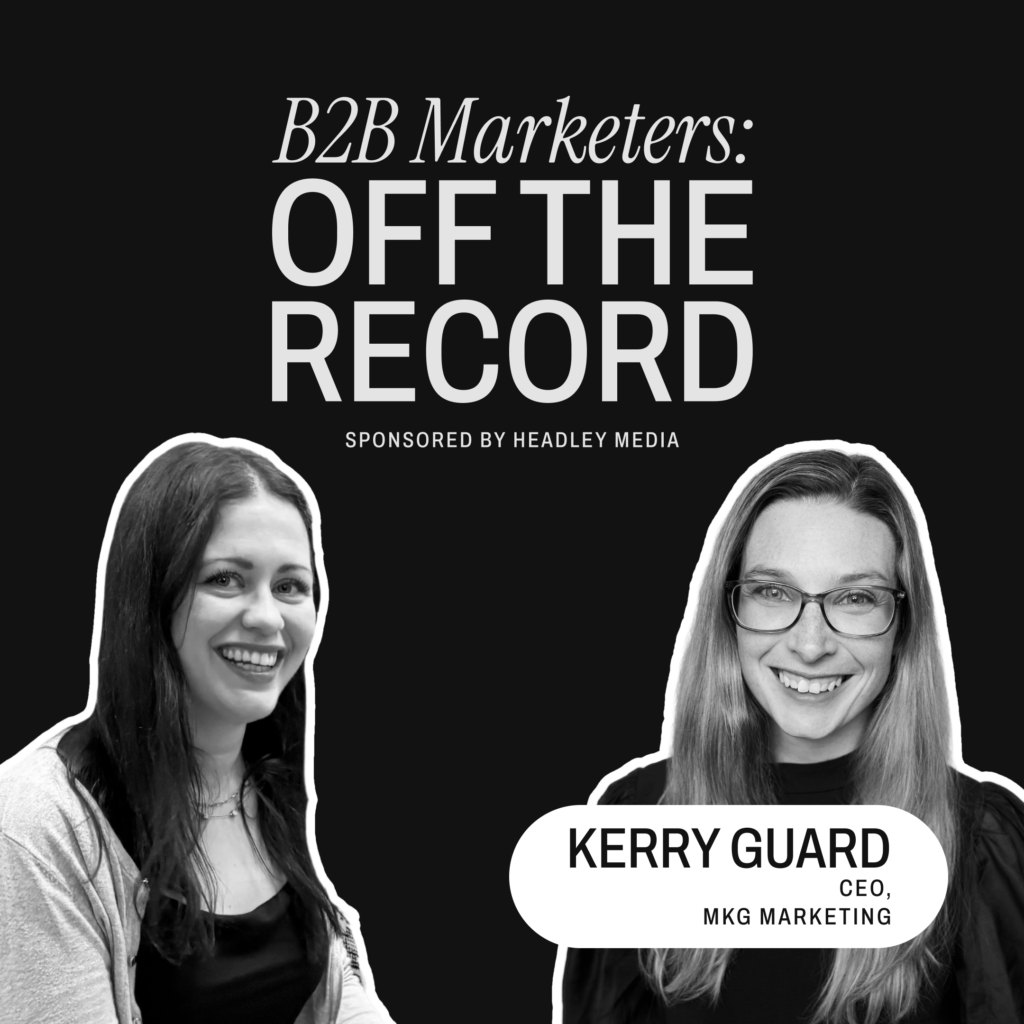
"If you wanna be the answer [on LLM results], you have to be saying something different."
— Kerry Guard, MKG Marketing
The conversation covers search visibility optimization, digital ads, marketing operations, and the importance of building brand visibility. It also delves into the evolution of marketing strategies, the impact of AI and LLMs on customer behavior, and the need for customer-centric content creation. The conversation covers the importance of consistent messaging, resource allocation for marketing, the impact of AI on marketing, and the need for a thoughtful approach to positioning and messaging. It also explores the significance of slowing down in marketing and the use of AI in marketing strategies.



Kerry Guard (00:00)
But the the core of what you need to protect is your marketing ops team, your content, however your content’s getting produced, your social media. Because I think with those three things you can do.
a lot before you need to then invest in ads.
Chloe Addis (00:15)
Mm-hmm.
Kerry Guard (00:16)
and so if you’re running ads and you can’t tell the attribution from that and your budget’s about to get cut, I would seriously think about what’s happening bottom funnel that we could squeeze that lemon to do more and better. That’s the beauty of AI, I feel like, in terms of the impact it’s having on our jobs is that it shouldn’t be helping us move faster. It should be helping us go deeper and level up.
Chloe Addis (00:40)
Yeah.
So welcome to B2B Marketers Off the Record. I’m delighted to be joined here today by Kerry Guard Kerry is the CEO of MKG Marketing and host of Back on Track podcast, which I was very happy to have joined last week. So thank you. Welcome, Kerry.
Kerry Guard (01:20)
Thank you. So lovely having you on the show and
Chloe Addis (01:23)
and
Kerry Guard (01:24)
the clips are up and they’re getting track it’s so cool to see it like the conversation keep on going. So thank you for joining me.
Chloe Addis (01:29)
Amazing.
Yeah, I’m so glad how we’ve done this as well. It’s kind of like just exactly that continuing the conversation. So can you introduce yourself for our listeners, please?
Kerry Guard (01:40)
Sure. I’m Kerry Guard I’m the CEO and founder of MKG Marketing. And MKG is a a digital marketing agency that specializes in what we call SVO, search visibility optimization, which encompasses SEO, AEO, and GO. And the
Chloe Addis (01:58)
Mm-hmm.
Kerry Guard (01:58)
only reason why we brought in another acronym to the party is because we just got really tired of writing SEO, AEO, and GEO. So
Search visibility optimization is how we’re encompassing all three, because you need all three to make all three actually work. And we encomp and then we accompany that with digital ads because part of generative engine optimization specifically in terms of showing up in the LLMs is you have to build brand. And while you can do lead generation from ads, it’s actually a wonderful brand builder. And we’re finding that that’s really the shift that’s happening right now.
in terms of helping companies get that visibility around their ideal customer, triggering their customers to go search for them and then being able to be visible through the entire customer journey. and help people convert and buy. So that’s us in a nutshell.
Chloe Addis (02:51)
Amazing.
Perfect. And that’s just like hyper relevant for everything that, you know, all marketers at the moment are having this challenge of dealing with AEO, SEO, like you said. So I do hope SVO is an adopted term because like you said, it kind of encompasses everything. And the kind of brands that you work with within B2B is…
They’re a really interesting stage, aren’t they? So they’re kind of like past the initial startup, if I’m right. And then
Kerry Guard (03:24)
Mm.
Chloe Addis (03:25)
they’re kind of in that growth stage that is really like difficult, really, isn’t it?
Kerry Guard (03:30)
Yeah.
Chloe Addis (03:31)
It’s kind of an in-between-y stage.
Kerry Guard (03:33)
Yeah. It’s time to grow up, put your big adult pants on and
and actually set a real marketing engine up, starting with the foundation of your positioning and messaging, because everything, especially from an SVO and digital ad standpoint, really stems from that. making sure your website is connected into that messaging, having a CRM capture any leads, being able to nurture them, and having a true content engine.
Which SVO also supports in terms of making sure you’re building content that really reinforces not only the keywords and the prompts you’re trying to go after, but why you and what makes you different and better than anybody else. and so yeah, it’s that big transition moment where you can’t just keep throwing marketing and spaghetti against the wall and see what’s six anymore. You really have to build from the ground up. You have to set that strong foundation and you have to get after it.
Chloe Addis (04:24)
Absolutely, and it’s where the importance of marketing ops, it feels like, really comes into its own and like you said, if you haven’t nailed the basics at this point of those kind of hygiene items as they’re often called and like knowing your positioning and where you’re different and all of that kind of stuff. So it’s really interesting and a lot of common issues there that I’m sure kind of people will be able to relate to.
But back on you for a moment, how did you get into marketing in the first place?
Kerry Guard (05:03)
So I actually went to school for photography and
Chloe Addis (05:05)
Okay.
Kerry Guard (05:07)
yeah. And I really loved advertising. I actually in turn I went to Drexel University where you go they do a quarterly schedule in terms of your terms. So you go fall, winter, spring, summer. and so your junior year you take two terms, either fall, winter or spring summer, and you go work.
in your ideal field. And so I actually got to intern at DK N Y in New York City, working with the in-house stylist and going on all the photo shoots and helping. And so I always just really loved advertising and the way that the photographs told a story in relation to the brand and what the brand was trying to convey to the audience in terms of why they should buy from them. and I wanted to live in New York. It was the dream, right? Who
Didn’t you know, if you’re in this field, who doesn’t
Chloe Addis (06:01)
Yeah.
Kerry Guard (06:03)
want to live in New York City? So after after university, after college, I called up my Uncle Sean, who was working at People Magazine at the time, and I was just like, Get me to New York. I don’t care what I gotta do, get me to New York. And he’s like, Well, I can get you to be a media planner. I have a lot of connections there, but you can’t like it. Like you’re gonna go be a photographer and it’s gonna be great. I was like, Yeah, yeah, yeah. Sure. Photography,
Chloe Addis (06:23)
Aww.
Kerry Guard (06:26)
media planning sounds great. And I remember I had my first interview
at Universal McCann and the person who interviewed me, N Natanko and a very dear friend of mine now, actually asked me, Do you know what media planning is? And I was like, no. Why don’t you tell me? I just owned it. Like I have no idea. I’m
Chloe Addis (06:42)
I don’t know what
Kerry Guard (06:45)
not gonna sit here and pretend. And they hired me and I mean five of other other girls and we became media planners and I f yeah, that’s how I I just wanted to get to New York and
I loved media planning. It was it was so black and white. That’s what I love about photography. Not just that it’s black and white photography, but that it’s very methodical and that you have these systems and processes and how you take the photo. I used I’m gonna date myself, but I learned on film. I actually had to be dragged into digital kicking and screaming because I just loved the dark room with my whole heart.
Chloe Addis (07:23)
Yeah.
Kerry Guard (07:23)
And
and it had this very system and process orientation in terms of how you took the photo, how you developed the film, and then
Chloe Addis (07:31)
Mm-hmm.
Kerry Guard (07:31)
how you processed each print. And I just loved that system and process. And so when I met media planning and spreadsheets and numbers and the black and whiteness of it all, I was like, I get this. This totally we’re we’re good friends here. And so I did sorry, Uncle Sean, I did fall in love with with media planning and
Yeah, from there I just kept doing media planning until I started my own shop.
Chloe Addis (07:56)
wild, yeah, think there is kind of a key thread there. It’s a very creative output, photography, but like you said, it’s got the method there, and to excuse the metaphor, but the full picture thinking, like you’re aiming for something that has to look a certain way and has to be, and emote it has to, yeah.
trigger certain emotions and things like this. So actually that’s, it makes a lot of sense. And like you said, it’s kind of, well, know, something you could, the photography isn’t not part of marketing, is it? Like there’s always that
Kerry Guard (08:37)
Yeah, sure.
Chloe Addis (08:38)
kind of visual element there as well.
Kerry Guard (08:40)
Yeah. I’m actually
rebuilding my website for KerryGuard dot com ’cause I haven’t had I haven’t had it in ages. I don’t know if I’ve ever had it. I think I had it when I first very when I after I first got married and I like kind of made it into a photo website for like a hot second, but it’s been dormant
Chloe Addis (08:57)
Hehehehe
Kerry Guard (08:58)
ever since. And so I’m now bringing it back. And one of the things I want to do is very much bring my own photography into it, which is mostly family and kids, but it still has that.
artistic eye to it. So I’m really excited to like marry it with
Chloe Addis (09:11)
thank you.
Kerry Guard (09:12)
like my my marketing musings along
Chloe Addis (09:14)
there.
Kerry Guard (09:15)
with, you know, having that photo element. So
Chloe Addis (09:19)
Yeah,
absolutely. And like the core element of marketing being storytelling, as you said, it makes so much sense. Yeah, very, very interesting. switching up a gear back into kind of B2B marketing mode, what is one belief about B2B marketing that you’ve changed your mind on over the last 12 months?
Kerry Guard (09:43)
So many things.
One thing. I would say in the last twelve months it’s become very clear that brand is no longer a nice to have. I feel like we’ve been chasing leads. I’m gonna blame HubSpot for this. I think HubSpot had the best intentions when it came out with the the inbound method
Chloe Addis (10:09)
Yeah.
Kerry Guard (10:11)
where it was very much about bringing value to your customers.
Chloe Addis (10:15)
Mm-hmm.
Kerry Guard (10:16)
Gating the content so that they could get the content and then you could nurture them. I think the the intent of it being thoughtful and valuable was initially there, but
Chloe Addis (10:26)
Mm-hmm.
Kerry Guard (10:26)
then it just got gamified.
Chloe Addis (10:29)
Yeah.
Kerry Guard (10:30)
Right? And it was all about the lead score or and then and then the lead score kind of like fell off a cliff and like disappeared into a hole. And it was just like immediately the moment somebody downloaded something, sales was calling them.
Chloe Addis (10:43)
Mm.
Kerry Guard (10:44)
And I feel like this has caused a really big riff in so many ways. It’s caused a riff with the sales and marketing team, where the marketing with sales team is like, these are bad leads, and marketing is like, they’re not, they’re just not ready yet.
Chloe Addis (10:57)
Yeah.
Kerry Guard (10:58)
And so, and then it’s caused a rift with the buyer, where the buyer has lost complete trust in marketing because they know the minute they download anything, sales is gonna pounce on them and they don’t wanna talk to sales anymore. And so now we’re in this world.
Where if you think about it like buying a house, right? You have the buyer market or a seller market. We are in a total buyer market right now. They are completely in the driver’s seat. We cannot, there is no see it like it, buy it. It is very much about them having a trigger and a moment where they need a product, going and doing their own research and then deciding who their top three products are that vendors that they’re gonna potentially go work with.
then book sales calls to then have that conversation and they’re very much driving it every step of the way. And the only way to start building back that trust is step one, ungate everything. Ungate it. It doesn’t need to one, users need to read it and two, bots need to scrape it. Ungate it. and we need to build brand that you need to get out in front of your customers and
Be visible. They need to see you. And the beauty of now versus like the madmen days is we can target and we can be so intentional about it. We can really align our messaging to where the not only the who the customer is, but where they are in their buying journey. Are they top of the funnel, have never heard of you, and maybe don’t even know that this is a problem they should be concerned about.
Are they triggered and have the problem and now you need to be showing up and helping them through how to solve that problem? Or are they actually making a decision?
Chloe Addis (12:43)
Yeah.
Kerry Guard (12:43)
Right? And so we have to build we have to build brand now. It’s no longer a nice to have the leads are drying up, everybody’s like, what’s happening? Organic is eating our attribution. last month for one of my customers, we had one of the best Julys we’ve ever had year over year.
And fifty percent of it was organic. Like, which has never hap normally it’s like ten to twenty percent maybe, fifty percent organic, right? So
Chloe Addis (13:14)
Mm.
Kerry Guard (13:15)
it’s going to a place where people are seeing the messaging, they’re understanding that it’s a problem that they need to solve, and then they’re going to do their own research
Chloe Addis (13:23)
Yeah.
Kerry Guard (13:24)
and they’re in the driver’s seat now. And so you have to we don’t have control over it. And
Chloe Addis (13:29)
Yeah.
Kerry Guard (13:29)
by being visible and building that brand,
that gives us the leverage we have, that moat of protecting our pipeline, because we know that people know who we are, are seeing us out there and know that we’re here to help them and solve the problems that they have.
Chloe Addis (13:48)
Gosh, there’s so much in this, there’s a lot of
Kerry Guard (13:51)
No, sorry.
Chloe Addis (13:52)
themes. But I think coming back to kind of that whole HubSpot piece, I do agree, like the inbound has…
focused marketers or it was adopted so well that then
Kerry Guard (14:06)
Yes.
Chloe Addis (14:07)
it was taken extremely literally. Yeah,
Kerry Guard (14:10)
Extreme.
Chloe Addis (14:12)
and then the targeting became, know, targets that were put on marketers’ heads was you need to generate MQLs that…
you know, and
Kerry Guard (14:21)
Mm-hmm.
Chloe Addis (14:21)
that’s fine. But then there’s that misalignment pieces, as you mentioned, but it’s so, so prevalent and, a huge issue still for, for most marketers within like that, that kind of marketing sales transfer of leads and like, you know, misalignment on what the MQL means if it like, it’s not an SQL at the point of handover and things like that. And
Yeah, that focus, it does need adjusting. I mean, I would obviously argue that there is a point where a gate can help and generate more information at a later stage and in the right opportunity and in the right kind of environment. absolutely, the AOs, and I mean, this is completely your realm, isn’t it? They need the visibility. They need to be able to read
Kerry Guard (15:13)
Mm-hmm.
Chloe Addis (15:13)
what you’re putting out there and…
You need to put it everywhere you can. It’s not just like, obviously
Kerry Guard (15:19)
Yeah.
Chloe Addis (15:20)
your website, but it’s so many different places, isn’t it, that are indicating authority and, you know, the places across the internet that all have different
Kerry Guard (15:32)
Yeah.
Chloe Addis (15:34)
levels of influence on each different kind of LLM and source that people are going to searching organically, as you said.
Kerry Guard (15:43)
You got it. Mm-hmm.
Chloe Addis (15:44)
In your, you, when you mentioned that case about the 50 % organic, was that organic across different sources as well or was it kind of a general bucket of like, of where
you’re right?
Kerry Guard (15:58)
It was mostly Google search. Yeah. So it’s
yeah, it’s Google search. It’s that’s the other thing that SparkToro is is sort of being the drum on is that and I do think it depends on the industry. I do think the tech industry, and I have to I my p I haven’t done the research on this yet, but my plan is to go dig into this. My hunch is that the tech community is doing more
research in LLMs than the general consumer population. So I have to
Chloe Addis (16:28)
Okay.
Kerry Guard (16:32)
go I have to go pull this data apart. But SparkToro has been very clear that Google is still 90% of what people are sort like where they go and actually do a lot of their research. So
Chloe Addis (16:43)
Interesting.
Kerry Guard (16:45)
which is why I think a lot of agencies are putting their stock in answer engine optimization because A, it’s still incredibly prevalent. It’s it’s where you’re getting the most visibility in terms of Google itself.
Chloe Addis (16:56)
Mm-hmm.
Kerry Guard (16:56)
And
it’s where agencies have the most control over in terms of your content structure and how they ensure you can get found. where Geo is like you said, very much more about your full digital footprint.
Chloe Addis (17:11)
Yes.
Kerry Guard (17:13)
and so which we have less control over, but we still need to figure out how to help companies navigate that for sure, which is what we’re working on. but yeah, I it’s wild wild West right now.
Chloe Addis (17:25)
Yeah, yeah, that is really interesting. And I suppose with the with the geo, geo realm
Kerry Guard (17:33)
Mm.
Chloe Addis (17:34)
as well, Google is a huge influencer. to focus there primarily is never going to be a bad shout, is it? I mean, and that’s how we’ve got to where we are now is what has been built on will always have been optimized towards
Google first historically and that’s what everything is reading so it’s kind of like it feeds it works together doesn’t it. Gosh and that’s so interesting and I’d like to know whether your hunch you have to keep us updated
Kerry Guard (18:14)
so my my hunch is that especially dev developers and engineers or anybody in flow of building something,
Chloe Addis (18:21)
Mm.
Kerry Guard (18:21)
right? If they’re building a product or a feature and they need a third party vendor to plug into it, like SSO or a pay you know, pay package, right?
Chloe Addis (18:35)
Yep.
Kerry Guard (18:35)
To be able to take payments, the LLM’s giving them the recommendation, like, you need paddle. So
You need to go to paddle.com and you need to register for paddle and then you need to give us the API key. LLMs aren’t saying, here’s a couple different products that you could consider and maybe you should go sign up for them and see
Chloe Addis (18:53)
Yeah.
Kerry Guard (18:53)
which one you like and let’s do some research. It’s literally telling you what to do. And
Chloe Addis (18:57)
Mm.
Kerry Guard (18:58)
so if they recognize the brand name like Paddle, which all engineers do in terms of payment packages, they’re like, I just need, yeah, Paddle’s great. I totally know them. They come up all the time. I’m just gonna go sign up because I need to get this feature out. And they’re not gonna go.
And do the research that they need to, which is why I think building brand is so important. But again, I I hope that engineers would go and sort of say, Paddle sounds great, but like can you give me a bunch of other tools and then open up a new tab and ask it to do a bit of research and maybe go to Google and s and make sure that that’s going to be the right product for their tech stack. but when people are in flow and they need to get something out and they’re given the answer.
more often than not, they’re gonna take the answer. That’s my that’s the hunch that I need to go investigate. Yeah. Or and if it’s not happening yet, I I can imagine it’s going to be especially as more people start vibe coding, and people who aren’t engineers start building more. I
Chloe Addis (19:54)
Yeah,
it raises all sorts of questions, doesn’t it, as to if that’s the right thing to be doing. But, you know, I think primarily we need to know if that is what’s happening. And yeah, you know, exactly that. How much information does the LLM actually have on the full spectrum? You know, it’s providing an answer. Is that the best answer?
Kerry Guard (20:18)
Well, the end the other
th interesting thing, it did this to me the other day. And I was like, I have a client who is launching a book soon and we needed a publisher. And so
Chloe Addis (20:28)
Mm-hmm.
Kerry Guard (20:30)
I asked the LLM, I was like, What publishers do you recommend? Here’s our unique stance of like what we’re looking for to get. Like the book’s pretty much done. We just
Chloe Addis (20:38)
Yeah.
Kerry Guard (20:38)
need somebody to actually like turn it into a book and publish it. And
Chloe Addis (20:42)
Mm-hmm.
Kerry Guard (20:42)
I don’t know what I’m doing, so I need this off my plate. And so
It gave me three recommendations. And my client came back and he said, actually, I got this recommendation from the people who are gonna do my audiobook. I’d like to move forward with them. Here’s who they are. And I went back to the LLM and I said, Why didn’t you recommend these folks? Like these are perfect for what we need. And they’re like, Well, you use the language of get this off my plate. And so we were looking for that end-to-end solution and and brands talking about their end-to-end solution. And
Chloe Addis (21:13)
Right.
Kerry Guard (21:14)
that’s why we recommended these brands.
So we have to remember that LLMs are literally taking our own words and kind of using them against us. So
Chloe Addis (21:20)
Yeah.
Kerry Guard (21:23)
understanding how your customers are searching is just n again, no longer a nice to have. And unfortunately, there aren’t any great tools out there yet that can tell us how people are searching. We really have
Chloe Addis (21:32)
Yeah.
Kerry Guard (21:35)
to go do our own research and we have to use the language of our customers.
Chloe Addis (21:40)
Mm.
Kerry Guard (21:41)
Almost verbatim, right? Take this off my plate is like
Chloe Addis (21:42)
Yeah. Yeah. And
it’s so diverse, really. You think, okay,
Kerry Guard (21:47)
Mm-hmm.
Chloe Addis (21:48)
well, my product is these four keywords or whatever, but actually it’s like, they’re not like all of those substituted like phrases
Kerry Guard (21:59)
Mm-hmm.
Chloe Addis (22:00)
and you know, it’s like, actually, yeah. Yeah. Yeah.
Kerry Guard (22:03)
How are they describing their pain? Right. For me, it was,
I need this off my plate. But somebody could say, I want an end-to-end solution. Another person could say, I’m looking you know, there’s a thousand different ways to say that one thing. And if LLMs are looking for the phrases, then yeah, you have to understand that and be able to build content around it. Mm-hmm.
Chloe Addis (22:19)
Yeah. yeah, that’s Payment point
related and a lot of that will be around price and quality, know, like best quality, like lowest price kind of thing. But you don’t necessarily
Kerry Guard (22:35)
Yeah, absolutely.
Chloe Addis (22:36)
want to be putting out content that you’re the lowest price or, know, maybe like that, that might not sit with your
Kerry Guard (22:44)
Or if they’re looking for the lowest
price, you add language in there of why you’re probably looking for the lowest price, but let me help you understand what you’re gonna lose in doing that. Right. So you’re using
Chloe Addis (22:52)
Yeah, yeah.
Kerry Guard (22:53)
the words, but you’re counteracting it with. So then the L L will pick it up and say, I understand you’re looking for the lowest price, but actually this brand is saying that this is why that’s a problem and something you should consider. Right.
Chloe Addis (23:04)
Yeah,
Clever. Very clever. This is why you’re best placed to be to be thinking about these questions. And it’s a really interesting topic of how B2B buyers and buyers in general have changed how they behave because of LLMs and even Google just updating with AI information and AI answers and things. it’s changed the ballgame a lot.
What’s the strategic bet you think more marketing leaders will need to make over the next couple of years?
Kerry Guard (23:42)
Gosh, I’m setting like a broken record now.
Chloe Addis (23:44)
Hehehehe
Kerry Guard (23:45)
Build brand.
Chloe Addis (23:48)
I mean it makes sense.
Kerry Guard (23:49)
Yeah,
you have to go build brand. You have to make sure your positioning and messaging dialed in. Understand
Chloe Addis (23:55)
Mm-hmm.
Kerry Guard (23:56)
where you fit in the market of why you and what makes you better and what makes you different. And then make sure your all of your messaging from your website to your socials to your even what how your customers are talking about you. You have to be aligned to how your customers, like I just said, are asking about these problems because you need
When LLMs go out to make a recommendation, they’re
Chloe Addis (24:23)
Mm-hmm.
Kerry Guard (24:24)
not just looking at your website. They’re looking at your entire digital footprint and your authority and not just what what you’re saying, but what your customers are saying about you. And if those two things aren’t aligned, they’re not going to recommend you. So it’s really important that you understand your customer,
how
Chloe Addis (24:40)
Yeah.
Kerry Guard (24:41)
they’re searching for the problem that you solve, what makes you better and different, because the LLMs
If everybody’s solving the same problem in the same way, you’re just going to be a footnote, a citation,
Chloe Addis (24:51)
Yeah.
Kerry Guard (24:52)
right? Like when you open up a a old book, when you used to write those really long-term papers and you had to put stars at the end of things and then at the bottom,
Chloe Addis (24:59)
Yeah.
Kerry Guard (25:02)
like that’s what you think about some of those citations, right? They would just have a list of buried, right? That’s
Chloe Addis (25:08)
Yeah. Yeah.
Kerry Guard (25:09)
what’s basically happening when LLMs are getting the same answer from the same brands, is they’re just
pulling this together and then citing who they pulled the content from. If you
Chloe Addis (25:19)
Yeah.
Kerry Guard (25:19)
wanna be the answer, you have to be saying something different
Chloe Addis (25:23)
Mm-hmm.
Kerry Guard (25:24)
and understanding why you’re different in relation to the problem that your customers are facing. Like those two things have to align up from your website across your digital footprint and then how your customers are talking about it. And then you got to build that brand visibility, that halo from a digital ads perspective, from going on podcasts, from
you know, getting out there and sort of a PR, right? Being being able to go on to other publications and talk about this in the way that you and your customers talking about the problem and you being the solution. It’s gotta be everywhere. You gotta build brand. It’s no longer nice to have. So sorry.
Chloe Addis (25:59)
Yeah.
What would be your, if you had a client coming to you or if you had a brand new kind of company, a technology kind of company and they were like, well, how, where do we start with our brand? Like we have a brand, we have a website and we’re doing social media or, you know, the kind of
Kerry Guard (26:22)
Mm-hmm.
Chloe Addis (26:23)
small…
play, I guess, what would you recommend as kind of like the basic steps to start or where to focus to start building brand?
Kerry Guard (26:34)
Yeah, I think again understanding your customer is definitely where you need to start, right? So you need to make sure. So if you have that, if you have your positioning and messaging and it’s documented in a way that everybody can access it and everybody’s using it in the same way, then the next step after that is building it into having a content engine, I think, is the most powerful thing you can have because that’s really at the center and then the spokes sort of.
come off of that, right? So having a repeatable system that allows you to build consist, you know, content that is aligned to your positioning and messaging, that is aligned to a a a strategy from keywords and prompts that is really answering the questions that your customers have in relation to the problem that you solve and then baking in again what makes you different. Like getting that down and having content pump out, you know, at least I
ideally once a week is like the best system you could set up because it everything can come from that. Your newsletters for your email
can come from that. Your
Chloe Addis (27:40)
Yeah.
Kerry Guard (27:41)
social media posts, we do one blog post a week, but then we have like five different pieces of social media that come from that. Sometimes we turn
Chloe Addis (27:51)
Yeah.
Kerry Guard (27:51)
them into blog into we’ve been doing this really cool thing with LLM notebook where we actually turn them into podcasts. So
Chloe Addis (27:57)
that’s cool.
Kerry Guard (27:59)
they they’re basically instead of reading it,
It’s like them having a conversation. It’s AI basically having a conversation around the topic. a lot of a lot of university students actually use this for studying where they’ll take, yeah, they’ll take all their notes from the, you know, when they’re studying for a test, they’ll drop all their notes into it, and then it’ll turn into a podcast. Pre cool. so we do that. And so we have we’ll just do a text, we’ll just do images, we’ll do carousels, and we’ll turn it into multiple pieces of content that then live on for a whole week.
But having that content engine down first
Chloe Addis (28:35)
Mm-hmm.
Kerry Guard (28:35)
is and really making sure that it’s that QA. Everybody’s saying it almost ad nauseum.
Chloe Addis (28:42)
you
Kerry Guard (28:43)
Google just pumped out a guide on how to show up in AEO and LLMs, and it was basically
Chloe Addis (28:48)
Bye.
Kerry Guard (28:49)
very much around the QA of it, right? Know what questions your customers have and make sure that you’re building content that answers those. And then LinkedIn just dropped a guide that basically said the same thing. Like
The content that’s gonna work best on LinkedIn is when you’re answering your question like answering your c your customers questions. So
Chloe Addis (29:06)
real questions.
Kerry Guard (29:07)
yeah, it’s it’s really about that that Q and A. So building content around that in a way that your, you know, your audience really has is trying to understand the space is is key.
Chloe Addis (29:19)
Yeah,
and I think from that perspective, if you have been doing SEO for years, as most of us have, like, that really should have been kind of those…
guiding principles of it, isn’t it? Like, you know, talking in your customer’s language and using the words that they’re using and answering, like being valuable. It just seems we’ve lost that in the age of AI when there’s just been so much information. Actually, now what makes you unique is giving genuine, like proper customer-led information. yeah, no, thank you for that.
Kerry Guard (29:55)
Yeah, I’m not
really saying it’s it’s funny, right? Like and this is sort of the big argument that’s happening in the SEO community is like good SEO is good enough. And it’s like as SEOers, we know we truly know and believe that, right?
Chloe Addis (30:06)
Mm-hmm. Yeah.
Kerry Guard (30:09)
But that’s not how customers are talking about it.
Chloe Addis (30:11)
Yeah.
Kerry Guard (30:12)
Right? If you tell a customer that you’re just doing SEO, they’re going to immediately ask you if that includes LLMs and GEO
Chloe Addis (30:18)
Hmm.
Kerry Guard (30:19)
So again.
Going back to using the customer’s language. I could sit here all
Chloe Addis (30:22)
Yeah, yeah.
Kerry Guard (30:23)
day and just try and convince them that it’s just SEO, but they’re not convinced. They’re like, but it’s a different beast
Chloe Addis (30:27)
You
Kerry Guard (30:28)
and a different engine. And they’re not wrong. But all the principles that we’ve been talking about for decades still stand.
Chloe Addis (30:34)
Yeah. Yeah.
Kerry Guard (30:36)
It’s just in a different lens now in terms
Chloe Addis (30:38)
Mm-hmm.
Kerry Guard (30:39)
of how the LLMs are picking it up versus how Google’s picking it up.
Chloe Addis (30:43)
Yeah, I love that. Talking to customers language. It’s 101, isn’t it? And if they’re changing the language and if they don’t like what you’re talking about, know, almost as we were talking about at the start of the conversation and, you know, inbound through HubSpot, it’s like, well, change it. you know, let’s change
Kerry Guard (31:00)
Mm-hmm.
Chloe Addis (31:03)
kind of the rhetoric and the record and come back to, yeah, marketing 101.
And so with that, that does make sense. And it’s a good segue into, okay, this is what we should be focusing on right now. But is there anything that you think that marketers should leave behind? Is there things that they’re doing still that you think actually, no, in this new
Kerry Guard (31:25)
Please stop.
Chloe Addis (31:25)
age, yeah, we need to stop doing this.
Kerry Guard (31:35)
Random acts of marketing. I kind of hate that term, and I think a bunch of people are picking
Chloe Addis (31:39)
you
Kerry Guard (31:40)
it up. And I think there’s even one company trying to trademark it. So sorry if I used a thing that’s not trademarked. but we no longer can just throw marketing up against the wall to see what quote unquote sticks. Chances
Chloe Addis (31:52)
Yeah.
Kerry Guard (31:53)
are it’s not the channel.
Chloe Addis (31:55)
Yeah.
Kerry Guard (31:56)
Right? Like you can’t really go and test a channel anymore because it’s not the channel’s probably not the problem. The
Chloe Addis (32:03)
Yeah.
Kerry Guard (32:04)
problem is either
your messaging is not resonating.
Chloe Addis (32:06)
you
Kerry Guard (32:07)
It’s not hitting the pain point specific
Chloe Addis (32:09)
Mm-hmm.
Kerry Guard (32:09)
enough to what your customers are feeling. You’re measuring it wrong, right? So like we’ve been so with HubSpot, right? We’ve been so driven to drive leads, drive leads, drive leads, drive leads that we feel like every single channel should drive leads. But like I said, organic has come to eat our attribution. So you really need to be measuring certain channels differently now to understand the impact it’s having on your brand to then be driving
organic to go up, right? That’s sort of your leading indicator. How is organic being impacted? And is your direct and your direct traffic? Like for one of our customers, I was trying to understand like we’re doing all this brand building, how is it impacting our website and and our leads and our conversions? And it turns out that I was looking at I was trying to look at branded search volume because I think that’s a such a good indicator of like are more people searching for our branded name.
Chloe Addis (33:02)
Yes.
Kerry Guard (33:02)
But
turns out they’re just going directly to the website. So
Chloe Addis (33:05)
Okay.
Kerry Guard (33:06)
our direct traffic is way up.
Chloe Addis (33:08)
Yeah.
Kerry Guard (33:10)
but our branded search is flat. So that was like, okay, something’s happening here where I there’s like this bucket of stuff I can’t measure. It’s ending up in direct. that’s
Chloe Addis (33:19)
Yeah.
Kerry Guard (33:20)
coming that’s probably coming from people seeing us enough that they’re they’re taking action.
Chloe Addis (33:24)
Mm-hmm. Yeah.
Kerry Guard (33:26)
so you have to measure it differently. So you
Chloe Addis (33:29)
Mm-hmm.
Kerry Guard (33:29)
have to
make sure your messaging’s resonating, you have to measure it differently, and you have to have enough resources buff behind it. Like
Chloe Addis (33:35)
Yeah.
Kerry Guard (33:37)
you can’t just do a newsletter once a month.
Chloe Addis (33:40)
Right.
Kerry Guard (33:40)
It’s
that’s not gonna tell you whether it’s working or not. You need that consistency of always on, of ideally weekly, bi weekly. I feel like you can get away with once a month if it’s like I have one customer where we do only do a monthly newsletter because it’s such a we just wouldn’t have enough co we wouldn’t have enough content to really do it
Chloe Addis (34:03)
Sure, yeah, yeah, yeah, of course.
Kerry Guard (34:05)
on it’s it’s a a unique situation where
For them particularly, they wouldn’t have enough content. But generally
Chloe Addis (34:10)
Thank
Kerry Guard (34:11)
I feel like weekly is really the new consistency for newsletters.
Chloe Addis (34:15)
Okay.
Kerry Guard (34:16)
and social media daily. Like LinkedIn is telling you two or three times a week. I mean, I think you need to be on every day.
Chloe Addis (34:25)
Okay.
Kerry Guard (34:26)
and so that it are you’re putting enough of resources behind it. For ads, you need budget. Five hundred
Chloe Addis (34:34)
Yeah.
Kerry Guard (34:34)
dollars a month isn’t gonna get
Chloe Addis (34:37)
Yeah.
Kerry Guard (34:38)
No,
if you really can’t pony up like five, ten, fifteen grand a month for ads, then
Chloe Addis (34:44)
Mm-hmm.
Kerry Guard (34:44)
it’s probably not a channel you should be investing in right now. And that’s okay. There’s plenty of other
Chloe Addis (34:48)
Okay.
Kerry Guard (34:49)
places where people’s time can resonate and build that brand for you versus ads dollars. Like ads dollars
Chloe Addis (34:56)
Yeah.
Kerry Guard (34:57)
comes in when all those other places sort of plateau and you’re
Chloe Addis (34:59)
Yeah.
Kerry Guard (35:00)
like, okay, we have the engine going, we have the content going.
We have the newsletter going. We have our nurture sequences from an email perspective going. We’re able to capture people. We’re able to produce content on a regular basis. It’s going out through our socials. We’re getting some good engagement there. People are starting to know and recognize who we are. And now
Chloe Addis (35:15)
Mm-hmm.
Kerry Guard (35:16)
we just need that umbrella of like
Chloe Addis (35:18)
Yeah.
Kerry Guard (35:19)
really identifying our customer and really dialing into being visible there. And you know, it doesn’t mean that it needs to be wasteful. I’m not saying to spend five, ten grand.
For the sake of it, it needs to be dialed into your ideal
Chloe Addis (35:32)
That’s where I would get it, yeah.
Kerry Guard (35:33)
c it gets expensive, especially LinkedIn gets expensive because the more targeting you do and
Chloe Addis (35:38)
Yeah.
Kerry Guard (35:38)
the more honing you do, the more expensive it gets, right?
Chloe Addis (35:41)
Mm-hmm.
Kerry Guard (35:43)
but it’s to your ideal customer, there’s no waste there. So,
Chloe Addis (35:46)
Yeah.
Kerry Guard (35:48)
you know, that’s sort of how I would build up the engine, and that’s where ads comes in. But yeah, it’s we can’t we can’t be random about it.
Chloe Addis (35:56)
Yeah.
Kerry Guard (35:57)
And if you say you tried everything and the channels aren’t working, it’s not the channel.
Chloe Addis (36:01)
Yeah, I think we’ve tried and tested. know, marketing has developed to where it is at the moment, but yeah, the channels aren’t in and of themselves the wrong places. Like we know where we can access people. It is, as you said, it comes down to the messaging and giving it the right the targeting, giving it the right amount of…
of strategic thought really, like you said, if that budget’s not there then it’s like, well, what do we really want from this campaign? Like, you know, if we’re not gonna give it everything to make it successful, then it won’t be successful. It’s really interesting. And I think it kind of beds into what you were saying earlier about kind of the marketing ops and being informed and being able to plan everything out.
from the start with the messaging, So the type of investment that kind of ties in, actually, so our next question, so what type of investment should marketing leaders protect even if budgets are tightened?
Kerry Guard (37:05)
So if they’re going to take budget away from you, you have to understand the attribution of it all. And like I said, I think organic has come to eat our lunch on that. So you have to understand how your channels are influencing organic, and what channels are actually making an impact there. It’s a question that we’re definitely I have clients asking me and I sometimes feel kind of lost in the answer of I don’t actually know for sure.
so one of the things we’re going back to is is having the sales team ask, How did you find us? And actually I just got off the call with a prospect who’s doing the same thing
Chloe Addis (37:43)
Yes, yeah, yeah, yeah.
Kerry Guard (37:45)
of that being the very first question of how did you find us and then a follow up question if they did say organic or they used an LLM. That’s so cool, like that’s so new. What kind of prompts are you using? What kind of keywords are you using? How are you thinking about this problem and getting that content from them through those sales calls? Because
It’s it is just really difficult to measure. and I do think attribution is gonna be a lot in organic and we’re not gonna really know how much of our brand, what what brand activities we’re doing is impacting.
But the the core of what you need to protect is your marketing ops team, your content, however your content’s getting produced, your social media. Because I think with those three things you can do.
a lot before you need to then invest in ads.
Chloe Addis (38:35)
Mm-hmm.
Kerry Guard (38:37)
and so if you’re running ads and you can’t tell the attribution from that and your budget’s about to get cut, I would seriously think about what’s happening bottom funnel that we could squeeze that lemon to do more and better. That’s the beauty of AI, I feel like, in terms of the impact it’s having on our jobs is that it shouldn’t be helping us move faster. It should be helping us go deeper and level up.
Chloe Addis (39:00)
Yeah.
Get the most out of what we’re already doing.
Kerry Guard (39:02)
And so exactly. So
if you’re only running a newsletter once maybe you’re not even running a newsletter, right? So it’s like,
Chloe Addis (39:09)
Yeah.
Kerry Guard (39:10)
okay, if our budget’s gonna get cut, let’s pull it from ads and let’s figure out how to get more out of our ops p the best thing you you know, whenever I join a new a new client, one of my favorite things to do is always like, how can I shake their CRM, right? So if you’ve been at a customer, if you’ve you’ve if you’ve been part of a brand for a long time.
To go back to their CRM and be like, okay, how do we shake this tree? If we haven’t done that in a while, is always a great way to like reallocate resources
Chloe Addis (39:39)
you.
Kerry Guard (39:39)
and figure that out. Social media is another place I feel like that’s an under serviced area. You sort of get into a pattern, but really like creating community, generating an audience, having engagement there, like, yeah, I really believe in that sort of core from
your website to your CRM to your content engine to your social. I feel like that core has really got to be locked in and and I think that takes time and is hard to do. So reallocating your resources to really making that a true marketing engine could be where you put your your energy opposed to ads.
Chloe Addis (40:18)
Yeah, that makes a lot of sense actually, like the breakdown set up of knowing where, knowing the results before, I mean it’s a whole…
system isn’t it that feeds back into itself is that you know if you’re if you are spending money in places do you can you can you track it is that attribution there and if it’s not or if it’s if it’s obscured by something what’s it being obscured by if it’s influencing something that
you
aren’t tracking, you know, like that’s it’s, it’s working out the risk, isn’t it? Before you turn something off, like you said, what’s influencing organic are the ads influencing organic in some way. And if you turn them off, what? Yeah.
Kerry Guard (41:06)
what would happen. That’s a yeah,
I mean, I we are an S an SVO and digital ads agency.
Chloe Addis (41:13)
Mm.
Kerry Guard (41:14)
So I, you know, obviously I think they both are detrimental to your your marketing engine for sure.
Chloe Addis (41:23)
Yeah.
Kerry Guard (41:24)
but if I had to choose one, especially now,
Chloe Addis (41:27)
Mm.
Kerry Guard (41:28)
that content engine and making sure it’s it’s dialed into search visibility optimization.
But like I said, if things are plateauing, that probably means you need to build that umbrella and that is where ads comes in. And so
Chloe Addis (41:40)
Yeah.
Kerry Guard (41:41)
if you to your point, Chloe, such a good point, if you’re already running ads,
Chloe Addis (41:44)
Mm.
Kerry Guard (41:45)
like I’m terrified. I I generally know what campaigns are doing well in terms of driving our performance, but performance max is really like where most of our budget is these days.
Chloe Addis (41:52)
Yeah. Yeah. Yeah.
Kerry Guard (41:55)
And I don’t know how much is direct impact in terms
Chloe Addis (41:59)
Mm.
Kerry Guard (41:59)
of they see an ad, they click, they convert.
Chloe Addis (42:03)
Yeah.
Kerry Guard (42:03)
versus
how much of a halo they’ve created in terms of just those ads being visible to now we’re organic taking up fifty percent, right? So such a good point. It’s a test you can run, right? It might hurt for a minute or you turn ads off and
Chloe Addis (42:16)
Yep.
Kerry Guard (42:16)
then your organic craters, you know, in two weeks and you’re like, okay, that was that. We turn that back on and it will
Chloe Addis (42:21)
Yeah.
Kerry Guard (42:23)
it is a hairy, scary test because when you turn ads back on, it’s gonna have to go back through the learning phase. It is going to kick up again. It is going to take
Chloe Addis (42:30)
Yeah.
Kerry Guard (42:32)
a minute to
figure out where it was, what it was doing.
Chloe Addis (42:34)
Yeah.
Kerry Guard (42:35)
But yes, it’s such a good point to if you do need to understand attribution because while I’m saying, you know, turning off ads or scaling back ads is an is an option in terms of where resources can come from,
Chloe Addis (42:48)
Mm.
Kerry Guard (42:48)
if that is creating a huge halo effect on your organic, that is something absolutely to take into consideration, a hundred percent.
Chloe Addis (42:54)
Yeah.
I wish there was some way of testing that was not quite as risky.
Kerry Guard (43:02)
It’s so risky now. Yeah. It’s I
would say scaling it back, right? So like the thing with any of these platforms is whether it’s meta, whether it’s Google, is they just LinkedIn. They don’t like big swings. They’re
Chloe Addis (43:16)
Yes.
Kerry Guard (43:17)
right. So making small tweaks as you go, like I’m about to turn off three campaigns that have not been producing conversions at all
Chloe Addis (43:24)
Mm-hmm.
Kerry Guard (43:25)
that are paid search campaigns. So paid search campaigns should be pretty transactional.
Chloe Addis (43:30)
Yeah.
Kerry Guard (43:30)
So if
they’re not producing, I’m just gonna turn them off. And actually, I’m not gonna rededicate those assets just yet. I’m just gonna hold them for a minute and see what impact that has to
Chloe Addis (43:39)
Yeah.
Kerry Guard (43:40)
figure out then where do I want to potentially dial up PMAX? Do I wanna test demand gen ads? Do I wanna put
Chloe Addis (43:46)
Mm.
Kerry Guard (43:46)
this somewhere totally different? Maybe I try Chat GPT ads. I’m a little terrified about that, but that’s a thing. Maybe we give it a go. So
Chloe Addis (43:51)
you
Kerry Guard (43:54)
so yeah, I think, you know, really figuring out
where your resources are making the biggest impact and
Chloe Addis (44:01)
Yeah.
Kerry Guard (44:02)
then just trimming the fat, so to speak,
Chloe Addis (44:04)
Yeah.
Kerry Guard (44:05)
is is a great place to start in terms of finding, you know, money in the couch cushions. But definitely
Chloe Addis (44:12)
Yeah.
Kerry Guard (44:13)
if you cannot turn things off completely, it that is ideal.
Chloe Addis (44:17)
Yeah, yeah, that is that always on, isn’t it? They’re keeping the light. Yeah.
Kerry Guard (44:20)
It is. We were just talking about this. I I host
a a monthly meetup and we were talking about campaigns and how campaigns have really changed from being this sort of blip, like this few month big blast blip
Chloe Addis (44:33)
Yeah. Yeah.
Kerry Guard (44:35)
that happens and then you turn it off and you come back with a blip and it’s like actually
Chloe Addis (44:38)
and then.
Kerry Guard (44:39)
now it’s always on. You can change out your messaging and switch things up in terms of iterating. But then
Chloe Addis (44:45)
Mm.
Kerry Guard (44:46)
one of the one of the gals I was talking to was doing campaigns differently where she
is focusing it on an ABX standpoint. So she’s doing campaigns around specific audiences
Chloe Addis (44:54)
Yeah.
Kerry Guard (44:56)
in relation to the market of what’s happening. and actually another person I just talked to on the podcast last week, he said similar thing where he’s reading he’s reading the signal of the market to understand what messaging’s happening from a PR perspective and then
Chloe Addis (45:10)
Mm.
Kerry Guard (45:11)
layering that into a campaign to be of the time. And so if you take her ABX approach with his signal approach.
Chloe Addis (45:19)
Yeah.
Kerry Guard (45:19)
I think
there’s definitely something there, but yeah, otherwise everything else has gotta very much be always on.
Chloe Addis (45:26)
Yeah, it’s the consistency, isn’t it? And as we’re talking
Kerry Guard (45:28)
Yeah.
Chloe Addis (45:29)
about like investing in brand, we know that’s time. Like, you know, we have to add in more time. We are obscured or separated from the customer journey. They’re doing their own thing and their research and their journey and they’re in control of it. It’s their market. So if we’re just doing the brand thing and hoping like the campaigns need to be, like we’ve said, they need to be consistent.
and always there and reminding so that when they get to that point that they’re ready for
Kerry Guard (46:01)
Triggered him.
Chloe Addis (46:04)
buying, that you’ve done your job already by that point. it’s the
Kerry Guard (46:07)
Mm. Yep. You’re they recognize you. Mm-hmm.
Chloe Addis (46:11)
age old part of marketing, isn’t it? So last question before we kind of move on to suggesting some who we should speak to next.
The last question is what’s one thing you wish you could change about marketing if you could?
Kerry Guard (46:35)
The speed. We need to slow down.
Chloe Addis (46:38)
Okay.
Kerry Guard (46:39)
Yeah. When the internet happened in 2000,
Chloe Addis (46:42)
Thank you.
Kerry Guard (46:43)
I feel like there there was this shift in like 2008, 2007,
Chloe Addis (46:47)
Okay. Yeah.
Kerry Guard (46:48)
2008, where the internet was becoming bigger in terms of ad dollars,
but
Chloe Addis (46:54)
Mm-hmm.
Kerry Guard (46:55)
brands didn’t want to give up their TV dollars. We had to like beg borrow as media planners.
We had a beg borrow and steal from the from the T V budget and it was like
Chloe Addis (47:05)
Thank
Kerry Guard (47:06)
pulling teeth.
Now with AI, right, we’re we’re not we’re so used to disruption. Disruption is just part of what happens every
Chloe Addis (47:15)
Yes. Yeah. Yeah.
Kerry Guard (47:18)
few years, right? AI is one of the big disruptions, like the internet was. This
Chloe Addis (47:22)
Yeah.
Kerry Guard (47:23)
isn’t our first rodeo, but we’re moving way too fast. Like we weren’t moving
Chloe Addis (47:26)
Yeah.
Kerry Guard (47:27)
fast enough with the internet, and now we are moving way too fast. Like I
Chloe Addis (47:30)
Yeah.
Kerry Guard (47:31)
had a company who fired us as an agency and gave their marketing manager.
And L L instead figure out SEO.
Chloe Addis (47:41)
Gosh, I mean, it’s, yeah, I think you’re exactly right. I don’t think there’s been
Kerry Guard (47:44)
Right. So like and
Chloe Addis (47:47)
any kind of, I mean, all of the messaging and stuff that you see is around, you know, uncertain times or whatever. like, times through COVID and like you said, AI, it’s just something else every kind of couple of years
Kerry Guard (48:01)
Mm.
Chloe Addis (48:02)
is changing the landscape completely. We don’t really know where we are. We know that AI is this big thing and we don’t really know.
exactly how it’s affecting or if we can place our bets in it. Like we’re seeing what’s happening now and that’s great, but where’s the future of it? We don’t actually know. So it’s, I think that’s, that’s so true. Like there isn’t.
Kerry Guard (48:21)
So to s to slow down,
Chloe Addis (48:24)
Yeah.
Kerry Guard (48:25)
build the foundation, slow is smooth
Chloe Addis (48:27)
Mm.
Kerry Guard (48:28)
and smooth is fast. If you take the minute to use AI to help you build your foundation around understanding the landscape, reading the signals of the market, figuring out how you fit into that that’s different and better than anybody else. And I have to caution you with great intensity
because if you let AI come up with your positioning and messaging, you will sound like everybody else.
Chloe Addis (48:49)
Yeah.
Kerry Guard (48:51)
I may be speaking from experience. So
you have to really understand what makes you different and special and bring
Chloe Addis (48:57)
and
Kerry Guard (48:58)
that first party data to the table with AI, whether it’s through sales calls, whether it’s through customer reviews, whatever that first party data is, whether it’s pod for us, I did I’ve been doing podcasting since
Chloe Addis (49:11)
Mm-hmm.
Kerry Guard (49:11)
2019. So I brought all those podcasts to the table in terms of understanding our customer. Whatever that first party data is, bring it to the table.
Chloe Addis (49:19)
Yeah.
Kerry Guard (49:19)
To
have AI help you understand what makes you better, different than anybody else. But don’t let AI run it for you. But doing that foundational work and slowing down to do it really thoughtfully and iterating on it, right? Like I figured out very quickly when I got my messaging into market that I was sounding like everybody else, that then I was like, whoops.
Chloe Addis (49:42)
Yeah, yeah, yeah.
Kerry Guard (49:43)
I got some iteration, I got some fixing to do here. And then you can iterate on it.
the progress over perfection for sure.
Chloe Addis (49:50)
Mm-hmm.
Kerry Guard (49:52)
but we have to slow down and we have to be intentional because once you do get your positioning and messaging out there and it does start to seed and take shape and it does end up being everywhere, to course correct that these days is such an undertaking.
Chloe Addis (50:07)
Yes. Yeah.
Kerry Guard (50:08)
So
and to retrain all the algorithms and the LLMs is such an undertaking. So
Chloe Addis (50:15)
Yeah.
Kerry Guard (50:16)
slow down.
Chloe Addis (50:17)
Mm.
Kerry Guard (50:18)
It
will compound. If you can get that core. I had a customer in twenty twenty-five. I I was like, I’m so sorry. I gotta rebuild from the ground up. You need to do what you need to do everything. And
Chloe Addis (50:32)
Yeah.
Kerry Guard (50:32)
I’ve been holding off because I’ve been so scared of pulling the carpet out from underneath you. But the carpet has been pulled all on its own. We went from we went from clearing your goals to bottoming out. And I
I should have been building in the background all along, but I wasn’t sure when it was gonna come and I didn’t want to be out to date and I waited and I shouldn’t have waited, but like I I gotta start you over. And this
Chloe Addis (50:55)
Yeah.
Kerry Guard (50:55)
was in July of of sorry, this was in February of 2002 2025. But when I did that and I did the positioning and messaging right and I really understood their customer, by August, not only did we recover, but they had their best month ever. So
Chloe Addis (51:09)
Yeah.
Kerry Guard (51:10)
the results will come and they will compound, but taking a beat.
Slowing down? Yeah.
Chloe Addis (51:16)
It’s so important.
think like you said, otherwise you’re just going to sound like everyone else. And it might not, I don’t know the case in that situation, but it might not have been anything to do with that. you know, it’s, it’s the industry can catch up with you. If you aren’t
Kerry Guard (51:29)
Yeah.
Chloe Addis (51:30)
getting, you know, it’s not necessarily that you’re the one that’s using the LLMs to inform all your marketing. And then suddenly it looks like everyone else. Cause you know, we could have, could have told you that.
Kerry Guard (51:39)
The market caught up. Totally.
Chloe Addis (51:40)
But yeah, the market copied, the LLMs copied and regurgitated what you had. So then where are you going now? You need to have a sidestep or, you know, really go back to the
Kerry Guard (51:52)
You did a bit Yeah.
Chloe Addis (51:54)
customers and figure out exactly that differentiating, having that authentic and unique.
voice or voices that are saying the same thing that you’re saying, it’s much easier said than done, isn’t it?
Kerry Guard (52:11)
It’s really
about the the receipt quote unquote, this is another phrase that’s being tossed around that I really hate. but it’s about having the quote unquote receipts or
Chloe Addis (52:22)
Mm.
Kerry Guard (52:22)
the the proof, right?
Chloe Addis (52:24)
Yeah. Yeah.
Kerry Guard (52:25)
And so for us, like I can prove all day long that our customers stay with us for three plus years, right? That’s
Chloe Addis (52:32)
Yeah.
Kerry Guard (52:33)
a data point that’s that’s different than every other agency. Agencies generally have turnover of a year or less.
In terms of their customers. I have
Chloe Addis (52:41)
Yeah.
Kerry Guard (52:41)
customers who continuously bring us along. So I have one customer who’s hired us five times, another who’s hired
Chloe Addis (52:46)
Thank
Kerry Guard (52:47)
us three times, right? So that’s consistent data around what makes us different and why us.
And
Chloe Addis (52:52)
Yeah.
Kerry Guard (52:52)
it’s because, and I can pay that off because of why they do it, and it’s because of our team. And
Chloe Addis (52:57)
Mm.
Kerry Guard (52:57)
our team are not only experts of 10 plus years of experience, having lived SEO and digital ads for that long.
But because of the way we treat them from a people first perspective, they stay with us. So that turnover you experience from other agencies where your team is not only not sticking with you for a year to to eighteen months, but then you’re getting downgraded to a junior, we don’t have that because our team stays with us for three to six years. So
Chloe Addis (53:23)
Yeah.
Kerry Guard (53:24)
that is the proof.
of why you want to work with us and that is the differentiator that we were able to then build upon when we’re doing our own positioning and messaging of why you would want to work with us in terms of then having help LLMs not only cite us but recommend us because of those things.
Chloe Addis (53:42)
Yeah.
Yeah.
Kerry Guard (53:45)
So
yeah, you gotta figure that out, and it takes a minute.
Chloe Addis (53:49)
Yeah, but then when it does, like you said, it’s so compelling. Amazing. Thank you. I have enjoyed this. There’s been so much information in here that’s actually super, super practical. So I know it’s going to be a fantastic listen. So our final questions are, who do you think we should invite on to the podcast next?
This will be like, because you’ve got your pod I always feel funny asking this to people who have a podcast. So it’s like, which one, which, which guest you most enjoy.
Kerry Guard (54:21)
I know. Who am I gonna get?
Chloe Addis (54:23)
If you’re even allowed to say that.
Kerry Guard (54:27)
I’ve had her on twice and I just love her.
Chloe Addis (54:30)
Okay.
Kerry Guard (54:30)
Teresa Portres. I’ll put I’ll send DMs between the two of you. She’s she hosts a podcast. Have you? Have you spoken to Teresa?
Chloe Addis (54:34)
We’ve spoken to her. Yeah, she’s
not out yet, but we have her episode. But yes, she was absolutely fantastic. So that would have been a great recommendation. Yeah, I
Kerry Guard (54:41)
see, this is another problem. We’re gonna have some overlap. my gosh. And her podcast, horrible. my gosh, I love her podcast.
Chloe Addis (54:48)
know. She’s like one of a kind, she’s absolutely doing what she’s meant to be.
Kerry Guard (54:55)
Yes. Yes. She is awesome.
I’m literally scrolling through my list right now because I
Chloe Addis (55:00)
I’m
Kerry Guard (55:01)
she immediately came to mind and then I I stalled. Evan Patterson’s another awesome B2B marketer. He
Chloe Addis (55:06)
Okay? Okay.
Kerry Guard (55:09)
he’s a fractional, and more on the content side. So he’s seeing a lot from a LinkedIn perspective of like how to build content
Chloe Addis (55:15)
Nice.
Kerry Guard (55:17)
and so he’s really wonderful. who else do I have here? Yeah.
and Lee Moskowitz, so you talked to Lee, he’s great, he
Chloe Addis (55:27)
9.
Kerry Guard (55:27)
hosts a podcast too called be to Lee. So great.
Chloe Addis (55:32)
beatily.
Kerry Guard (55:34)
yeah, so he’s awesome. Yeah, so I would recommend those two folks.
Chloe Addis (55:36)
Perfect. Okay, cool.
Fab. And so if it is them or if it’s someone else who’s our next guest, what is a question that you would recommend we ask that you’d like to kind of pass forward that we should ask them?
Kerry Guard (55:50)
I guess the elephant in the room of how AI is impacting their jobs and their their outcomes, right?
Chloe Addis (55:56)
Yeah. Yeah.
Kerry Guard (55:58)
So how they’re thinking about using it and what the impact is having on the things they don’t control. Yeah.
Chloe Addis (56:06)
Yeah.
I mean, it’s so prevalent and that is, what everyone wants to know. It’s like, well, how are you implementing it? How are you using it? What’s it changing for you? What is the challenges? And also if you’ve got, and you know, tricks up your sleeve that you wanna share. So no, fair enough. Perfect. Amazing. So I know we’ve talked about your podcast and MKG. So where can people find you if they wanna follow up?
Kerry Guard (56:35)
I live on LinkedIn, so you can definitely DM me. or you can visit MKG Marketingink.com if you want to see more about what we do. And kerryguard.com is coming out soon, where I’m gonna move all my thought leadership over there. So you can come hang out with me and I’ll get a newsletter going and you can hear if you wanna hear more about how I think that’s where that’s where that’ll be.
Chloe Addis (56:56)
Fabulous.
I for one will be signing up to that newsletter. Thank you so much for talking to me today. I’ve really enjoyed it.
Kerry Guard (57:05)
Thank you, Chloe. Cheers.
In this episode of B2B Marketers: Off The Record, Chloe Addis speaks with Kerry Guard, CEO and Founder of MKG Marketing and host of the Back on Track podcast. The conversation explores why brand has become essential in B2B, how AI and LLMs are reshaping search and buyer behaviour, and why marketers need to slow down, strengthen their foundations and rethink how they measure success.
A central theme throughout the conversation is that buyers are firmly in control. Traditional lead generation tactics are becoming less effective as buyers increasingly research independently, use search engines and LLMs to find answers, and approach sales only once they have already narrowed down their options. For Kerry, the response is clear: marketers need to build brands buyers recognise, trust and actively seek out.
One of Kerry’s biggest changes in thinking over the past year is the importance of brand.
B2B marketing has spent years optimising around lead generation, gated content and MQLs. While the original intention behind inbound marketing was to provide useful content and nurture potential customers, Kerry argues that the model became increasingly gamified.
The result is a disconnect between marketing, sales and the buyer. Someone downloading a piece of content does not necessarily mean they are ready for a sales conversation, and buyers have learnt that providing their details can result in immediate follow-up.
Today, buyers can conduct much more of the journey themselves. That makes visibility and familiarity increasingly important. Brands need to show up before the buying moment so that, when a buyer is ready to make a decision, they are already part of the consideration set.
Kerry describes MKG’s approach as Search Visibility Optimisation, or SVO, bringing SEO, AEO and GEO together rather than treating them as completely separate disciplines.
While LLMs are changing how people discover information, Kerry believes many of the principles behind good SEO remain relevant: understand what your audience is asking, answer their questions and create genuinely useful content.
What is changing is the breadth of information influencing discovery. LLMs are not simply looking at a company website. They can draw on a much wider digital footprint, including what customers and third parties say about a brand.
That means positioning and messaging need to be consistent, distinctive and grounded in how customers actually describe their problems. If every company gives essentially the same answer, Kerry argues that a brand risks becoming another citation rather than the recommendation.
The rise of LLMs makes customer language even more important.
Kerry shares an example of asking an LLM to recommend a publisher. The recommendations it returned were influenced by the specific phrase she had used to describe what she wanted: someone to “take this off my plate.”
For marketers, the lesson is that customers will describe the same need in countless different ways. Keyword research alone may not capture that nuance.
Sales conversations, customer reviews, interviews and other first-party sources can therefore become incredibly valuable. They reveal how customers naturally describe their pain points, requirements and desired outcomes, giving marketers language they can use across their content and wider digital presence.
For businesses looking to strengthen their brand, Kerry recommends starting with positioning, messaging and a clear understanding of the customer.
From there, build a repeatable content engine.
One strong piece of content can become a newsletter, several social posts, visual assets, carousels or even audio content. Rather than constantly creating disconnected assets, marketers can develop a consistent system centred around answering real customer questions.
Kerry suggests that this core engine should include the website, CRM, content and social media before significant investment is made in advertising. Ads can then provide an additional layer of visibility once those foundations are working.
One thing Kerry would like marketers to leave behind is disconnected experimentation without sufficient strategy or investment.
When a channel appears not to be working, the channel itself may not be the problem. The messaging may not resonate, the measurement might be wrong, or the activity may simply not have enough resources behind it.
This also means reconsidering how channels are measured. Brand activity might not generate an immediately attributable lead, but it could increase direct traffic, organic search or the likelihood that a buyer searches for the company later.
Instead of expecting every channel to produce leads directly, marketers need to understand how different activities work together to influence demand.
When budgets tighten, Kerry recommends protecting the core marketing engine: marketing operations, content and social media.
Before cutting activity, marketers need to understand as much as possible about attribution and how channels influence one another. That may include returning to a deceptively simple question on sales calls: “How did you find us?”
CRM data is another underused opportunity. Rather than immediately spending more to generate new demand, marketers can look at the audience and opportunities they already have and ask how they can get more value from them.
AI can support that process, but Kerry believes its value should be in helping marketers go deeper and improve the quality of their work, rather than simply producing more, faster.
If Kerry could change one thing about marketing, it would be the speed.
AI has created enormous pressure to move quickly, adopt new tools and transform existing ways of working. But moving too quickly can lead businesses to automate or scale weak foundations.
Kerry argues that marketers should use AI to help understand their market, analyse first-party data and identify opportunities, but not outsource their positioning and differentiation to it. Without genuine customer insight and human judgement, AI-generated messaging risks sounding exactly like everyone else.
Her advice is to slow down long enough to understand the customer, establish what genuinely makes the business different and build the right foundations. Once those foundations are in place, the results can compound.
The future of B2B marketing may involve more AI, more search experiences and less visible attribution, but the underlying principles remain remarkably familiar: understand your customer, speak their language, differentiate clearly, create useful content and build a brand they remember.
Kerry Guard is CEO of MKG Marketing and host of the podcast Back on T-R-A-C-K. She and her team of paid media experts (digital ads) and search visibility experts (SEO, AEO, GEO) help B2B tech SaaS brands stuck in the Growth Valley—where growth stalls and what used to work stops—get their marketing back on track to grow and exit.
Conor Bant, Head of Media and Performance at Fox Agency, discusses the evolution of B2B…
Lindsay O’Brien, Head of Marketing at Pragmatico, shares her marketing journey, insights on B2B marketing…
The conversation covers the evolution of marketing measurement, the transition from PR to marketing, the…