

S02E04 – Paula Medeiros – B2B Marketers: Off The Record
In this conversation, Freya Ward and Paula Medeiros explore the evolving landscape of B2B marketing,…
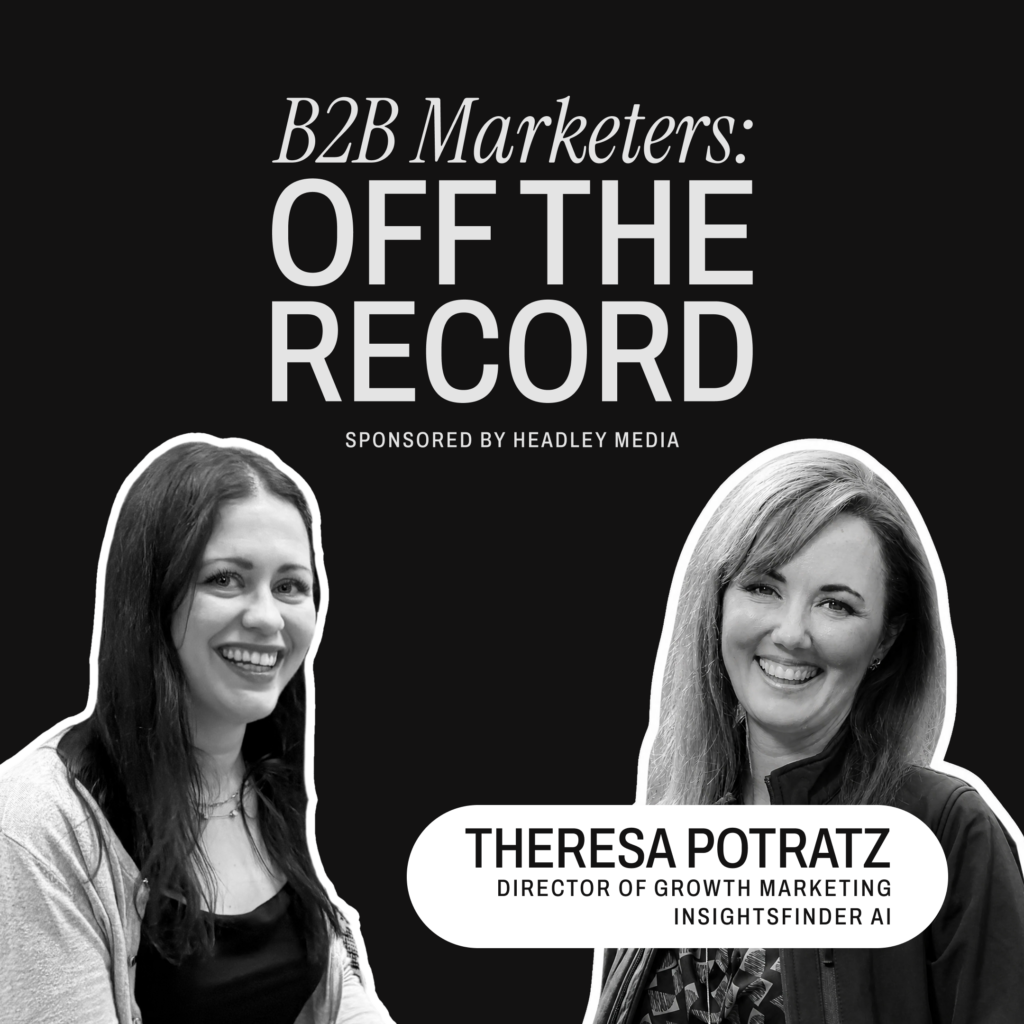
Theresa Potratz, Director of Growth Marketing at InsightFinder AI and host of Unhinged History podcast, shares her journey into marketing, the impact of AI on B2B marketing, and the need for alignment between marketing and sales. She emphasizes the importance of protecting ad spend and the need for marketers to be more technical. Theresa also highlights the significance of learning from marketing faux pas and the value of aligning marketing and sales teams.
Takeaways
Chapters



Theresa Potratz (00:00)
I think all too all too often, even in great organizations where there’s a lot of alignment, somehow we find ourselves wearing different color jerseys on the field facing off with each other.
Chloe Addis (00:11)
Yeah.
Theresa Potratz (00:12)
And I think that that’s silly. It’s it doesn’t make sense to me. Some of my best work has been because of my lockstep relationship.
with sales teams,
Chloe Addis (00:22)
Mm-hmm.
Theresa Potratz (00:23)
where two, three times a week, I’m in their stand-ups and they’re talking to me about the quality of leads. And instead of saying, well, the leads suck, they’re saying, here’s what we need to improve about these leads. This is how we can be make it better. And then there’s a conversation and then there’s a couple of small tweaks. Suddenly it’s, hey, can we spend less on ads right now because we can’t call them fast enough? We can’t email them quick enough. Like that is where there’s great alignment.
Chloe Addis (01:09)
so welcome back to B2B Marketers Off the Record. I’m excited to be joined here today by Theresa Potratz who is Director of Growth Marketing at Insights Finder and the host of Unhinged History podcast. Theresa, welcome to the show and would you be able to introduce yourself?
Theresa Potratz (01:30)
Yeah, I’m stoked to be here. So I am a growth marketer born and bred. Any role I’ve had, regardless of what the title has been, I’ve been doing growth marketing. that’s just kind of how I’m wired. beyond marketing, when I’m not sitting at my computer doing this, I run the Unhinged History podcast where I cover everything from like
the molasses flood that happened in Boston or the real origins of Beauty and the Beast and how it is based off of a dude in France with werewolf syndrome who’s gifted to King Louis the or King Henry the Second and his wife Catherine de’ Medici.
Chloe Addis (02:10)
my goodness. I can already tell from just from the enthusiasm that you have for that, that probably threads through everything that you do. Love the podcast. Yeah, to come back to marketing, there’s obviously a broad range of interests there, which is fantastic, but I know there’ll be like a real depth here, which is perfect. So before we get into it and start off with your story, we kind of like to open the pod with a bit of nostalgia. So
Tell me you’ve been in B2B marketing for many years without telling me.
Theresa Potratz (02:45)
I still refer to X as Twitter. I can’t stop, won’t stop.
Chloe Addis (02:54)
That is a fair one. I think that’s fair enough. Particularly if you’re kind of, I mean, it doesn’t doesn’t matter about what you think about Elon Musk, but you know, things have changed in that realm a lot, I think. So yeah, it definitely makes sense. I don’t think anyone’s going to be calling you out for saying, you know, tweets or whatever. I mean, what do you call the actual like messages on there now? Are they exes or I mean?
Theresa Potratz (03:17)
I
there’s no way, ’cause I have exes, and I don’t message them.
Chloe Addis (03:21)
that’s so true that you’re calling that out and I love it. So let’s dive into a little bit more about kind of you and your history. So how did you get into marketing in the first place?
Theresa Potratz (03:33)
I think like most marketers, I fell into it, right? I ended up working for a local jewelry store that didn’t even have a website and thought, you know what we need to do? We need to be doing social media marketing. And so created their Facebook profile, created stuff for them on Twitter and Pinterest. And within a short period of time, I was pulling in $25,000 a month in dedicated sales from Facebook posts. And
A attribution’s never been easier. It’s people coming in with their phone, showing the post, saying, Do you have this piece of jewelry? Can I buy no, can you make me another one?
Chloe Addis (04:11)
Wow, that’s just, I mean, it really is the true marketing, like, you know, in all sort of distilled senses of what marketing is, there’s not like a truer thing, is there, you’re like, you know, we need to reach more people. Okay, we’ll do a Facebook post and get that, see that full thread of things happening and then that discovery of, okay, I think I could do that. Like, I think there’s an interest
Theresa Potratz (04:36)
Mm-hmm.
Chloe Addis (04:37)
here, like that worked. And I think, you know, for all marketers.
is that feeling of fulfillment, isn’t it? Like, I tried this and actually it made people do that. Like whether it
Theresa Potratz (04:47)
Right.
Chloe Addis (04:47)
was psychology or, know, whatever you did, you, you put something out there in place in the world and someone interacted with it and you caused something. That’s kind of like the basics of it, isn’t it?
Theresa Potratz (04:59)
Huge dopamine rush.
Chloe Addis (05:00)
A hundred percent. So where did you go from there?
Theresa Potratz (05:04)
From there, I got hired on at a small SEO agency and started managing social media for their bevy of clients. And then learned how to do SEO and write compelling blogs from everybody from sedation dentistry to mold remediation. And let me just tell you, mold remediation is the least sexiest industry you can work in.
Chloe Addis (05:30)
Okay, so if you can do that, you can do anything.
Theresa Potratz (05:33)
Right. From there up
SAAS is super simple because it’s fine. It’s fine.
Chloe Addis (05:36)
Yeah,
that’s so funny. And I love that. And I think that just like you, all most marketers will have had some instance like that where they’ve kind of cut their teeth and learned it on something that isn’t particularly interesting. But you you go through the motions, don’t you? And that’s exactly how you learn.
Theresa Potratz (05:57)
Mm-hmm.
Chloe Addis (05:58)
Perfect.
What is one belief about B2B marketing that you have changed your mind on in the last 12 months?
Theresa Potratz (06:08)
I have worked for several really AI forward companies. And I have being on that, you know, I have gotten to see the full mad scientists who will stay up late at night and create make.com work, you know, flows that push data in and out of other websites, push it into clay, enrich the data with gong, and do all this amazing things. And I naively was under the belief that we were all doing this.
That we were all we all had at least one mad scientist on our team who fixated and built brilliance. And I realized no, no, indeed not, that that I I have been lucky to be in such incredible rooms and to see humans do amazing mind blowing things.
Chloe Addis (06:58)
Yeah, I think that’s, that kind of goes to show, doesn’t it? I mean, everyone can have access to the same level of technology, but only if you are, you can see the end goal or like, you know, if you’re particularly that way inclined, you know, be that the technology is kind of like you said, mad scientist part of it, or you’re just very goal oriented. Like I will make this work for me.
Theresa Potratz (07:22)
Yeah.
mad scientist on the team who spurs you to think differently. And I’m not the mad scientist, but sitting next to them and hearing them talk, it changed how I think about things. And then I pushed them in some creatively fun, bizarre directions. And then they pushed me in some. It was fun. It’s that idea of iron sharpening iron.
Chloe Addis (07:43)
Yes, yeah, 100%. I think that’s exactly what you do. That describes it really well. Working off of somebody else, that sort of unlocks more ideas, doesn’t it? You can get the
Theresa Potratz (07:55)
Yeah.
Chloe Addis (07:56)
basics of, okay, well, we can achieve more. We can achieve efficiencies. Like you said, an automation flow, because that would do it for us without much input at all. But actually
It’s more than that, isn’t it? It’s refining it. It’s kind of getting the nuances of things that you can achieve.
Theresa Potratz (08:14)
Right. It’s
it’s like saying, well, I’m gonna use AI to write an email. And I don’t think that’s wise because I will spend two hours on it refining a good prompt. So
Chloe Addis (08:25)
Yeah.
Theresa Potratz (08:26)
to do one email, no, don’t do it. Write the email yourself. If you’re writing thousands of emails that are heavily personalized, spend the two hours on that damn.
Chloe Addis (08:35)
Yeah, yeah, exactly. there’s so much going on in AI and like you said, kind of, yeah, people, people will use it. think there’s definitely like a, a discovery timeline, isn’t there with AI? Like, you know, as it first comes out, we could use it for loads of stuff and then adoption and a lot of, you know, the kind of resulting AI slop as people call it and
you know, then there’s kind of a little bit of a pullback. Okay, how do we use it? Where’s the AI? Where’s the human like level and just finding that the balance really before then scaling or like using, you
Theresa Potratz (09:11)
Mm-hmm.
Chloe Addis (09:11)
know, moving into agentic, like we kind of look, everyone’s at a different point with it, I suppose. So with that, what shifts are you seeing now in how B2B buyers are behaving?
Theresa Potratz (09:25)
You know, I think because and it truly it’s probably because of AI as well as at least in the US, how we’re seeing inflation and a bunch of things, you know, negatively impact the economy,
Chloe Addis (09:34)
Yeah.
Theresa Potratz (09:37)
there is a pullback on spend. And this pullback on spend, regardless of what you identify as the cause, and I’m assuming there’s a myriad of points,
Chloe Addis (09:47)
No.
Theresa Potratz (09:48)
that you’re going to see buyers more hesitant to do the purchase.
you’re going to see a longer buying cycle. You’re going to need to be involved in more conversations. And then buyers are also expecting a
Chloe Addis (10:01)
Mm-hmm.
Theresa Potratz (10:01)
highly personalized journey as well as one that doesn’t sound like AI. So you need to use AI to create the full thing, but don’t sound like it. It’s like being a woman, you know?
Chloe Addis (10:09)
Okay.
Theresa Potratz (10:12)
You need to you need to be pretty, but don’t try too hard.
Chloe Addis (10:15)
So what kind of challenges do you think this brings up practically day to day for marketers?
Theresa Potratz (10:23)
I think short-term challenges that this brings up is definitely alignment with sales, right? Because
Chloe Addis (10:29)
Yeah.
Theresa Potratz (10:30)
we’re required to really be the backbone that feeds sales all of these leads. And
Chloe Addis (10:35)
Mm-hmm.
Theresa Potratz (10:35)
so there’s going to need to be a lockstep relationship between these two departments because they’re the ones talking to the customer. Marketing tends to get siloed. We tend to get pushed away. We might get to listen to the gong call after maybe
Chloe Addis (10:49)
No.
Theresa Potratz (10:49)
we’re just given the transcripts. Who knows?
Chloe Addis (10:52)
Yeah.
Theresa Potratz (10:53)
But we need to be able to have that dialogue to say, okay, sales, is this an email that you would open or is this an email that our prospect would open? And if not, how can I refine it? And then you go back to the prompt, you spend hours with it, and then you go back to trying to get sales to say yes or no if they’d open this email.
Chloe Addis (11:12)
Yeah. And that’s a really key point. And I mean, as with kind of most marketing and sales, there’s often alignment issues, your point on email automation there can kind of sit both sides kind of like we all see these emails like
flooding into our LinkedIn messages and things that are automated to the point where most marketers look at that and go, absolutely not, like can tell that
Theresa Potratz (11:38)
Yeah.
Chloe Addis (11:39)
it’s too much the other way, it’s too automated. So there’s kind of like that push and pull, I suppose, between marketing and sales.
What’s a strategic bet you think more marketing leaders will need to make over the next couple of years?
Theresa Potratz (11:54)
I think we’re going to invest heavily in making marketers more technical. I think
Chloe Addis (12:00)
in
Theresa Potratz (12:00)
there is going to be a degradation of humans that are more brand or creative oriented at purely. We’re going to need to be more left brain, right brain, because we’re going to need marketers that not only have the marketing shops, but also know how to code, at least vibe code. We’re going to need to see that technical skill development.
So that we can really fill the gap between developer and marketer. You know, kind of I think go to market engineer is, you know, filling that for individual
Chloe Addis (12:33)
Yes, yeah.
Theresa Potratz (12:34)
roles. But I’m of the opinion that each marketer is gonna need to do some. Like a lot of marketers now might know a tiny bit of HTML code for when they’re thrown into the mix and it’s like the website did something funky, fix it, you know. So you need
Chloe Addis (12:46)
Yeah. Yeah.
Theresa Potratz (12:49)
to know, that bold.
Is how you do that in the in the HTML. And I think we’re gonna see that across the board just with with a lot of GTM motions.
Chloe Addis (12:58)
Okay. So are you talking more kind of like vibe coding type immersion experience or?
Theresa Potratz (13:06)
I mean, I think
vibe coding could be a heavy part of it. I think it’s also gonna go into if you use a tool like clay or something similar, where you
Chloe Addis (13:15)
Right.
Theresa Potratz (13:16)
can pull it in, give it a ton of data, have it use various AI prompts to pull different information out, push transcripts in, pull information out of that, and then
Chloe Addis (13:28)
Yeah.
Theresa Potratz (13:29)
design a workflow around that. Like
Chloe Addis (13:31)
Mm hmm. Yeah. Like,
Theresa Potratz (13:32)
that’s what I see.
Chloe Addis (13:33)
yeah, very technical. but also, yeah, very needed. So I think, and I think one of the things that we’ve, or I’ve come across in a lot of these conversations, around AI and how it affects like the workforce is thinking about, a lot of these kind of graduate level jobs that are being, you know, the tasks of the kind of generative stuff that we’re asking AI to do.
like leaning more on AI and not necessarily recruiting for the graduate level or potentially then we’re going to see in a few years, gaps in that level of person coming up because they haven’t been trained. They haven’t done the, as kind of we started at the top of the call talking about, you know, the writing for blogs for companies.
particularly boring, et cetera, you know, doing all the groundwork and becoming marketers through like experience and knowledge, and learning and actually a lot of that being filled with AI and kind of, you know, skipping a few of those stages. so having some knowledge gaps within the workforce. But if you see it as you’re, as you’re kind of explaining more technical
knowledge is needed, then actually perhaps it’s not so much that there will be a massive gap, there will just be a shift in what we’re expecting of them,
Theresa Potratz (14:59)
Right. And I think that’s true. I mean, you look at, we’ve been through this moment in history. This is why I love studying history. When machines came out and we had the invention of the washing machine, it eroded, it removed laundress. You’re no longer a laundress. You d everyone has a a washer in their house or they have it at the laundromat. That doesn’t mean that anybody who was a laundress was out of work for good and always. Their work changed.
They went to a different thing. They did something different. You know, it’s adapt, migrate or die. We’re going to s we’ve been here before, we’ve evolved past this. This is just the
Chloe Addis (15:38)
Yeah,
Theresa Potratz (15:39)
latest iteration.
Chloe Addis (15:40)
yeah, I think you’re, that makes sense. Your ability to draw on history is fantastic because it makes so much sense, doesn’t it? like these kind of inventions that revolutionise, like, you know, such a simple thing that actually revolutionise how people, women in particular, like, spent their time, spent their days, and then suddenly you can move on to so much more, which is, you know, obviously what we’re experiencing a lot with.
with AI, which is kind of part of why these conversations are now existing. Like, okay, let’s take ourselves above the day to day and actually think, okay, where can we move forward with these things? So what’s something that you see marketing teams still doing that you think no longer works, something they do out of habit?
Theresa Potratz (16:32)
I think you touched on this earlier, you know, with people sending you DMs, pitch slapping you.
Chloe Addis (16:37)
Yeah.
Theresa Potratz (16:38)
Good God, stop it. For good and always. Like I think I was complaining about that a decade ago and in ten years I’m still gonna be complaining about it. Because if you jump into my DMs and you pitch slap me with an automated message that was clearly sent to a hundred other humans and has no information on who I am.
Why this matters to me and doesn’t draw on our previous relationship. I dislike you. I dislike our previous history. I dislike our future history. Like you taint your entire brand. You’re not gonna be at that company forever. And when
Chloe Addis (17:14)
Mm, yeah.
Theresa Potratz (17:15)
you go to the next one and you hit me up with a, hey, can you do this for me? It’s like, let me tell you about my favorite.
piece of software that I’m currently marketing. And once you sign up for a free trial and give me six figures for a three year contract, then I’m gonna talk to you about that. No.
Chloe Addis (17:32)
Yeah, I’m on your team. I don’t know why it exists. I don’t know. is it like, it can’t be generated? No one’s ever gone through and gone, oh yeah, that’s the fourth or fifth automated email I’ve received from that one person. I’m going to reply. I’m now really interested in whatever it is they’re trying to
Theresa Potratz (17:52)
You
know, in an email I feel is I’m I’m forgiving of emails, right? I’m not forgiving of you using your personal LinkedIn profile to pitch me. No. Cause I keep those DMs live. I I scroll through, I’m like, no, no.
Chloe Addis (18:07)
Yeah. I mean, yeah, especially if you do, you know, you are using LinkedIn, how it’s meant to be used for the network. So you are actually in there and you just have to like stifle through all of the stuff. Yeah. Yeah.
Theresa Potratz (18:19)
The dross and it’s like no kick rocks.
Chloe Addis (18:25)
Yeah. I love that. Because I wouldn’t say that that’s something that B2B teams like good marketers are doing. Surely it’s not good market. It’s just kind of sales
automated sales systems.
Theresa Potratz (18:37)
But I’m gonna I’m
gonna push h on that. I’m gonna say that good marketing repels the people you don’t want and attracts the people
Chloe Addis (18:42)
Yeah.
Theresa Potratz (18:43)
you do.
Chloe Addis (18:44)
Yes. Yeah. So what type of investments should marketing leaders protect even if budgets are tightened at the moment?
Theresa Potratz (18:53)
I say ads. They need to protect ad spend. Now, with that in mind, I think given where we’re at with AI, with the amount of information, the amount of things we can do, I think that ad budget needs to be protected, but it needs
Chloe Addis (19:08)
Mm-hmm.
Theresa Potratz (19:08)
to be scrutinized. Does your copy, is it relevant, useful, and interesting to your
Chloe Addis (19:14)
Mm-hmm.
Theresa Potratz (19:15)
ICP? When you get to that landing page, does that mirror the expectations that they had when they clicked the ad?
Chloe Addis (19:22)
Mm-hmm.
Theresa Potratz (19:23)
And are you maintaining that that through line all the way through the buyer’s journey? And I think you really need it starts with, you know, having a good I’m a growth marketer, of course I’m gonna want budget for ads, but I think we
Chloe Addis (19:35)
Yep.
Theresa Potratz (19:36)
need to very carefully shepherd what we’re doing, how we’re doing, and why we’re doing it.
Chloe Addis (19:43)
That’s really interesting, a great reminder. Particularly on a personal level, always think, actually from these conversations, there’s always something that comes up that I’m like, yeah, I need to kind of look into that. Because when you’re focused on one thing, like say for example, yeah, you’ve got the huge, you’ve got ad managers, you’ve got kind of budgets in different areas. So it’s always like, okay, well we’re optimizing this.
at the moment and then something else is changing. there’s, mean, I guess it’s part of AI as well. Everything’s constantly changing within
Theresa Potratz (20:17)
Mm-hmm.
Chloe Addis (20:18)
ad management systems and kind of the optimization there. So actually something that was working very well up until now, probably, like you said, needs that really close monitoring and like the thread through. Does it still resonate? Is it still, you know, from the keywords to the creative?
and everything in between. I think there’s a lot of examples of people doing it wrong, I would like to say, kind of from everything that is thrown at you. again, it comes back to there’s just so much content. There’s just so much to sift through for marketers. like having your ads with a really clear message and really like stand out. You know, that’s what you can do with ads is you can be a bit more creative. You can be a bit
like a bit more out that you want to stand out, but also have that clear, like exactly as you said, kind of a story hook or whatever that leads right through to your landing page. So interesting. Could you give any kind of examples of that, of what you see people doing wrong maybe?
Theresa Potratz (21:26)
You know, I I think we see it done wrong all the time, particularly as marketers. And here’s my example. Because I chat with marketers regularly and I commonly hear, I’ve said it too, I’m immune to ads. Or my daughter will be sitting watching a video with me on my my phone and she’ll be like, what was that? I like, It’s gone. It’s an ad. I’m I’m immune to it. And I think that. I th I think we all believe that about ourselves.
But what we don’t pay attention to are the ads we converted on. Where we’re like, ooh, my gosh, I need that lip balm, that lip stain that will give me the color I want for six hours. Yes. And add to cart ooh, that’s the exact shade. Go. We don’t pay attention to the fact that that was an ad and we converted. And
Chloe Addis (22:15)
Yeah. Yep.
Theresa Potratz (22:17)
we didn’t hesitate. So if we slow down enough to go, when was the last time we converted?
Chloe Addis (22:23)
Mm-hmm.
Theresa Potratz (22:24)
Why? And then work through that whole process. That’s the the more holistic way to look at it. Because
Chloe Addis (22:31)
Mm-hmm.
Theresa Potratz (22:32)
we’re a bunch of cynics. We think we’re better than everybody else. We know the hook. If you’re
Chloe Addis (22:36)
Yeah. Yeah.
Theresa Potratz (22:38)
if the product is free, you’re the product, you know? And it’s just, no, when’s the last time you signed up for something free? What was
Chloe Addis (22:43)
Mm.
Theresa Potratz (22:44)
your motivation? Now figure out the back, you know, how to reverse engineer that.
Chloe Addis (22:49)
Yeah, I love that. It’s so funny, isn’t it? Like thinking I was just slacking in my colleague, I was saying, I’ve just joined the gym, but then I was thinking, how long was I a lead for? Such a marketing thing, isn’t it? To go back to your brain and be like, well, actually I inquired in the new year because, know, new year knew me didn’t occur.
And so now six months later, here we are, but I’ve been a lead for them for six months. And I was thinking, well, they didn’t really reach out to me for like, was a bit, I was a bit annoyed that I’d converted because I hadn’t actually had any nurturing. I’d kind of obviously got there myself or, you know, been watching all these things on that, not ads, but stuff on Instagram or whatever, you know, I’d been receptive to stuff. So.
Theresa Potratz (23:39)
Right.
Chloe Addis (23:39)
Had I seen more ads, could my buyer journey have shortened itself? Do you know what I mean? I’m of like reversing the whole process.
Theresa Potratz (23:49)
Now you’re gonna go back through and realize you belong to some sort of text chain and one of the moms there is an influencer with a paid account and you’re gonna be like, dang, it was Sandra’s fault. That’s why I’m here.
Chloe Addis (23:58)
Yeah,
absolutely, absolutely. fair enough, like kudos to her. She deserves it.
Theresa Potratz (24:10)
Sandra for listening. We love your work.
Chloe Addis (24:11)
Yeah, great work. It’s all about the referrals. So yeah, perfect. No, but yeah, I think that’s that’s just the mind of a marketer, isn’t it? You have to there is there will always be some sort of thread.
And yeah, the points of influence are just getting more and more, I think, these days. So with that, what is one thing you wish you could change about marketing, if you could?
Theresa Potratz (24:38)
You know, I would change the siloing of marketing and sales. And
Chloe Addis (24:45)
Yeah, yeah.
Theresa Potratz (24:46)
I think all too all too often, even in great organizations where there’s a lot of alignment, somehow we find ourselves wearing different color jerseys on the field facing off with each other.
Chloe Addis (24:58)
Yeah.
Theresa Potratz (24:59)
And I think that that’s silly. It’s it doesn’t make sense to me. Some of my best work has been because of my lockstep relationship.
with sales teams,
Chloe Addis (25:09)
Mm-hmm.
Theresa Potratz (25:10)
where two, three times a week, I’m in their stand-ups and they’re talking to me about the quality of leads. And instead of saying, well, the leads suck, they’re saying, here’s what we need to improve about these leads. This is how we can be make it better. And then there’s a conversation and then there’s a couple of small tweaks. Suddenly it’s, hey, can we spend less on ads right now because we can’t call them fast enough? We can’t email them quick enough. Like that is where there’s great alignment.
Chloe Addis (25:37)
Mm-hmm.
Theresa Potratz (25:37)
But the
more we have, well, marketing is on the hook for MQLs and sales is trying to bring in the revenue. So there’s going to be this different North Star, it it just sets everybody up for failure.
Chloe Addis (25:52)
Yeah, a hundred percent. see that so much, particularly within lead generation, because there’s just no alignment at the beginning or there was
Theresa Potratz (26:02)
Yeah.
Chloe Addis (26:03)
maybe at the beginning of the year when you have like a big marketing and sales, like call or whatever. And so you’ve agreed on what the ICP is, but not what qualifies as an MQL or an SQL or what point that is.
handed over just as you’re saying, of,
Theresa Potratz (26:21)
Yeah, well
Chloe Addis (26:22)
would them, you know, if they, you generate too many at the lower end of the scale that are less qualified, hand them over. Like you said, you might be getting that feedback of we can’t deal with all of these and also
Theresa Potratz (26:32)
Right.
Chloe Addis (26:33)
they’re not that great, but can marketing do something else to nurture them in the meantime? And then they pass across a few when they’re much more nurtured.
Theresa Potratz (26:42)
Yeah.
Well, and double tapping on that, I think some of the best orgs I’ve been at, one of it was three, four months into the year and it was, hey, the market shifted. We need to change our definition of MQL be to go after this change. You know, we’re seeing because this was working in a mortgage and or working with realtors, so we saw
Chloe Addis (27:04)
Mm-hmm.
Theresa Potratz (27:05)
the reality the reality market change, mortgage rates went up, so everything changed. So it was like, okay, looking at the
Know different lead scores we have, A, B, C, and D, we were going after A’s. A’s were who we were going after, but it’s the B’s that are the ones that are showing up to the demos. And the B’s represent this huge category that if we change some of our marketing, we could really go after and we could really dominate here. And so by changing that and going after a different persona and marketing them differently.
That helped us firm up and really reshape what we were doing. But
Chloe Addis (27:43)
Mm-hmm.
Theresa Potratz (27:43)
it required that alignment, it required that conversation to see who’s converting, why are they converting? And now how can we double down on it?
Chloe Addis (27:51)
Yeah, absolutely. And agility and flexibility because you are so close and you know, you are working in that kind of symbiotic nature that is like, you know, if things change, then you can change too. But if you don’t know that you’re behind the market, you’re changing to market needs as they happen.
Theresa Potratz (28:13)
Yeah.
Chloe Addis (28:15)
But actually if you didn’t, and if you weren’t agile, if you weren’t working that closely together, you would
possibly missed that and then, you know, when the market changed back, if you’re kind of six months behind the flow, then where does that leave you? I think there’s, there’s obviously a lot of nuance in that. If you’re thinking about different, obviously different markets, but different size teams as well, you know, kind of there isn’t in bigger company, you know, corporate enterprise size businesses, there often isn’t that agility or flexibility because you know, everything has to go through.
processes and be signed off and they’re almost working to yearly plans if you’re like, know, months ahead. So yeah, unfortunately, like that’s great when you can have it. But I think, you know, there’s a lot that still can be done in the in-between, you know, there’s
Theresa Potratz (29:09)
Mm-hmm.
Chloe Addis (29:09)
a lot of kind of, and as, you know, creative marketers, as we are creative, there’s a lot of ways to kind of get through that and get around that.
by instilling these relationships within the teams that you work with.
Theresa Potratz (29:23)
Completely.
Chloe Addis (29:24)
so I think that’s kind of come to the end of the podcast and now looking forward to
do you think we should invite on as our next guest?
Theresa Potratz (29:34)
Honestly, I think I would love it and I don’t have a close relationship, but Kyle Lacey. I have followed
Chloe Addis (29:40)
Okay.
Theresa Potratz (29:41)
his career from afar on LinkedIn, seen him go through several, you know, organizations and really
Chloe Addis (29:47)
Yeah.
Theresa Potratz (29:47)
do some cool work.
Chloe Addis (29:49)
Yeah, think so too. I follow him So I think that’s a perfect guest, quite aspirational. I’m hoping that he’ll hear this and be open towards reaching out to him. And what do you think if it, whether it’s for Kyle or whether it’s for anyone else, what kind of question would you leave the next guest for the pod?
Theresa Potratz (30:12)
I would wanna hear what’s one marketing faux pas that you had that shaped how you do things from now on. Not in the tell me your dirties. I want to hear your most embarrassing moment, but I think
Chloe Addis (30:25)
You
Theresa Potratz (30:26)
that your most embarrassing moment or your biggest like, no, can really
Chloe Addis (30:30)
Mm.
Theresa Potratz (30:31)
influence how you do things better, stronger next time. You know, it’s knowing your weak spot and
Chloe Addis (30:38)
Yeah.
Theresa Potratz (30:38)
then being able to reinforce and protect that moving forward.
Chloe Addis (30:42)
Yeah, yeah, I like that. And you don’t know them until you’ve done it, do you really? You you don’t know where your weaknesses are until you’ve experienced that. And that’s the great part of learning. Could I be really cheeky and ask you what your answer to that question would be?
Theresa Potratz (30:58)
gosh. I mean the one that pops up isn’t my like I this one is worse than one I’ve done. Okay. because
Chloe Addis (31:05)
Okay.
Theresa Potratz (31:06)
I have done things like at one point I was managing for one company thirty-three corporate social media profiles. it spanned Facebook, Twitter, Instagram.
think a couple of groups, LinkedIn, I was managing parent and child brands. I was localizing the language between American English and British English because we had a British Twitter account. And I was posting 1500 times a month, responding in real time, you know, doing all of that. I witnessed one of the teams send an email to the public sector audience where they put public sector in the subject line, but they forgot the L in public.
Chloe Addis (31:49)
no.
Theresa Potratz (31:51)
And
that went out to like 40,000 humans. And I didn’t experien like I didn’t hit send. I wasn’t in charge
Chloe Addis (31:58)
Okay.
Theresa Potratz (31:59)
of reading that. But watching that influenced how fast I tweet on the bus on my way into work on one of the public handles. It’s like, you know, I need to actually slow down a second. I need to make sure that I have all my I’s dotted, T’s crossed, because
Chloe Addis (32:15)
Yeah.
Theresa Potratz (32:16)
I don’t want to send something that would go to
millions of people, potentially.
Chloe Addis (32:22)
Yeah,
yeah. Learn from other people’s mistakes, I think is what
Theresa Potratz (32:27)
Yeah.
Chloe Addis (32:28)
you’ve done well there. Amazing. Yeah, no, you definitely don’t want to get into that sort of, it’s, but I mean, managing socials is, that’s why, you know, people find it so, so fun and, you know, that ability to kind of like connect to people and get out there and be responsive and reactive. But, and so you need that, like the quick.
The element of speed and time there is really important, but you’re absolutely right. Make sure have something in place that copy edits, checks, and you know, thank God for AI. think there’s less, you see less of those things happening with, you know, like the Grammarly add-on and things like that. But again, that would have been spelt correctly, just completely.
Theresa Potratz (33:12)
Yeah. Grammarly wouldn’t have flagged that. Grammarly would have gone, Go with God, you know, and then
Chloe Addis (33:21)
dear, that’s amazing. And I think that’s the perfect way to end. So thank you so much for coming on the podcast. And could you tell people where they can find you and obviously about your great history podcast?
Theresa Potratz (33:34)
Yeah, so I am obviously on LinkedIn, Teresa Potratz. Connect with me. I’m the only one with vivid hair color. I don’t update my photo as often as I update the hair. but it’s going to be bright. Now, beyond that, Unhinged History is found wherever you get your history podcast. It has a wooden logo, we are or wooden background on the logo, we are not history unhinged. They came later. And yeah, we’re
most social media platforms. So find us, say hi.
Chloe Addis (34:06)
Perfect, amazing and go listen. Thank you so much, Theresa and yeah, take care.
Theresa Potratz (34:12)
Thank you.
In this episode of B2B Marketers: Off The Record, Chloe Addis is joined by Theresa Potratz, Director of Growth Marketing at Insights Finder and host of the Unhinged History podcast, to discuss how AI, changing buyer behaviour and tighter budgets are reshaping B2B marketing.
Theresa shares why the next generation of marketers will need to become more technically capable, combining traditional marketing skills with AI, automation, data and workflow design. But as technology becomes more powerful, she argues that the human side of marketing becomes even more important, particularly when buyers increasingly expect personalised experiences without feeling like they are being marketed to by AI.
The conversation explores the growing need for marketing and sales to work in lockstep, why automated LinkedIn outreach can do more harm than good, and why marketers should think carefully before cutting advertising budgets. Theresa also explains why teams need to continually reassess who is actually converting, rather than relying on fixed definitions of their ideal customer or MQL.
00:00 Introduction and Theresa’s journey into growth marketing
06:08 AI, automation and the marketing “mad scientists”
09:25 Changing B2B buyer behaviour
10:23 Why sales and marketing alignment matters more than ever
11:54 The increasingly technical B2B marketer
16:32 Why automated LinkedIn outreach needs to stop
18:53 Protecting and scrutinising advertising investment
21:26 Reverse engineering the ads that make us buy
24:38 Breaking down marketing and sales silos
26:42 Rethinking MQLs as markets change
29:34 Theresa’s recommendation for the next guest
30:12 Marketing mistakes and the lessons they leave behind
This vivid–haired marketer partners with mid-market and start-ups in SaaS to build scalable growth marketing systems. In her off-time she’s constantly learning unhinged history stories for her podcast.
In this conversation, Freya Ward and Paula Medeiros explore the evolving landscape of B2B marketing,…
In this episode of B2B Marketers Off the Record, Freya Ward interviews Niall Ratcliffe, CEO…

In this episode, Simon Gould shares his extensive journey in digital marketing, emphasizing the transformative…