

S02E04 – Paula Medeiros – B2B Marketers: Off The Record
In this conversation, Freya Ward and Paula Medeiros explore the evolving landscape of B2B marketing,…
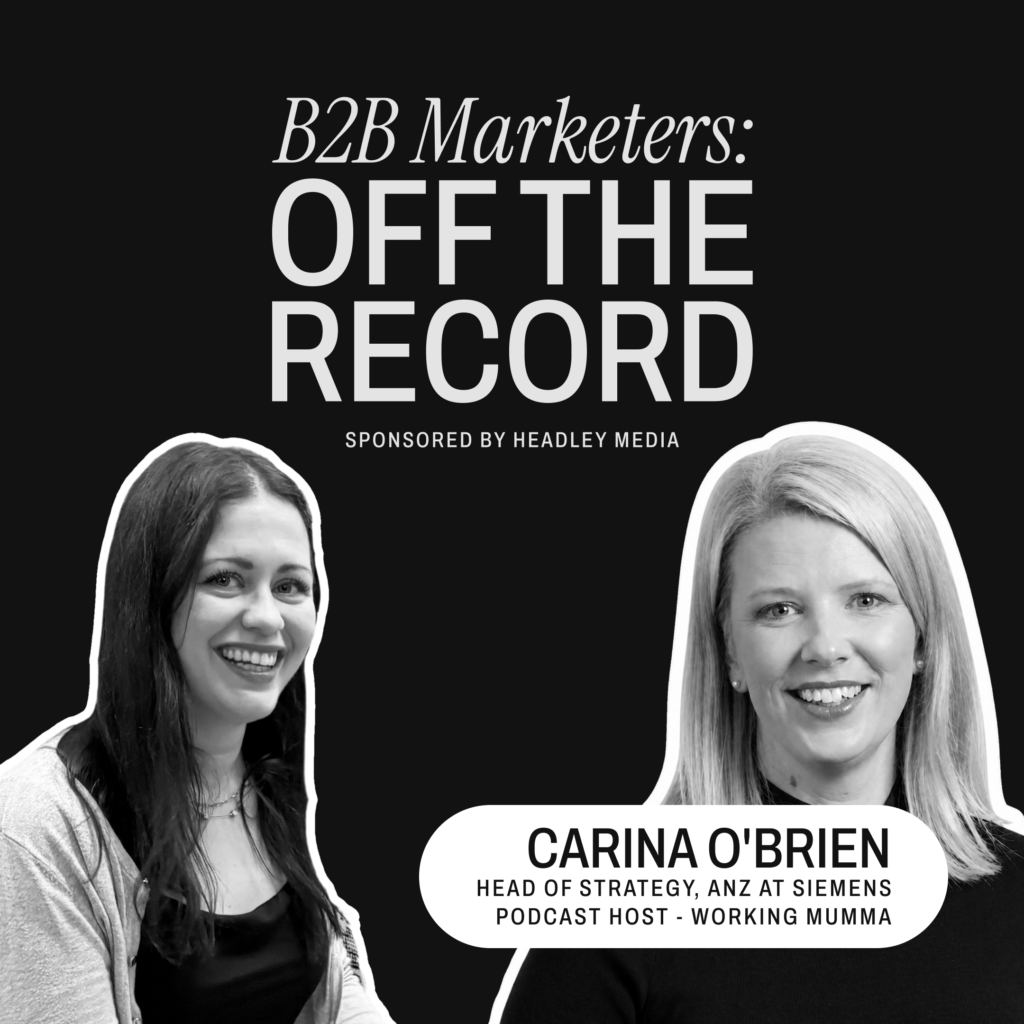
“If we don’t have the customer at the heart of what we are doing, the campaign may just fall flat because we’ve got the wrong objectives and the wrong ambitions from the very start.”
— Carina O'Brien, Working Mumma & Siemens Mobility
Carina O’Brien, Head of Strategy ANZ at Siemens Mobility, shares insights on B2B marketing and emphasizes the importance of human connection and the strategic plays marketing leaders need to make in the face of technological advancements. The conversation delves into the cost of AI implementation, the value of people in marketing, and the misunderstood perception of marketing.
Takeaways
Chapters



Carina O’Brien (00:00)
even in Australia but also now
even go to to global trade shows sometimes, that human connection now, I would say is stronger now than what it was 10 years ago. So there’s also an element of we’ve got so much data and information coming at us. But I would say at a B2B level, there is that human to human connection, that face to face value that I think people are actually wanting more so than ever. And
Chloe Addis (00:25)
Yeah.
Carina O’Brien (00:26)
And I’m actually saying that the people that go, look, I’ve just sent them an email or they’ve seen it online, you’re going, no, like you’ve that human, you they you don’t get the same as when you’re like on an email or a Teams call versus face to face.
Chloe Addis (00:40)
Yeah.
so welcome to B2B Marketers Off the Record podcast. I’m delighted to be joined here today by Carina O’Brien, host of Working Mumma podcast and head of strategy ANZ at Siemens Mobility. Thank you so much for joining me, Carina.
Carina O’Brien (01:18)
Thanks, Claude. I’m really looking forward to this.
Chloe Addis (01:20)
Yeah, absolutely me too. I know there’s going to be so much to unpack here with you today. So could you introduce yourself to our listeners?
Carina O’Brien (01:30)
Hi everyone, so my name’s Carina O’Brien. As you can tell, I have an Aussie accent. I’m based in Melbourne, Australia. I’m the proud mum to two young boys that are five and eight. I, as Chloe said, I’m the host and producer of the Working Mumma podcast. And in my corporate life, I am responsible and the head of strategy for Siemens Mobility across Australia and New Zealand, but also responsible for communications as well as sustainability.
Chloe Addis (02:00)
Amazing. Yeah, there’s so much in there and that’s exactly why I knew you’d be a perfect guest to come on and talk about all of your experiences from all different angles, both personal, business, B2B, B2C, all of that. So thank you so much for joining us and all the way from Australia as well. I know we’re online, but it is a different time of day for us both. So
Carina O’Brien (02:22)
Yeah.
Chloe Addis (02:25)
that’s perfect. So to kick off, we normally ask…
a
light question which is tell me you’ve been in B2B marketing for many years without telling me.
Carina O’Brien (02:39)
a great question, I think, to kick it off.
Chloe Addis (02:40)
you
Carina O’Brien (02:43)
I would say that what is the angle or the message that you are trying to deliver? And that’s the very first question that you’ll ask someone.
Chloe Addis (02:55)
That’s perfect.
People kind of go for that question in all different ways actually. We’ve had so many different answers to it. So to actually like, you know, get to the point really quickly,
Carina O’Brien (03:06)
Yeah.
Chloe Addis (03:07)
think that’s where you start and that’s where you finish. That’s that’s a perfect answer.
Carina O’Brien (03:11)
You’re always asking what who’s the target audience, what’s the message, what’s the objective? And so many people think this is what needs to get done but you’re like, Well, no, you’ve got to take a step back.
Chloe Addis (03:21)
Yeah, 100%. It comes back to the narrative. That’s what, you know, marketing is storytelling at the end of the day. So perfect answer. how did
Carina O’Brien (03:27)
Hundred percent. Storytelling for adults.
Chloe Addis (03:33)
you into marketing in the first place?
Carina O’Brien (03:39)
I had a weird and wacky background. I actually studied IT at university as part of my undergraduate. And then I worked in IT for a number of years, then went into sports management. So I was managing a large sports facility here in Melbourne. Part of that I was studying my masters and I threw a subject was like, I actually love, you know, back into the corporate world and that’s what I really want to do. So
I spoke with someone and then she said, Look, there’s this position going at at Siemens, would you be interested? And I was Yes, I’m gonna give it a go, threw my hat in the ring. So I was in strategy for a while. And then they were disbanding the strategy team. And as we know, between strategy and marketing and communications, there are a lot of similarities and there are some crossover skills. So for the head of communications at the time, who is actually now the head of communications for Siemens Globally, I said to her, Look,
Is there anything going? And also the former CEO of Siemens Australia said, Look, what would you like to do? I said, Look, I’ll give communications and marketing a go. And so that is literally what I would say is I fell into it and that would be
Chloe Addis (04:46)
Thank
Carina O’Brien (04:47)
now about fourteen years ago.
Chloe Addis (04:50)
Wow, yeah, so obviously enjoying it then. It stuck
Carina O’Brien (04:54)
Yeah.
Chloe Addis (04:54)
with that for 14 years. No, I think that’s a really great story. You do often hear of kind of the technical people kind of coming in and that gives you just such a broad range of depth of understanding of what it is that you’re trying to market. So, you know, people find their niches and like you say, fall into marketing.
from lots of different avenues. We kind of hear a lot about people in sales that switch over to marketing and also vice versa. But yeah, it definitely is one that’s much related to strategic thinking. Like you said, kind of you’re in strategy and then you can see that bigger picture on why marketing works for the business. So that completely makes sense to me. So what is one belief about B2B marketing?
that
you have changed your mind on in the last 12 months.
Carina O’Brien (05:45)
I would actually say it’s around AI and the power of AI.
Chloe Addis (05:50)
Mm-hmm.
Carina O’Brien (05:50)
if someone had said, I remember about three years ago someone said to me, You should try this and give it a go. And my first thought was, my goodness, it’s gonna take my job. Whereas now in the last twelve months, I would say both for my podcast but also in my corporate role, I’m able to see the value. I’m able to see the productivity gains that actually come by AI. And I wouldn’t say that it
Chloe Addis (06:15)
Yeah.
Carina O’Brien (06:15)
gives you everything. It is good if you’ve got a blank sheet of paper. Even today I was brainstorming on my iPad about a press release I need to write. But I know to help write the first draft of that with what I feed it is what
Chloe Addis (06:32)
Yeah.
Carina O’Brien (06:33)
I’m seeing that benefit. So I think, yeah, definitely the last 12 months AI’s really transformed the way that hopefully I will work in the future.
Chloe Addis (06:44)
Yeah, I think there’s been like a slow kind of hesitant adoption in some places, hasn’t there? Like, you know, it’s kind of the AI search and everything has come about maybe three years ago and kind of really kicked off with everything. But I agree. And kind of from these conversations that I’ve been having over the last 12 months, the practical applications and learning where to find those efficiencies. Like you said, people have like, you know, tried it out. You wouldn’t just let it write a press release.
for you, but with that input and kind of using it as your kind of co-worker is where people do find those efficiencies. But definitely still kind of part of the testing phase, isn’t it, before it’s like scaled up to actually be kind of doing a lot of autonomous things. Unless you are finding that, what types of applications do you see it being used at?
Carina O’Brien (07:41)
So for my podcast, I use it to edit. so literally with a click of a button, all the ums and ahs can go. And that
Chloe Addis (07:50)
Yeah.
Carina O’Brien (07:50)
would usually take me three to four hours to edit some podcasts, particularly if there was there was one serial podcast I remember, every second word, no joke, was an And so it took me hours
Chloe Addis (07:59)
Hmm
Carina O’Brien (08:00)
that was painful to edit this one podcast.
So definitely from that perspective, using AI there, I then can get a download of a transcript. I can upload it to either ChatGPT or Claude. I’m now paying for Claude because I really I’ve read a lot saying that that’s better than ChatGPT, but it’s interesting about how it takes a lot more to tr for it to train your voice and for it to get used to your tonality and the like. So then I can upload a transcript and I can then say
write my show notes, come out with ten, say, podcast titles, but then I’m also feeding it at the same time of be like this, no, I want this and what’s working, what’s not, remember this style. So from a podcast perspective, it has dramatically, I would say, improved my efficiencies. but then from a corporate perspective, it helps with planning. I know I use it quite a lot in strategy about overlaying
different levels of data to then have an output as well. So in the last couple of weeks I’ve actually seen the advantages of it’s not just saying review this, but by using or creating a bot. Like for example, we’ve created a bot for for someone to actually help their tonality of writing their LinkedIn posts. And because sometimes
Chloe Addis (09:14)
Okay.
Carina O’Brien (09:15)
they’re like, I don’t know what to write. So we’ve then created a bot and so then they’ll be able to then produce content based out of that. So I think it actually
For me, it’s it’s getting to think about what is the outcome or what am I looking for. So you’ve really got to start with the end in mind and
Chloe Addis (09:30)
Yeah. Yeah.
Carina O’Brien (09:32)
then work backwards. Just like anything, rubbish in, rubbish out. But if you’re
Chloe Addis (09:37)
Mm.
Carina O’Brien (09:37)
thinking, Okay, what how can I then see that it can make me more efficient or I keep playing and then see what happens? and that’s where both from a podcast perspective but also then in a corporate role, you can just
Go, all right, I wonder what this is gonna do. Or if you’ve got an idea of going, I’d love to be able to do X. And I said that to someone, I’d love to be able to do this. And then 10 minutes later, he’d created this bot for me. And I’m going, my goodness, this is gonna change my
Chloe Addis (10:07)
Okay.
Carina O’Brien (10:08)
world. And it did, it changes my perspective, my thinking. But also at the same time, I’m realizing that I’m starting to go a few steps ahead, but there’s other people that are still.
is this going to take my job? And they’re a bit doubtful. So I’m now
Chloe Addis (10:22)
Yeah. Yeah.
Carina O’Brien (10:23)
realizing there’s also a change management approach with the people around me. I might be sprinting ahead and saying how cool this is, but then I also need to slow down to bring others along for the ride and to show the benefits and also the proof points about what I’m producing.
Chloe Addis (10:40)
Yeah, there absolutely is that evolution isn’t there and it’s just knowing what your place is and what its place is and how that works together, like you said, to achieve. So you’re coming up with the ideas and the human element there
Carina O’Brien (10:55)
Hmm.
Chloe Addis (10:55)
is really clear actually in your example is, you you had the idea, you had the originality of thought and creativity to be like, this is what I want to do.
And then that implementation was there and then you’ve got the efficiencies and you’re benefiting from that. So it’s almost like that kind of perfect example to be able to take away and say like, look, this is how it won’t take your job. Like you wouldn’t be able to have done that without it.
Carina O’Brien (11:20)
No
Chloe Addis (11:21)
But it won’t have just magically thought that you might need that, you know, that use case. It’s definitely like the nature of those two things working together.
Carina O’Brien (11:32)
Yeah, more of that critical thinking approach of okay, what am I gonna
Chloe Addis (11:34)
Thank
Carina O’Brien (11:35)
need and what are the different data sets or information to help feed it. So I think, yeah, if you’re thinking, look, right, review this LinkedIn post with no brief, no background, no context, it’s not going to actually produce something that’s actually worthwhile. You know, I think it’s now referred to as like H AI slob or something. But
Chloe Addis (11:55)
Yeah,
yeah.
Carina O’Brien (11:56)
But
actually if you want something that is a lot more individual, that it’s got your tonality and that, it does take some time to help build that up. And once you are working on it, you can then see the benefits and and I think it’s starting to really differentiate, you know, some companies, just even the analytics. Like obviously in marketing there’s so much data. And that’s where
Chloe Addis (12:19)
Yeah, yeah.
Carina O’Brien (12:20)
if you can help get the the analytics to even help do that.
It’s going to save time and potentially also help marketing campaigns, help the audience that you’re trying to target, but you s it’s never gonna get your hundred percent. Like it’s probably sometimes gonna help fill a blank sheet of paper, help you with some time, but I cannot stress you still need that human oversight
Chloe Addis (12:44)
Yeah.
Carina O’Brien (12:44)
in what you’re doing with it.
Chloe Addis (12:46)
100%. I think what you’re talking about with the audience there is a really key piece because people are using it and relying on it and kind of, you know, accepting the truth of it, even though there’s a very kind of obvious reason why you shouldn’t do that. like, you know, they’re kind of the hallucinations and the risks of relying on it. But we are seeing a lot more, especially in kind of B2B, that’s where people go to for their research and things like this.
So would you say what shifts are you seeing in how B2B buyers are behaving right now?
Carina O’Brien (13:23)
I from a like I work in the rail industry in Australia and I have to say actually after COVID it’s been an interesting shift. So I think before COVID we we saw a lot of webinars and and I thought, that’s events are going to, you know, start to go away and conferences and things like that. Everyone’s gonna wanna go online, they wanna be more productive and things like that. But I think because of COVID we didn’t actually have that human to human connection. And so now,
Chloe Addis (13:48)
Yeah.
Carina O’Brien (13:49)
well,
even in Australia but also now
even go to to global trade shows sometimes, that human connection now, I would say is stronger now than what it was 10 years ago. So there’s also an element of we’ve got so much data and information coming at us. But I would say at a B2B level, there is that human to human connection, that face to face value that I think people are actually wanting more so than ever. And
Chloe Addis (14:15)
Yeah.
Carina O’Brien (14:16)
And I’m actually saying that the people that go, look, I’ve just sent them an email or they’ve seen it online, you’re going, no, like you’ve that human, you they you don’t get the same as when you’re like on an email or a Teams call versus face to face.
Chloe Addis (14:30)
Yeah.
Carina O’Brien (14:31)
So it might sound a bit old school, but for me it’s still that that face to face aspect.
Chloe Addis (14:38)
Yeah.
Carina O’Brien (14:39)
I think also weirdly it cuts out some of the noise that you’ve got online. People’s inboxes are crazy. The WhatsApp messages are going off and the team’s messages. But if you actually sit down and have a conversation with someone over a nice cup of coffee, I think it’s actually taking things back to back to bare bones a little bit, but also cuts out the noise.
Chloe Addis (15:01)
Yeah. Yeah. And it does come back to real human relationships, that trust
Carina O’Brien (15:05)
Mm.
Chloe Addis (15:06)
element. If there is so much like exactly, exactly that, it’s noise, isn’t it? It’s just, oh, OK, I can get information from everywhere. It’s coming at me, you know, whether I like it or not. I scroll on LinkedIn and see all of these different messages trying to reach me. And there’s no guarantee.
that you have reached the person or that that information has gone in and being digested in the way that you want it to. Whereas real conversation, you then control what elements are brought out to the top. And people need that commentary and that kind of narrative for you to guide them through what is actually important because otherwise it’s just lost, isn’t it, that content.
Carina O’Brien (15:48)
a hundred percent. And one thing I think as well in B2B, it’s so much not what you know of who you know. B2B marketing is so much as well built on engagements. As we know in B2C, it’s very much about people will buy a brand. but in B2B, people will also buy not only the company, but also the people behind the company. So do you trust them? Are they gonna be good for it?
Definitely an Australia of, well, I know someone at that company and they’ll be good, you know, they’ll be okay. So there is an element of personal relationships that I think also come into B2B marketing that you don’t see in B2C. particularly at at a broad, you know, mega level, you know, B2C level. It’s such a different style and a different way.
Of of marketing and and engaging with
Chloe Addis (16:39)
Yeah.
Carina O’Brien (16:39)
your audience. and obviously the the sales cycles are also at times quite you know drawn out and a lot lengthier than the B2C cycle. So that’s also where those relationships you need to use the different marketing channels, the different marketing tactics. It’s not going to be a one size fits all. We as we know that it takes, you know, what is it, 10 to 14 times for one message just to sink through. I even had a conversation today and they’re like, well.
Well, I’ve already this person’s already posted on LinkedIn, so it doesn’t matter. I’m like, well, no, your audience is going to be different to their audience and it’s going to articulate. Just because someone one person out of one billion peop people have posted on LinkedIn doesn’t mean everyone’s seen it.
Chloe Addis (17:23)
Yeah, 100%. We were talking about this. So I recorded a podcast with Kevin Kapezi the other day. So he is in SEO and search. And he was saying exactly that, how many touches you need,
how many points of information you need and how many, and then across how many different modes that is. And I think that actually B2B is, like you said, it’s more extended than B2C. And so you do have the opportunity to have more touch points and to build that relationship along that cycle.
you know, with the complexity of B2B, mean, from my background in technology and B2B marketing, is only getting longer because there’s so much more technology to consider, so many more players involved in the expanding buying committee. it’s, yeah, like you said, that actually is, it’s obviously a challenge for marketers to reach more people, but it’s also a huge opportunity to be testing out.
where they are, where they’re buying. Obviously, as we’ve said, kind of they’re evolving to be using search and relying on that information. But the focus on real human interaction to navigate those conversations and direct them still can’t be underestimated, I don’t think.
Carina O’Brien (18:46)
One hundred percent.
Chloe Addis (18:48)
So what do you think a strategic bet is that you think more marketing leaders will be needing to kind of place in the next couple of years?
Carina O’Brien (19:00)
Great question. I think it comes back to AI, but I think also the skill sets as well. And I think also the data. and using the data to our advantage. We probably don’t use it enough and actually help use the data to help us advocate for the value of the role and what we can actually
Chloe Addis (19:19)
and
Carina O’Brien (19:19)
bring the organization. Obviously everyone knows yes, we need to protect the the brand, no matter if it’s B to C or B to B, but I think also having the data to back it up.
to show the value and show the strength and also then the different channels. So I think as well that, yeah, I know for myself and my role, it’s something that, yeah, getting more conscious about, okay, we need to have monthly reporting, what is it looking like, what’s working, what channels are we engaging with, and a lot, and also what messages are hitting. and I think really validating that, I think in the future, I think as marketers, we know that
what we’re doing is of value to everyone in the organization. Probably not, because no doubt our budgets are the ones that are sometimes the first to get cut. Or people are like, that’s all right, you’re okay, you’re marketing. And you’re like, well, no, we actually are contributing. We do have a role to play. so I think validating that and I think AI can actually help us, but I think also making sure that we are skilling up young workers that
you know, that of giving them the skills and also giving them the all rounded perspective on it. As we know, marketing is not just one channel, one activity, you know, one campaign, but there’s so much that we can learn from a variety of the different skill sets that you get from marketing. And and I also overlay that with communications, you know, interchange the two at times because I think there’s a value of understanding both worlds. but yeah, it’s interesting that
Things are evolving so rapidly, but I think also keeping up to date with technology, what platforms are available, not sitting still, because if we’re sitting still, we’re technically going backwards. So I think definitely, yeah, there’s an element of data and reporting, but there’s also a data an element of technology, but then also a third element of people.
Chloe Addis (21:13)
Okay. Yeah. I like what you’re doing there with the building blocks and kind of setting out some frameworks to work with about looking forward strategically. You’re absolutely right. A huge part of what marketers do is proving their worth, which is, seems like we are the only department that has to do that
Carina O’Brien (21:35)
Yeah.
Chloe Addis (21:35)
constantly. But as you’ve said, using
the data that we have using those platforms. I think that’s such a key thing you mentioned there. If we’re not moving, we’re moving backwards because everything else is like, you know, we’re not staying with the tide there, are we? We’re kind of like, yeah, we’d be left behind. And it is moving so quickly that, yeah, keeping that focus. But I do see the thread of everything that you’re saying having that human element too.
So it’s a real balance. It’s really.
Carina O’Brien (22:13)
Yeah, I think it you
can’t take away the people of it. And I know that I was at a workshop recently with someone and they were saying, Well, do we replace people with a with an AI tool? But then also when you get into the cost of AI and and that, th sometimes it’s actually not. So I think, yeah, we I think humans have still got a role to play and I think there’s also that
human connection. So you’re right. Yeah. I maybe I’m also being a bit biased that I don’t want to lose my role and and things, but I think it’s also about still showing your value and your worth. And I think to be able to do that, you’ve got to keep up to date. And that’s been so much in technology if you look over the last fifty years of, you know, as we had email come on, computers and it’s as the internet and things have constantly evolved and changed with technology. So
Chloe Addis (23:00)
Yeah.
Carina O’Brien (23:00)
if you’re not keeping up to date, you will make yourself redundant.
Chloe Addis (23:04)
Yeah, absolutely. And that just goes to show, yeah, we do adapt, don’t we? Like email came in, computers came in, we have adapted. The working world is so much different than it was five, 10, 50 years
Carina O’Brien (23:18)
Hm.
Chloe Addis (23:19)
ago. yeah, there’s definitely room for everyone, I think, as we adopt the new technologies.
But something that you touched upon there, and I know we’ve kind of spoken about the past, is the real cost of AI. Because I know in a past conversation we were talking about tokens and actually fully assessing what that cost is if you are looking to move some work across from humans to AI. we were, I think it’s been raised about we’re not training.
the younger generation, if we’re just gonna get AI to do these basic tasks, generating things and kind of focusing on the efficiencies, but actually not bringing in the younger generation and training them on all of the basics because we’ve got AI to do it, then we’re gonna face this gap.
And
Carina O’Brien (24:16)
Mm.
Chloe Addis (24:17)
is it worth it? Like you said, is the cost truly, does it make sense for you and your business? I know you were talking about
considering that recently.
Carina O’Brien (24:26)
Yeah, it’s interesting to see how organizations and I think a lot of media headlines will say, AI, AI, I but as you say, there is a cost of the tokens. And so then you actually
Chloe Addis (24:35)
Mm.
Carina O’Brien (24:35)
do need to weigh it up. And I was hearing this analogy from someone that said, Right, you know, how much of the tokens going to cost? And they’re obviously going to start inflating and and getting more and more expensive as, you know, you’re anthropics and the like that want to make more and more money. But then they actually worked out that
given the cost of tokens, it actually and what they were wanting those tokens to do actually didn’t replace the people. So they ended up actually keeping both of those roles and obviously just changing it a little bit. But it’s one of those things that it actually for me made me think of like, okay, everyone instantly thinks, Ay, it’s gonna, you know, so productive and that. But there is also a cost overlay that you also do need to consider. and it’s something
Chloe Addis (25:17)
Mm.
Carina O’Brien (25:18)
that I was actually working on something the other day and I said to someone, Well, how much is this costing?
And w I had an intern in the meeting as well and he looked at me a bit strangely of like, I haven’t actually heard that analogy yet. ‘Cause we’re still very
Chloe Addis (25:31)
Yeah.
Carina O’Brien (25:32)
much, you know, the the diagram and the four quadrant of
of storming, forming and the like. So I think we’re very much still from an AI perspective, just that test and learn. We’re storming to work out what’s it like. We’re like little kids at the moment of just just playing and exploring. but then I think, yeah, once we start putting the financial impacts of each query into it, overlaying it what the cost is, I think it then also then starts to even out some of those ripples that we’re seeing.
in particularly B2B marketing as well and and even society of AI. So I think the next, yeah, one, two, three years in this space will certainly continue to evolve. but you know, there is a financial consideration that you also do need to do and consider as well.
Chloe Addis (26:21)
Yeah,
of course. So we’ve been talking a lot about the future of marketing and adopting technology. What’s something that you think is something that is going to kind of fade out, something that marketing teams are doing at the moment that actually you think they shouldn’t be doing any longer?
Carina O’Brien (26:41)
Good question.
I actually don’t know. and this that’s probably
Chloe Addis (26:43)
Yeah.
Carina O’Brien (26:44)
a very biased view in actually providing that I think everything we do at the moment is actually a value. I think I’m just going through my head of the different channels, the different engagement. I think there’s still there’s such a mix of the way that we communicate and that we market of channels that
It’s just constantly evolving. it’d be
Chloe Addis (27:08)
Yeah.
Carina O’Brien (27:09)
nice, as I said, like serving some of the data, but the data’s becoming more and more important than ever.
Yeah, hopefully less meetings I think with people would be nice with particularly your internal
Chloe Addis (27:19)
Yeah!
Carina O’Brien (27:20)
stakeholders would be nice. They’re just I think sometimes you gotta justify yourself and okay, what’s this? What’s that? Yeah, I think great question, but I would actually like to think that hopefully everyone’s already realising their value. And actually I think if anything, we’ve actually potentially got to expand and support the work that we’re doing rather than actually taking things away.
Chloe Addis (27:41)
Yeah.
100%. I think that’s a really valuable answer and really valid response because yeah, why would we be doing things that aren’t like almost to my own point earlier, as I was talking about us having to kind of continually justify what we’re doing and why most teams and again for larger teams in kind of enterprise sized companies, each kind of tactic or provision, division of marketing is going to have
Yeah, it’s its own people, its own teams and doing things. So that’s already got its own justification,
So what type of investment should marketing leaders protect even if budgets are tightened?
Carina O’Brien (28:24)
This might come as a real surprise given what I’ve already been speaking about. And I would say protect the investment in people and also training and the upskilling of your teams as well. So I think as I said, you can have all the great tools in the world, but they are not going to necessarily replace the human element. And if you’ve got a good team and if you’ve got good people, do what you can and invest in those people so you don’t lose them.
‘Cause no doubt
Chloe Addis (28:53)
Mm-hmm.
Carina O’Brien (28:54)
if they’re really good people, they’ll go somewhere else and other people get to benefit from all your hard work of actually developing them. But I think if you can retain them, help them grow, give them different examples, your marketing is gonna be better for it because it’s you know, it’s different working with a grad with someone that’s five years out,
Chloe Addis (29:15)
Yeah.
Carina O’Brien (29:15)
ten years out and
the value that you get from those individuals is just and they also know your brand and you can get so much runway out of it. So yeah, you don’t I you can have all the tools, but if you don’t have the right people to help be the air traffic controller with it all, it all falls flat.
Chloe Addis (29:35)
That’s exactly right, isn’t it? It’s the opportunity to learn and expand. there’s a lot of kind of things that will happen organically and on the individual level, providing the tools, but it’s the kind of the wider support and recognising that it’s not just the tool, it’s the person using the tool and how can we invest and optimise that. think that’s, yeah, it’s absolutely a theme to our conversation here, which is focus on the human element.
Pulling
back in, so one of our questions that we received from another guest last week, his name was Niall Sullivan, he’s left the question, what has been one of your biggest mistakes in marketing and what can we learn from it?
Carina O’Brien (30:23)
Great question. I think there’s a few. I think when I first joined and got into marketing, I probably didn’t appreciate the technical knowledge of colleagues. So as marketers, sometimes we think that we know all the answers and we’re gonna have the solution. But I think also speaking to the technical experts that are always on the ground that they then can also give that customer voice.
I think is also a really big way that as marketers we think, we can do it all, we’ve got all the answers. We don’t
Chloe Addis (30:55)
Mm-hmm.
Carina O’Brien (30:55)
have all the answers and that I think I learned probably some hard lessons in that way and not in in a bad way, but it really showed me that when I collaborated with others, I bought others into the team or into even a campaign of what are the objectives and what are we wanting to do. When you brainstorm A, you’re also showing them what
the value of marketing is and the process that you go through. But
Chloe Addis (31:19)
Yeah.
Carina O’Brien (31:20)
also B, you get to see their insights and you hear what’s coming from the customer and and make it land.
Chloe Addis (31:26)
Yeah.
Carina O’Brien (31:28)
and yeah, for me that’s something that having been learnt that and also seen the value of working with like your technical counterparts in a B2B sense. now I do it all the time and I’ve certainly learnt from that and it’s built relationships. People then have gone
Carina’s got good value, she can then aid it. So, from that perspective, I think it’s really good. And also, it’s probably not a mistake, but a key learning has also been of just always having the audience or the customer front of mind. so many times we think, we know best of our technology, but unless we’re reframing it around, well, what’s the problem we’re trying to solve? What’s the customer’s issue?
If we don’t have them at the heart of what we are doing, the campaign everything may just fall flat because we’ve got the wrong objectives and the wrong ambitions from the very start.
Chloe Addis (32:25)
100 % that speaks so much truth to particularly technology, a lot of, know, and B2B SaaS, everything. You constantly see the same, I guess, mistakes being made about, you know, focusing on what the tech does and isn’t this feature cool because it does XYZ. Yeah, that is great. But if it’s not translated into what that means for the customer, you know, the…
what pain points are they facing that that solves, you know, really coming back to it almost the same like how we started this conversation is what’s the message exactly that. it’s kind of a nice full circle moment for us in this podcast
Carina O’Brien (33:07)
Mm-hmm.
Chloe Addis (33:08)
that we’ve actually, you know, focus on what it is that the customer needs and bringing in those additional people who can help you translate that in kind of real-term day to day. think, that’s, that is.
a lot of what marketing does as well, isn’t it? the department that kind of sits between all the other departments. It has a lead into finance. It has a lead into obviously sales and revenue, but you know, of much, much wider translating the technical side to customers and things like that. So it’s very, very broad. So the perfect answer. And to continue that, what is one thing you wish you could change about marketing if you could?
Carina O’Brien (33:54)
I wish people really understood and probably respected what actually can come from marketing and the you’re never not always going to see the return on investment straight away, but understanding what can come from it because as I often joke, you know, people are walking through the door because of what the brand represents, not for you sometimes of an individual. And so I think also if people understood, you know, the the marketing funnel that
People go, I I’m just gonna do a LinkedIn post. And then when you then take a step back and say, well, what’s the message? Who you what are you trying to do? And there’s so much more to it that it’s a bit of the dark arts that people can’t
Chloe Addis (34:35)
Mm.
Carina O’Brien (34:36)
say, right, you know, it’s like in finance, you know, one plus one equals two. But in marketing, it’s one plus one, well, who’s the audience? And there’s just a lot more questions. So it’s
Chloe Addis (34:45)
Yeah.
Carina O’Brien (34:48)
it’s not clear and always concise for some people and
it would be nice that people understood and actually I think saw the value of, okay, right, I’m people are buying something because of brand, what it represents, because of all the different touch points that that company or individual has had. Have they had that? Well that’s because of all the marketing efforts that have gone in the background to actually help them with their buyers decisions. So because it’s so multi channel, often we take a three sixty approach. It’s not just
one way or another. and I think also just appreciating the work that goes into it. It’s not just a message that just is just thought up in thin air. People are thinking long and hard about what’s doing it and what they need to put in. So there’s just so much work that I think, yeah, it’s probably a bit of the dark arts. And I know I’ve heard someone
Chloe Addis (35:42)
Yeah.
Carina O’Brien (35:42)
many years ago refer it to as the colouring in department. And I was like, well no, that’s actually
Chloe Addis (35:47)
Yeah.
Carina O’Brien (35:47)
quite a put down. but there’s so much more value that
Yeah, as people buy a brand, people buy a a feeling and things like that. As I was saying before about people, but people are representing that brand and what it stands for. you
Chloe Addis (36:01)
Mm-hmm.
Carina O’Brien (36:02)
take that brand away, are you necessarily going to buy a no br name name brand something? Probably not, because people always
Chloe Addis (36:08)
Mm.
Carina O’Brien (36:08)
are affiliated with a brand or a service. so I think marketing has a really big role to play. And we also see when that goes doesn’t get done well that the brand can
really diminish in value, their sales plummet and you’re like, Why? Because you haven’t respected and owned what you’re actually doing. So it’s sometimes in a crisis mode, people are like, this is really important. But then other times everyone’s like, no, we can we can cut that budget. You’re like, really? You sure?
Chloe Addis (36:35)
Yeah, the thing that takes the longest to build up is the thing that is also kind of, you know,
Carina O’Brien (36:40)
Mm.
Chloe Addis (36:40)
knocked down the quickest as well. Yeah, that makes complete sense. It’s that communication piece again and kind of, you know, coming back to justify, but to have that understanding of everything that goes into it. So many different elements, so many different parts, psychology. Yeah, it’s definitely one of the most strategic departments
as we’ve just had.
Carina O’Brien (37:04)
Yeah, and people see one
element of what you do and they’re not real
Chloe Addis (37:07)
Mm.
Carina O’Brien (37:07)
like I’m working on something at the moment and I’m trying to I’m working on this one element but then I’ve joined the dot to another part and they’re only looking at this one element, but then you’re actually then going, Well, no, you’re trying to then think of trying to how you join three dots together to actually help you like, okay, slightly different target audience or brand awareness and things like that. So people may not
join those dots. But to you as a marketer, you’re going, well, I know all of their campaigns. I know the strategic direction and I need to be able to join it at the same time. So I
Chloe Addis (37:39)
Mm.
Carina O’Brien (37:39)
think that that’s often such a challenge that people want to go, right, if I do a LinkedIn post, someone will join. Like, well, no, nothing’s going to happen off a LinkedIn post. Like that’s
Chloe Addis (37:48)
Yeah.
Carina O’Brien (37:50)
also your personal brand and that’s your personal marketing. So it’s interesting how some people think
Chloe Addis (37:54)
Yeah, yeah, 100%.
Carina O’Brien (37:56)
one channel and one activity, all right, we’ve done it.
tick and you’re like, Well, no, not gonna happen.
Chloe Addis (38:02)
And
that’s completely distilling the miscommunication that can happen there because at the same time they’ll be like, okay, we’ve done what you wanted on LinkedIn.
Carina O’Brien (38:11)
Mm.
Chloe Addis (38:12)
We’ve ticked that box and you will have spent hours explaining why LinkedIn, that it’s great and we need to be communicating through LinkedIn. then on that point of view, you’re also in the same breath saying,
No, one post on LinkedIn isn’t going to do it.
Carina O’Brien (38:28)
Yeah.
Chloe Addis (38:29)
you’re kind of, again, you have to hold all of these multiple like strategies and tactics in your head at the same time. And yes, it’s that understanding and communication again, isn’t it?
Carina O’Brien (38:41)
Yeah. And people sometimes
just want a quick answer of okay, right, yep. How about I’m gonna do it? I was even in a meeting recently and I’m going, but w who’s the target audience? What are you going to do? And what’s the message?
Chloe Addis (38:51)
Yeah. Yeah.
Carina O’Brien (38:52)
No, you can’t just take a fact sheet and and things like that and they’re like and someone I think was getting more annoyed at me when I was saying it. But I’m like, but if you need to manage this, there is a marketing element to this. There’s a consideration of what your competitors are gonna think and what your customers are gonna do. They’re going, I don’t and I know sometimes it sounds like more work, but I’m going
If you want this to land, you’ve actually got to think about the different channels, the messages, the audience and like, which is just marketing one one. But to some people
Chloe Addis (39:19)
Yeah.
Carina O’Brien (39:20)
like, look, we’re just gonna send out this email and it’ll be done. You’re like, Well, no, there’s a bit more to it if you want it actually be to be done well.
Chloe Addis (39:27)
Yeah, absolutely. And there might be a few checkbox parts of it because they have to be done and have to be considered, but they’ll unlock a lot as you go, you know, considering
Carina O’Brien (39:38)
Mm.
Chloe Addis (39:38)
the competitors, considering what the response might be. So can you get ahead of that? Actually, you’re not just doing this launch, you’re doing this roadmap or whatever it is, like, you know, what needs to be considered and communicated? Yeah, a hundred percent.
I think I used to have a mug that said, marketing’s favorite response to that question is, it depends.
Carina O’Brien (40:00)
Yes.
Chloe Addis (40:04)
Any question I ask is like, well, how long is a piece of string? You can say,
Carina O’Brien (40:07)
Yeah.
Chloe Addis (40:07)
can we launch this? Well, we could, but it depends on so many factors, not least of which being time and resource mostly.
Carina O’Brien (40:16)
Yes.
Chloe Addis (40:20)
No, fantastic.
This has been absolutely fantastic talking to you. I’ve got so, so many nuggets of gold of where you’re currently thinking and what you’re experiencing within marketing at the moment. Who do you think we should have on next on the podcast?
Carina O’Brien (40:37)
I would actually suggest another Aussie and her name would be Mia Farman who is looks at who’s she’s in small business at B to B and also B to C. she is the queen of campaigns.
Chloe Addis (40:51)
Queen of Campaigns. my goodness, that sounds perfect to like really dig in and get a bit technical. That might be quite interesting. Thank you so much.
Carina O’Brien (40:58)
Yep, campaign Del Mar. So she’s my hot
tip if you want to go all things marketing campaigns. She’s your lady.
Chloe Addis (41:06)
Perfect, okay, I will absolutely be reaching out to her. And then what question, whether it’s for her or not, what question would you like to leave for our next guest?
Carina O’Brien (41:17)
I would say why do you do what you do? It’s not what you do, but why, the fame famous Simon Senex. So why do you do your role?
Chloe Addis (41:27)
That’s perfect. I like these. There’s been a lot that are quite practical questions. know, obviously we’ve talked a lot about AI shaping the future. So we’ve had kind of about practical implementations, but I like that. That kind of goes with the pod kind of bringing the conversation up to more strategic thinking. So yeah, we’ve definitely had a few themes in here about that. That’s perfect. Thank you so much. You’ve been an amazing guest. Can you tell people where they can find you?
Carina O’Brien (41:56)
Yes, if you’d like to listen to the Working Mumma podcast, just search on Apple Podcasts or on Spotify for Working Mumma, U A. My name’s Carina O’Brien. You can look me up on LinkedIn. It’s Carina with a C. and otherwise I’m on Instagram for Working Mumma community as well. So otherwise you just Google Carina O’Brien and hopefully you find me from Australia, not the newsreader in Ireland.
Chloe Addis (42:24)
Okay, that’s perfect. Yes, no, we wouldn’t want to confuse you with a newsreader. But thank you so much. Yeah, I have been listening to the Working Mumma podcast and that’s absolutely fantastic. So I’m hoping that what we’ve said and your approach and that human first element is obviously included and kind of part of how Working Mumma is set up. fantastic. We’ll direct people to go in to go and find you there.
But thank you very much for being on the show.
Carina O’Brien (42:54)
No, thank you so much for the opportunity, Chloe, and for reaching out for all the way in Australia. So thank you so much. I’ve loved the chat.
In this episode of B2B Marketers Off the Record, Chloe Addis speaks with Carina O’Brien, Head of Strategy ANZ at Siemens Mobility and host of the Working Mumma podcast. The conversation explores how AI is changing marketing, why human relationships are becoming more valuable in B2B, and what marketing leaders should prioritise as technology continues to evolve.
AI should augment marketers, not replace them. Carina describes a significant change in her attitude towards AI. Having initially worried it could replace her job, she now sees it primarily as a productivity tool. She uses AI for podcast editing, transcripts, show notes, content ideation, strategic planning, data analysis and tailored content creation. However, she stresses that useful outputs depend on strong briefs, context, critical thinking and human oversight.
An important part of AI adoption is therefore change management. Some marketers may be racing ahead with experimentation while colleagues remain concerned about what AI means for their roles. Leaders need to demonstrate tangible benefits and bring people with them rather than simply introducing new technology.
Human connection is becoming more important in B2B, not less. Despite the growth of digital communication, Carina believes the post-COVID environment has increased the value buyers place on face-to-face interaction. Trade shows, conferences, coffee meetings and genuine conversations can cut through crowded inboxes, LinkedIn feeds, Teams messages and the sheer volume of information buyers encounter.
This matters particularly because B2B buyers buy into people as well as companies. Trust, reputation and personal relationships can influence decisions alongside the corporate brand. With long sales cycles, marketers also need multiple channels and repeated touchpoints rather than expecting one email, event or LinkedIn post to generate a result.
Looking ahead, Carina identifies data, technology and people as three critical areas for marketing leaders. Marketers need stronger reporting and analytics to demonstrate their contribution to the organisation, while continuously developing their knowledge of new technology. At the same time, organisations need to invest in developing people with broad marketing and communications skills.
She also challenges the assumption that AI automatically creates a financial saving. Organisations need to consider the actual cost of AI usage alongside the human roles it might augment or replace. Her view is that businesses are still firmly in a period of experimentation, with the economics and practical applications likely to become clearer over the next few years.
If budgets tighten, Carina’s priority would be protecting investment in people, training and upskilling. Great technology is only valuable when capable people know how to direct and apply it. Retaining experienced marketers also preserves institutional and brand knowledge that takes years to develop.
One of Carina’s biggest career lessons has been not assuming marketing has all the answers. Technical colleagues and customer-facing experts can provide insights marketers cannot generate alone. Bringing them into campaigns improves the work, strengthens internal relationships and keeps the customer’s actual problems at the centre of the strategy.
Finally, the discussion highlights the persistent challenge of proving marketing’s value. Marketing rarely works through one easily attributable activity. Brand, campaigns, content, communications and individual touchpoints work together over time. That makes marketing harder to measure than functions where inputs and outputs appear more directly connected, but does not make it less commercially important.
Core takeaway: The future of B2B marketing is not simply about adopting more AI. It is about combining AI and technology for efficiency, data for evidence and decision-making, and people for creativity, judgement, trust and relationships. The marketers who succeed will be those who can connect all three while remaining relentlessly focused on the audience and the problem they are trying to solve.
Carina O’Brien is Head of Strategy, Communications and Sustainability at Siemens Mobility Australia & New Zealand, with a career spanning technology, communications, transport and sustainability.
In 2019, Carina founded Working Mumma, a platform supporting professional women to navigate motherhood and their careers. She also hosts the Working Mumma podcast, which has published more than 180 episodes exploring career journeys, expert advice and the realities of working motherhood.
In this conversation, Freya Ward and Paula Medeiros explore the evolving landscape of B2B marketing,…
In this episode of B2B Marketers Off the Record, Freya Ward interviews Niall Ratcliffe, CEO…
In this episode, Simon Gould shares his extensive journey in digital marketing, emphasizing the transformative…