

S01E08 – Niall Sullivan, Senseye at Siemens – B2B Marketers: Off The Record
The conversation with Niall Sullivan, Head of Marketing at Senseye for Siemens, covered various topics…
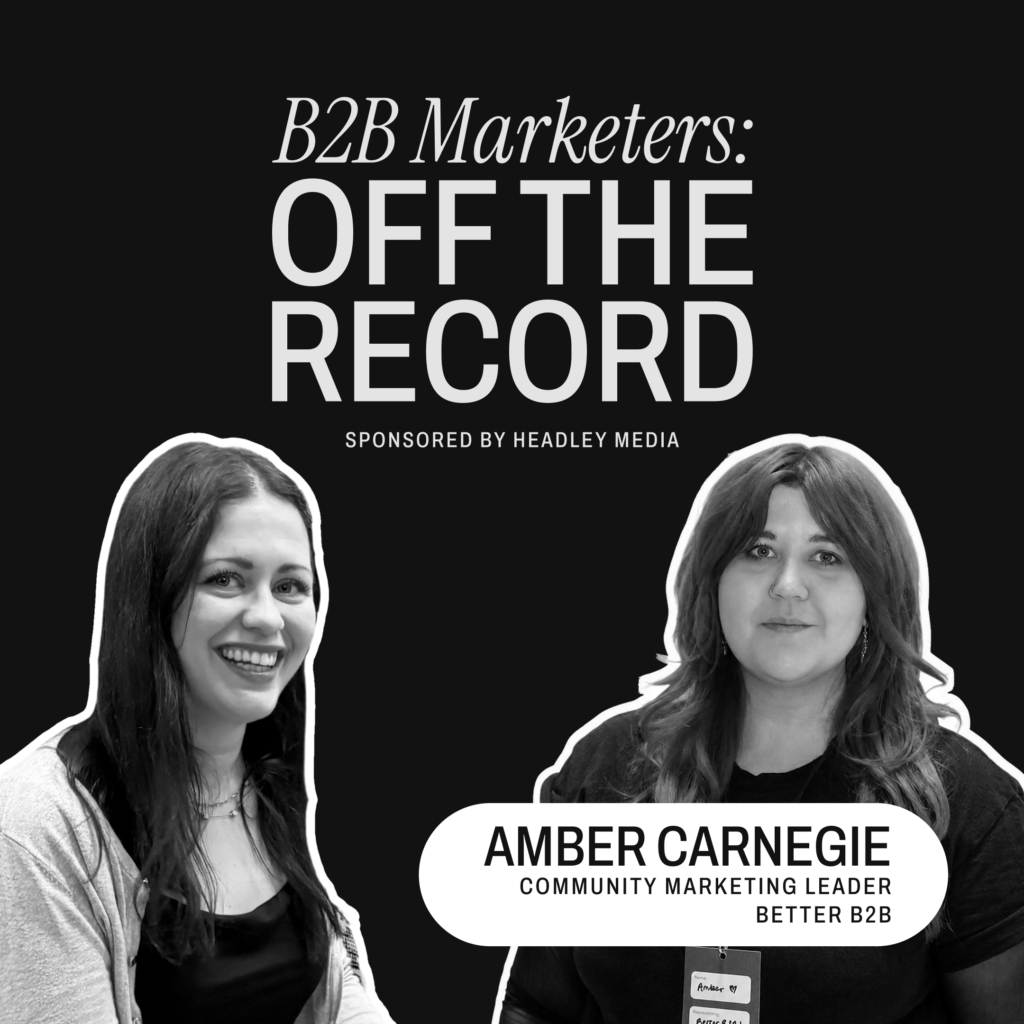
The conversation delves into the journey and evolution of B2B marketing, highlighting the value of brand and content, and the human side of marketing. Amber emphasizes the importance of community engagement and storytelling in B2B marketing.
Takeaways
Chapters


Chloe Addis (00:43.912)
So welcome to B2B Marketers Off the Record. I’m so excited to be joined today by Amber Carnegie. Thank you for coming and joining us. Amber is the Community Marketing Manager at Better B2B. And would you be so kind as to introduce yourself to our listeners?
Amber Carnegie (01:03.249)
Yeah, without sort of a too long don’t read version, I’ve been working in marketing for over a decade now across everything from content and search, to digital strategy, both in-house and in agency across B2C and B2B. So a lot of history there, but really my passion is in turning sort of complex ideas into great stories and engagement.
Amber Carnegie (01:25.145)
my advocacy for community sort of was happening alongside my career, which has then made me quite passionate about creating a space for B2B marketers to sort of come together and learn and develop. And that is sort of where I’ve led myself into better B2B and creating that and growing that network. So sort of combining my history in marketing with that and doing that. then on my sort of side hustles, I love doing things that are creative. So I do a lot of
Amber Carnegie (01:53.275)
For the community, I do book clubs, do creative writing workshops, I interview authors for Waterstones, and I also run immersive TV and film events, so I don’t like to stay still, essentially. Yes.
Chloe Addis (02:03.028)
Wow, that is,
Chloe Addis (02:05.289)
that’s a lot you pack a lot into your time. And that’s, that’s one of the reasons why I was so excited. I was like, we have to get Amber on. She’s, there’s just so much there that we need to unpack. So with that in mind, one that we like to kick off with a, with a fun one, which is tell me, without telling me that you’ve been in B2B marketing for many years.
Amber Carnegie (02:28.058)
So.
Amber Carnegie (02:29.105)
We’re laughing about this because we originally started just for context of people listening about Clippy in Word. But when you asked me that question just now, the first thing that came to my head is that we are so used to things like Dropbox. We transfer Google Drive now. I actually remember it being quicker as an intern to be sent in taxis with USBs of photographs or CDs of photographs to send to a designer. But also I remember when…
Chloe Addis (02:53.841)
my gosh.
Amber Carnegie (02:58.502)
Gitti, no what, who does the images? Like Giffey, no? I remember when those used to be in folders and you would go through an index, yes. And then you’d be like, okay, I need this CD with this photo and then you’d go find it. So if you needed stock imagery, that’s how we used to find it. So that’s how old I am.
Chloe Addis (03:01.928)
GIF. Yeah.
Chloe Addis (03:07.176)
Yes.
Chloe Addis (03:18.45)
Yes,
Chloe Addis (03:19.431)
my gosh, you’re like, so much for me. I feel like this is gonna happen every time as we’re recording the episodes and I’m like, my gosh, like there’s so many things that you just sort of pack away in your memory and like press packs we used to do with like, well, there were CDs and then USBs like print out, you know, like in a whole physical thing that I guess you just wouldn’t do anymore. That’s just, yeah.
Amber Carnegie (03:25.574)
Yeah.
Amber Carnegie (03:32.016)
Mm-hmm.
Amber Carnegie (03:44.238)
No, and like now
Amber Carnegie (03:45.49)
we laugh at terrible stock imagery, but that’s all we had then. Like you just were, you’d search for like people in meeting room and like go find the CD. So that’s what you got.
Chloe Addis (03:52.668)
Yeah.
Chloe Addis (03:55.833)
Amazing. So how did you start out in marketing? How did you get into this?
Amber Carnegie (04:02.214)
I’ll try again, do a too long don’t read version. But as I think a lot of people I meet in marketing, I was meant to be going to study economics at university and then I ended up getting an internship and working in London for a lads mag, which I won’t name and I’m much more of a feminist now and would never do such things these days. But ended up spending a lot of time there and getting published quite a lot and was like, right, no, I’m gonna go off to university and do English.
Amber Carnegie (04:30.393)
and as many English graduates go, we all end up working in marketing. Went from university to working for a magazine and…
Chloe Addis (04:34.046)
Mm-hmm.
Amber Carnegie (04:40.308)
a marketing company in China. So ended up being there for a few years and they were sort of Western brands launch themselves into Asian markets. And from there, I came back to the UK and ended up working at RS Components, massive B2B company, as we all know. And when I was working there, I was actually a buyer in semiconductors. And every week, the hirers would be like, you should be marketing really. Because I was doing all these internal comms events and I was doing loads of things. And eventually went, yeah, I should probably work in marketing. So I ended up actually getting a job.
Amber Carnegie (05:10.232)
at a brewery in marketing. They took me on and all of this was through side hustle work that I proved myself on. Ended up working at a brewery for several years and absolutely loved it. And a gin distillery.
Amber Carnegie (05:23.878)
doing all that and it was sort of part of the gin boom as well. So absolutely some fun years. From there, I ended up moving into the B2B space, which was actually in tattoo supplies, strangely. So tattoo supplies, veterinary supplies, medical. But one of my favorite things about learning that B2B journey was actually, I spent the whole time going, but our customers are still in the customer space. So why do we have to attribute us as a B2B business all the time? So this was always like in the back of my head. And then from there,
Chloe Addis (05:27.546)
yeah, I love that.
Chloe Addis (05:34.354)
Okay.
Amber Carnegie (05:54.266)
I stepped into agency life and never looked back. So yeah, ended up going into a startup agency for a couple of years and doing some amazing campaigns there, then moved into…
Chloe Addis (05:56.968)
Ho ho ho ho.
Amber Carnegie (06:05.604)
a very large, I think second largest agency in the world. And then with that, I was sort of missing that humanity, that connection, getting to do really cool stuff and stepped into a smaller agency. And now I’m having the time of my life running Better B2B and getting to do this and connect with marketers, which is my favorite part of marketing, I think. So I tried to do the too long, don’t read version, but basically people tell you you should work in marketing, you probably should.
Chloe Addis (06:14.74)
Mm-hmm.
Chloe Addis (06:30.996)
Chloe Addis (06:32.446)
my gosh, we love a long story like that. think it’s that most people in marketing have this kind of, well, I fell into it and
Amber Carnegie (06:41.744)
Yes.
Chloe Addis (06:41.959)
I can definitely relate English language graduate here. that’s, know, yeah, marketing has its draws for many of us. But yeah, it sounds like absolutely you’ve got, you’ve had the side hustles, fingers in many pies. And I think that’s, that’s just perfect.
Chloe Addis (07:00.852)
especially from that community side of things and you’ve just got that relational aspect throughout your career. So with that in mind, what’s one belief about B2B marketing you’ve changed your mind on in the last 12 months?
Amber Carnegie (07:03.333)
Yeah.
Amber Carnegie (07:16.602)
I feel like people might come for me, but I think there are just too many assumptions around B2B marketing being inherently dull. And I see these like posts all the time or events all the time. And I actually, what I think we often mean…
Amber Carnegie (07:31.61)
to say is that we’re seeking clarity within these industries. They’re really like, a lot of B2B is really complex with like deep needs problems and like products even. And I think what we actually need to be saying is being more accessible rather than not dull. there’s a lot of talk around like B2B doesn’t need to be boring, which is the thing that I think people will come for me for. And I agree with it in principle, but I think it’s often misinterpreted for like being loud and…
Chloe Addis (07:44.797)
Anyway.
Chloe Addis (07:58.452)
Mm-hmm.
Amber Carnegie (07:59.354)
like taking on new color ways, completely changing your brand up or like being attention grabbing for irrelevant reasons when it might not like align with business values. So I feel like for me, I’ve shifted more towards the idea of differentiation and like following emotion more than.
Amber Carnegie (08:17.094)
boring. So more like being different, not being different visually, but like being meaningfully distinct in how a brand like thinks or like shows up or speaks. So yeah, B2B doesn’t need to be boring, but it’s still really complex. And in that context, brands I think need to be more clear trusted, like distinctive. So you’re actually like just cutting through the noise rather than being the loudest person in the room. So yeah, I think it was a hard one for me to come to terms with because I’m all for being creative and weird. But actually,
Chloe Addis (08:26.996)
Thank you.
Chloe Addis (08:39.624)
Yeah. Yeah.
Chloe Addis (08:46.226)
Yes.
Amber Carnegie (08:47.181)
it’s not always the right thing.
Chloe Addis (08:48.657)
No, and I think it ties back to something you said initially, which is about the storytelling. If that is clear, it doesn’t mean that you have to do it in an extravagant way, but it’s about the messaging and focusing on what you’re saying, being different and bold and different to your competitors and standing out. And just because we’re in B2B doesn’t mean that we have to make it dull or make it the same as our competitors or just because that’s what we feel will be accepted.
Chloe Addis (09:16.368)
especially now and the amount that we have access to. There’s just so many different ways to do that, I suppose.
Chloe Addis (09:24.803)
What shifts are you seeing in how B2B buyers are behaving right now?
Amber Carnegie (09:31.655)
I don’t think I’ll be the only person that ever says this, but for me, it’s that before buyers would reach sales and they’d have all these questions and concerns. And I actually think now before they even fill in a form or book a demo, they’re already 80 % way through their decision-making and we’re just formalizing that. think…
Chloe Addis (09:47.549)
Yeah.
Amber Carnegie (09:50.905)
the traditional buying funnels being compressed is probably the best way to say it. I actually think people are forming all their opinions from content peers, communities, forums, short form video, things like that, before they even before they even come to us as a qualified lead essentially. And I think before that we were putting a lot more on the other side of that journey and we should be changing around. I think
Amber Carnegie (10:13.699)
But by the time they’re already in the funnel, most of the journeys happened and I think that’s been a really big shift in the past 18 months at least and I think we’re still catching up with it.
Chloe Addis (10:23.559)
Yeah,
Chloe Addis (10:24.319)
it’s really hard for marketers, isn’t it? There’s this kind of, especially with AI and how people are searching and finding like exactly to your point, they’re doing all of that research before they’re even making contact. So we do have to turn to things that we, know, marketers like less, like, you know, the less trackable things that happen in communities, which is exactly where, where you’re at. And the kind of work that you’re doing is nurturing those communities.
Amber Carnegie (10:44.549)
up.
Chloe Addis (10:52.733)
And I’m sure even within what you’ve created, there’s, you know, the referral systems and like, know, people asking for help and other people pointing them in the right direction and all of that being completely untrackable, untraceable really. But ultimately, you know, really important and will be a key driver for some people and for many businesses really.
Amber Carnegie (11:18.714)
You’d hope, but then we can’t track it, so can we validate it? It’s so tough, isn’t it?
Chloe Addis (11:21.695)
Really hard, but you
Chloe Addis (11:24.318)
know, the moment that that’s taken away and then, you know, there’s not this source of revenue is just how you know, I mean, things are going dark. It’s a difficult time out here for B2B marketers for sure. So what is a strategic bet you think more marketing leaders will need to make over the next kind of couple of years?
Amber Carnegie (11:33.888)
You
Amber Carnegie (11:46.032)
So.
Amber Carnegie (11:47.44)
briefly touched on it, but I have like a big period in my background was in digital PR and it was a shift that we saw a few years ago and I think it’s a shift that is happening, but B2B is maybe a bit slower to get to it just because of compliance and stakeholders, et cetera. But I think we’re seeing a shift in how we strategize and budget. I think we’re moving from like big campaign led marketing to actually having an always on building process and like, and then layering those campaigns on top. I think.
Chloe Addis (11:52.383)
you
Chloe Addis (12:03.294)
Mm.
Amber Carnegie (12:16.231)
This isn’t, like I said, just coming in the next couple of years, we’re already in it. with, but with like all these layers of sign-off, I think in B2B, we really need to get ahead of it now while it’s still fully landing within the industries. I think instead of like focusing primarily on like individual launches or short-term events and things like that, I think we need to have this constant presence building. And I think that leads back to like content community and thought leadership. And I know a lot of teams are trying to work on team advocacy. And I think all of this will then lead to that sort of buyer
Amber Carnegie (12:46.204)
journey that we talked about where people are going to have demand and trust before they even know they need it essentially. But by the time a buyer is ready to act like that decision of influence has already happened. it’s kind of a concerning area where actually
Amber Carnegie (13:03.846)
could they have been influenced before that campaign even lands? So should we be changing up our strategy already? But I do think the education around that change of strategy style is going to be the harder thing to do in Better B2B. So that’s kind of something I think people need to be getting a hold of now for the next few years to really take steed… heed? There we go.
Chloe Addis (13:16.477)
Right.
Chloe Addis (13:24.275)
Yeah.
Chloe Addis (13:26.436)
Take heed think that’s really interesting and it opens up a whole new avenue of messaging and strategy and how we reach our buyers. It’s also around, yeah, the messaging part is really interesting there because it’s like, what are we always saying that’s not just our USPs? It’s going to be boring and dull B2B. know, there needs to be those kind of…
Chloe Addis (13:53.875)
the storytelling that is always true, that always relates to the buyer, that always on piece. And then it’s thinking, okay, well, how and who, it, because, you know, especially in our world where we work in B2B tech, we know that the buying committee is expanding. So those people need different messaging, all of that, like, you know, there’s a lot of kind of different, okay, what tactics are we using? What messaging are we using?
Chloe Addis (14:22.185)
but you’re really, makes a lot of sense saying that, they need an always on approach that it, yeah, just, makes so much sense.
Amber Carnegie (14:31.056)
And I don’t know how we’re gonna turn and plan for that because again, there’s so many layers of sign off and things like that. So actually saying we’re gonna do this many different types of content for this many different people who are in that process, it’s quite a long process and I don’t know what it’s gonna look like but it’s an exciting place to be.
Chloe Addis (14:32.767)
Yeah.
Chloe Addis (14:42.847)
Mm.
Chloe Addis (14:47.807)
Chloe Addis (14:49.008)
Is it definitely is there’s so much change happening all of the time. Yeah.
Chloe Addis (14:54.308)
So what type of investment should marketing leaders protect even if budgets are tightened? Now, I feel like you’re going to be like, community. Like I’m asking a community marketing manager this question.
Amber Carnegie (15:04.746)
yeah. No, you’re
Amber Carnegie (15:09.273)
It’s not actually what I was thinking, which is probably, I don’t know,
Chloe Addis (15:10.668)
Oh, okay.
Amber Carnegie (15:11.828)
is that terrible? I was more thinking, I’ve been in this game long enough to know marketing always goes first. And I think I’ve seen it happen that many times that.
Amber Carnegie (15:22.786)
I know top of my head that brand and content is the thing to protect, the things that are evergreen are the things to protect. I would now say like, if you are engaging a community of your audience, then make sure that is top of mind too, but you can dial performance up and down, but like having that brand behind you and a narrative and an audience.
Amber Carnegie (15:43.232)
mean like without it then nothing else you can do on top of that won’t perform
Amber Carnegie (15:47.015)
so I think I think you need like I would say that if you are having to tighten budgets keep brand at heart and those like for like fundamental areas that if you lose them you could be paying more in the long run to fix them so yeah it’s really tough isn’t it because yeah marketing is always going to take the hit first and we know that but what’s even tougher is that is an area that isn’t easy to measure so it’s harder
Chloe Addis (15:58.74)
Mm, yeah.
Chloe Addis (16:10.94)
No, no, certainly.
Chloe Addis (16:13.161)
It’s the age old problem, it? Where are the numbers on brand return and, you know, yeah, quantifying the reach and how big a brand is, is a huge kind of project in and of itself. But you’re right, it takes a long time to build a brand. So when that budget is cut, it can drop quickly, but to build it back up again is going to take again another
Amber Carnegie (16:17.39)
Mm-hmm.
Chloe Addis (16:38.398)
however long, long time to build the brand. And what is one thing you wish you could change about marketing if you could?
Amber Carnegie (16:40.366)
Yep.
Amber Carnegie (16:50.564)
Kind of going on from my point about brand is that like in this day and age, we’re expected to track everything or attach value to at least something. And I understand why, like, but what I miss is like that humanity in marketing. And it’s something else that kind of draws me to the community side of things as well. Like I sometimes feel like marketing has been reduced to a process. And when actually the marketing that we connect with and admire most is marketing that stays with us, it’s work that.
Chloe Addis (17:11.82)
Mm.
Amber Carnegie (17:17.823)
it really sits with us and ironically that’s what really drives growth. So yeah, something just deeper in the heart of marketing, that’s what I’d really like to get back to and communicating sort of the real principles and values of brands by tapping into that emotion again. Probably not a straight answer, but that’s kind of what I wish we could get back to sometimes or remember that we can do those things and everything doesn’t need to be a process and doesn’t need to.
Chloe Addis (17:37.587)
Hmm
Chloe Addis (17:40.605)
Yeah.
Amber Carnegie (17:46.041)
have that value attached to it sometimes we need little bit of risk.
Chloe Addis (17:49.216)
It is hard. think there’s marketing in general has a fine line to walk, doesn’t it? It’s all about balance of proving that what you’re doing is you’re walking the right walk and talking the right talk and that there is some revenue associated. There’s some sort of trail back to the business, you know, to be able to prove that the function works. But if there’s too much focus on that side of things, it is often to the detriment
Chloe Addis (18:18.819)
of brand and the awareness side of things, which is not, yeah, it’s the two parts of the same puzzle, aren’t they? So, absolutely. And I think what you’re saying is almost, let’s go back to the basics. That’s kind of like, as you would be learning marketing and, you know, reading through books about strategy and pricing and, you know, brand is central in all of those and psychology and, you know, building something.
Chloe Addis (18:48.456)
Those are very hard to track. The hardest, Yeah, absolutely. Okay, so we’re into our final sort of couple of questions now, which is about who we should maybe bring on as a next guest. Is there anyone that you would recommend that we invite to speak and why would that be?
Amber Carnegie (18:50.275)
Yes. The things I love are usually the hardest, yeah.
Amber Carnegie (19:10.394)
So if she’s not already planned, I would love to see you speak to Amy Watts. She is at the forefront of B2B social. I think she’s really clear, but also very creative in how she produces work. And I think she’s also an absolute joy to talk to. So she would be my shout out for someone that you could have on or would be great to have here.
Chloe Addis (19:33.67)
Amazing. Yeah, I have definitely seen some of her posts, keeping us all entertained. Perfect. Yeah, I can’t wait. I’ll definitely get her on the list. What’s one question, whether it’s that guest or not, what’s one question you think we should pass on to the next guest to answer?
Amber Carnegie (19:48.665)
Hmm
Amber Carnegie (19:54.713)
I should probably be quite poignant here or ask something really serious, but something that I always ask in job interviews is, and sometimes throws people off a little bit, is what TV, film or character do you most associate yourself with? And it’s often a really good indicator of of character or how people see themselves. So yeah, that would be my question.
Chloe Addis (20:13.488)
my gosh. That’s
Chloe Addis (20:15.551)
also one that nobody would ever be able to like prep for. He’s like, who am I? Interestingly, I do want to know, I hope that you’ve thought about this for yourself. Who would be your TV character?
Amber Carnegie (20:19.245)
Yes.
Amber Carnegie (20:28.407)
So
Amber Carnegie (20:29.999)
I would go for Leslie Knope in Parks and Rec, who I sort of see my values align with, her work ethic, just out of that energy. But in recent years, I’ve had a lot of comparisons to Ted Lasso, so he could sneak in there too.
Chloe Addis (20:44.308)
okay.
Chloe Addis (20:45.589)
That’s two different types of character. Gosh, I think I’m going to have to come back to mine. don’t think I could have one straight away. think almost like you, there’ll be two different ones, very different kind of working people. One probably quite scatty and then one very focused and like, we’ve got to do this.
Amber Carnegie (20:48.653)
Yes.
Amber Carnegie (20:53.731)
There you go.
Amber Carnegie (20:59.245)
Mm-hmm.
Amber Carnegie (21:02.413)
Mm-hmm.
Amber Carnegie (21:09.645)
So yeah,
Amber Carnegie (21:10.468)
it’s fun. It’s a fun one to test, like sort of see who’s in people’s brains and sort of who they attest themselves to. So yeah, I like it.
Chloe Addis (21:17.62)
Amazing.
Chloe Addis (21:19.24)
It’s been lovely chatting to you. And I actually think we could talk for ages on B2B marketing speculating and kind of digging into some of these things a bit more. But thank you so much for joining me. I really hope that some of these answers been like just, you know, the idea of the pod is just to kind of lift everything up and get people thinking a little bit wider than they’re just their day to day. So, yeah, thank you so much for joining me.
Amber Carnegie (21:23.289)
Yeah.
Amber Carnegie (21:46.041)
Thank you so much for having me.
In this episode, Chloe Addis speaks with Amber Carnegie, Community Marketing Manager at Better B2B, about her career journey, the evolution of B2B marketing, and why community, storytelling, and brand are becoming increasingly important in an AI-driven buying landscape.
Amber’s career spans more than a decade across agencies and in-house roles, covering content, SEO, digital strategy, and community marketing. After studying English, she worked across publishing, international marketing in China, manufacturing, breweries, gin distilleries, and specialist B2B industries before moving into agency life. Alongside her career, she’s built creative communities through book clubs, writing workshops, author interviews, and immersive TV and film events.
Her biggest takeaway is that marketing careers are rarely linear, and side projects often become the experiences that open new opportunities.
Amber challenges the common phrase “B2B doesn’t have to be boring.”
Instead, she argues that the real challenge is making complex products and services clear and accessible, rather than simply trying to be louder or more visually disruptive.
She believes brands should focus on:
One of the biggest shifts Amber has observed is how much research buyers now do independently.
Today’s buyers are:
By the time someone enters the sales funnel, much of the buying decision has already been made.
This creates new challenges because much of this influence happens in places marketers cannot easily track.
Amber believes marketing leaders should shift away from relying primarily on individual campaigns and instead invest in continuous brand building.
An always-on strategy should include:
Campaigns then become moments that sit on top of this foundation, rather than the foundation itself.
When discussing shrinking budgets, Amber argues that brand and evergreen content should be the last things to lose funding.
Performance marketing can be increased or reduced depending on business needs, but rebuilding a damaged brand takes years.
She stresses that:
Amber feels modern marketing has become overly focused on measurement and attribution.
While recognising the importance of proving ROI, she believes the industry’s best work comes from:
Not everything valuable can be measured immediately, and marketers should feel more comfortable taking thoughtful creative risks.
Amber’s career demonstrates several recurring themes:
Amber laughs about how much marketing has changed over the years, remembering:
When asked which TV character best represents her, she chooses Leslie Knope (Parks and Recreation) for her values and work ethic, while admitting she’s also frequently compared to Ted Lasso.
Amber is the Community Marketing Manager for Better B2B, with over a decade of experience across content, search and digital strategy. She has a strong track record of helping brands turn complex ideas into clear, compelling stories that drive engagement.
A strong advocate for community, Amber is passionate about creating spaces where people can share ideas and learn from one another. At Better B2B, she leads community initiatives that bring B2B marketers together to exchange insights, build relationships, and grow their networks. With a background in creative marketing and communications, she blends strategic and human perspectives to bridge the gap between performance and storytelling.
Outside of work, Amber builds community through book clubs, creative writing workshops, immersive TV and film events, and interviewing authors.
The conversation with Niall Sullivan, Head of Marketing at Senseye for Siemens, covered various topics…
This conversation covers the importance of funding and tactical campaigns for B2B marketers, the need…
This conversation with Tony Larks covers his journey in B2B marketing, the evolution of marketing…