

S01E17 – Conor Bant – B2B Marketers: Off The Record
Conor Bant, Head of Media and Performance at Fox Agency, discusses the evolution of B2B…
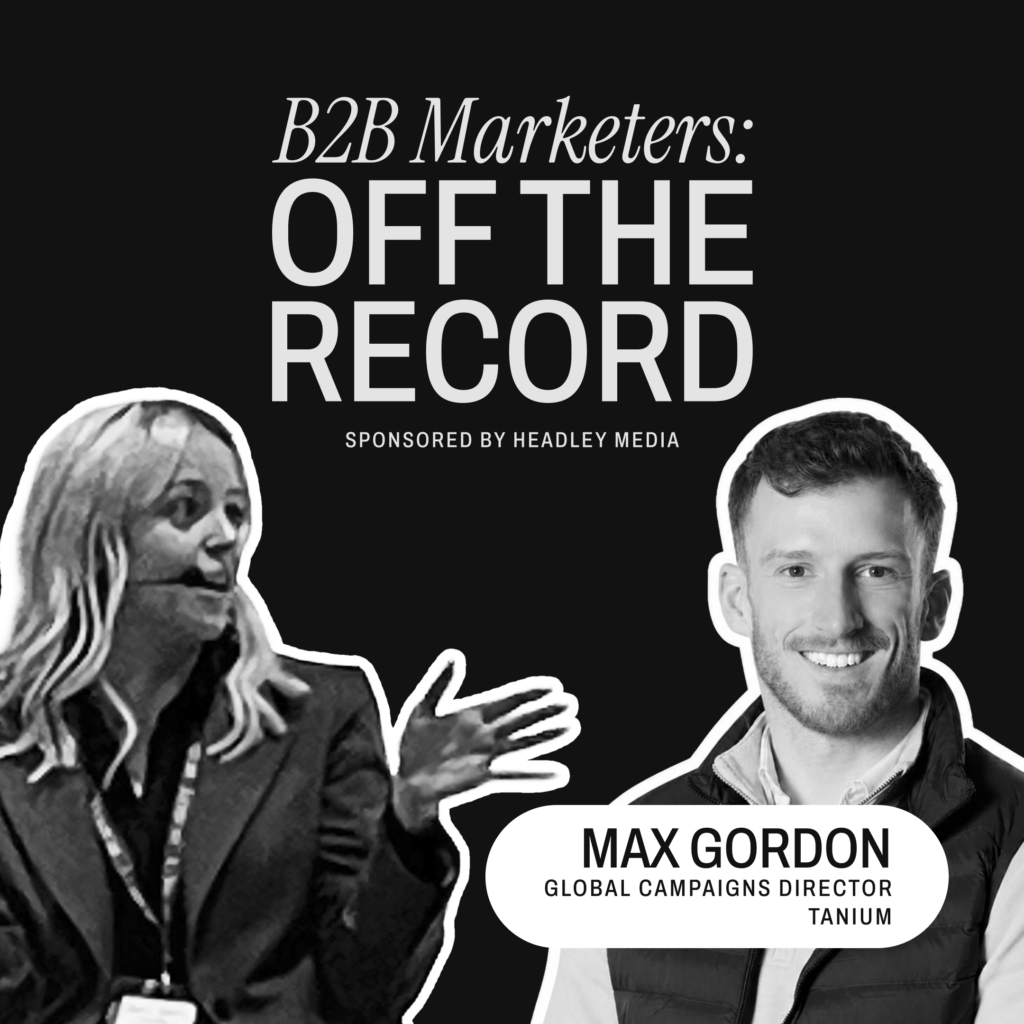
Max Gordon, Director of Campaigns at Tanium, shares insights on B2B marketing, buyer behavior, and the strategic bets marketing leaders should make. He discusses the challenges and opportunities in B2B marketing, the importance of marketing hygiene and the AI/LLM landscape. The conversation covers a range of topics including the impact of AI on future generations, the need to redefine marketing qualified leads (MQLs), the importance of brand investment, and the challenges of attribution in B2B marketing. The discussion also delves into the role of AI in stakeholder translation and the value of simplifying marketing messages for senior executives.
Takeaways
Chapters



Freya Ward (01:56)
Welcome to B2B Marketers Off the Record. I am absolutely delighted to be joined by Max Gordon, who is a director of campaigns at Tanium and has also featured in FutureCMO100 list, which is incredible. Max, please introduce yourself.
Max Gordon (02:12)
Hello, yeah, lovely to be here. Thank you for inviting me on. Yeah, so Max Gordon. I’m the director of campaigns at Tanium. I’ve been at Tanium for five years nearly. I prior to that though I did work with Tanium for two and a half years, so shameless plug is probably seven and a half years. but I used to be agency side working with Tanium, and then it took them two and a half years to convince me to join them. So I joined the dark side and joined client side.
Freya Ward (02:37)
You joined client side, amazing Max. So tell me you have been in B2B marketing for several years without telling me. I’ll go first. Mine would be when we had all those fun and games naming personas like Digital Debbie, CEO Chris to really familiarize them and humanize them. That’s my kind of marketing throwback. What’s yours?
Max Gordon (03:01)
I mean it’s probably still it probably still exists today, but it’s gotta be the a hundred slide PowerPoint deck that exists ’cause B2B marketing is rife for a massive PowerPoint.
Freya Ward (03:13)
massive PowerPoint presentation with all the standard stock images that everybody has within them, I’m sure.
Max Gordon (03:19)
I tried
to diversify, I tried to put some animations in there and morphs, but yeah, sometimes you do have to resort to a stock image to try and show tech in all its glory.
Freya Ward (03:29)
100%. Tell me, Max, how did you start in B2B marketing? What was your journey into the industry?
Max Gordon (03:35)
quite interesting actually. I I was talking about this with the team yesterday. We had a similar sort of icebreakery question and it’s it’s the it’s the usual thing. I think a lot of people say they fall into sort of a sphere, an area around a pr
sort of a specialism if you like. so I I typically I studied finance originally, did a lot of like business work and international business work during my studies. And then I had the opportunity to dress up as a carrot, believe it or not, on a to feature on a TV ad for a a well known British supermarket. I won’t name names.
Freya Ward (04:04)
Hehehe.
Max Gordon (04:05)
and I was a carrot in one of their T V adverts and then that’s how I found myself here today. But no. but no I spent a bit of time B2C doing a lot of the sort of agency side.
and then found myself in the B2B sphere of right moving over because I think one of the things I found quite interesting and we’ll come onto it obviously in some of the questions later on is the the B2B marketing world is
it it was perceived in my mind as more difficult and and different. It’s like how do you sell something that’s way more complex and how do you target people that are way harder to find and you know, we’re not just selling a kind of kind of coke, other drinks are available. We’re not just selling a kind of Coke here, right? We’re selling something that can be a quarter of a million pound, a million pound piece of software, could be whatever it might be in the B2B sphere. So I quite enjoyed the concept of that challenge, I think, was what motivated me to get into B2B.
Freya Ward (04:54)
Interesting. I really want to unpack the carrot story to be honest, because that’s something I didn’t know about you. We’ve worked together for some time.
Max Gordon (05:00)
Listen to the guest.
Freya Ward (05:03)
And I’ve never heard about the time you dressed up as a carrot. But I completely agree with you. think coming into the B2B marketing space, can be really challenging to, or it can be quite daunting on kind of how do I help support selling a million pound investment or a competitor displacement or whatever it might be.
But one thing is for sure that B2B marketing is not boring, right?
Max Gordon (05:29)
No, I mean it’s to be honest, I think any form of marketing
should never be boring. It’s about y you know, you think about how you engage with things and you think about you as a person every single day, the things that you might go and do normally, whether it’s walking a dog outside of work, whatever it is, like you are there to be marketed to and the things that stand out to you are the things that engage you the most and they’re the things that you you know you typically gravitate towards. So I don’t think in any way it should be boring. I think that perception to be honest, it was sort of like ten years ago when you think about all the
conferences you’d go to and it’s all about creativity and B to B and breaking the mould and stuff like that. And it’s like we there was shouldn’t have been a mould there to be broken in the first place. Still selling to people, right?
Freya Ward (06:09)
Yeah,
for sure. Definitely. It’s human to human sales at the end of the day, whether they’re in business or whether it’s consumer side. So working in the tech space, it’s fast paced. Every company has a platform or a solution or whether you’re SaaS or you’re selling hardware. What is one thing that you think leadership need to understand about marketing?
Max Gordon (06:33)
So that’s a good question. I think one of the main things is that
I think you’d probably see it histor and again interested to hear, you know, what other people say when they they join the podcast, right? If they ask a question that’s similar. Like I think one of the main things that if you think leadership, different areas of the business would understand is that the product sells itself. I think every every tech vendor, and and luckily, you know, I’ve worked with a a fair few in my career, every tech vendor’s got the best piece of technology, right? And everyone’s trying to tell the same story and and and typically, right, you know, you as an advocate and working for a certain business, you would say, Wow, that is it’s fantastic. You know the ins and outs of it ’cause you’d you’d
Selling it ultimately. that is to be fair, like going back to the sort of opening around how I joined and found myself at Tanium was I worked on the product for two and a half years before I was convinced to join here, and obviously it was sort of an aspiration of mine to join because the the technology itself is fantastic, right? It’s a shameless plug. It’s one of the best, you know, it’s the best on the market, best in breed if you want position it somewhere. But the challenge I think is you can have the best product, but it’s about how you market that and how people understand that it is the best.
Product
that’s going solve all their challenges. And I think typically what you see in the B2B space is you know leadership and people typically say when people see my product, they buy it, and the conversion rate from you know demo, or at least like you know, people engaging with some sort of whether it’s virtual demo, physical demo, whatever it might be, see you at an event. the conversion rate’s like in the high 90s or whatever, right? That’s sort of standard practice. But you know, not every product I think is the equivalent of the unicorns, if you like, in the news at the moment, your anthropic.
Exclaude your open AI, ChatGPT, those types of things, which arguably at the moment sell themselves, where probably don’t even need a marketing department. If anyone’s listening from it, apologies. But it’s the thing there, it’s the trend, right? And it’s like for that technology, it has sold itself, but not every vendor’s the same. Like not every piece of technology is the answer to everybody’s problem. And you have to do the job still of marketing that to show people that they need it.
Freya Ward (08:36)
Definitely.
And I think when businesses are, you know, the example of Anthropic and any of the kind of products that you were talking about, they’ve created a new market, right? A new marketplace for something that wasn’t there before. And therefore they’re on that curve and right now they might not need marketing, but I’m sure we’ve all seen across LinkedIn, there’s loads of hires happening in these companies within their marketing and go to market departments or department. And…
they’re going to need marketing soon because they’re going to need to secure and retain that market share. But for businesses that have been around a little while that are either starting out in an industry and a marketplace that already exists and they’re trying to break through or for businesses that are well established and they want to retain that leadership status, if they lean purely on you can have the best product in the world, right? But it’s not going to market itself. And it’s our job as marketers, especially in the B2B space to
build that connection with the target audience. And yeah, I think it’s a really good lesson for leadership. Marketing can’t be, you don’t notice the impact of a marketing department until later on as well, right? So any campaign that’s running, it’s gonna be matched to your length of your sales cycle and things like that when you’re starting to see the results of that activity. And I think all too often within the B2B marketing space leadership.
can see, and we’ve talked about this actually a lot on the pod so far in the conversations that we’ve had so far. There is still a perception that marketing is like the colouring in department or the cost department. And a lot of the wishes that our guests have made are around changing that and continuing to change that and change that perception. So let’s talk a little bit about your, you know, this podcast is not about trade secrets. It’s about your experience and your opinion. What are you, what shifts are you seeing in B2B buying behaviour?
in the marketplace right now.
Max Gordon (10:32)
yeah, it’s I don’t it’s a it’s when I read the question as well, it’s the the framing of a B2B buyer I think that probably offends me the most, if I’m to be honest, because I don’t think and I never have to be fair coming through the industry and everything that I’ve done both B2C and B2B side, it’s marketing is you you’re attracting buyers and it’s how a buyer behaves. And I think that like sort of going back to our reference before in terms of how you think you digest things and engage with certain things yourself, like
When was the last time you downloaded a product brochure for this thing? Or like you actually said, you know what, I want a demo of this thing I’ve never heard of before? Like you you think of the journeys that you take people on. I think buyers
Inherently the it’s the buyer itself that’s changed and that’s with the introduction of things like you know, AI, LLMs, all those different things, like you know, they’re not necessarily new things. People have been asking Google questions for ages. It’s the way it’s it’s inherently been forever. Now there’s almost like a competitor and sort of a sort of fox amongst the chickens, if you like, that’s different. and people suddenly think everyone’s behaving differently. It’s like, no, they’re just asking a question somewhere else. So I think buyers, the shift obviously again is
to adop adoption of like new places of searching for things and engaging with things, but I don’t necessarily think the behavior is that different. I think one of the biggest determining factors, which is it’s grown over time, and and maybe I’ll have people think differently if they do listen to the podcast, like, you know, data is your currency. And I think people now understand the value of that currency a lot more than they used to. particularly in the cybersecurity space, like if we’re asking you know
highly security conscious individual to just submit their information or download this or give us your email address and your phone number, those types of things. It it’s for me it’s not it’s not a thing. Like if you ask people and you think about a traditional buyer and the way they behave, when was the last time if somebody stopped you in the street and said, Freya, can I have your phone number and your email address? You buy, who on earth are you? And what is that? Like, no. Like it’s my information, right? So I think that’s sort the shift in sort of buyer behavior’s probably become
it’s it’s become more how people value their own data and also the things that are like I I I think probably an inherent laziness like around different ways they can ask questions and get responses to certain things. And I think one of the things is that pre you know pre data
pre-data engagement that people have. So I’m unknown to a business if I’m ferreting around and I’m looking on the internet and I’m typing questions and getting responses. and the challenge is like how you connect that almost like pre-intent data to a data record. Say this person’s done all this stuff I’m asking to get credit, which we, you know, I’ll talk about a little bit later on in around attribution. But it’s a really difficult thing now because I don’t think I don’t necessarily think like behaviours have changed that much. I just think they’ve
People are starting to cotton on to how valuable their data is and they’re just moving to different places to do the same things they were doing before.
Freya Ward (13:40)
Yeah, the introduction of new channels and with that, I think comes maybe a slight shift in patience, like the patience of the B2B buyer, you know, they’re a bit more demanding of information. They want that information in a way that they want to consume it and the specifics as well, I think has shifted slightly. Like it’s the consumption habits, I think, that have changed. But I completely agree with you, Max. The actual…
buying journey is still the same, know, if, if, if not longer, if not more challenging with more stakeholders that are more informed than ever before.
Max Gordon (14:23)
But also there’s an element of like I think one of the things that it would be interesting, right? And I would say
10, 20 years time to redo this podcast, right? And ask like the next generation of marketeers to come through, right? Where you’ve got, and excuse the phrase again, I’m not meaning to offend anybody, the TikTok generation, right? Of people consuming information quickly and you know in various different formats, like and obviously the LLMs and AI search function stuff being around, it’s created that laziness, right? And that that thirst for information in the first two, three, five seconds, right? You’ve got one
The leaders I’ve worked with previously here at Tania, and one of the things that she always used to say, and I used to love it, was she was like, it needs to be stupid simple. Like the first three seconds need to be like, this is what we need to do. And if you think about that as a concept of what marketeers are gravitating towards, this is why I’m saying cross out the B2B part because it’s the buyer, it’s everyone’s ways of consuming information is just changed, and it’s inherently, I think, creating an element of laziness, but also then a challenge for marketers to go, how do you stitch together that initial intent?
To then funnel it through into well, actually, when that person reveals itself, like reveals themselves, how do we then go back and say that thing that we did, whether it be on like a review site early doors, or whether we did some advertising on, you know, when ChatGPT and the likes bring out advertising, I’m sure, which they’ve already doing, like that actually worked. But how you prove
Freya Ward (15:48)
Yeah.
Max Gordon (15:48)
that?
Freya Ward (15:50)
Is really, really tough. And I think it brings in even more important, shameless plug, but for the channels that you are, where you are getting content. like we were talking about the value of that data, the control now and the power that the buyer has in the, or the awareness of the value of their information, making sure that where you are getting content, it’s the right place to be able to
support that attribution, but also that value exchange. If you’re gate gone are the days of gating absolutely everything on your website, because you need to be able to share that information so that it gets picked up by the LLMs or whatever channels they’re searching within. And you make it easy for them to find and for your brand to surface. But yeah, I think it’s a really interesting take on kind of buying behavior. And I take your point. It’s not just B2B.
Max Gordon (16:42)
No. But is it is that to just a final thing you mentioned, like gating things, right? And I always in my head at the moment, one of the things that I constantly think about is the element of like gatekeeping information, like and that open source nature of how LM’s work and questions and queries and how things show up and what have you. And like SEO’s been around forever, still exists, it’s still there. Like if anything, it’s more prevalent and pertinent now. And I think you don’t the the challenge for businesses now is how you
Don’t gatekeep your information to make sure that then you’re actually appearing, you’re being present, people can understand who your brand is before they even get to the point of converting or submitting anything. Like that’s the big, big challenge.
Freya Ward (17:23)
Yeah.
Yeah, 100%. I completely agree with you. So looking at the future then, what is a strategic bet that you think more marketing leaders should be making in the next couple of years?
Max Gordon (17:35)
Think easy pivot is is probably similar topic, right? Not to be buzzwed bingo and everything everyone sees on LinkedIn at the moment. It’s just it’s gotta be about that sort of AI LL landscape, right? I think
The the twist in that is that it’s not necessarily a change from things and how they are currently. It goes back to sort of referencing just like in regards to like SEO and ensuring your practices and everything is are up to speed and you do feature and you are building the right thing. So you’re featuring whether it’s like blog posts, articles, backlinks, like all these different things that are like really intricate areas of SEO are buttoned up and they’re aligned. There are certain things like when you I was listening to a podcast the other day, actually a chapter you know she’s building my
Clients actually back in the day. he now works for the HR company, and I listened to his podcast, and was talking around
The fact that their Wikipedia page was out of date. Now, Wikipedia, you can’t just go in and update, right? It’s obviously, you you’ve got to go in and and submit changes and references and those types of things. It’s all based on impartial to a degree, impartiality. and he was saying that one line on their Wikipedia page was throwing the response from LLMs and and and the responses people were getting. So like when you think of it like that, you go, it the big thing in the strategic bet is almost like keeping your house tidy, like keeping everything nice and
Clean and like and understanding that actually the simple things are the things that are gonna benefit you the most. It’s not let’s outbid our competitors and put 10 million into this. It’s like maybe actually let’s spend some time tidying the house a bit and then going, This is actually gonna benefit us more in an organic sense, but also you see the rewards from that from a paid perspective afterwards as well. So it’s all intertwined, but my cop-out answer to the question is that is the on-trend response. It’s like a
AO, LLMs, that landscape like I think needs to be the focus. And that comes from, as you say, SEO and brand, brand building.
Freya Ward (19:34)
Yeah,
it’s not a cop out answer. I think it’s pretty accurate. I completely agree with it. And I think I hate, I hate this phrase, but I think it’s the, it’s a nice way to kind of wrap it up in a bow is marketing hygiene. Essentially, right. It’s, it’s classic marketing 101, but it’s good hygiene. You’re back linking the digital PR side of things. Your website is tidy. You’ve got a good wealth of content that is ungated. I still cannot compute that Wikipedia has such.
an influence on the LLM side of things. Like, I don’t, I don’t know when it changed from, I think there was a page on me on Wikipedia, like 15 years ago, that was, you
Max Gordon (20:11)
It is
Freya Ward (20:13)
know, not anything to really do with me. It was like a jokey page and how that has gained so much presence and dominance in and value in the marketing landscape is wild. There’s a real piece as well on the AEO and SEO or whatever you want to call it around sentiment.
as well and how if your brand is misrepresented or incorrectly associated. So I feel sorry for companies that have got company names that are quite generic words that aren’t really, you know, don’t necessarily identify that company on its own that is getting lost in that mismatch of information and that impacting that sentiment.
It’s an interesting time for marketing, I think, but like you said, Max, I completely agree. It leans back on good marketing hygiene and having that foundational marketing in place. Be that SEO or just your website, the journey, the experience, meta tags, all of those important things that keeps everything tidy. it’s actually really nice, I think, as a marketer to see that there is…
actual tangible value in those things now because they’re things that think marketers for many years have been working on pushing, pushing forward, but having to kind of fight for the resource to support those activities.
Max Gordon (21:37)
And I think as well, like yeah, you you you’re totally right. And it’s it’s yeah, it’s weird to go full circle where you think ten years ago and you talk about SEO and stuff, it used to be this like black box of like, what do you mean if I change my H two tag, it changes this and all these different like things that I have to do to make sure my page is ranking properly and you know, it’s it’s really interesting when you think about how
that as part of a principle in a business should just be table stakes. But I think with the introduction of like, again, AI and you can ask Claude anything and it’s gonna solve all these different things, like the challenge you’ve got is anyone can do that. So I could just prompt it to give me how can I fix this page? How can I do that? How can I do that? And I think that the ability and and the ability to generate a response and answer and almost feel like you’re an expert is the challenge you’ve now got because you you’re being fed information from something, which yeah in the most part can be accurate, but then
that human in the loop arm to make sure it’s correct and it is working and and what have you is so so important.
And I think it’s become, you know, the tech landscape and obviously marketing landscape and and the introduction of AI and stuff has been, you know, i in in no sort of unfiltered way of saying like it’s thrown the whole marketing departments into complete disarray in regards to well, what job should exist and what job shouldn’t exist and how these things work and consolidation of staff and and all these different things. And
It’s it’s mad because I think it’s not necessarily like a staffing requirement, it’s how people are using AI and using LLMs to become more efficient. I think it becomes an efficiency play, right? So you’ve still got the expert in SEO that’s there. It’s making them more efficient. They can just connect in Claude to SEM Rush or whatever, and they can automate their reports and they can simplify the reports and they can create them that they’re leadership ready. Like you’re actually shouldn’t, in my opinion, it shouldn’t be a disposition of talent.
should be a reutilization of and also AI enablement. So I coined the phrase of you’re almost turning every marketer into Ironman. Like that is what you’re doing. You’re just giving them a suit that now makes them more efficient, that makes them able to do certain things, but also gives them a rational base to dispute things and and and compute things as well. But it still comes back down to the person who’s driving the
the the questioning
and I know I’ve sort of waffled on on this point, but one of the things one of my colleagues was talking about yesterday and it really, really stuck with me, is she’s got a couple of young children and in this whole world of AI, like, you know, I worry about what’s the next generation gonna look like, like all these different things. And one of the things that she was telling me is that
She rather than shying away and going, I know there’s been a social media ban and all these different things that come into practice in the UK. So any global listeners, if you’ve not known that, seen that news, you know, that’s sort of where the UK is going at the moment, who knows? but there’s like a lot, people are scared of it. And what she was telling me was like, I have empowered my children to have chat GPT on their apps, on their devices, right? And the ask is that every day you get like three, well, however many tokens you get a day, right? They free stuff, right? And she goes, I’ve empowered them every day that they have a chat.
And their task is to ask ChatGPT three questions about things they want to know about or questions that they’ve got about whatever it might be. And the premise is obviously to one, understand and become like
understand how those things work, but also understand how it benefits them, but also how it can teach them and how it can learn like how they can learn how to control and use the technology that’s there. And I love the sentiment around it because it’s not this thing of going this person’s like, I don’t know, asking questions about how to build the best thing on Roblox or Minecraft or whatever. It’s asking real world questions, but r refining the questions to get a response.
And I was like, I j I loved it so much. Slight segue, but I think it was such a phenomenal concept of leaning into the nature of what the future’s going to be. And I was just like I I loved it. So anyway, slight segue off marketing, but I just love the principle of how people are adopting it and using it moving forwards.
Freya Ward (25:39)
I it’s amazing. It’s a slight segue, but I love it. I think it’s not shying away and not having that fear. And instead she is empowering her children who are, let’s be real, they’re gonna be the AI natives, right? We’re the generation that’s, we’ve gone no internet to internet. We’ve got no mobile phone to mobile phone. We’ve gone, you know, all of these different shifts. We’re like the middle generation that’s just trying to keep going. The
Max Gordon (26:04)
Yeah, yeah.
Freya Ward (26:04)
next generation is gonna be AI natives and they need to know.
we can’t allow our fear and our resistance impact their future and their potential, right? But she’s doing it clearly in a very controlled way and refining it to normalize it as well. I think it’s amazing. It’s a great example. Okay, so we’ve talked about kind of a bet that marketing leaders should be making in the next couple of years. What’s something that you think that marketers should…
they’re doing out of habit and they should maybe stop doing.
Max Gordon (26:43)
I mean for my last answer to the question being quite by the line and appropriate, I think this one’s a little bit less by the line, something I’d probably call it like rage bait. I saw the rage, isn’t it at the moment, say the
Freya Ward (26:52)
you
Max Gordon (26:52)
word rage bait. So I’ll throw that in there so you can have a headline.
But I think the the rage bait post you see on LinkedIn at the moment,
talking about MQLs being dead. I think that that this whole habit of like how marketing are defining leads is it just blows my mind. ‘Cause every business is different and you see so many posts now, the MQL is dead and AI native businesses are doing this and following leads around an intent driven why and it’s like it’s such a false narrative. I mean if you I mean it doesn’t take a genius to say, well the marketing qualified lead is defined by how you’re defining it. So a lead’s a lead, person’s information is person information, right? And then how you’re then saying and you categorize that and then feed that through to be it’s sales, be it to further marketing programming.
campaigns, whatever it might be. It’s almost like a false narrative. It’s not dead. It’s the way you’re categorizing it is dead. So it’s like you’re almost shifting the bracket of an MQL to being earlier in the funnel because you’re trying to see what people are doing and engaging with. And I think there was something I was giving a presentation on earlier this morning and it’s something like I think it’s like 50 plus digital touches from it nowadays from a single person who will then convert to anything within the B2B marketing sphere. And I was like 50 digital touches. So
So our job to be so front and center in all the different channels and having connected strategies. So it’s so important to run things like you know, whether you’re running on LinkedIn, you’re running on Meta, whether you’ve got you know, your Google programming setup, you’ve got you know, third-party media programs as well, you’ve got review sites, like all these different things feed into this digital ecosystem that’s pre-anyone doing anything. And then for this whole narrative that people are sharing globally, and you know, you see it and you see senior execs and people who aren’t in marketing going, the MQL is dead, the MQL’s dead. I’m like
No, your definition of it’s incorrect, like fundamentally. It’s a false narrative.
And it just it’s it rage baits me every time I see it. Like I want to comment
Freya Ward (28:35)
Thank
Max Gordon (28:35)
on everything, but like I’m not that type of person. I won’t be on there arguing with somebody on LinkedIn on a Friday afternoon, got better things to be doing. But it’s just how it’s defined that’s that’s shifted. So I think that teams are still doing out of habit is I think categorizing their leads the way they did 10 years ago. And I think that needs to change. And that’s the thing I would urge anyone who’s listening to the podcast still who’s not got bored of me yet.
is to look at that. Look at lead scroll model. Like, is it reflective of today? Is it reflective of the modern world? Are we missing that whole front end piece of data? How can we get to that? And one thing I will say again, if again people are listening this far, you’ve got every single media vendor on the planet who’s got their own intent data, who’s got their own system, their own way of doing things. Like the narrative is not new. It’s a feature and it’s a thing, right? And it’s yes, of course it’s your data. It’s self-contained. You you back your own intent day. Of course everybody does.
But the point of it is like what that means to a business is very different and how we integrate that in our systems is also very different and how that comes together to stitch data sets together is a thing that I don’t think people from external perspectives who’ve not been in a client-side business really understand. It’s like you might have the best intent data, the pu the purest, purest data and the buyers and the best information ever.
But it’s how that information then gets aggregated and connected to the data that a business has and then through all the other different sources and connects together is the big part. And that’s the barrier to entry. So it’s not people not understanding how intent data works. Like it really isn’t that. It’s understanding how you can actually integrate within your stack and do it seamlessly. And that’s what I think will happen with AI and LLMs and those types of things. It’ll start to become, you’ll see that shift in how an MQL is defined through connectivity and through openness of data.
Freya Ward (30:23)
You are preaching to the choir, Max Gordon. I completely, completely align with everything that you’ve just said. As someone who works with B2B marketers and speaks with them every single day, you can buy the best data in the world, like you said. You can purchase the best leads in the world, but what controls that conversion is what we as marketers do next. How we define it inside of our business, how we score it.
what we do next when it comes to nurture, when it comes to handing over to sales and everything else, how you ingest that information. Otherwise you’re treating all leads as equal and your expectation is that you don’t need to do anything with that data and it will just convert. And as marketers, we know that that is not the reality. Something that I find that I really enjoy talking about on this MQL as Debate is the actual reputational damage that it does to your marketing.
effort inside of your business. You’re engaging with multiple stakeholders inside of your business. And if you are supporting or if you are enabling the MQL is dead debate for individuals inside of that business that do not have marketing experience, they do not understand why the MQL is potentially dead inside of your business. It’s around definition.
And if you’re enabling it, you’re actually creating reputational damage towards the efforts of the marketing department. That’s reputational damage or perception shifts from the sales department. You’re giving them another excuse to say marketing needs don’t convert or whatever it might be. If you aren’t auditing, I love the way that you described it, Max. If you aren’t essentially auditing your definition and your scoring system today, based on what’s going on in the market today, if you’re still relying on a system that was created 10 years ago,
and you’re expecting a different outcome, it’s not gonna work for you.
Max Gordon (32:24)
Yeah.
Freya Ward (32:25)
Your rage baiting completely worked as well, because you’ve got me going off on a tangent on this as well, Max.
Max Gordon (32:29)
Well exactly.
Freya Ward (32:33)
Okay, tell me a little bit, I wanna learn a little bit more about you. A question from a previous guest, this was from Niall Sullivan, and I think it’s a great question to ask, and I know you’re gonna have an excellent answer for this. What is…
One of the biggest mistakes you’ve made either in B2B marketing or inside of your career, what are the lessons that you learned from it?
Max Gordon (32:56)
I mean, generally in I think generally in life, you the more mistakes you make, the better person you become ’cause the whole point is you’re pushing boundaries and you’re doing things differently and then learning from that. So, you know, if there’s anyone listening, it’s you know, if you fail at something every single day or you see this thing’s not quite connected properly, your UTM’s out of position, you’ve changed the code, you’ve done something like those mistakes and stuff are the things that formulate and make the next stage of your career ’cause you never make the same mistake twice ’cause you’ll learn from it. But
Think one of the main things from my side, to be fair, it’s not it’s not all that controversial or anything like that, but I do like the whole less is more narrative. Like I think one of the things that I’ve always tried to do, and I’ve probably spent too much time on this podcast doing as well, is like over like explaining things and also over engineering things for senior execs that they probably don’t understand what it is that you’re talking about. It’s going back to the MQL structure as well, right? They will go, they’re reporting on MQLs and they’re reporting on opportunities influenced or those types of things. But then the definitions and how that then works behind the scenes, they’d never know. If you try to explain that to somebody who’s a non marketing,
native or a technical person or an engineer, they’re just sort of like, what are you talking about? This makes no sense to me. So I do think one of the things that, you know, anyone who knows me or has worked with me before, they I love a pretty PowerPoint deck and I love like trying to again articulate and and and
take people on a journey through any presentation that I give or talk about or anything that I do. I think the whole less is more narrative and and trying to steer senior executives in the right way by having a really crisp this is why one bullet point response answer to certain things. So I think the mistake I’ve learned from in the past is yeah, trying to overengineer cause you ’cause marketing is marketing, you can have an opinion on anything. So I could sit and build a deck that says SEO is great and everything we spoke about today, but I could build also a deck that complete competes with that and says no paid is the best. Or like
This is the best. So it’s you you can’t build a hundred slides that defend everything. But in the in the sort of breath I always want to, but then because my brain spirals, I’m like, this slide does this, this slide does that, this one does this, and I’m like, whoa, whoa, whoa, too much. So should have just taken a leaf out of my own book and not said that much, but anyway, less is more, so
Freya Ward (35:00)
I think that’s
a really powerful lesson. And actually one of my favorite use cases of AI at the moment is stakeholder translation is what I’m calling it. Let’s call it that, which is essentially if you are a marketer and you are presenting to the board or you’re meeting with finance or you are meeting with the sales team and you’ve got statistics to show them, you’ve got a report to show them role play with an LLM with that presentation, but ask the LLM to be
the finance director or the salesperson or whatever it might be and ask it not to rewrite your presentation. I’m not for AI, you know, I’m all for AI support and ideas, ideation and things like that, but I’m not for content creation, it, you know, on its own using AI. Rather than asking it to recreate the deck for you, instead ask it for the key takeaways from the perspective of whoever it is, whatever stakeholder you’re meeting with, ask it to help you translate.
essentially, and be that persona, meet with the finance director before you meet with the finance director using the LLM. And I think that’s a really good way of because I have a habit of doing the same thing or have previously max where it’s like, I make the assumption that anyone I’m talking to is as passionate about marketing as I am, and the data and the numbers and the metrics and everything else. And but actually, if you roleplay it with your LLM, it can really help
you understand what it is that they might care about seeing and in what language.
Max Gordon (36:28)
Yeah. Yeah. It’s one of those things I think that it’s and also as well, I mean to be fair, when you’re role playing with AI, it’s like you’re getting an AI response to that.
as well. And then nothing will ever beat the human interaction. Nothing will ever, you know, you there I think of countless meetings that have suddenly gone complete one eighty because someone’s thought of something completely different. So it’s like it is sometimes quite difficult in terms of the audience, but I do think as marketeers like our job is to is to simplify. And also like in a world where everyone seems to be a specialist and everything because AI can give them an answer to it. Like I’m I’m a plumber now. It’s amazing. I can fix all sorts of stuff. Like just take a picture of it and go, how do I fix that? So I think there’s elements to that where you have to go, you know
marketing still needs to be marketing and people still need to know how to do that and and people can tell slop from non-slop. You can see AI, I mean there’s always the tells, you’ve got the the gradients and the spaced words and all these different things, right? And you can tell it to get rid of those and but like content consumption and people aren’t aren’t naive to it because they’re creating their own stuff. So it’s like how you cut through all that noise, how you position things in the right way to leadership and stuff is is the same principle as that. Like talk like a human
be a human and and obviously consolidate your own. It goes back and we can talk about forever, I won’t, but like the whole critical thinking narrative, like use your brain. Like you know you’re a specialist, you’ve been employed, you’ve got a job, you’ve been doing it for years, like your opinion’s great. Bounce ideas off, get AI and stuff to critique and get it to question. And think about different angles that you’ve not thought about. And that’s the best way to prepare. Not get it to just do your job for you ’cause
Freya Ward (37:57)
I completely agree. Yeah, use it, use it to challenge, use it as a challenger, use it so that to help you prepare and critique is the key word with any LLM I think it’s critique and provide me with rather than rewrite this or recreate this or translate this for a sales manager for example, is not using it to do the job for you, it’s using it to challenge you to take the different perspectives.
What? So in the B2B marketing space, lots of businesses are having budgets cut. Lots of marketing departments are having their budgets cut. What is one investment that you champion protecting if budgets are cut inside of your marketing department?
Max Gordon (38:43)
Brand. Sounds boring. Again, it’s the easy response. It’s every it’s it’s been every B2B conference you’ve ever been to in your life, narrative for the last ten years, like how brand creates demand and all that stuff. But I think more than ever when you’re talking about the new world and the new era and AI and all these different things, like it is brand and your sentiment, which you mentioned, which you brought up, which I is the the perfect way of describing it, that’s the area in which I think you should be protecting and pushing the best. Like at the most, sorry. Because
If people don’t know who you are, and again it’s the same thing as going if people don’t know, also the machines don’t know. So you’ve got to be present, you’ve got to be engaged in the right things, and you’ve got to be investing in brand, SEO, the softer things potentially that have been probably overlooked and always been sort of like a I wouldn’t even say secondary conversation at a table, like th you know, talking tertiary, talking like third, fourth, fifth, like conversations are always like way down the priority list. You don’t have specialists and whatever. Like now’s the time I think marketing leaders should be protecting that and making sure that they’re
brand is in places it holds credibility. It becomes a thing people want to query, I think is probably again another soundbite.
Freya Ward (39:50)
Yeah, amazing. Thank you, Max. Okay, almost final question is what is one thing that you wish you could change about B2B marketing?
Max Gordon (40:03)
Attribution.
I think attribution is I’m just gonna say it I think boldly enough. If people listen this far then they’ve they’re probably interested in what I’ve got say. But I just think it’s all a nonsense. I think at the end of the day, yes, there’s elements of going, well, this person went to this event or they converted with this or these certain things that tips people over the edge, but the if you think about how brand and how the modern world is gonna work, it’s all pre you even having any visibility of any of that data. It’s not like the Wild West in Europe where you can just like people’s data seems to be free and willy-nilly, right? It’s like we’ve got GDP
Are to compete with, we’ve got all these different legislations and regulations and also ways people work and and and their behaviors, which we spoke about earlier on. if your marketing is present and you know you’re hitting your target accounts and you know you’re in front of them, I can go and stick a billboard outside of one of our key prospects offices. I can’t guarantee attribution from that, but what I can guarantee is they all saw it in that office because I quite literally put a billboard outside their office.
And I think that’s one of the things where people get completely lost in this dis desire and need to chase attribution. Like if you’re doing marketing well and you’ve got a a business that respects it, you’ve got a CMO that drives for it and protects it, I think you become it’s almost like that explicit and implicit impact in everything that happens. And like that’s it. Like we could have customers that have gone to an event this year that saw Tanium, I don’t know, six months ago, but just haven’t had the need yet. And then all of a sudden they go, my something’s happened.
we breach this, this has changed, systems have changed, people have changed, organization structures changed, and then they suddenly go, Tanium’s actually the answer. We’ve had budget freedom. Let’s go and get that.
But you’ll never see it, you’ll never get attribution back to it. So I think one of the things that you need to look back at is you can look at return on ad spend, you can look at ROI, you can look at all those different things, which are great metrics for like again, higher level conversions, softer engagements, but like that dis that dying need to have one-to-one attribution is just it’s it’s insane in the B2B space. Dis decision making units are umpteen people now, 20 plus in the tech sphere sometimes. I mean, probably slightly less with our our product, but it’s really
really difficult to then say, well, how do we know that person saw this thing? You just they they you just have to assume that they have seen it. Because if you’ve done a good enough job marketing, you would assume they’ve seen it. You should have
Freya Ward (42:21)
Yeah.
Max Gordon (42:21)
they should have seen it. And if they haven’t, marketing’s not doing its job.
Freya Ward (42:25)
attribution is becoming harder and harder and harder, right? And last touch, well, you made a point earlier, Max, 50 touch points. The journey itself is not linear anymore. And there are so many dark metrics and there are so many, it’s not as tangible as it maybe once was. And even then, I’m going to say it, was theoretical. wasn’t any kind of attribution model saying, this,
There is never going to be one single thing that convinces someone to purchase. And there is never going to be one thing that defines how they got to the contact us form on your website. You know, what is it? Is it peer conversations? Have they seen you at two, three events? Have they, has it been three years that they’ve actually wanted to work with you, but they’ve just not had the budget freed up or they’ve not had the need or there’s been changes within their department or there’s, you know, hiring changes and hiring shifts and someone that is brand loyal to you has brought you in with them. We can.
I think the clearest way to get that intelligence is to speak to your customers, of course, but you’re still not going to get to the defining thing because so much of it is passive as well and subliminal and building that alliance.
Max Gordon (43:36)
But you know you
you know all the things that you’ve got on your list of things that you wanna buy. You could probably tell it me now. You could go, There’s ten things that I’m gonna buy. You’ve not bought them yet.
Like so and you go back to it and go, the you know you’re gonna get to them at some point and like these things are great and these are it’s gonna change the way I I don’t know, it could be a new office chair, it’s gonna change the way I sit all day, it’s gonna be fantastic, it’ll be a new comfy thing, whatever in between, right? And you’ve just not pulled the trigger on it yet. But then that office chair company is like going, Where’s this lead? Like sh what do we do with it? How does it like w we’ve seen this person constantly going on our website, constantly researching these different things and it’s like I don’t it you will you will eventually make that purchase because you want that product and it’s about being
There and being ready for when that person’s ready. And it’s no different in B2C, it’s no different in B2B. It could be the pair of shoes that you’ve wanted for ages. Then their job is to follow you around to drive that engagement and drive that softer that side of things. But you could have seen 15 different ads on different platforms, and then you’ve seen one randomly on. I’m not going to say you’ll buy a pair of shoes off Reddit, but I’m going to use it as example. You see an ad on Reddit and you go, that’s where I made the purchase. And then that whole one-to-one narrative is completely misrepresented internally. It’s like red
It’s where we need to be spending your money. And you’re like, hang on a minute. W what are all the other things they’ve done? Like review sites, like all those other things that feed the things of you looking for what is the best shoe? None of that is taken into consideration. So yeah, massive job, and I do not have the answer for it, and we also don’t have the time to answer that. But someone out there listening might have the answer. So if you do reach out.
Freya Ward (45:06)
Please do share it with us. Okay, final questions, Max. Who would you recommend joins us on the podcast in the future?
Max Gordon (45:15)
I don’t know this person, but I see a lot of them on LinkedIn. I’d say I’d love the CMO of G2, Alexandra London, to join it. Shout out there.
Reason for that is I mean, we’ve been doing a lot more work with G2 recently and also the recent acquisition of of Gartner Digital Markets, Cap Terra, GetApp, those types of things are integral to our sphere and our audience and those types of things. and I just love what they’re doing, like in terms of their brand itself, but also like their growth as a business. I think it’s phenomenal. But also I’d love to ask the question about how they’re allowed to have a market monopoly on tech review sites, but that’s for another day. and the other one, if I can have two, can I have two?
Freya Ward (45:53)
You can
have two.
Max Gordon (45:55)
This one’s like not necessarily a person though, but you mentioned it earlier on about like anthropic hiring loads of people. Get anyone from Anthropic’s go to market team on there. Because there seems to be loads of people who’ve suddenly got new roles as anthropic go to market. Love to hear some stuff about what they’re doing day to day.
Freya Ward (46:09)
Yeah, we want to unpack what they’re doing. Great, great recommendations. And if it’s someone from Anthropic or if it’s Alexandra London or if it’s someone else, what’s one question that you would like us to ask our next guest?
Max Gordon (46:21)
Or necessarily it’s say for those guys ’cause I’ve definitely I have a list of questions you can ask those people. But
Freya Ward (46:24)
Hehehe.
Max Gordon (46:25)
you’re the podcast host you ask them the questions. But one question I ask the next guest. I mean it’s a typical one. I think you when you reflect on careers and what have you, you know, you start the podcast by saying what made you get into B to B marketing or or marketing in general.
I think one of the questions I always find really interesting is if you could go back and like finish say your studies, university again, whatever, like this isn’t to say what career would you do because people probably nowadays would be like I’d do some like joinery because there’s none of them left in the UK. but I would do like what role in marketing would you specialise in now? Like I think because people might look at it differently and think, what’s the role that they think is emerging?
Freya Ward (47:02)
That’s such a great question. can’t wait to ask a future guest that question. Thank you so much, Max, for joining B2B Marketers Off the Record. It has been an absolute pleasure. Where can people find you?
Max Gordon (47:14)
find me hiding. no.
Freya Ward (47:16)
you
Max Gordon (47:17)
Find me on find me on LinkedIn. or I’m sure Zoom Info’s probably got my phone number and all of you’ve got access to it. So you can find my phone number there and ring me.
Freya Ward (47:27)
Thank you so much, Max.
Max Gordon, Director of Campaigns at Tanium, joins Freya Ward to discuss how B2B marketing is evolving, why buyers have changed less than marketers think, and what marketing leaders should focus on as AI reshapes the industry.
B2B marketing is about people, not businesses
Max challenges the idea that B2B buyers are fundamentally different. Whether someone is buying enterprise software or consumer products, they are still human, responding to clear messaging, trust and relevance.
Great products still need great marketing
Even the strongest technology will not sell itself. Marketing’s role is to help buyers understand why a solution matters and how it solves their problems. Product quality alone is rarely enough to drive growth.
Buyer behaviour hasn’t changed as much as people think
Rather than changing how they buy, buyers have changed where and how they research. AI tools and large language models (LLMs) have become another research channel alongside search engines, while buyers are increasingly protective of their personal data.
Marketing hygiene matters more than ever
With AI-powered search becoming mainstream, marketers need to ensure their digital foundations are strong. This includes:
Small inaccuracies, such as outdated information on Wikipedia, can significantly influence AI-generated answers.
AI should make marketers more effective, not replace them
Max argues that AI is best used as an efficiency tool. Rather than replacing marketers, it should help them automate repetitive tasks, analyse information faster and challenge their thinking, while human expertise remains essential for strategy and judgement.
The MQL debate misses the real issue
One of Max’s strongest opinions is that “MQLs aren’t dead”. Instead, organisations need to modernise how they define and score leads. Today’s buying journeys involve dozens of digital interactions, meaning outdated lead scoring models no longer reflect reality.
Attribution is becoming increasingly difficult
With buyers engaging across multiple channels before identifying themselves, traditional attribution models fail to capture the full customer journey. Max believes marketers should focus less on proving one-to-one attribution and more on ensuring consistent brand visibility throughout the buying process.
Protect brand investment during budget cuts
If budgets shrink, brand should be one of the last areas to cut. Strong brand recognition, credibility and discoverability create long-term demand and improve performance across every marketing channel.
Max Gordon is the Global Campaigns Director at Tanium, where he orchestrates multi-channel, integrated GTM campaigns across the full funnel globally. As operational architect, channel specialist, and growth enabler, he turns ambitious campaign strategy into clean, measurable systems that drive pipeline and power Tanium’s growth marketing engine.
Conor Bant, Head of Media and Performance at Fox Agency, discusses the evolution of B2B…
The conversation covers search visibility optimization, digital ads, marketing operations, and the importance of building…
Lindsay O’Brien, Head of Marketing at Pragmatico, shares her marketing journey, insights on B2B marketing…