

S01E17 – Conor Bant – B2B Marketers: Off The Record
Conor Bant, Head of Media and Performance at Fox Agency, discusses the evolution of B2B…
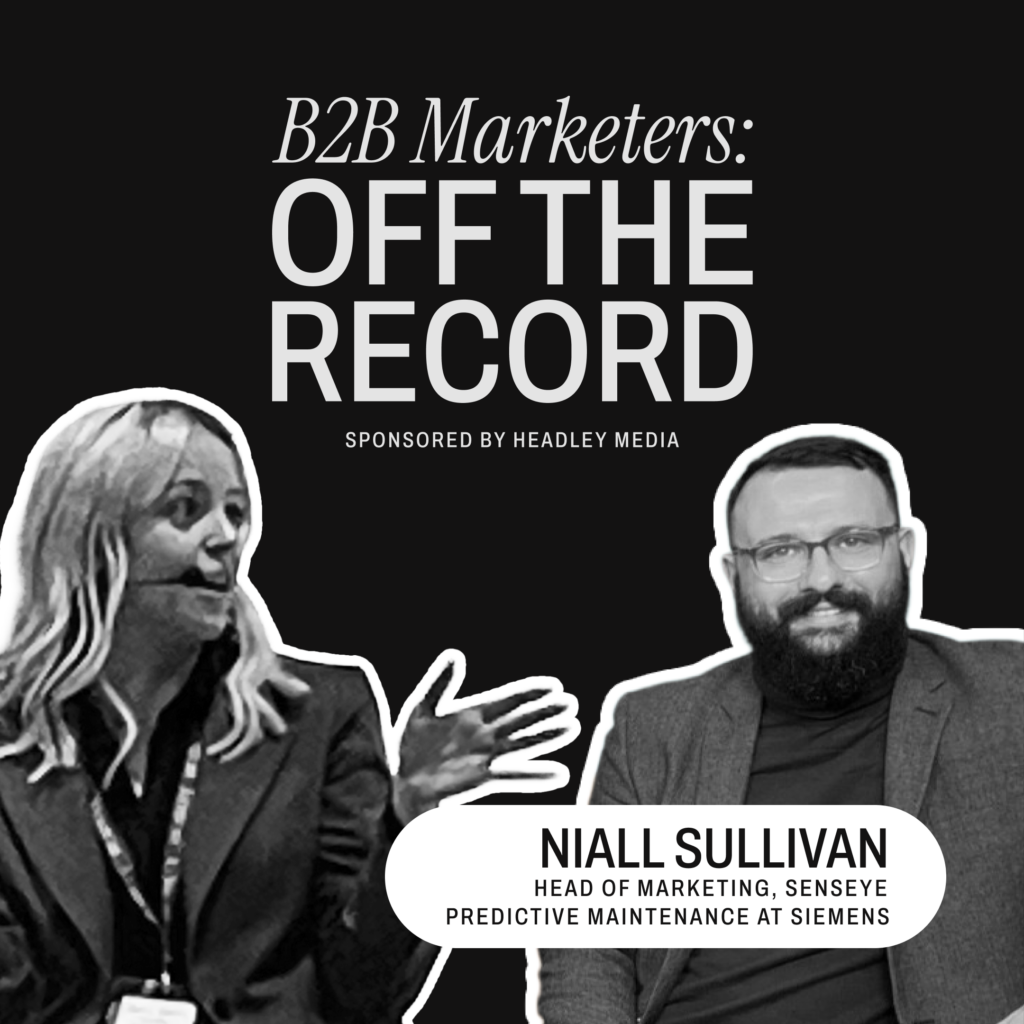
The conversation with Niall Sullivan, Head of Marketing at Senseye for Siemens, covered various topics related to B2B marketing. Niall shared insights on content strategy, authenticity, the value of events, the B2B buyer journey, and the role of AI in personalization. He emphasized the importance of investing in people and AI, changing the perception of marketing, and learning from mistakes.
Takeaways
Chapters

Freya Ward (01:06)
Welcome back to B2B Marketers Off the Record. I am joined by Niall Sullivan. He is Head of Marketing at Sensei for Siemens. Niall, would you like to introduce yourself?
Niall (01:18)
Yes, no thanks very much for inviting me on. I’m the head of marketing of Sensei at Siemens. So Sensei was a company that was acquired by Siemens June 22. So yeah, nearly four years maybe to the day or something like that. So it’s been quite a journey. I mean, my background, so I’ve been in B2B software marketing for over 10 years now. I’ve worked for companies of…
all different sizes from 10 person startups or mid-size companies, Siemens now, big multi-nationals. I’ve seen a lot. guess where my passion lies, and you’ll probably hear about it a lot today, is in the content side of things. At heart, I’m a content marketer. I did journalism when first, know, at university, and I’ve always loved the written word. And in most recent times, I’ve shifted very much into the podcasting world and big believer in that.
every company, let’s say every B2B marketer should be running a podcast. I’m really pleased you are, of course as well.
Freya Ward (02:20)
No, of course. We’re so happy to have you on, Niall. I think we originally met at one of the B2B marketing events. I think you were on a panel and I was on a different panel, but we met as kind of co-speakers and it’s, yeah, it’s a pleasure to have you on and share all the insight from your experience. One of the things that we like to do at the top of the B2B Marketers Off The Record podcast is play on a little bit of nostalgia.
Niall (02:26)
Yes.
Freya Ward (02:45)
Niall, tell me you’ve been in B2B marketing for several
years without telling me.
Niall (02:49)
From
perspective, it’s quite a funny one because I think if you’ve ever worked, you know, luckily working for Siemens, though, you go to events and everything’s all done, laid out for you. But back in the old startup days, pre-acquisition and with other companies, where you’ve had to do
The long, long walk, I’m use the NEC as an example, but it could be any big arena where you’ve done these huge exhibitions, but you’ve had to walk for miles from the car park, like packed full of stuff, know, banners and giveaways, and you drop them all over the floor. And it’s particularly hard after three days of on your feet talking to people at the end. So I think that’s one that I think a lot of our fellow B2B marketers would relate to, I think.
Freya Ward (03:29)
Definitely, we’ve all been there trying to trek from the car park into wherever. Why do they make it so difficult to enter these arenas and these places where the events are hosted? You’ve got to carry everything on your back. Or my favorite is one of those little pull-along trundles, loading that up and just hoping it doesn’t rain.
Niall (03:48)
exactly, yeah, that’s it. I didn’t even mention weather conditions, but and actually I never really thought of that, you’re right. I something to pull everything along, I didn’t think of that, but maybe I needed the exercise or something is a good excuse too. But yeah, yeah, mainly those sort of days are behind me at the moment having to do that. But I think it’s like an initiation for any B2B marketer is that you have to do the, you know, these shows and have to carry everything and do every little logistic around them. So that’d be the one for me.
Freya Ward (04:16)
Yeah, for sure. And a conference center looks so different pre-stand build, right? When you walk in and it’s empty, huge, and everyone is there in their, their scraps, trying to build everything and pull everything together. Now you have been in the industry for some time and I, well, looking at your LinkedIn, it looks like you’ve got an interesting story to tell us. How did you get into B2B marketing in the first place?
Niall (04:38)
you
Yeah, well, I hope so, first of all. if you, yes, one of my LinkedIn profile or the description at the top, I describe myself as an accidental marketer, which sort of describes it quite nicely. But I guess the story behind it, I mean, I mentioned at the start about doing journalism at university. So first of all, never thought about marketing as a career. I wanted to be a journalist at the time. The journalism industry wasn’t, know, at that time it was sort of paper based. There was very little online.
So it’s got a bit of a dying industry. Thought she was picked up thanks to social media and all that kind of thing. But anyway, so one of my first jobs was actually copywriting and writing websites. I worked for the Yellow Pages or yellow.com. So I used to do a lot of writing for websites and for builders and plumbers and this kind of thing. So what I didn’t know at the time is some of these skills maybe overlap with marketing, what I was doing at the time. I then applied for a job at software company.
and an ERP software company. And it was basically to be their web admin, it was described as. And I went to the interview, didn’t get the job unfortunately, and then thought, well, that’s that then I’ll carry on. But then a few months later, I had an email from the CMO there at the time. And he said, well, we did not feed that job at the time because actually we wanted someone more technical. It was more of a technical development role, not a content role.
But our digital marketing executive didn’t know what that was at all. But yeah, their digital marketing executive was leaving and they said, well, we thought your skills overlapped quite nicely. Do you want the job? Basically, you don’t know interview or anything. And like I said, never considered it. Didn’t really know. You know, there was a bit of a description about what it might entail and what I might lead, but didn’t know too much about it. But there was a gut feeling you get where you’re like, this actually sounds quite for me kind of thing like in marketing. Yeah, I guess it does fit. then
The journey began and yeah, like I said, we’re at various different sized companies on teams and eventually, lucky enough to sort of been more senior roles and lead bigger teams from there. But it all started from this, yeah, by accident. And I should say by lots of, you know, I think of at least three or four names that have actually opened the door and given me a chance to progress before maybe even I’m ready or even knew I was ready, right? So I think that’s very important to mention as well. So yeah, that was a bit of a ramble, but.
Hope that covers it nicely.
Freya Ward (07:07)
Yeah, it absolutely does. And you know what is so interesting during this podcast, all the recordings that we’ve done so far, obviously, the whole concept of the podcast is to ask B2B marketers of different experiences, different levels, different time spent in the industry, the same sort of five, seven questions. And when we ask that question, how did you get into B2B marketing? The amount of quite senior marketing professionals now who tripped and fell. They tripped and fell or someone opened a door for them or, know,
the story of people’s journeys into B2B marketing, they’re not too different. Everyone’s kind of not considered marketing as a profession, but their skillset lent towards it or somebody identified along the way that actually this could be a really good position for you. And I think it’s actually quite refreshing. If I was new and starting out in this industry, I would love to hear from…
senior marketers like yourself who say, you know, it isn’t something that I considered, but it’s obviously worked and you’ve stuck with it and you’ve gained all this experience throughout your career. Bringing it then into the current day, what’s one belief in B2B marketing that you’ve changed your mind on in the last 12 months?
Niall (08:18)
Yeah, so it’s a really interesting question. guess, and yeah, when I was thinking about this, relates, it sort of relates what I saying about the NEC sort of, because it is actually about events. So, you know, in the early stage of my career, and even, I guess today to a degree, it’s always baffled me why, you know, when you talk about budget and what spend marketing budget on, if you mention an event, a big industry event, which is like 30K, 50K or more, or whatever it might be.
No problem at all. Signed off. We have to do it. You know, it’s an industry event. But when you talk about something more nuanced, like, you know, podcasting or content strategy or, you know, let’s really invest in a really great website and things like, think things have changed now. think people, but I mean, if I talk over 10 years ago, I think at the time there’s more sort of, you know, do we really need to invest in social media and LinkedIn and, you know, we’ve got these big, so, and yeah, and so I guess with that in mind, I…
I sort of got this attitude about events being, putting them all in one bucket saying they’re expensive. You know, do we get the return on investment? You know, I could invest that in a content strategy, which is scalable, better return on investment and all this kind of thing. But, you know, I must admit, you know, you know, I think I was too sort of single minded on this. I was probably having nightmares about the NEC and things like this. And some of the events I’ve done there, some of them just, you know, cost a lot, but didn’t really produce anything, if I’m being honest. But
Events are more than just that, right? It’s obvious now, but you we talk, you talked about B2B Marketing Live where we met, you know, it’s like more of a community. You’re meeting people, you’re you’re having these small sessions where you learn about things. we did, it’s about a year or 18 months ago, we did like an online event called the Digitalization Playbook. And we invited customers, prospects, opportunities. It was all done online, but we had different sessions. We had panel discussions, we had interactive sessions and things like this. And then, and that’s also an event, right?
So I guess, yeah, so I guess that’s, it’s changed my, you my perspective on events. I don’t need to think about them as these big, sometimes soulless exhibitions. They probably do have a place, right? I mean, they probably do have a place, but I think, and that’s another conversation. I think you have to have a different mindset around these big exhibitions. So it’s not all about hundreds and thousands of leads or scans. It’s the quality of conversation, which is much harder to then go back to a CFO and say.
I’ve had great conversations because they probably want more than that. that’s what I would say is that events is more than just exhibitions and things like that. And you can get a really good return on investment. An in-person meeting is actually, you know, it’s hard to put a return on investment on paper, but you know, the relationship you’ve built, you know this as well as me, but you know, relationships you build and the rapport you build and things like that. can’t be beaten than being in person, whatever you try and do online.
So, yeah.
Freya Ward (11:15)
I completely agree and I think it’s almost been the value of more kind of micro events I guess is to summarise what you’re saying that in-person connection and focusing on smaller events that have more impact with the right people and in front of the right people. Do you think that has been supercharged by our need for connection?
post pandemic remote work, know, the shift to remote work and everything else, people are actually finding those micro events more valuable from a marketing and business perspective, but also from an attendee perspective than they were maybe eight, nine years ago when it was that footfall focus.
Niall (11:58)
Yeah, I think so. I I could look at it a lot of different ways, but if we talk about the big exhibitions example, so a lot of them moved to like online virtual, you know, during COVID obviously when it wasn’t possible. And maybe at that time they thought, we could save loads of money on hosting, know, booking out halls and doing all this kind of stuff. But then they realised quite quickly the experience, don’t know if you remember them, but they’re like…
at these virtual exhibitions. you’d go around and it’s just not the same way. It’s completely not the same. You could still talk to someone or message someone, but you know, and I can see why they did it obviously during a very difficult time. But it just doesn’t replicate that in-person feeling. I I could only talk from my point of view, but I sort of appreciate both sides because I love, you know, being remote first and be able to work whenever, however, fit different things in and be flexible.
Freya Ward (12:26)
Mm.
Niall (12:54)
That doesn’t mean I don’t like going to the office, meeting people, doing workshops and that kind and I’m sure it’s exactly the same for other people. We all crave some form of human connection. And I think we probably all got a bit sort of webinar, well, to come up with the phrase, but you know, we got a bit sick of webinar, but you know, it’s kind of a virtual events, which were, you know, very informative, but you’re right. They don’t replicate that in-person networking, connecting.
Freya Ward (13:12)
Yeah, yeah.
Niall (13:21)
even just having a beer, right? know, there’s things like that you can’t replicate. it doesn’t surprise me that that’s come back because I think, I don’t know whether, you know, I trying to think way back when, if there was like a presumption that forever we’d all just go, well, remote’s way better. So we’ll just never do it in person again. I don’t, yeah. I went to, for example, is it a few, was it about a month ago now, to a big podcast show in London. And that was amazing. You meet so many people, you know.
Freya Ward (13:28)
Yeah.
Niall (13:51)
connect with so many people and people I’ve met online as well and then in person. And it’s just a completely different feeling to it. So that’s all I can say about it.
Freya Ward (14:00)
Yeah, completely agree. And yes, I absolutely did attempt to partake in the virtual event version of exhibitions. it was, I mean, hats off to them for turning it around and trying something different, but it was a bizarre experience. What shifts are you seeing then, Niall, in the B2B buyers and the B2B buyer journey through sort of recent times?
Niall (14:28)
Yeah, I guess this is when we bring in the magical word of AI into the conversation, which probably is in every single conversation. yeah, I mean, I think that’s just been, that’s just adding to a theme that’s been progressing over the past sort of 10 years. I mean, one of my big sort of heroes, and you when we’re talking about earlier in my career, who sort of inspired me in marketing, like Chris Walker, who’s probably someone you’ve, or most people have.
have heard of. But, you he was the one who sort of shifted my mindset on marketing completely away from this sort of MQL, SQL, hamster wheel, think you used to call it. But it’s like, it’s just like common sense marketing and that people do their own research. So I’m not sure, think, I think the AI is actually helping to shift it in that direction where people do their own research. So they don’t need to be guided by vendors. They don’t need a salesperson holding their hands. They’ll contact Siemens or whoever.
whenever they’re ready to buy. And I think AI has probably just accelerated that, because all the information’s at your fingertips. And it’s another reason, don’t want to keep bringing it back to events, but it’s another reason why people don’t go to events now to browse all the various products. Or it shouldn’t be seen like that. It really should be seen as a way to connect with people, have a conversation, keep the relationship warm. hopefully, particularly I’m talking maybe more from an enterprise point of view at Sensei, sort of targets a bit more.
So yes, I’m not sure it’s a shift, but I think it’s just continuing that realization that we as marketers or B2B organizations don’t have very little control over a B2B buyer journey. And it’s more and more in the hands of the people who doing their research and that kind of thing. Although there is things we can do, of course, which we could come onto, I guess.
Freya Ward (16:20)
Yeah, of course. that’s that’s kind of the challenge for marketers now, isn’t it is to analyze and make strategic bets on exactly what they can do to influence the buyer while they’re conducting their own research, because I completely agree with you and all the stats are there. You know, Gartner reports on the buyer’s journey shifting 70 % 80 % of their journeys conducted independently before they even raise their hands to your company. So
I guess this leads us nicely onto our next question, which is, what is a strategic bet that you think more marketers need to make or that you’re making in the next couple of years?
Niall (16:57)
Yeah, so don’t, if you’ve been listening carefully, so for this one, come, there’s too much of a surprise, but it’s in content. But content that’s authentic, primarily. And what I mean by authentic, so, I many years ago, like I said, I used to copyright, I used to write blogs, I used to write white papers, you know, the written word was everything to me. But when I think back to those times and the people, the organizations I was working for, who were we trying to sell to? And I’m…
like a junior marketer writing blogs, trying to impress, you know, senior as like C-level or whatever. And it sounds a bit, yeah. I mean, I didn’t do a good job at them, but you can see the disconnects, like trying to connect with people. There’s a big sort of gap there. So what I mean by sort of strategic investment and it’s something I’ve talked about lot recently. mean, podcasting is the main vehicle for this as far as I’m concerned, cause you can capture.
capture sounds a bit strange, but being capture the expertise within your organization. And that’s what I realized quite soon. So the story at Sensei was I started off as a marketing manager, got promoted to like VP, the marketing, completely shifted the strategy towards this sort of content led approach and focusing and less focused on how many MQLs and SQLs and all this kind of thing. And the whole thesis was we’ve got so many extraordinary clever people within.
Sensei, know, doctors of this and there’s so many doctors in it. And it’s like at the moment. And if I think back to earlier, my criminal student, white papers and stuff and white papers have their place again, like blogs have their place. But the problem is they get over sanitized, you know, pass through five, 10 P you know, depending on what your approval process is. So I don’t feel the real expertise makes it through. Whereas on a podcast talking like this, it’s authentic. talking, they’re saying it in their own words. It connects with people.
a lot more. So it’s a really long-winded way of answering, but content strategy primarily podcasting is a certainty because the retirement investment is off the scale. If no one listened to my podcast that I host, in a way I’d still get retirement investment through repurposing and reusing it and many other things as well. So I think that’s the starting point, but it starts with authenticity. People probably think scaling up content is use LLMs and off you go kind of thing.
And of course they have their place to improve the workflows and stuff around it. But the heart should always be the people within your organization. Find the people who like to be on podcasts, who have the expertise, and find ways to package and share it with the world. And do that consistently at scale.
Freya Ward (19:39)
absolutely love that. And it’s one of the reasons that we’ve launched this podcast, right? We want to give the voice back to the B2B marketer. We want B2B marketers to have a place where they can come and communicate what they’re doing and share those pain points and challenges. Because these questions that you’re answering for us now are questions that we’re asked or having conversations with marketers about every single day. And one of the questions that tends to
these kind of questions tend to lead on to is a marketer saying to me, is anyone else experiencing this? And that’s where the concept of this podcast came from. It was, hold on a minute. If I’m having all these conversations and our team are having all these conversations and every B2B marketer we talked to feels quite alone in the environment that they’re working in or the situation, you know, the changes and everything else.
let’s give a platform, let’s provide them with a platform where they can actually hear from other experts in the space and their peers and hear that actually, yeah, things are changing over here. And, you know, they can relate to that. And like you said, bringing that inside of your business as well, especially a business like the company that you’re working for, it’s really hard to capture that expertise in a different way with authenticity. And it’s really interesting when you say about
the number of levels of approval on written content versus this sort of content. Because you’re right, having worked agency side in the past, I worked in the electronics field and we tried to produce product matter expert content and even down to a press release, for example, and that quote would go from something really, really strong and then it would go down and down and down all through the chains of approval or the levels of approval. And then by the end of it, it was a very standardized quote.
that had kind of lost that essence. You mentioned AI and I trust that you’re using AI inside of your business. I know you spoke on a panel about AI and it was really, really interesting. I wanna ask you a question from a previous guest. So Leanne was a guest on B2B Marketers Off the Record and she asked the future guest, which is you, how are you using AI to support with personalization?
Niall (21:33)
You
Oh, with personalization. So I think, not to, we’re, I’m okay to mention sort of specific tools, but within a corporate environment like Siemens, what we’re very lucky to have is things like Microsoft Copilot 365. And the reason why I mention it is because, and I think it probably is not the coolest tool out there, everyone’s loving Claude and ChatGPC and all this kind of stuff. But in an environment where you imagine Siemens and all the different information.
in a SharePoint for a company of 300,000 people and not say I’ve accessed all those documents. But the thing is you can ask, you know, if someone asked me a question or emails me something and wants some information, I can pull together all these different, all these different sources, all the different contexts. Because what I see the most powerful thing about AI is the way it is powerful is the context you provide. And if you have the right context, which Siemens has all this backlog of
I say backlog, but years and years and years, multiple decades of information available, then you’ve got all the context you need to provide that personalized response. it’s an email, personalized content, if you’re adapting something. Like I said, mean, AI is a great way to repurpose, but it’s not about generating something from nothing, which I guess you could do. Just ask it, create me a great blog post about X, or you could bring in
I’ve got this podcast here from this guy, this podcast here from here, this podcast here from here. I mean, yeah, sorry, I was just figuring an example where I’ve done that recorded different episodes and said, how can I turn this into a mini series? And it sort of knows the context then goes, this is the series title should be done in this order. Maybe do a trailer as well with these quotes and stuff. it just is amazing. So, but the feed into it is the human expertise.
And then my judgment ultimately is go, yeah, I like that idea. I actually, that one’s not so good. And again, I’ll come on to that later about where investment should be made is sort of linked to that. yeah, it’s at the moment, mean, if you can balance between human and the AI, that’s where you get the true value, not replacing anything.
Freya Ward (24:10)
completely agree humans at the start with the you know the context and the information that’s going in so garbage in garbage out that classic AI phrase but humans at the start AI in the middle and then humans at the end to analyze critique feedback tweak and assess what’s coming through that’s a great example actually both internal comms and personalization using internal comms I mean hadn’t even considered how valuable
a platform like Copilot will be for a business like Siemens that has vast amounts of information inside a SharePoint, multiple points of view, documentation and everything else. You would be lost forever if you were trying to read through all of the resources that are available for you in that SharePoint, but using AI to pull it together and analyze it and then give you some responses is a great use case.
Niall (25:07)
Yeah, I’m always forgetting what it was like before, know, it’s getting to that stage now. I must have done this before somehow, but I the podcast, you know, I joke about it, but the podcasting and you said it’d been on a panel and I described sort of how we’ve developed a, you know, a workflow for scaling up both the recording, editing, distribution, repurposing and everything. But that all started before AI, right?
Freya Ward (25:10)
Bye!
Niall (25:34)
So it sounds easy now, you got AI, so of course you can repurpose, actually a lot of it, the groundwork was already done before AI, I mean, it’s always, it’s been a thing for a long time. If, you know, people think AI was invented with LLMs, yeah, what we call conversational AI, let’s call it. Yeah. So, so yeah, so yeah, so yeah, we were very, very efficient even before AI, but of course it’s just made things so much simpler.
Freya Ward (25:35)
Yeah.
Yeah, of course. So you kind of alluded towards this and I want to unpack it a little bit further. What type of investment do you think marketing leaders should protect even when budgets are tightened?
Niall (26:16)
Yeah, interesting one. So the only thing that springs to mind and it’s a hot topic in every industry at the moment, but I think it’s actually people. So because you read all these stories, how true some of them are or how exaggerated some are, be nowhere.
And it’s not just a marketing thing, but hear about marketing leads going, I’m going to replace my whole team with agents and that will save me lots of money. And everything I’ve talked about, for authenticity, human input.
you know, count, you know, for me counters that argument. ultimately you should invest in the two things, invest in the people you’ve got. It should be about replacing expertise with AI. You should be looking and go, and most teams are probably incredibly stretched already. So you’re looking and going, I’ll go, you know, how can I support them to be more efficient and work and produce more and better results for our business? That should be the first thought. And then on the other side, then it’s investing in the right AI tools to help.
support that. And again, I emphasize support that, not replace,
support them on working. I don’t have a percentage for it, but so much more efficiently. Certain tasks can just get done much, much simpler rather than spending lots of time thinking. So then I can focus on the things that AI can’t replace at the moment, guess, know, creativity or just a human judgment on things. There’s certain things that an AI can’t judge in the moment, you
with various different priorities. Even if you ask an AI for an opinion, should still, you could still use your own judgment or trust your own judgment to do it. So it’s basically, yeah, in summary, it’s the people first, invest in the people, help support them, invest in them, upskill them, and then bring in the tools, AI tools, various out there, but even just the ones we all know and love, invest in those to help.
make them more efficient and help them focus in other areas that can support your business would be what I’d say.
Freya Ward (28:19)
Yeah, I completely agree with that and I love how you’ve put it. It reminds me of a talk that I heard the other day by a gentleman called Jeremy who I think is head of communications at IBM and he gave a really simple concept which is don’t think about it as AI, think about it as IA. So it’s not artificial intelligence, it’s an intelligent assistant and using it in that way enables you to…
lean on your experience, lean on your expertise and create space like you’ve said now for the creative thoughts, the cognitive thinking, the, you know, all of the things that we possess from years of work, learning, and the things that we actually really enjoy as well. Like if I can get AI to take some of the mundane tasks off of my to-do list so that I can focus on the more strategic aspects or the more creative aspects of my role, that’s a win-win. It’s when
AI is taking over the creative side of it, writing the content for me and everything else that I then find myself just doing more administration and more prompting and more rather than actually the part that inspires me and the part that I agree with you. I think that’s the area that the human touch should be is in those more creative, inspiring, strategic thought pieces rather than
Yeah, on the administration side of things.
Niall (29:48)
Yeah, I mean, yeah, just think, do we want a future where we’re just our roles are just orchestrating agents to do everything or do we want to work together? know, so, you know, who knows what the future will bring? mean, things are developing so fast. could be out of date in a week’s time what we’re saying here. But, you know, I still see no sign. I that might be a certain industry, but I still don’t see no immediate sign of AI wiping out.
lots of jobs. think what’s happening is it’s making, it’s helping to make people work more efficiently. So with that, they’re like, well, we can do slightly more with less. I don’t think it’s about, yeah, replacing or maybe, maybe I’ll just contradict myself. I don’t know, but I’m a belief that the two can play together and benefit, benefit both if, if used in the, in the right way, of course.
Freya Ward (30:40)
Yeah, of course. What’s one thing that you wish you could change about marketing?
Niall (30:45)
Yeah, and again, this is something I’ve been passionate about for many years and a journey I had to go through at Senso and that promotion, not that the founders at the time weren’t supportive, but again, it’s this idea that marketing should be treated seriously, right, as a revenue generator, not a cost on a spreadsheet that, no, we have to do it, or another way to look at it is treated like a sales assistant, right? So you’re there just to be subservient to…
sales needs and I mean that’s part of that that’s honestly part of the job you know it should be even then it should be a collaborative thing it’s not like we’re just assistant assistants waiting to to do that there’s a lot more than marketing can do if they’re given the trust and the the buy-in from the very very top which I’m very fortunate to have had they’re big big believers in in marketing and the direction I wanted to take um Sencai at the time
and in previous roles as well. But I think, yeah, first of all, you need to be lucky to find, like I said, that leadership team who actually believes in marketing. I remember when I used to do interviews a lot more often than I have done in recent times, when I used to interview, I always used to ask, especially when I was speaking to the CEO, what do you think of marketing? What’s your view on marketing? And if I wasn’t satisfied with that response, how important is it to the growth of your business kind of thing?
And I think from that, can find out a lot. But yeah, again, long-winded answer, but it’s really that marketing is treated seriously for what it can do, which is drive a huge amount of business and attention to an organization when done correctly. And I think it’s moving in the right direction, but I suspect it’s still not fully there. There’s lots of crayons and coloring in department, all that stuff. There’s probably still a lot of that.
going around showing is you’re completely underestimating the profession.
Freya Ward (32:46)
completely agree with you. And I think, I think actually the shifts in the B2B buyers, certainly within the space that we work in within the tech space is almost helping support and champion the value of marketing because the B2B buyer wants to research, they want to conduct their own, you know, self analysis of vendors and that, you know, they’re doing their own research and they’re not ready to talk to sales. So
How do you get your brand in front of those people whilst they’re researching? One of the ways is through marketing efforts, right? And I think it’s helping prove the case for marketing, but I agree, there are far too many businesses still that look at marketing as the cost department, the colouring in department, and it’s just simply not the case. There is so, so much more to marketing than just nice graphics and you
Just nice stands. We’re coming to the end of the recording of this podcast and I would love to ask you, and it can be aspirational or someone you know, who would you recommend to join us in B2B Marketers Off the Record?
Niall (34:00)
Yeah, mean, LinkedIn, mean, this one so lucky now, because I think when I started, hey, social media wasn’t a big thing, there’s just so many fantastic people on LinkedIn, including yourself, actually. But yeah, lots of fantastic people sharing such valuable goals. And of course, podcasts, you know, as well, you know, I mentioned Chris Walker as well, because he started very much in the podcasting realm. So Chris Walker would be, you know, a dream one. He’s already
doing a lot of B2B marketing now these days. don’t think that he’d be an aspirational one, but if I get the chance to have two, there’s a lady called Natalie Marco Tullio, who works for Novatic. Novatic, I if you’ve heard of it, but Novatic’s like an interactive demo platform. So you can create, like recreate your, and I was actually on their podcast as well. But she’s, yeah, she knows her stuff. And particularly in the category.
mean, it’s emerging, it’s probably more mainstream now, but I guess she’s had to help build a completely new category. And it convinced me because the whole, it all proves about my view on marketing because the reason we use Novatic at Siemens is because I’ve been following Natalie on social media and following them. There was no outbound to me. There was no event I went to. was just simply great content. Right. So yeah, that’s who I’d recommend.
Really, really knowledgeable.
Freya Ward (35:26)
Amazing. Yeah,
interesting. I’ll have to have to check Natalie out on LinkedIn and hopefully she’ll join us for a future recording. It could be Natalie or it could be someone else. What one question would you like us to put to the to a future guest?
Niall (35:43)
Yes, my my question I’m always always one for learning and and particularly when you make a mistake, know, learning, learning from the mistakes. I guess what I’d ask someone is, you know, what’s the biggest mistake you’ve made in your career? And then what did you sort of what did you take away from that to help you sort of move forward and improve in the future? Or, I mean, if you want to second part, how would you reflect on?
reflect on that today, you know, and how far you’ve come. Sorry, that’s more than one question, more than one question. there we go.
Freya Ward (36:16)
think that is an amazing, well, more than one guest, more than one question. No, I’m joking. No, I’m
joking. I think that’s an awesome question. I can’t wait to ask it. Yeah, really insightful. And you’re so right now, we all make mistakes and I think it’s how you learn from them, right? And if we can hear other B2B marketers making mistakes along the way, what they took away from it, what they learn.
Hopefully we either won’t make the same mistake as them because we’ll take the learning and not the mistake or we’ll relate to the fact that we too have made a similar mistake and learnt something similar or something different from it. Thank you so much for joining us on B2B Marketers Off the Record. Your insight has been really, really valuable. Where can people find you if they want to hear more from you?
Niall (37:06)
Yeah, quite simply LinkedIn. So Niall, N-I-A-L-L, mainly mispronounced, but yeah, Niall Sullivan on LinkedIn, an accidental marketer in the tagline or whatever you call it, so you’ll able to spot me quite easily, I think.
Freya Ward (37:21)
Amazing. Thank you so much, Niall.
Niall (37:23)
No problem, thank you very much. Thanks everyone.
This episode features Niall Sullivan, Head of Marketing at Senseye (Siemens), discussing his career journey, the evolution of B2B marketing, the growing importance of authentic content, and how AI is changing the role of marketers.
Niall describes himself as an “accidental marketer.” After studying journalism and beginning his career in copywriting and web content, he was unexpectedly offered a digital marketing role at a software company. His background in storytelling and content naturally translated into B2B marketing, eventually leading him into senior leadership.
One of the biggest changes in Niall’s thinking over the past year is his view of events.
Previously, he questioned the ROI of expensive exhibitions, particularly when compared with investments in content marketing. Today, he believes events create value through:
He argues that post-pandemic, marketers and buyers value meaningful in-person interaction far more than large-scale exhibitions or virtual events.
Niall believes AI hasn’t fundamentally changed the B2B buying journey, but it has accelerated an existing trend.
Today’s buyers:
This means marketers have less control over the buying journey and need to focus on influencing buyers through valuable content rather than relying on traditional lead generation tactics.
The strongest theme throughout the conversation is Niall’s belief that authentic expertise should be at the centre of modern B2B marketing.
Rather than producing heavily edited whitepapers and blogs, he advocates:
He argues that podcasts preserve authenticity far better than written content, which often becomes diluted through multiple approval stages. Even if nobody listened to the podcast directly, the amount of reusable content generated provides significant ROI.
Niall uses AI extensively, particularly Microsoft Copilot within Siemens.
His approach is:
He strongly believes organisations should invest in both people and AI tools, using AI as an assistant rather than a replacement for marketing talent. Creativity, judgement and authentic expertise remain uniquely human strengths.
Niall argues that marketing is still too often viewed as a cost centre or a support function for sales.
Instead, marketing should be recognised as a strategic growth function capable of:
He encourages marketers to work in organisations where leadership genuinely understands marketing’s strategic value.
A practical example discussed was Siemens’ use of Microsoft Copilot, allowing marketers to search years of internal documentation, SharePoint content and organisational knowledge to create personalised communications and accelerate content creation while maintaining accuracy and context.
Niall Sullivan is the Head of Marketing for Senseye Predictive Maintenance at Siemens, where he leads the global marketing strategy for one of the industry’s most advanced predictive maintenance platforms. With over 10 years of experience in B2B and SaaS marketing, Niall specializes in building scalable, content-driven demand generation programs that drive pipeline and revenue growth.
Conor Bant, Head of Media and Performance at Fox Agency, discusses the evolution of B2B…
The conversation covers search visibility optimization, digital ads, marketing operations, and the importance of building…
Lindsay O’Brien, Head of Marketing at Pragmatico, shares her marketing journey, insights on B2B marketing…