Land & Expand Strategy: A B2B Marketer’s Guide to Smarter Growth
-
February 25, 2026
- 15 min read
-
Quick Summary: For experienced B2B technology marketers, Land and Expand is not a new concept. What is changing is how it is executed. In a market where acquisition costs continue to rise and buying committees grow larger, sustainable growth comes from within.The ability to land successfully in one department, prove value, and then expand across functions, regions, or business units is no longer optional. It is a strategic necessity.
Here, we explore what a modern Land and Expand strategy looks like, the key considerations for lead generation, and how to approach expansion in a way that builds long-term revenue rather than short-term activity.
What is a Land and Expand Strategy?
At its core, Land and Expand is a go-to-market strategy where a vendor initially lands within a specific department or team inside an organization, with a long-term goal of expanding adoption across other departments, territories, or regions.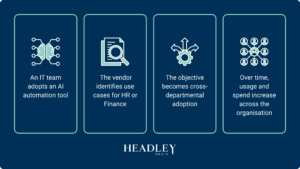
The logic is clear. Once a solution is embedded and delivering results in one area, expansion becomes commercially and operationally easier.
However, there is a common mistake vendors make: relying too heavily on a single internal advocate. While internal champions are valuable, expansion should not depend on one contact or one department carrying the message across the organization.
A robust Land and Expand strategy requires multiple stakeholder relationships, particularly within the departments you intend to target next. Expansion succeeds when it is intentional, not accidental.
Why Proof of Concept Matters in a Land & Expand Strategy
One of the structural advantages of a Land and Expand strategy is that much of the initial complexity has already been addressed. The solution is live within the organization, procurement processes are understood, and security and compliance have been approved. Operationally, the path to wider adoption appears clear.
However, expansion should not be automatic simply because access has been secured. Commercial credibility still needs to be established beyond the initial department. Before initiating cross-departmental conversations, there must be clear, defensible evidence of value.
This means:
- Demonstrating a proven use case supported by measurable results
- Building a business case that translates outcomes into departmental impact
- Defining success metrics that resonate with new stakeholders
- Cultivating a positive internal perception of your brand
These elements shift the conversation from possibility to performance. When your solution is recognized for reliability and measurable return in one function, expansion discussions become more strategic and more commercially grounded. Without that foundation, outreach into new departments risks feeling premature rather than purposeful.
The principle is simple: land with intent, validate performance, then scale with confidence.
Key Considerations When Planning a Land and Expand Campaign
Executing this strategy through lead generation requires discipline. Here are the critical elements to prioritize.
Prioritize Lead Quality and ICP Accuracy
If you are working with a lead generation provider, precision matters. Your campaigns must align tightly with your Ideal Customer Profile (ICP), your Target Account List, and senior decision-makers within specific departments.
A high Target Account List match rate reduces budget waste and ensures you are engaging stakeholders who genuinely influence expansion potential.
At Headley Media, we use zero-party and first-party data to map our readership across our seven global technology brands. This enables us to identify not only known stakeholders within your target accounts, but also additional departments, geographies, or influencers that may strengthen your expansion strategy. That visibility can uncover an opportunity you may not have previously considered.
Why Zero-Party Data Is Valuable to Your Lead Generation Campaigns
Zero-party data is information that your audience voluntarily and proactively shares. That makes it uniquely valuable:
- 100% consent-led, supporting compliance with GDPR, CCPA, and other privacy regulations.
- Highly accurate, because it reflects self-declared interests.
- Enables hyper-personalized campaigns, especially at the top of the funnel.
Headley Media’s Intent Data Targeting campaigns gather multi-touch engagement data across our content syndication programs. Each time a reader engages with a piece of content from one of our websites, we tag their profile with keywords, progressively profiling and scoring their engagement to build up a picture of their interests and intent. By analyzing which assets and topics prospects interact with, we provide first-party intent signals that help B2B marketers prioritize the right leads.
Learn more about how we use zero-party and first-party data.
Develop Department-Specific Content
One of the most overlooked aspects of a Land and Expand strategy is content relevance. Expansion does not succeed with broad messaging. It succeeds when each department sees clear, specific value.
If you are targeting IT, HR, and Finance, each persona should receive content aligned to their individual challenges, priorities, and performance metrics. What resonates with an IT leader will not necessarily engage a Head of HR or a Finance Director. A single, generic asset may create visibility, but it rarely drives meaningful engagement.
Instead, content should:
- Demonstrate value in IT through technical depth and use-case specificity
- Show HR operational impact and workforce benefits of your solution
- Highlight financial efficiency and measurable ROI for Finance stakeholders
Nurture Before You Cross-Sell
The challenge is not that expansion happens too early. It is often triggered by activity rather than readiness.
Here is what this looks like in practice:
- A new departmental lead is generated, and Sales moves straight to outreach.
- Case studies are referenced before context has been established with the prospect.
- Cross-departmental conversations begin before value has been proven internally.
The intention is understandable. Teams are under pressure to demonstrate ROI. Leads come in, momentum builds, and expansion feels like the natural next step.
But effective Land and Expand requires maturity. Not every new stakeholder is ready for a sales conversation simply because they downloaded content. Expansion is not a single interaction. It is a process of alignment and education.
New departmental leads should enter structured nurture workflows aligned to their function and stage of awareness. That nurture should build brand familiarity, strengthen internal confidence and clarify the problem landscape,
It should also articulate solution relevance within their specific context. When this sequencing is respected, cross-departmental conversations feel commercially justified. They are grounded in understanding rather than assumption.
Expansion should be a logical progression based on demonstrated value, not a sales push driven by urgency.
Less Obvious Ways to Use Land & Expand
Land and expand is often viewed in two ways: landing in new accounts with clear expansion potential, or expanding within accounts where you already have traction. However, there is a third opportunity many marketers overlook.
Re-Engage Closed-Lost Accounts Through New Entry Points
If an opportunity stalled within one department, the entire organization should not automatically be considered closed lost.
Large enterprises are complex ecosystems, with multiple stakeholders, priorities, and decision-making pathways. A lack of traction in one team does not necessarily indicate a lack of overall opportunity.
If engagement slowed with an IT buyer, it is worth reassessing the wider account landscape. Is there a relevant HR use case that aligns with workforce priorities? Does Finance face overlapping operational or reporting challenges? Are there regional or business unit teams operating with a degree of independence?
By identifying alternative entry points and reassessing stakeholder alignment, you can create a new land opportunity within an account previously considered dormant. Sometimes expansion does not begin with scale. It begins with approaching the organization from a different direction.
Cross Geography and Cross-Business Unit Expansion
Expansion is not limited to departments. It may include regional subsidiaries, international divisions, separate business units, or recently acquired companies.
For global technology vendors, this creates layered opportunity. A successful implementation in one region can serve as the template for rollout elsewhere. Strategically mapping these pathways early in your campaign planning improves long term revenue forecasting.
Why Land and Expand Is Commercially Efficient
Acquiring net new customers is resource-intensive. It requires sustained investment in awareness, education, stakeholder alignment, and commercial validation before revenue is realized.
Expanding within existing accounts is typically more efficient. Trust has already been established. Procurement processes are familiar. Implementation pathways are clearer. Internal success stories provide proof that reduces perceived risk.These factors shorten sales cycles and lower the cost of growth.
When expansion is supported by high quality data, persona-specific content, and structured nurture workflows, Land and Expand moves beyond a tactical upsell strategy. It becomes a commercially disciplined approach to scalable revenue within accounts you already understand.
Want to Strengthen your Land & Expand Strategy with High-Quality Leads?
At Headley Media, we use zero-party and first-party data across our seven global technology brands to connect B2B technology vendors with the decision-makers who matter most. Get in touch to find out how we can support your next campaign