How To Create Your B2B Ideal Customer Profile (ICP)
-
March 19, 2026
- 21 min read
-
Quick summary: A B2B Ideal Customer Profile (ICP) is a structured description of the company type most likely to buy from you, benefit from your product, and deliver the highest lifetime value. This post covers how to define your ICP using firmographic and technographic data, how it differs from buyer personas, and why regularly refining it with first-party data is what separates a high-quality pipeline from wasted spend in B2B technology lead generation. It also walks through how to apply the Pareto Principle to your existing client base, a practical starting point for any B2B lead generation strategy.
ICPs are a foundation of effective account-based marketing and intent-based marketing strategies, as well as being fundamental to effective lead generation as part of your B2B technology marketing campaigns.
Of course, that’s when ICPs are used well. It’s unfortunately also common to see companies decide who they want to sell to and then continuously target those prospects even when their product is a poor fit.
To help you avoid this and other pitfalls, this article will define ICPs. We’ll go over what’s new, the fundamentals that haven’t changed, how to create ICPs, and how best to leverage them in your marketing.
What Is an Ideal Customer Profile?
The Ideal Customer Profile is a concept that’s been popular for a long time. An ICP comprises the firmographic aspects of the companies you want to serve, such as their industry, company size, and revenue, alongside their technographic attributes – which tech tools they currently use, and for what purposes – and a keen understanding of their pain points.
ICPs are particularly useful as a springboard for targeted, account-based marketing (ABM), where they help you find and focus on specific target accounts that would be a good fit for your product or service. As HubSpot puts it, an ICP “defines the perfect customer for what your organization solves for.”
Gartner writes: “The ideal customer profile (ICP) defines the firmographic, environmental and behavioral attributes of accounts that are expected to become a company’s most valuable customers.”
Note the italics in the two statements above, because they show a small but important difference. An ICP is based on assumptions about the customers, companies, or accounts you target, and must be updated in line with new evidence.
Why Are Ideal Customer Profiles Worth Creating?
There are many benefits to using Ideal Customer Profiles in B2B technology marketing. For starters, the ever-expanding buying committee means marketers need to reach a wider range of job titles in more departments than ever. Creating ICPs helps to do this more effectively.
As the world of AI is moving so quickly, reaching the right AI decision-makers for your technology solutions can be particularly challenging. ICPs are also extremely helpful here. Especially when it comes to navigating the complexities around some companies having dedicated AI roles, some extending existing job titles, and others placing AI decision-marking with traditional tech buyers such as heads of departments and C-suite roles.
Ideal Customer Profile vs Buyer Personas – Key Similarities & Differences
In a world where your marketing needs to reach multiple people in multiple roles, it’s important to be clear on the differences between Ideal Customer Profiles and Buyer Personas. Let’s go over them quickly right now to clear up any confusion.
ICPs and Buyer Personas both help marketers focus on specific targets and reach specific prospects that are more likely to want and need their products. However, the differences are significant.
- ICPs target company-level data, e.g., is this company a good fit for our product based on their industry challenges, market pain points, and the technology tools they already use?
- Buyer personas target individuals within companies, e.g., is this person a likely budget-holder, decision-maker, or purchase influencer? What department are they in? What day to day challenges do they face that our product can help them solve? Which are the best channels to reach them?
Another way to put it is that your ICP helps you identify key accounts in target segments, while Buyer Personas offer specific insights for personalizing your marketing efforts.
As a B2B technology marketer, you’ll probably use one ICP per market segment, while using multiple Buyer Personas for each target company. They work well together because you can use an ICP to target companies with certain budgets and specific tech stack profiles that marry well with your product in a specific market, say financial services. Then you can use your Buyer Personas to identify the specific individuals to reach within those companies.
This enables you to create segmented and targeted campaigns that are likely to yield better results and generate higher quality leads who are more likely to buy from you over time.
How to Create Your Ideal Customer Profile Today
There are now so many data points available to us as marketers that it can be hard to know what you need to create an Ideal Customer Profile. However, the important thing to remember is the quality of data. Poor quality data will result in cold leads – or no leads at all – where better quality data will lead to better ICPs.
So, the first place to start for most marketers is with your existing client companies. What do they have in common? To what extent do you want to replicate these clients and to what extent would you like to have clients with different characteristics?
It can be especially useful here to apply the Pareto Principle to your existing client base. In other words, what are the characteristics or attributes shared by the 20% of your clients that generate 80% of your revenues? These are the attributes you want to “clone” by feeding them into your Ideal Customer Profile.
So, then we look at the obvious firmographic attributes of your best clients:
- Industry
- Geography
- Revenues
- Number of employees / users
- Budget
Then the technographics:
- Compatible platforms
- Compatible software applications
- Any known or suspected tech gaps you can fill
- Any competitor technologies installed?
Then you look at market challenges, trends, needs, common behaviors and pain points.
Once you’ve compiled a profile based on your best existing clients, you can move onto other data gathering methods, such as:
- Client interviews
- Surveys
- Your own customer data
- B2B lead generation suppliers who provide zero party data and first party data through their own audiences (like Headley Media), and can share enhanced insights into your target audiences.
- Adding profiling questions as part of your lead generation campaigns can also provide valuable data, which you can iterate and refine over time.
It’s also important to work together with Sales to develop an effective ICP. Your best performing salespeople should have a good sense of the shared attributes of the best prospects and can offer invaluable feedback to Marketing. This can be especially useful when creating a new ICP or refining existing ones.
At the same time, it’s vital to continue refining your ICP over time based on market trends and direct feedback from your marketing campaign results and the sales team. One example of a key piece of information you need to keep in mind today is the impact of the expanding buying committee, and what that means for who you need to reach and when.
Ideal Customer Profile Examples
Now we’ve discussed Ideal Customer Profiles and how best to create and leverage them in 2025, let’s look at a couple of practical examples, based on the following simple Ideal Customer Profile template:
| Ideal Customer Profile |
| Industry |
| Location |
| Company size (employees) |
| Annual revenues |
| Pain points |
| Tech budget |
| Existing tech solutions |
| Possible tech gap? |
| Key decision-makers |
| Key purchase influencers |
Let’s use the example of how you would fill this template if you were providing a cloud-based customer data platform to Fortune 500 companies in the financial services industry.
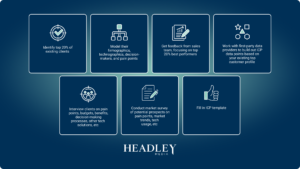
First off, follow the Ideal Customer Profile playbook:
- Identify top 20% of existing clients
- Model their firmographics, technographics, decision-makers, and pain points
- Get feedback from sales team, focusing on top 20% best performers
- Work with first-party data providers to build out ICP data points based on your existing top customer profile
- Interview clients on pain points, budgets, benefits, decision-making processes, other tech solutions, etc
- Conduct market survey of potential prospects on pain points, market trends, tech usage, etc
- Fill in ICP template
| Ideal Customer Profile | |
| Industry | Financial services: P&C insurers, Life & Health insurers, insurance brokers, investment banks, retail banks, credit unions, savings and loans companies, mortgage providers |
| Location | Global multinationals headquartered in United States |
| Company size (employees) | 50,000 – 90,000 |
| Annual revenues | $7.5bn – $100bn |
| Pain points | Data accuracy; not converting enough SQLs to clients; not having a robust enough lead qualification process; inability to execute personalized omnichannel marketing campaigns at scale; may have too many tools in the martech stack; data siloes |
| Tech budget | Est. $500m per year for all martech solutions |
| Existing tech solutions | CRM (eg Salesforce), SEO tools, email marketing platform, marketing automation |
| Possible tech gap? | Lack of unified CDP to unite all marketing efforts |
| Key decision-makers | CMO; CFO; COO; CTO; possibly CEO, depending on size of purchase |
| Key purchase influencers | Senior sales and marketing; legal (compliance); senior IT; operations |
You can see how there is a danger of this ICP being too big and too vague. It may still throw out too wide a net. The more you can focus, the more effectively you can target, for example:
| Ideal Customer Profile | |
| Industry | Mortgage providers |
| Location | US, EMEA |
| Company size (employees) | 500 – 5,000 |
| Annual revenues | $100m – $500m |
| Pain points | Data accuracy; data siloes; no single customer view; not able to execute personalized omnichannel marketing campaigns at scale |
| Tech budget | $2m – $5m per year ($160k – $425k per month) |
| Existing tech solutions | CRM; email marketing platforms; social media marketing tools |
| Possible tech gap? | Good CDP with AI capabilities |
| Key decision-makers | CMO; CFO; senior sales and marketing |
| Key purchase influencers | Legal; Operations; IT; key AI roles |
These are just a couple of examples. Take this Ideal Customer Profile Template and use it yourself following the ICP playbook outlined above. Just remember to continue to iterate your ICP inline with the feedback you get from clients, Sales, and your campaign results. As well as any partners and data providers you might be working with.
The Importance of an Up-To-Date Ideal Customer Profile
In the fast-moving global technology market, it’s almost impossible to overestimate the importance of keeping up to date with industry changes. The rise of AI in particular presents many new challenges not faced before, while the expansion of buying committees has only continued as organizational needs become more complex, budgets have continued to tighten, and proving ROI becomes more important that ever.
The increase in the number of departments, roles, and individuals your marketing has to satisfy is only making campaigns more complicated to manage well. If you’re unsure where to start, or your lead generation campaign’s ICP needs a refresh, a reputable supplier will be able to help advise you.
Final Thoughts
Before you invest another budget cycle in campaigns built on a shaky ICP, it’s worth taking stock of what you actually know about your best-fit customers. A strong ICP isn’t just a targeting tool, it’s a business decision:
- For Marketing, it’s about focusing spend on the accounts most likely to convert, not just the ones that look good on paper.
- For Sales, it’s about walking into conversations with confidence, knowing the prospect fits the profile before the first touchpoint.
- And for your C-Suite, it’s about pipeline quality and ROI, not volume for its own sake.
When your ICP is built on solid first-party data and regularly refined, you stop guessing who to target and start generating leads that actually move through the funnel.
Ready to build smarter B2B lead generation campaigns around your ICP? Get in touch to explore how we can help you reach your ideal audience through targeted content syndication across our seven global technology brands.